Why Choosing Between the Marines and Army Special Forces Matters for Your Military Career
Should I join the Marines or the Army Special Forces is one of the most critical decisions you’ll make in your military career. Both paths lead to elite service, but they differ dramatically in mission focus, training pipelines, lifestyle, and long-term opportunities.
Quick Answer:
- Join the Marines if you want to be part of America’s rapid-response force, specialize in amphibious operations, and thrive in a culture of intense tradition and esprit de corps
- Join Army Special Forces (Green Berets) if you’re drawn to unconventional warfare, foreign languages, teaching tactics to allied forces, and operating in small autonomous teams
- Key differences: Marines focus on speed and direct action; Green Berets specialize in foreign internal defense and diplomacy
- Entry paths: Marines accept ages 17-28; Army allows up to age 35 and offers direct Special Forces contracts (18X)
- Training: Marine boot camp is 13 weeks, then specialized courses; Army SF requires passing SFAS then the 1-2 year Q Course
- Promotions: Army typically promotes faster to E-4 (18-24 months); Marines often spend 4 years at E-3
The choice isn’t about which branch is “better”—both produce exceptional warriors. It’s about matching your personal skills, goals, and lifestyle preferences to the right mission set.
I’m Larry Fowler, publisher of USMilitary.com Network since 2007, where I’ve helped thousands of service members and veterans steer critical decisions like should I join the Marines or the Army Special Forces. My team has supported recruiting efforts across all branches and provided specialized guidance on elite military career paths.

Should I join the Marines or the Army Special Forces vocab to learn:
Primary Missions: Rapid Response vs. Unconventional Warfare
When we look at the core of these two organizations, we see very different philosophies on how to win a conflict. The Marine Corps is often described as America’s “911 force.” They are designed to be coiled and ready to strike at a moment’s notice.
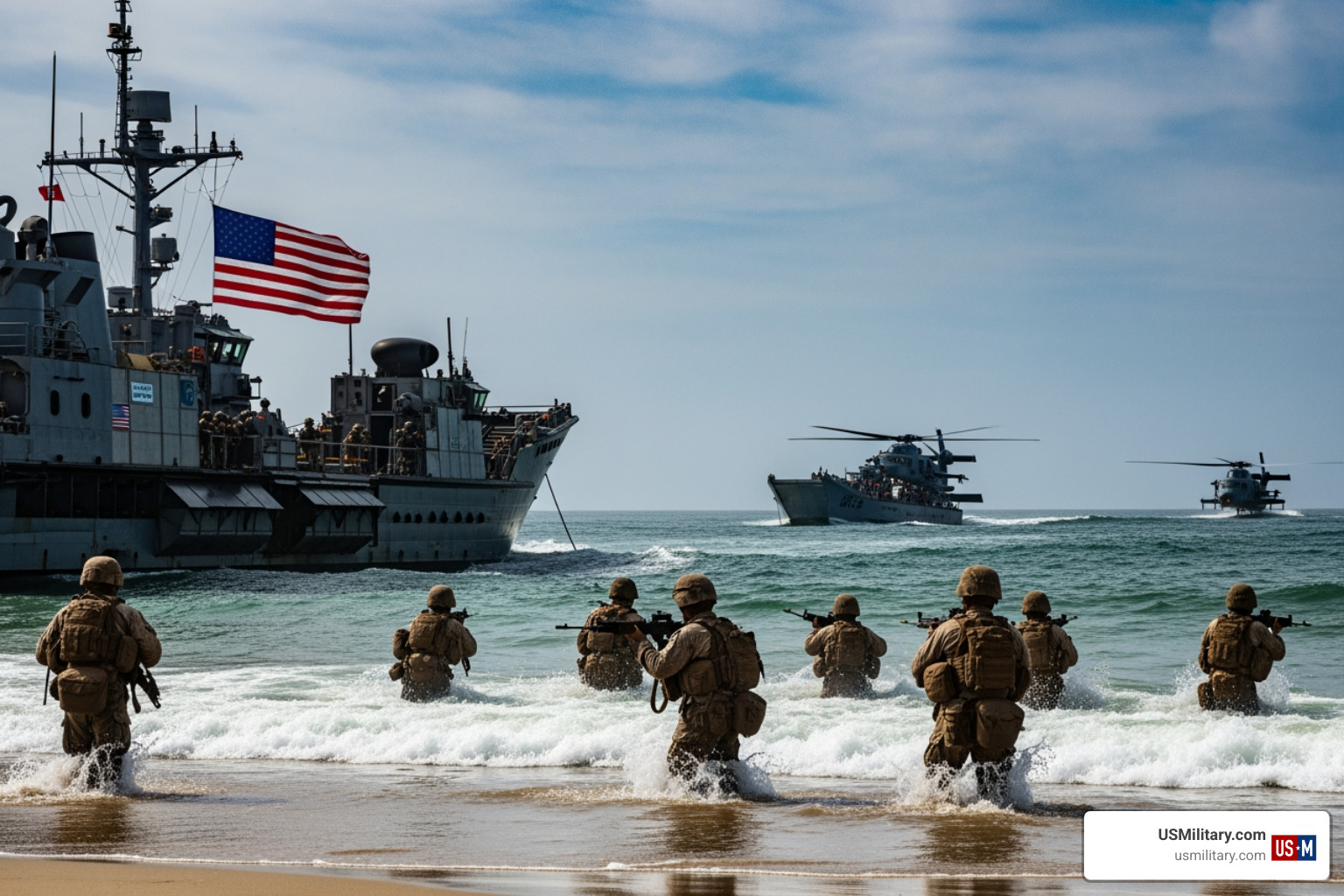
The Marine Corps: Amphibious Powerhouse
The primary mission of the Marines involves amphibious operations and rapid crisis response. Whether it is a humanitarian disaster or a sudden flare-up in a foreign port, the Marine Expeditionary Unit (MEU) is usually the first on the scene. They specialize in moving from the sea to the shore, seizing a beachhead, and holding it until larger Army forces arrive. If you want to be part of a team that is always at the tip of the spear for rapid-response missions, the Marines might be for you. You can learn more about their unique structure in our guide on special-forces-us-marine-corps/.
Army Special Forces: The Quiet Professionals
On the flip side, the Army’s Green Berets have a mission that is often more subtle but equally dangerous. They take on terrorists through quiet, guerilla war-style missions in foreign countries. Their primary bread and butter is Unconventional Warfare and Foreign Internal Defense.
Unlike the Marines, who might kick down the door to clear a room, a Green Beret is more likely to enter a village, learn the local language, and train the local population to defend themselves. This requires a unique blend of diplomatic roles and linguistic skills. They are teachers and diplomats as much as they are warriors.
Mission Comparison Table
To help you visualize the difference, we’ve broken down the primary mission sets:
| Feature | Marine Corps (General/Elite) | Army Special Forces (Green Berets) |
|---|---|---|
| Primary Mission | Rapid Response / Amphibious Assault | Unconventional Warfare / Training Allies |
| Unit Size | Large (MEU) to Small (Raiders) | Small (12-man ODA teams) |
| Environment | Littoral (Coastal) & Land | Diverse (Jungle, Desert, Mountain) |
| Language Req. | Minimal (unless specialized) | High (Language school is mandatory) |
| Main Goal | Seize and Control | Advise and Assist |
Should I join the Marines or the Army Special Forces? Eligibility and Entry Paths
Choosing a path often depends on where you are in life right now. The entry requirements for both branches have some significant differences that might make the decision for you.
Age and Basic Requirements
The Marine Corps generally targets a younger demographic. The age limit for enlistment is 17 to 28. If you are 30 years old and wanting to start your journey, the Marines might require a waiver that isn’t always easy to get. The Army is more flexible, allowing recruits up to age 35 to join. This makes the Army a popular choice for those deciding on a career change later in life.
ASVAB Scores and Intelligence
Both paths require you to be “squared away” mentally. For the Marine Raiders (MARSOC), you generally need a General Technical (GT) score of 105 or higher. The Army Special Forces path is even more demanding, typically requiring a GT score of 110. These scores are pulled from your ASVAB results, so we always recommend hitting the books before you head to the recruiter. You can see how these branches compare more broadly in our marines-vs-army/ breakdown.
The Entry Contracts
One of the biggest advantages the Army offers is the 18X contract. This allows a civilian to enlist with the specific goal of going to Special Forces Assessment and Selection (SFAS) immediately after basic training and infantry school.
The Marines work a bit differently. You usually cannot join as a “Raider” on day one. You typically must graduate boot camp, the School of Infantry, and serve honorably (often for about three years) before you can apply for MARSOC selection. If you want to know what that process looks like, check out our raider-ready-your-guide-to-marsoc-assessment-and-selection/.
Training Pipelines: From Boot Camp to the Q Course
The training for both is legendary for its difficulty. If you are asking, “Should I join the Marines or the Army Special Forces,” you need to be prepared for months—or years—of physical and mental exhaustion.
Marine Corps Training
Every Marine starts at one of two locations: Parris Island or San Diego. Marine Boot Camp is a fixed 13-week program designed to break you down and rebuild you as a rifleman. It is widely considered the most physically and mentally demanding basic training among the general service branches.
After boot camp, those pursuing elite paths like Recon will attend the Basic Reconnaissance Course (BRC) and eventually the Individual Training Course (ITC) if they move toward MARSOC. The Marines even offer a free fitness app to help you get your body ready for these specific challenges.
Army Special Forces Training
Army Basic Training ranges from 10 to 22 weeks depending on your MOS. However, for those on the SF path, basic is just the beginning. Candidates must pass SFAS (Special Forces Assessment and Selection), a brutal 24-day evaluation.
If they are selected, they enter the Q Course (Special Forces Qualification Course). This can last anywhere from 12 to 24 months. You will learn everything from advanced combat tactics to foreign languages and medical skills. The attrition rates are high—often over 50%—meaning many who start never wear the Green Beret. We compare the different Army elite paths in our army-ranger-vs-beret/ article.
Fitness Standards
To succeed in either, you need to exceed the minimums. We’re talking about:
- Swimming: Essential for Marines, Force Recon, and Raiders. You should be able to crush a 500-yard swim.
- Rucking: The “Green Beret” specialty. You must be able to move for 10+ miles with a 45-pound rucksack (often much heavier in reality) at a fast pace.
- PT: Maxing out pull-ups, push-ups, and 2-mile or 3-mile runs is the baseline, not the goal.
Deciding Factors: Should I join the Marines or the Army Special Forces for Career Growth?
Promotion speed is a major “real world” factor. Because the Army is a much larger force (roughly 500,000 active duty vs. under 200,000 Marines), there is more “churn” and more opportunities for advancement.
In the Army, you can often reach the rank of E-4 (Corporal or Specialist) automatically within 18 to 24 months if you stay out of trouble. In the Marines, promotions are more competitive. It is not uncommon to see a Marine finish their first four-year enlistment as an E-3 (Lance Corporal).
If you love job diversity, the Army offers over 150 different roles (MOS). You could be anything from an army-special-forces-weapons-sergeant/ to a cyber specialist. The Marines offer fewer MOS options but emphasize that every Marine is a rifleman first, providing a very strong sense of identity regardless of your specific job.
Lifestyle, Culture, and Esprit de Corps
The culture of these two branches is where the “feel” of your service will differ the most.
The Marine Culture: Semper Fidelis
The Marines are built on tradition. From the birthday ball celebrating their 1775 founding at Tun Tavern to the “Blood Stripe” on their trousers, Marines are proud of their history. The lifestyle is often described as “no-frills.” Marine bases might not always have the newest gyms or housing, but the camaraderie—the Esprit de Corps—is best.
If you join the Marines, you will likely experience life on a ship. Marine Expeditionary Units spend months at sea on Navy vessels, which is a unique lifestyle of tight quarters and oceanic travel.
The Army SF Culture: The Quiet Professional
Army Special Forces soldiers are often more autonomous. Because they operate in small 12-man teams (ODAs), there is a high level of trust and maturity required. You aren’t just following orders; you are solving complex problems in foreign environments.
Army bases are generally larger and often have more amenities than Marine bases. Locations can range from the beaches of Hawaii to the mountains of Colorado or bases in Europe. You can find more about the perks of different branches in our article on which-military-branch-has-the-best-benefits/.
Final Verdict: Should I join the Marines or the Army Special Forces based on Lifestyle?
When it comes down to the final decision, we suggest you look at your long-term personal goals.
- Choose the Marines if: You want the title more than the job. You want to be part of a storied tradition, you love the idea of amphibious warfare, and you don’t mind a stricter, more disciplined environment with slower promotions.
- Choose Army Special Forces if: You want a specific, high-level skill set. You want to learn a language, work with foreign cultures, and enjoy a bit more autonomy and faster career progression.
The risk levels are high for both. Special operations training and deployments carry inherent dangers. The commitment length for an Army 18X contract is often five years or more because the training takes so long. Marines typically sign for four or five years.
If you’re still on the fence, we have a comprehensive guide on should-i-join-the-military/ that explores these questions even further.
Frequently Asked Questions about Marines and Special Forces
Which branch promotes faster, the Army or the Marines?
The Army promotes significantly faster. Due to its size and higher turnover, soldiers can reach E-4 in about two years. Marines often face “stagnation” at the E-3 rank due to a more rigid and competitive promotion system.
Do Marine Raiders and Green Berets do the same thing?
Not exactly. While both are under the Special Operations Command (SOCOM) and can perform direct-action raids, Green Berets focus heavily on unconventional warfare and training foreign armies. Marine Raiders focus more on small-team lethality and direct-action missions.
Can I join the Army Special Forces directly from civilian life?
Yes, through the 18X enlistment contract. You must meet high ASVAB and physical fitness requirements, but it allows you to go straight from basic training to the Special Forces selection process.
Conclusion
Deciding should I join the Marines or the Army Special Forces is a personal journey that requires honest self-reflection. Are you a “911 responder” who wants to be the first to hit the beach, or are you a “quiet professional” who wants to live in a foreign village and build an army from scratch?
At USMilitary.com, we believe that both paths offer an incredible way to serve your country and build a lasting military legacy. Your next step should be to speak with recruiters from both branches. Ask them about current signing bonuses, specific training dates, and lifestyle expectations.
Before you go, make sure you are physically ready. Whether it’s rucking 10 miles or swimming 500 yards, the work starts today. For more insights into how these elite units compare to others, check out our More info about elite force comparisons page. Good luck with your decision—either way, you are choosing to join the ranks of America’s finest.
Free for Service Members & Veterans
Get the military benefits intel no one tells you about.
Weekly updates on VA benefits, pay changes, and money tips — free for service members and veterans.
No spam. Unsubscribe anytime. Your info is never shared.


