Why Marine Raider Selection Matters for Special Operations Hopefuls
Marine Raider selection is the gateway to becoming part of the Marine Corps’ elite special operations force, MARSOC (Marine Corps Forces Special Operations Command). This rigorous process identifies Marines who possess the physical toughness, mental resilience, and character needed to operate in the world’s most challenging environments.
Quick Answer: What You Need to Know About Marine Raider Selection
- Who Can Apply: Active-duty Marines only (no direct entry from civilian life)
- Minimum Requirements: GT score of 105+, PFT score of 235+, pass swim assessment, eligible for Secret clearance
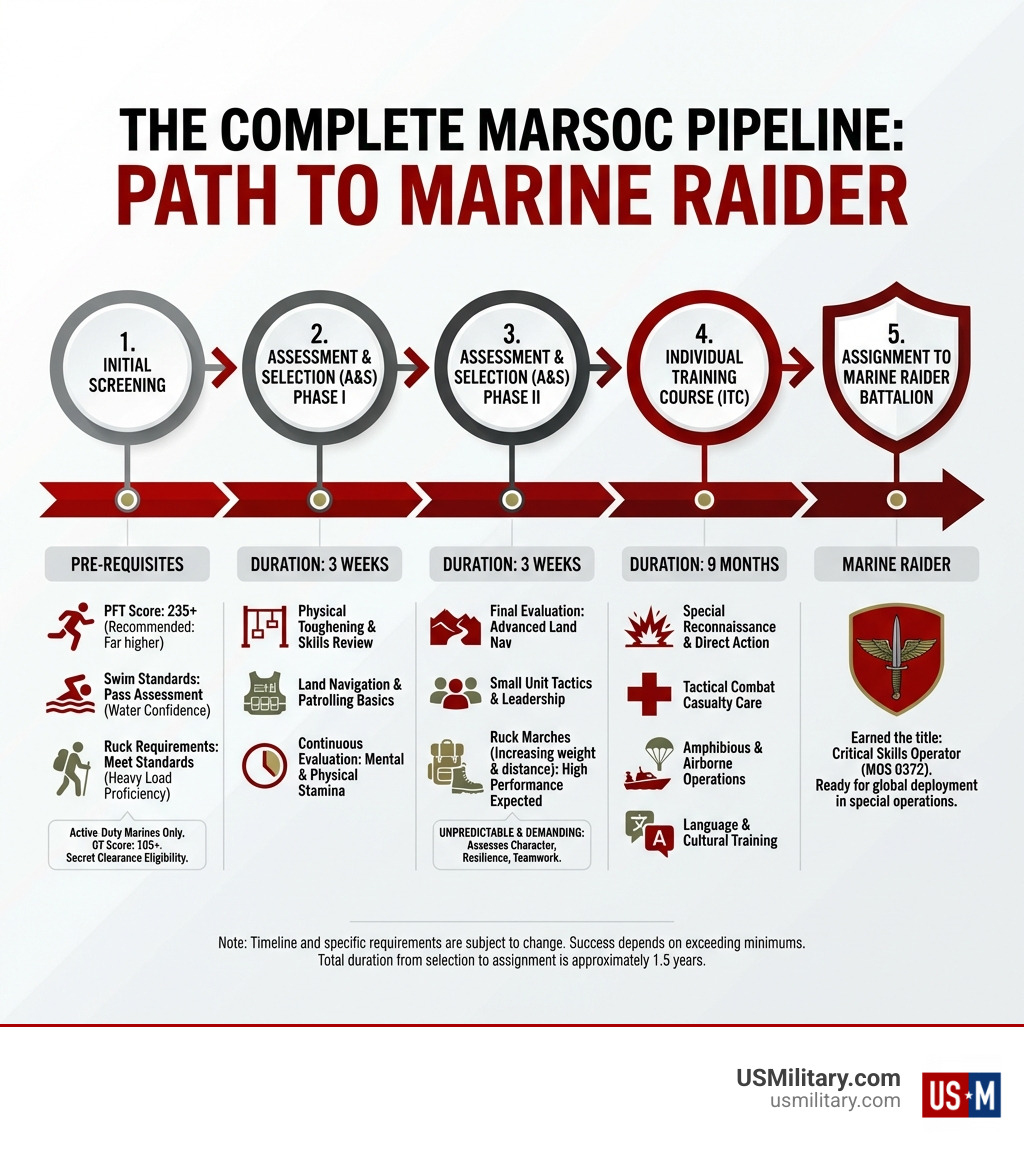
- Selection Process: Two-phase Assessment & Selection (A&S) totaling 6 weeks, followed by 9-month Individual Training Course (ITC)
- Timeline: Plan for 12+ months of preparation before attempting selection
- Success Factors: Physical fitness far exceeding minimums, water confidence, mental toughness, and teamwork
Since its establishment in 2006, MARSOC has grown into a force of over 2,700 members, with more than 1,000 operators serving in the Marine Raider Regiment. The unit’s motto, “Spiritus Invictus” (Unconquered Spirit), reflects the determination required to earn the Marine Raider title.
The selection pipeline is deliberately designed to be unpredictable and demanding. It’s not a training course—it’s a continuous evaluation of your existing capabilities. As one MARSOC recruiter plainly states: “Attaining only the minimum physical fitness standards to enter MARSOC will not guarantee success during the entire A&S process.”
Understanding this process is critical before you commit to the journey. The path from active-duty Marine to Critical Skills Operator (MOS 0372) requires roughly 1.5 years of dedicated preparation and training. This guide breaks down every phase of that journey, from initial prerequisites through graduation from ITC.
The First Hurdle: Prerequisites for MARSOC
Before you can even dream of donning the Marine Raider insignia, you must meet stringent initial requirements. First and foremost, Marine Raider selection is exclusively for active-duty Marines. This means there’s no direct entry from civilian life; you must already be serving in the Marine Corps. This ensures that candidates bring a foundational understanding of Marine Corps ethos and discipline to the table. Currently, MARSOC does not offer Assessment & Selection (A&S) slots to reservists.
We’ve seen that merely meeting the minimum standards isn’t enough for success. The truly competitive candidates far exceed these benchmarks. This dedication to excellence is a hallmark of special operations forces.
For official details and to explore further, you can always visit the Official MARSOC Recruiting Information.
Enlisted vs. Officer Requirements
The path to becoming a Marine Raider differs slightly depending on whether you’re an enlisted Marine aiming to be a Critical Skills Operator (CSO) or an officer aspiring to be a Special Operations Officer (SOO). Let’s break down the core requirements:
| Requirement | Critical Skills Operator (CSO) | Special Operations Officer (SOO) |
|---|---|---|
| GT/GCT Score | Minimum 105 GT Score | Minimum 110 GT/GCT Score |
| PFT Score | Minimum 235 | Minimum 235 |
| Rank/Time-in-Grade | No more than 18 months TIG as a Sergeant upon entering ITC | No more than 24 months TIG as a Captain upon entering ITC. Must be career designated prior to MRC. |
| Security Clearance | Eligible for a Secret clearance | Eligible for a Secret clearance |
| Medical Screening | Meet MARSOC medical standards | Meet MARSOC medical standards |
| Reenlistment | Eligible to reenlist | Not applicable, officers have service obligations |
| Service Obligation | Not specified upon selection | 5-year obligation upon MRC graduation |
As you can see, both paths demand a high level of intellectual and physical capability. For officers, we also know there are no time-in-service restrictions, but the ideal time to apply is after attaining 1stLt and well before career designation, ideally between your first and second deployments if you’re in a Victor unit. No specific officer MOS is preferred for selection; what truly matters are leadership qualities and a demonstrated ability to perform.
Essential Skills and Fitness Benchmarks
Beyond the administrative requirements, a strong foundation in physical fitness and aquatic skills is non-negotiable.
- PFT Score: You must score a 235 or higher on the initial Physical Fitness Test (PFT). However, MARSOC highly encourages candidates to have the ability to run a 260 or higher PFT. This isn’t just about meeting a number; it’s about demonstrating a superior level of fitness that will be tested day in and day out.
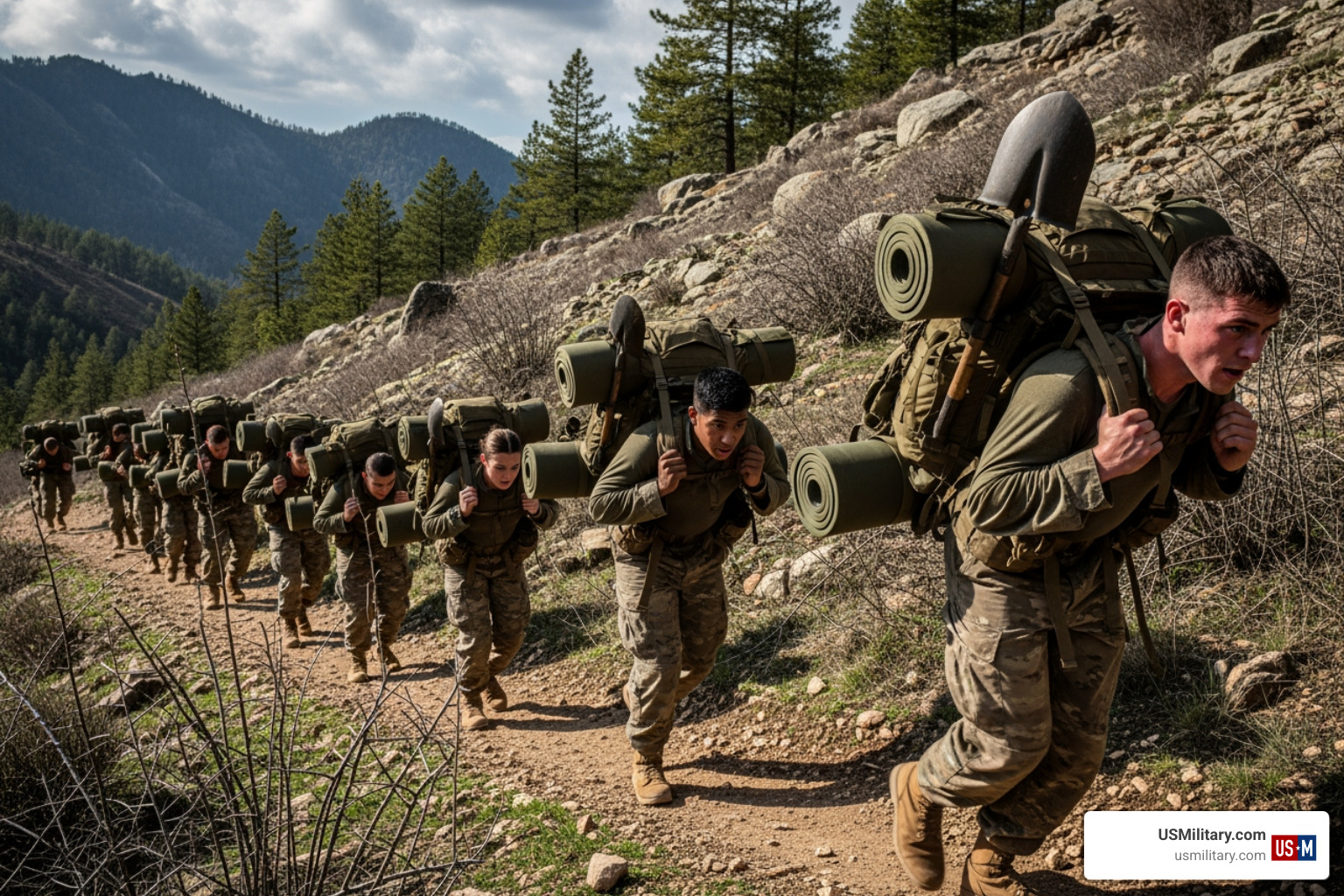
- Rucking Ability: The ability to maintain a 4 mph (15-minute mile) pace with a 45-pound rucksack, regardless of distance, is a critical skill. You’ll be expected to perform ruck marches up to 12 miles, maintaining a sub-12-minute-per-mile pace, and even perform “ruck-ups” with a 100-pound pack. This simulates the sustained load-bearing required of a Raider in the field.
- Water Confidence: Aquatic proficiency is crucial. We’re not just talking about splashing around; we’re talking about demonstrating absolute confidence and capability in the water, often in full uniform. Here’s a list of initial swim assessment standards you’ll face:
- 300-meter swim: Safely, confidently, and continuously swim 300 meters using prescribed strokes (side or breast) while wearing the MCCU uniform (no boots). This needs to be completed in 13 minutes or less, with competitive times being 9 minutes or less.
- 11-minute water tread: Conduct an 11-minute water tread in full utility uniform (no boots).
- 4-minute flotation: Following the tread, demonstrate 4 minutes of either blouse or trouser flotation.
- Abandon ship drill: Conduct an abandon ship drill from a 6-meter platform.
- Confidence: Above all, you must demonstrate confidence in the water and the ability to remain afloat.
- No Major Non-Judicial Punishments (NJPs): For enlisted Marines, you must have no more than two Non-Judicial Punishment events on your current enlistment. This emphasizes the importance of good conduct and discipline throughout your Marine Corps career.
The Crucible: The Marine Raider Selection Process (A&S)
Once you’ve met the initial prerequisites, you’ll be invited to the Assessment and Selection (A&S) program—the true crucible of Marine Raider selection. The purpose of A&S is not to train you, but to identify Marines who already possess the physical and mental fortitude, character, and attributes compatible with special operations missions and the MARSOC way of life. It’s a continuous evaluation, designed to test your integrity, effective intelligence, physical ability, adaptability, initiative, determination, dependability, teamwork, interpersonal skills, and stress tolerance. Think of it as a relentless, multi-faceted job interview where every action is scrutinized.
Understanding the Marine Raider selection phases: A&S Phase I
A&S Phase I is a 3-week comprehensive program. It primarily focuses on physical screening and a foundational assessment of your capabilities. During this phase, you’ll be tested on your physical and mental limits through various events, including:
- Physical Fitness Test (PFT) and Combat Fitness Test (CFT).
- Ruck marches, including a 12-mile ruck.
- Aquatic events, such as the abandon ship drill, 300-meter swim, and 11-minute water tread.
- A “physical in-test” that further evaluates your endurance and strength.
Beyond the physical grind, Phase I also incorporates the Performance and Resiliency (PERRES) program. Here, you’ll receive professional education on fitness, resiliency, and nutrition, aiming to achieve maximum fitness results. This phase also offers mentorship from Critical Skills Operators (CSOs), providing invaluable insight and guidance. Even if you excel in Phase I, attendance does not guarantee a seat at selection or assignment to the Marine Raider Course (MRC). It’s just the first step on a very long and challenging road.
A&S Phase II: The Unseen Challenge
Following a successful Phase I, selected candidates move on to A&S Phase II, another 3-week program. This phase is notorious for being even more mentally and physically challenging, often conducted at an undisclosed location. Here, the predictability you might be used to is stripped away, forcing you to manage your stress response and perform effectively in chaotic, unpredictable environments.
Phase II digs deeper into assessing your adaptability, stress tolerance, and teamwork. You’ll face a mix of intense team and individual events designed to push you to your breaking point and observe how you react. A significant aspect of this phase is peer evaluations. Your fellow candidates will assess your performance, attitude, and professionalism, and these evaluations can be a deciding factor. Candidates who prove toxic, selfish, or unreliable, regardless of their individual physical prowess, can be dropped. The cadre are looking for the “whole Marine” – someone who not only possesses individual skills but can also integrate seamlessly into a small, high-performing team. This is where your true character shines, or falters, under immense pressure.
Forging an Operator: The Individual Training Course (ITC)
If you successfully steer the intense waters of Assessment and Selection, you’ve proven you have the raw material. But the journey isn’t over; it’s time to be forged into a true Marine Raider. This is where the Individual Training Course (ITC) comes in. This nine-month-long program is where selected Marines are trained to become Critical Skills Operators (MOS 0372) and Special Operations Officers.
ITC is structured using a building-block approach, where the training rigor systematically increases. This mimics the complexity and stresses of real-world combat, ensuring that by the end, you’re prepared for anything.

Key Training Blocks of ITC
The ITC is divided into several phases, each building upon the last to develop a well-rounded special operations professional:
- Phase 1: Basic Skills (approximately 10 weeks)
- This phase covers fundamental special operations skills. You’ll receive training in Survival, Evasion, Resistance, and Escape (SERE), advanced medical skills (Tactical Combat Casualty Care – TCCC), communications, mission planning, fire support, land navigation, hand-to-hand combat, and patrolling. These are the essential tools every Raider needs.
- Phase 2: Small Unit Tactics (approximately 8 weeks)
- Building on basic skills, this phase focuses on applying tactics in various environments. Training includes small boat operations, scout swimmer operations, crew-served weapons, demolitions, photography, and information collection and reporting. This phase also includes notable exercises like “Operation Raider Spirit” and “Operation Stingray Fury,” designed to test your tactical proficiency.
- Phase 3: Close Quarters Battle (CQB) (approximately 5 weeks)
- This is where you hone your skills for precision assaults. You’ll receive intensive training in rifle and pistol marksmanship, assault operations, and urban combat. This phase culminates in “Operation Guile Strike,” a full-mission-profile exercise that pushes your CQB capabilities to their limit.
- Phase 4: Irregular Warfare (approximately 7 weeks)
- The final phase focuses on the complex world of irregular warfare. Here, you’ll learn to train, advise, and operate with Partner Nation or Irregular forces. This includes foreign internal defense and counterinsurgency tactics. The capstone exercise for this phase is “Operation Derna Bridge,” which integrates all the skills learned throughout the course in a realistic scenario.
Upon successful completion of ITC, graduates are awarded the MOS 0372 (Critical Skills Operator) and then typically attend a 6-month basic language course, further enhancing their capabilities as “cross-cultural diplomats and global scouts.”
For more in-depth information about the training, you can refer to the Details on the Marine Raider Course.
Preparing for the Marine Raider selection and ITC
The journey to MARSOC is not something you decide on a whim. It demands deliberate, long-term preparation. Most successful candidates train for at least 12 months, with some dedicating up to two years to physically, emotionally, mentally, and socially prepare.
- 10-week training guide: MARSOC provides a 10-week Fitness Guide and recommends using the TrainHeroic app to prepare for A&S. Marines should complete at least the first 7 weeks of this guide before attending A&S Phase I.
- Long-term physical preparation (12+ months): Your preparation should focus on building a robust foundation. This includes:
- Aerobic capacity: For sustained energy and rapid recovery from intense efforts. This means building a deep aerobic base through consistent running and rucking.
- Relative strength: The ability to efficiently move your body and heavy loads. Think functional strength, not just gym-bench numbers.
- Work capacity: The ability to sustain high-volume workloads over extended periods, managing fatigue effectively.
- Injury prevention: With such intense training, movement quality and injury prevention are paramount. You can’t succeed if you’re constantly sidelined.
- Developing mental resilience: This is where the “unconquered spirit” comes in. Learn to manage stress, adapt to unpredictability, and perform under immense pressure. This is trained by pushing your limits, not just your muscles.
Life in the Regiment: Roles, Missions, and Deployments
Becoming a Marine Raider means embracing a life of challenge, dedication, and unparalleled impact. As Critical Skills Operators (CSOs) and Special Operations Officers (SOOs), you become part of small, agile teams of “combat athletes” capable of operating across the globe. You are not just warriors; you are “cross-cultural diplomats and global scouts,” influencing situations in areas where traditional authority may be absent.
Primary Missions:
Marine Raiders are ready to execute any mission, in any clime, or any place. Their core activities are diverse and critical to national security:
- Direct Action (DA): Short-duration strikes and other small-scale offensive actions taken to seize, destroy, capture, recover, or inflict damage on designated personnel or material.
- Special Reconnaissance (SR): Reconnaissance and surveillance operations in hostile, denied, or politically sensitive environments.
- Foreign Internal Defense (FID): Training and advising foreign military or paramilitary forces to enable them to protect their own sovereignty.
- Security Force Assistance (SFA): Assistance to foreign security forces to enable them to provide security for their population and to counter threats.
- Counterterrorism (CT): Actions taken to neutralize terrorists and their organizations.
- Counterinsurgency (COIN): Comprehensive civilian and military efforts designed to simultaneously defeat and contain insurgency and address its root causes.
- Preparation of the Environment (PE): Actions that improve the ability of special operations forces to conduct future operations.
Notable Engagements:
Marine Raiders have a distinguished record of service and valor in conflicts across the globe. Since MARSOC’s formation, they have conducted over 300 operational deployments across 17 countries, earning more than 300 valor awards, though not without sacrifice, with 43 Raiders killed in combat and training. Some notable examples include:
- A Marine Raider Battalion participating in operations to liberate Mosul, Iraq, from ISIS’s grip during Operation Inherent Resolve.
- A Marine Raider receiving the Silver Star for actions during a terror attack in Mali.
- Another Raider being awarded the Silver Star for taking out an armored-vehicle IED with a Javelin during operations in Iraq.
- A Marine Raider earning the Silver Star after a 4-hour firefight in Afghanistan.
- The deployment of MCSOCOM Detachment One (Det 1) to Iraq alongside Navy SEALs, showcasing early integration into joint special operations.
Career Paths and Unit Structure
Within MARSOC, there are distinct career paths and a clear unit structure designed for optimal special operations:
- Critical Skills Operator (CSO): Enlisted Marines who complete the ITC are awarded the MOS 0372. CSOs can remain in MARSOC for the duration of their Marine Corps career, continuously honing their skills and deploying with their teams.
- Special Operations Officer (SOO): Officers who complete the ITC lead these elite teams. They are expected to provide leadership at the point of friction, integrate capabilities, lead planning, and influence various commands and partners.
- Special Operations Capability Specialists (SOCS) and Combat Service Support (CSS): These essential Marines provide specialized expert support, acting as force multipliers. SOCS leverage their original MOS (e.g., intelligence, communications, EOD, dog handlers, fire control specialists) to support Raider operations. CSS Marines provide critical logistical and administrative support (e.g., motor transport, supply). Both SOCS and CSS Marines are assigned tour lengths and are eligible for additional opportunities within the special operations community.
The Marine Raider Regiment (MRR) is the principal combat component of MARSOC, authorized for 1,512 personnel (1,475 military and 37 civilian). It consists of a Headquarters Company and three Marine Raider Battalions (MRB). Each MRB has four Marine Special Operations Companies (MSOC), and each MSOC is comprised of four fourteen-man Marine Special Operations Teams (MSOTs). An MSOT’s headquarters element typically includes an SOO, Team Chief, Operations SNCO, and Communications SNCO, while each tactical squad has four CSOs and a Special Amphibious Reconnaissance Corpsman (SARC).
The Marine Raider Support Group provides the crucial logistical, intelligence, and technical support to the Raider Battalions, while the Marine Raider Training Center (MRTC) is responsible for the entire selection and training pipeline, from A&S to ITC.
Operational Tempo and Deployments
Life as a Marine Raider involves a demanding operational tempo. After graduating from ITC, newly minted Raiders undergo extensive pre-deployment training, which typically lasts 10-12 months. This period ensures the team is cohesive, proficient, and ready for any mission.
Typical deployments can range from 90 days to 8 months, with a flexible deployment cycle depending on mission requirements. Marine Raiders are deployed globally, often in austere and unconventional settings. While the need for operational secrecy means families might not always know the exact location or nature of a mission, MARSOC places a high priority on family readiness and support. After a deployment, time with family is a command priority, and Raiders have opportunities for schools and non-deployable billets to balance their operational tempo throughout their careers.
Frequently Asked Questions about Marine Raider Selection
We understand you likely have many questions about this challenging path. Here are some of the most common ones we encounter:
What happens if I am not selected at A&S?
A&S is voluntary, and we want to emphasize that not being selected carries no negative career impact within the Marine Corps. If you are not selected, you will return to your parent command. The A&S staff will inform you of your eligibility to re-apply, and you will not have any negative paperwork on your record. Furthermore, MARSOC may have other billet assignments within your PMOS (Primary Military Occupational Specialty) or other special operations support MOSs (like 8006 or 8007) that you might be eligible for. For officers, re-application opportunities are rare and usually only under extraordinary circumstances, as you typically have a very limited window to attend A&S.
Can I join MARSOC as a reservist?
At this time, MARSOC does not offer Assessment & Selection (A&S) slots to reservists. To apply for Marine Raider selection, you must be an active-duty Marine.
What are the biggest reasons candidates fail selection?
Failure in Marine Raider selection most often stems from a lack of comprehensive preparation across multiple domains:
- Insufficient Physical Preparation: While minimum standards exist, competitive candidates far exceed them. Many fail because they only train to the minimums, which is not enough for the sustained physical demands, especially with rucking and swimming. The constant physical exertion, coupled with sleep deprivation and mental stress, quickly exposes any weaknesses.
- Lack of Water Confidence: The aquatic assessments are rigorous and often a significant hurdle. Candidates who aren’t truly comfortable and proficient in the water, particularly in uniform and under stress, will struggle.
- Mental and Emotional Fatigue: The unpredictability and continuous evaluation of A&S are designed to break down candidates. Those who cannot manage their stress response, adapt quickly, or maintain composure under extreme pressure often fail.
- Poor Teamwork and Interpersonal Skills: Marine Raiders operate in small, tight-knit teams. Candidates who are selfish, toxic, unreliable, or lack the ability to effectively communicate and collaborate with their peers will be identified through peer evaluations and dropped from the course. You need to pass the “beer test”—meaning your teammates would want to have a beer with you after a tough mission.
- Inability to Adapt: The environment in A&S is chaotic by design. Candidates who cannot think critically, solve problems, or adapt to rapidly changing situations will not succeed.
Selection doesn’t care about your intentions or potential; it reveals your actual level of preparation. You can’t fake the resilience, teamwork, or discipline required.
Your Journey to Becoming a Raider
The path to becoming a Marine Raider is undoubtedly one of the most challenging in the U.S. military. It demands total commitment—physically, mentally, and emotionally. Success isn’t handed out; it’s earned through relentless preparation, an unyielding spirit, and a deep understanding of what it means to be part of an elite team.
We at USMilitary.com are here to provide resources for every step of your military career, from initial enlistment to pursuing specialized paths like Marine Raider selection. If you’re ready to answer the call and embody the “Spiritus Invictus,” begin your preparation today.
Free for Service Members & Veterans
Get the military benefits intel no one tells you about.
Weekly updates on VA benefits, pay changes, and money tips — free for service members and veterans.
No spam. Unsubscribe anytime. Your info is never shared.


