How to Estimate Your 2027 Active-Duty Pay

Your 2027 pay will depend on your pay grade, years of service, and allowances. For a quick estimate, multiply your 2026 monthly basic pay by 1.036, then add any housing and food allowances you qualify for. If you earn $4,000 in basic pay now, that would be about $4,144 per month under the projected 3.6% raise, before allowances. The final 2027 rates are not yet set.
Larry Fowler, a Navy veteran, BUD/S Class 89 graduate, and publisher of USMilitary.com, explains how much you will earn on active duty in 2027 by separating projected basic pay from the allowances and benefits that can add to its value.
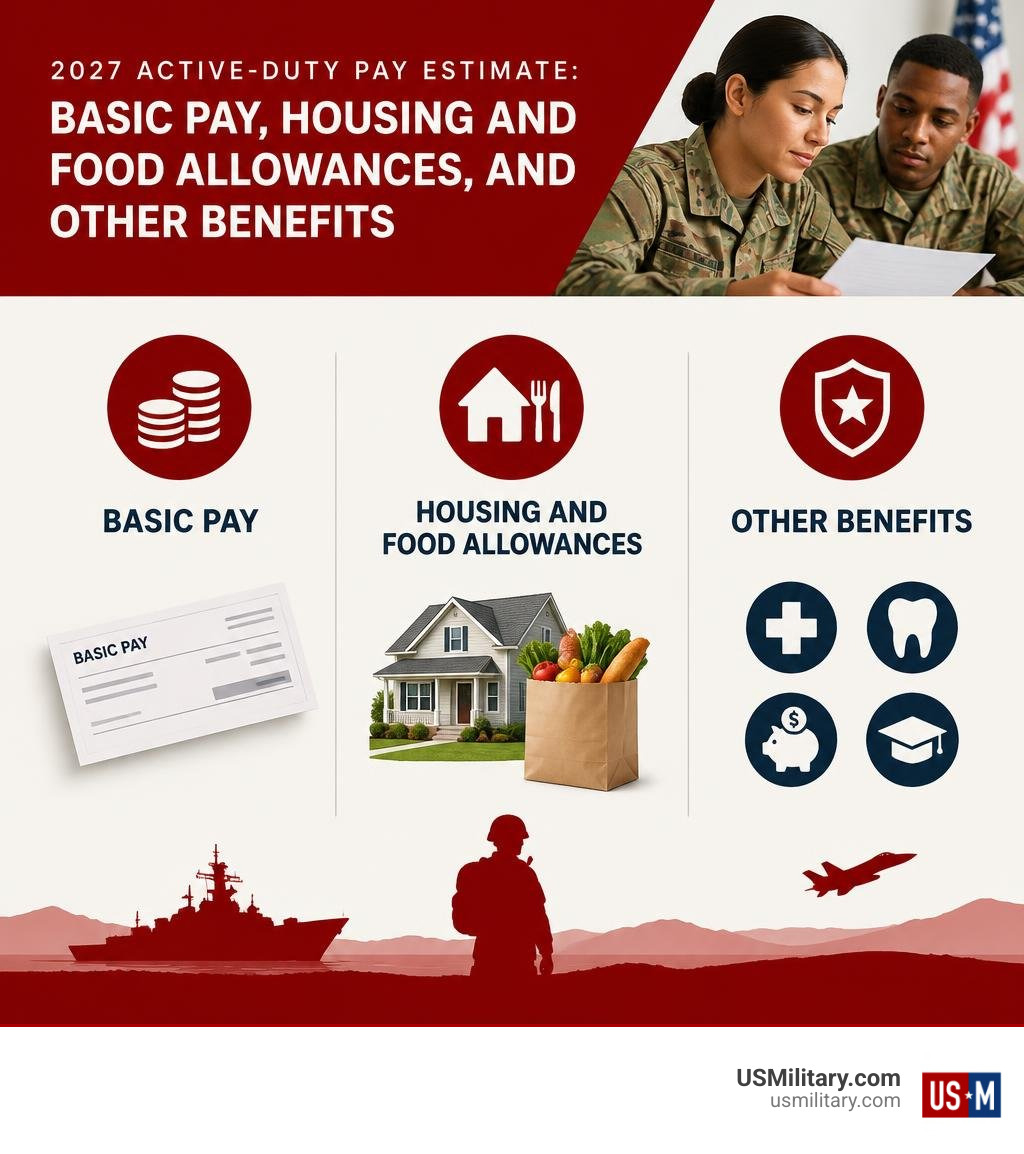
Projected Base Pay: How Much Will You Earn On Active Duty in 2027?
As we look ahead from October 2026 into the upcoming fiscal year, estimating next year’s earnings comes down to understanding how military raises are calculated. By law, statutory military basic pay raises track the Employment Cost Index (ECI). Based on third-quarter economic indicators, the baseline across-the-board pay raise for 2027 is projected at 3.6%.
However, legislative discussions surrounding the FY2027 National Defense Authorization Act (NDAA) include an alternative, targeted compensation plan. Under this proposal, Congress and the administration have weighed a tiered raise:
- 7% increase for junior enlisted service members (E-1 through E-5)
- 6% increase for mid-grade personnel (E-6 through O-3)
- 5% increase for senior officers (O-4 and above)
Whichever plan takes final legislative effect, the new rates will become active on January 1, 2027.
Enlisted Basic Pay: How Much Will You Earn On Active Duty in 2027?
For enlisted personnel across all branches—Army, Navy, Air Force, Marine Corps, and Space Force—basic pay rises steadily with pay grade (E-1 to E-9) and cumulative time in service.
When comparing the 2026 enlisted pay structure to the 2027 forecasts, junior enlisted members will see meaningful bumps in base earnings. An E-1 with less than 2 years of service is projected to earn roughly $2,407.20 per month in standard base pay. A mid-grade E-5 with over 6 years of service will see basic pay reach $4,258 per month under the 3.6% baseline, or climb as high as $4,532 per month if the proposed 7% targeted raise is signed into law.
| Pay Grade & Experience | 2026 Base Pay (Monthly) | 2027 Projected (3.6% Baseline) | 2027 Proposed Tiered (6%–7%) |
|---|---|---|---|
| E-1 (< 2 Yrs) | $2,323.55 | $2,407.20 | $2,486.20 |
| E-3 (Over 3 Yrs) | $2,711.10 | $2,808.70 | $2,900.88 |
| E-5 (Over 6 Yrs) | $4,109.80 | $4,258.00 | $4,532.00 |
| E-7 (Over 6 Yrs) | $4,675.50 | $4,843.80 | $4,956.03 |
| E-9 (Over 20 Yrs) | $7,725.30 | $8,003.40 | $8,188.82 |
Commissioned Officers: How Much Will You Earn On Active Duty in 2027?
Commissioned officers (O-1 through O-10) and Warrant Officers (W-1 through W-5) follow a structured pay ladder that rewards operational leadership and longevity. Prior-enlisted officers (grades O-1E, O-2E, and O-3E) also receive higher compensation bands that honor their cumulative enlisted service.
When estimating active duty military compensation for officers in 2027, an incoming O-1 (Second Lieutenant or Ensign) with under 2 years of service is estimated to earn $4,150.20 per month in basic pay. A mid-career O-3 (Captain or Navy Lieutenant) with over 6 years of service will earn roughly $8,016 per month under the 3.6% benchmark, or $8,201 per month under the proposed 6% adjustment. At the senior leadership level, an O-6 with over 6 years of service will see basic pay rise to $10,284.30 per month.
Allowances and Tax-Free Benefits That Expand Your Take-Home Earnings

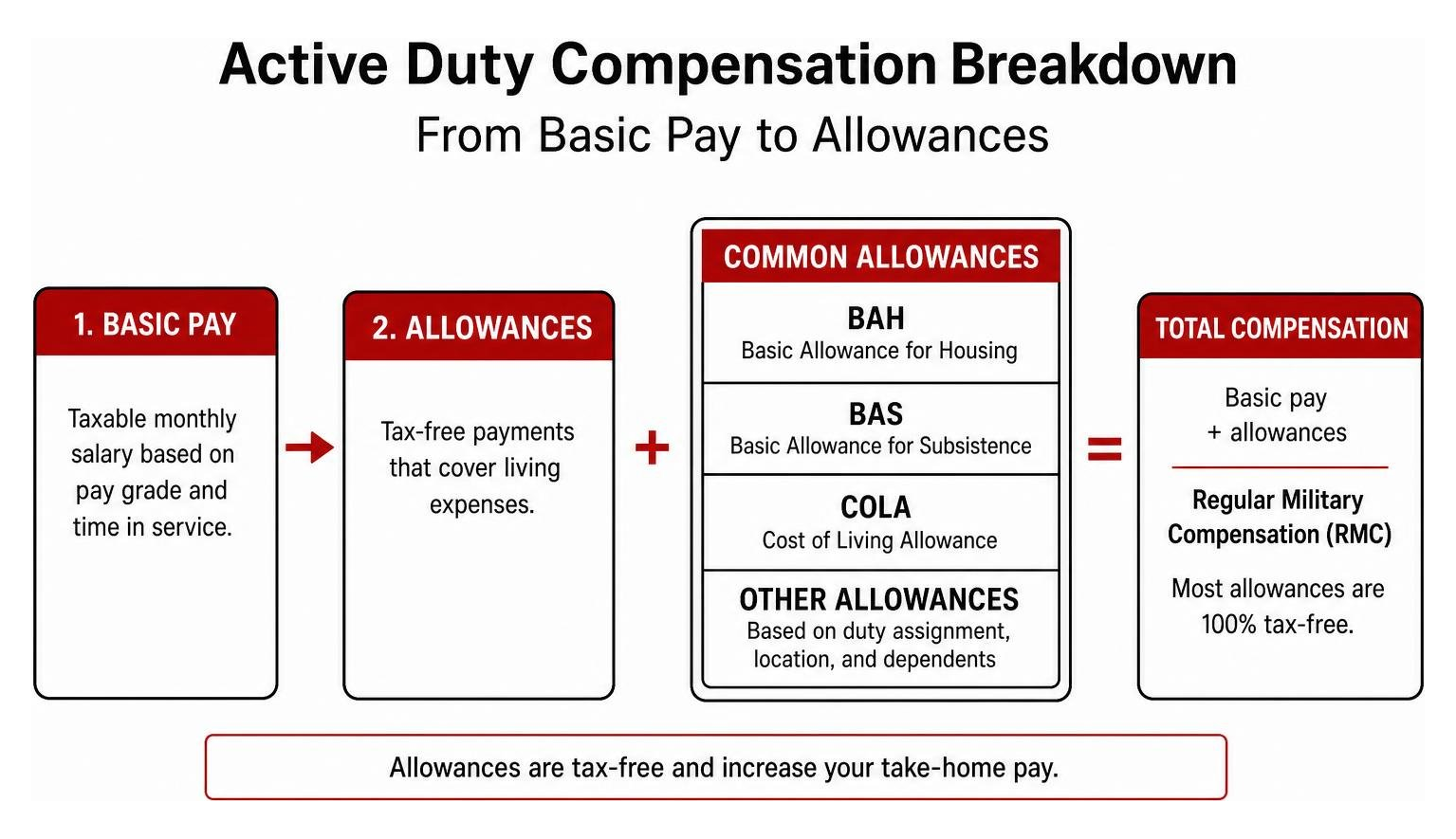
Base pay is only one part of your actual earnings. One of the greatest financial advantages of serving on active duty is that allowances are completely exempt from federal and state income taxes. When you evaluate your Regular Military Compensation (RMC), these tax exclusions add substantial purchasing power to your pocket.
You can learn more about these non-taxable advantages by reviewing comprehensive active duty military benefits.
Basic Allowance for Housing (BAH) and Subsistence (BAS)
The two largest non-taxable stipends are:
- Basic Allowance for Housing (BAH): Calculated based on your duty station zip code, your pay grade, and whether you have dependents. In high-cost areas, BAH can easily equal or exceed your monthly base pay.
- Basic Allowance for Subsistence (BAS): A non-taxable monthly food allowance designed to offset meal costs. While officers receive a fixed standard rate, enlisted personnel receive a slightly higher monthly baseline (projected at approximately $475 to $490 per month for 2027).
Comprehensive Healthcare, Travel, and Retirement Value
Beyond cash allowances, active duty compensation includes world-class non-cash benefits:
- TRICARE Prime: Comprehensive medical, dental, and vision coverage for active duty members at zero out-of-pocket premium costs. We cover exact family co-pays and options in our guide to budgeting for TRICARE Prime expenses.
- Paid Annual Leave: Every service member earns 30 days of paid vacation per year, along with access to space-available military travel flights worldwide.
- Blended Retirement System (BRS) & COLA: Service members receive up to a 5% government match on their Thrift Savings Plan (TSP) contributions. For those planning a full 20-year career, our military pension and retirement pay guidelines outline lifetime defined-benefit payouts.
Notably, the military retirement Cost-of-Living Adjustment (COLA) for 2027 is projected between 3.6% and 3.8%, calculated using CPI-W inflation figures from late 2026. This increase takes effect on December 1, 2026, appearing on retirement checks starting December 31, 2026.
Special Pays, Enlistment Bonuses, and Education Incentives for 2027

Special duty assignments, hazardous duty billets, and high-demand skill ratings unlock thousands of dollars in annual incentive pay.
Incentive programs available across the branches include:
- Enlistment & Quick-Ship Bonuses: Branches like the Navy offer up to $25,000 in shipping bonuses for select ratings departing for recruit training before October 2027, with total enlisted incentive packages reaching up to $140,000.
- Special Operations Incentives: Physical Screening Test (EB-PST) excellence bonuses provide up to $20,000 for candidates entering elite pipelines such as Navy SEALs or Air Force Special Warfare.
- Student Loan Repayment Program (LRP): Qualifying service tracks offer up to $65,000 in direct student loan repayments.
- Specialty Pays: Service members in demanding billets receive monthly additions such as Aviation Incentive Pay, Career Sea Pay, Submarine Duty Pay, and Hazardous Duty Incentive Pay.
Education Benefits and Post-9/11 GI Bill Value
Education benefits represent one of the most lucrative parts of total military compensation. While serving, Tuition Assistance (TA) covers upfront college course fees. Once you reach 36 months of aggregate active duty service, you earn 100% eligibility for the Post-9/11 GI Bill.
For the 2026–2027 academic cycle, the Post-9/11 GI Bill provides:
- Full In-State Tuition: 100% coverage at public colleges and universities.
- Private Institution Cap: Up to $30,908.34 per academic year toward private or foreign institutions (with excess costs often covered by the Yellow Ribbon Program).
- Monthly Housing Allowance (MHA): Paid directly to you based on the local E-5 with-dependents BAH rate for your campus zip code (capped at $1,198 monthly for fully online degrees).
- Book & Supply Stipend: Up to $1,000 per academic year.
Discover how to structure your benefits by maximizing Post-9/11 GI Bill education payments.
Frequently Asked Questions About 2027 Active Duty Military Pay
What is the expected 2027 military basic pay raise percentage?
The statutory baseline pay raise for 2027 is projected at 3.6%, determined by the private-sector Employment Cost Index (ECI). However, Congress is evaluating a targeted structure offering a 7% raise for junior enlisted (E-1 to E-5), 6% for mid-grades (E-6 to O-3), and 5% for senior officers (O-4 and above). The approved increase takes effect on January 1, 2027.
Are military allowances like BAH and BAS subject to income tax?
No. Military allowances—including Basic Allowance for Housing (BAH), Basic Allowance for Subsistence (BAS), and overseas cost-of-living adjustments (COLA)—are completely exempt from federal, state, and FICA taxes. This tax exclusion significantly raises your true take-home pay compared to an identical civilian gross salary.
How do enlistment bonuses and student loan repayments impact 2027 earnings?
Enlistment incentives provide direct cash bonuses upon completing initial training milestones. Shipping bonuses can add up to $25,000, special operations fitness scores can earn up to $20,000, and military student loan repayment programs can pay down up to $65,000 in qualifying educational debt.
Conclusion
Understanding your true earnings in the military requires looking beyond basic salary charts. When you combine standard base pay with tax-free housing allowances, meal stipends, zero-deductible TRICARE healthcare, educational funding, and enlistment incentives, active duty military compensation remains one of the most robust and financially protective career paths in the United States.
Whether you are preparing to ship to boot camp or charting your course toward military retirement, we at USMilitary.com are committed to providing you with clear, accurate financial guidance. Start mapping your future earnings today by exploring the highest-paying careers in the military.
Free for Service Members & Veterans
Get the military benefits intel no one tells you about.
Weekly updates on VA benefits, pay changes, and money tips — free for service members and veterans.
No spam. Unsubscribe anytime. Your info is never shared.



Leave a Reply