What Are Military Career Paths? A Quick Overview
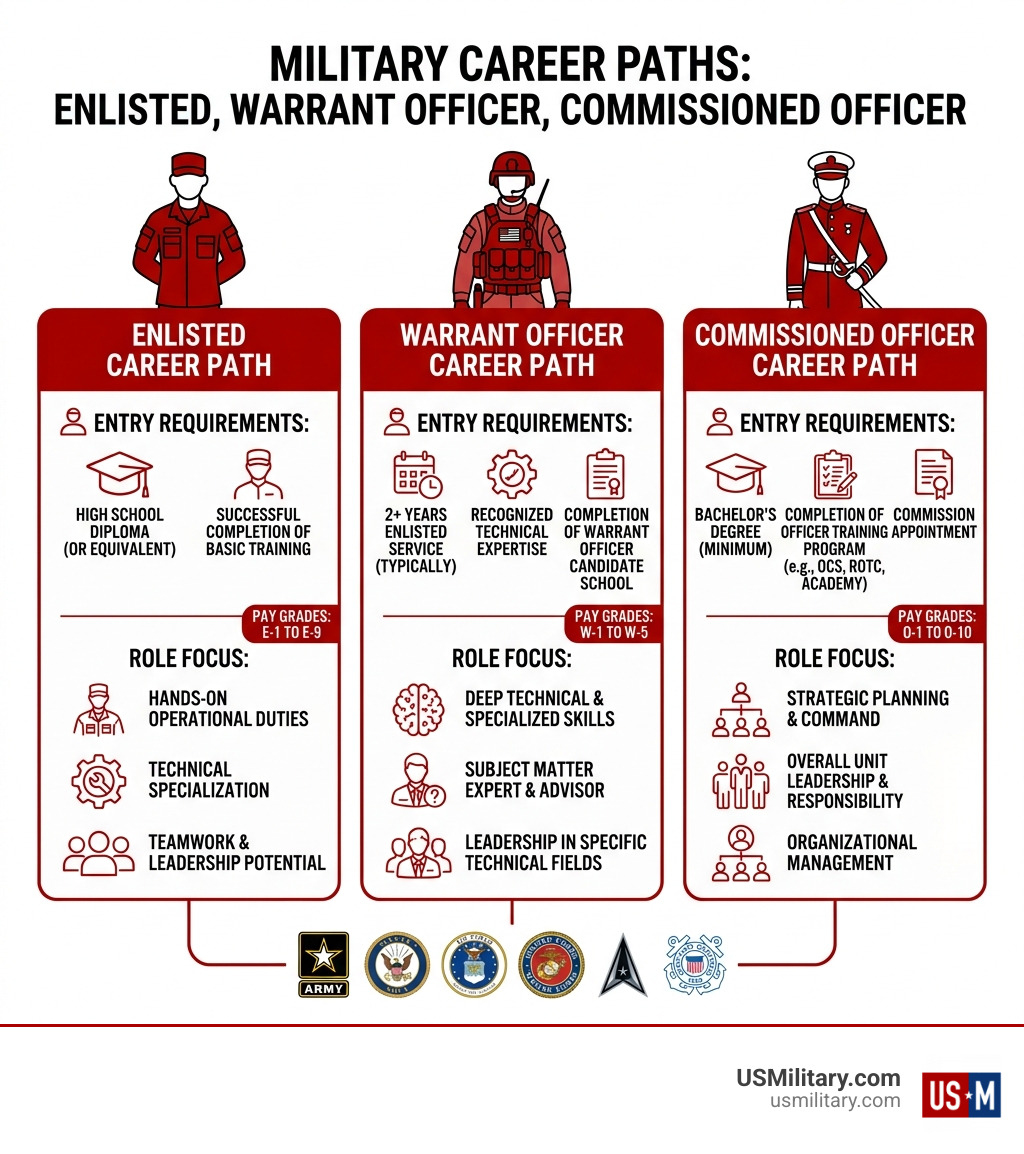
Military career paths fall into three main categories that shape everything from your daily duties to your pay and advancement potential:
| Career Path | Basic Requirement | Role Focus | Pay Grade |
|---|---|---|---|
| Enlisted | High school diploma | Hands-on technical and operational work | E-1 to E-9 |
| Warrant Officer | 2+ years enlisted service | Deep technical expertise and specialization | W-1 to W-5 |
| Commissioned Officer | Bachelor’s degree | Leadership, strategy, and command | O-1 to O-10 |
As of February 2024, more than 1.2 million people serve on active duty across six branches: Army, Navy, Air Force, Marine Corps, Space Force, and Coast Guard. Each branch offers a wide range of jobs — from combat roles and aviation to cybersecurity, healthcare, and engineering.
Whether you’re fresh out of high school, finishing college, or already a working professional, there’s likely a path that fits your background and goals.
I’m Larry Fowler, publisher of the USMilitary.com Network and a long-time resource for service members navigating military career paths, benefits, and VA resources since 2007. In this guide, I’ll walk you through everything you need to make a confident, informed decision about your military career.
Understanding the Three Main Military Career Paths

When we look at military career paths, we have to start with the hierarchy. The military operates on a structured rank system that dictates responsibility and authority. While every member is essential to the mission, the way they contribute differs based on whether they are enlisted, a commissioned officer, or a warrant officer.
Enlisted members are the “doers.” They make up about 82% of the total force. Officers are the “planners” and “leaders.” Warrant officers are the “technical experts.” Understanding these distinctions is the first step in finding your place in the service.
For a detailed look at how these ranks look across branches, you can see all military ranks, insignia and paygrades.
Enlisted Military Career Paths
The enlisted path is the most common entry point into the armed forces. It is designed for those who want to learn a specific trade and perform hands-on work. Most enlisted members join with a high school diploma or GED.
Once you enlist, you are sent to basic training followed by technical school. Here, you learn your Military Occupational Specialty (MOS), Air Force Specialty Code (AFSC), or Navy Rating. These roles cover everything from Navy enlisted electronics specialists to Army nodal network jobs.
Enlisted members can advance to become Noncommissioned Officers (NCOs). NCOs are senior enlisted members who have been given leadership authority. They supervise junior members and ensure that the day-to-day operations of their unit run smoothly.
Officer and Warrant Officer Military Career Paths
Commissioned officers are the managers and executives of the military. To become an officer, you generally need a four-year bachelor’s degree. Officers are responsible for leading troops, managing large-scale programs, and making critical decisions during missions.
There are several pathways for Army Officers and officers in other branches, including the Reserve Officers’ Training Corps (ROTC), federal service academies like West Point or the Naval Academy, and Officer Candidate School (OCS).
Warrant officers occupy a unique middle ground. They are highly specialized technical experts. For example, a warrant officer might be a master helicopter pilot or a top-tier cybersecurity expert. In most branches, you must serve as an enlisted member first to demonstrate your expertise before applying for a warrant officer commission. The U.S. Air Force is the only branch that does not currently utilize the warrant officer rank.
For those looking at elite leadership roles, the training is even more rigorous. You can find more info about becoming a Navy SEAL, which is one of the most challenging officer-led paths in the military.
Entry Requirements and the Enlistment Process
Before you can start your journey on any of these military career paths, you must meet the baseline eligibility requirements. We find that many people are surprised by the strictness of these standards, which cover age, physical health, and legal background.
Basic requirements include:
- Citizenship: You must be a U.S. citizen or a legal permanent resident (Green Card holder).
- Education: A high school diploma is standard, though some branches accept a GED with additional college credits.
- Background: You must pass a background check. Significant criminal records or certain medical conditions can be disqualifying.
- Physical Fitness: Each branch has its own physical fitness test involving running, push-ups, and sit-ups.
Age limits vary significantly by branch for active-duty enlistment:
- Army: 17–35
- Navy: 17–41
- Air Force: 17–42
- Space Force: 17–42
- Marine Corps: 17–28
- Coast Guard: 17–41
The Role of the ASVAB in Job Placement
The Armed Forces Vocational Aptitude Battery (ASVAB) is perhaps the most important test you will take when joining. It isn’t just an entrance exam; it’s a placement tool.
The ASVAB measures your knowledge in areas like math, science, electronics, and word knowledge. Your score on the Armed Forces Qualification Test (AFQT) portion determines if you can join, while your “line scores” determine which jobs you qualify for. If you want a high-tech job in intelligence or engineering, you’ll need to study hard to secure the necessary scores.
Training: From Boot Camp to Technical School
Every recruit starts with Basic Military Training (BMT), often called boot camp. This lasts between 7 and 12 weeks, depending on the branch. It’s designed to transform civilians into service members through physical conditioning, discipline, and basic tactical skills.
After boot camp, you move to Advanced Individual Training (AIT) or technical school. This is where you learn your specific job. For example, if you are pursuing a career in law enforcement, you would attend the Army Military Police training school. This phase can last anywhere from a few weeks to over a year for highly technical roles like nuclear power or linguistics.
Primary Occupational Categories Across the Branches
The military is like a self-contained city. We need almost every job found in the civilian world, plus roles that only exist in combat environments. We can group these military career paths into several broad categories.
- Combat Specialty: Infantry, artillery, and special operations. These roles are the tip of the spear.
- Healthcare: Doctors, nurses, and specialists. You can even find Air Force dental assistant careers that provide excellent training for the civilian world.
- Aviation: Pilots, air traffic controllers, and aircraft mechanics.
- Cyber and Intelligence: Protecting networks and gathering data to prevent threats.
- Science and Technology: This includes specialized roles like Air Force weather careers, where members analyze atmospheric data for flight operations.
- Logistics and Transportation: Moving troops and supplies globally. This is one of the largest occupational groups in the military.
Comparing Career Options by Branch
Each branch has its own culture and primary mission, which influences the types of military career paths available.
- Army: The largest branch, focused on land-based operations. It offers over 150 MOS options.
- Navy: Focused on sea-based operations, including surface ships, submarines, and naval aviation. It offers over 150 distinct roles.
- Air Force: Focused on air, space, and cyberspace superiority. It organizes careers into eight main categories.
- Marine Corps: An elite department of the Navy focused on rapid response and amphibious operations. It has over 300 MOS options.
- Space Force: The newest branch, focusing on satellite operations and protecting U.S. interests in space.
- Coast Guard: Part of the Department of Homeland Security during peacetime, focusing on maritime safety and law enforcement.
Many people also consider the National Guard vs. Reserve. The Reserves are federal and support active-duty units, while the National Guard has a dual state and federal mission, often responding to domestic emergencies like natural disasters.
Compensation, Benefits, and Advancement Opportunities
Military pay is structured differently than civilian pay. It consists of base pay plus several allowances and special pays. Base pay is determined by your rank and how many years you have served.
In addition to base pay, service members receive:
- Basic Allowance for Housing (BAH): A tax-free stipend to pay for off-base housing.
- Basic Allowance for Subsistence (BAS): A tax-free allowance for food.
- Special Pays: Extra money for hazardous duty, flight pay, or specialized skills like foreign languages.
For the most current figures, we recommend checking the official military pay tables and entitlements.
Education Benefits and the GI Bill
One of the biggest draws for many military career paths is the education benefit package. The military will often pay for your degree while you serve through Tuition Assistance (TA).
After you serve, the Post-9/11 GI Bill provides:
- Full tuition and fees at public schools (or up to a cap at private schools).
- A monthly housing allowance (MHA) while you are in school.
- A stipend for books and supplies.
These U.S. Department of Veterans Affairs benefits are among the most valuable compensation tools available, often worth over $100,000 depending on where you attend school.
Advancing to NCO and Leadership Ranks
Advancement in the military is based on a “up or out” system. You are expected to promote as you gain experience. For enlisted members, this means earning promotion points through physical fitness, education, and job performance to reach NCO status.
Officers promote based on time in grade and performance reviews by promotion boards. As you move up, your responsibilities increase, and so does your pay. Those who reach the top ranks often hold some of the best paying military jobs in the federal government.
Transitioning from Military to Civilian Careers
Eventually, most service members transition back to civilian life. The skills you gain in the military—leadership, discipline, and technical proficiency—are highly valued by employers.
We recommend using the Military Crosswalk Search tool to see exactly how your military job code translates into civilian job titles. For example, a military logistics officer might become a supply chain manager, or a public affairs specialist might transition into corporate communications or PR.
Programs like DoD SkillBridge allow service members to spend their last six months of service in a civilian internship while still receiving full military pay and benefits. This is a fantastic way to bridge the gap and secure a high-paying job before you even take off the uniform.
Frequently Asked Questions about Military Careers
What is the maximum age to join the military?
The maximum age varies by branch. The Air Force and Space Force have the highest limit at 42, followed by the Navy and Coast Guard at 41. The Army accepts recruits up to age 35, while the Marine Corps is the most restrictive with a limit of 28. These ages apply to active-duty enlistment; officer and reserve limits may differ.
Can I change my military job after enlisting?
Yes, but it isn’t always easy. This process is called “retraining” in the Air Force or “reclassification” in the Army. Usually, you can request a job change when you are approaching your re-enlistment window. Your ability to change jobs depends on whether your current job is overstaffed and if the job you want has openings.
How long is a typical military service commitment?
Most initial active-duty contracts are for four years of service, followed by four years in the Individual Ready Reserve (IRR), totaling an eight-year military service obligation (MSO). Some high-tech jobs or aviation roles may require a longer initial commitment of six or even ten years due to the extensive training required.
Conclusion
Choosing from the many military career paths available is a major life decision. Whether you want to serve for four years to earn your degree or serve for twenty to earn a pension, the military offers a structured environment for growth and success.
At USMilitary.com, we are dedicated to providing the resources you need to navigate this journey. From understanding your benefits to planning your transition, we are here to support our service members and veterans.
If you’re still wondering which path is right for you, take some time to research the unique cultures of each branch. Ask yourself: Which military branch should I join? The answer will depend on your personal goals, your strengths, and the kind of impact you want to make on our national defense.
Free for Service Members & Veterans
Get the military benefits intel no one tells you about.
Weekly updates on VA benefits, pay changes, and money tips — free for service members and veterans.
No spam. Unsubscribe anytime. Your info is never shared.


