What You Need to Know About Military Draft Requirements in 2026
Military draft requirements affect nearly every male U.S. citizen and male immigrant between the ages of 18 and 25. Here is a quick summary of what matters most:
Core Requirements at a Glance:
| Requirement | Details |
|---|---|
| Who must register | Male U.S. citizens and male immigrants ages 18-25 |
| Registration deadline | Within 30 days of 18th birthday |
| Automatic registration | Begins December 18, 2026 |
| Penalty for non-compliance | Felony; up to $250,000 fine or 5 years in prison |
| Is there an active draft? | No — U.S. military has been all-volunteer since 1973 |
| What triggers a draft? | Congressional legislation + Presidential signature |
Right now, there is no active military draft. The U.S. has relied entirely on volunteer service since 1973. But registration with the Selective Service System is still legally required — and the consequences of skipping it can follow you for life.
The biggest change on the horizon: starting December 18, 2026, eligible men will be automatically enrolled using federal database records. No form to fill out. No post office visit needed. The government does it for you.
This shift comes from a mandate tucked into the National Defense Authorization Act (NDAA), driven in part by a drop in voluntary compliance — only 81% of eligible men registered in 2024, down from 84% the year before.
Whether you are turning 18, helping a son navigate this, or just want to understand your legal obligations, this guide breaks it all down clearly.
I’m Larry Fowler, publisher of the USMilitary.com Network since 2007 and a trusted resource for active military members and veterans on topics ranging from VA benefits to military draft requirements. Over nearly two decades, I’ve helped millions of service members and their families cut through the complexity of military policy and make informed decisions.
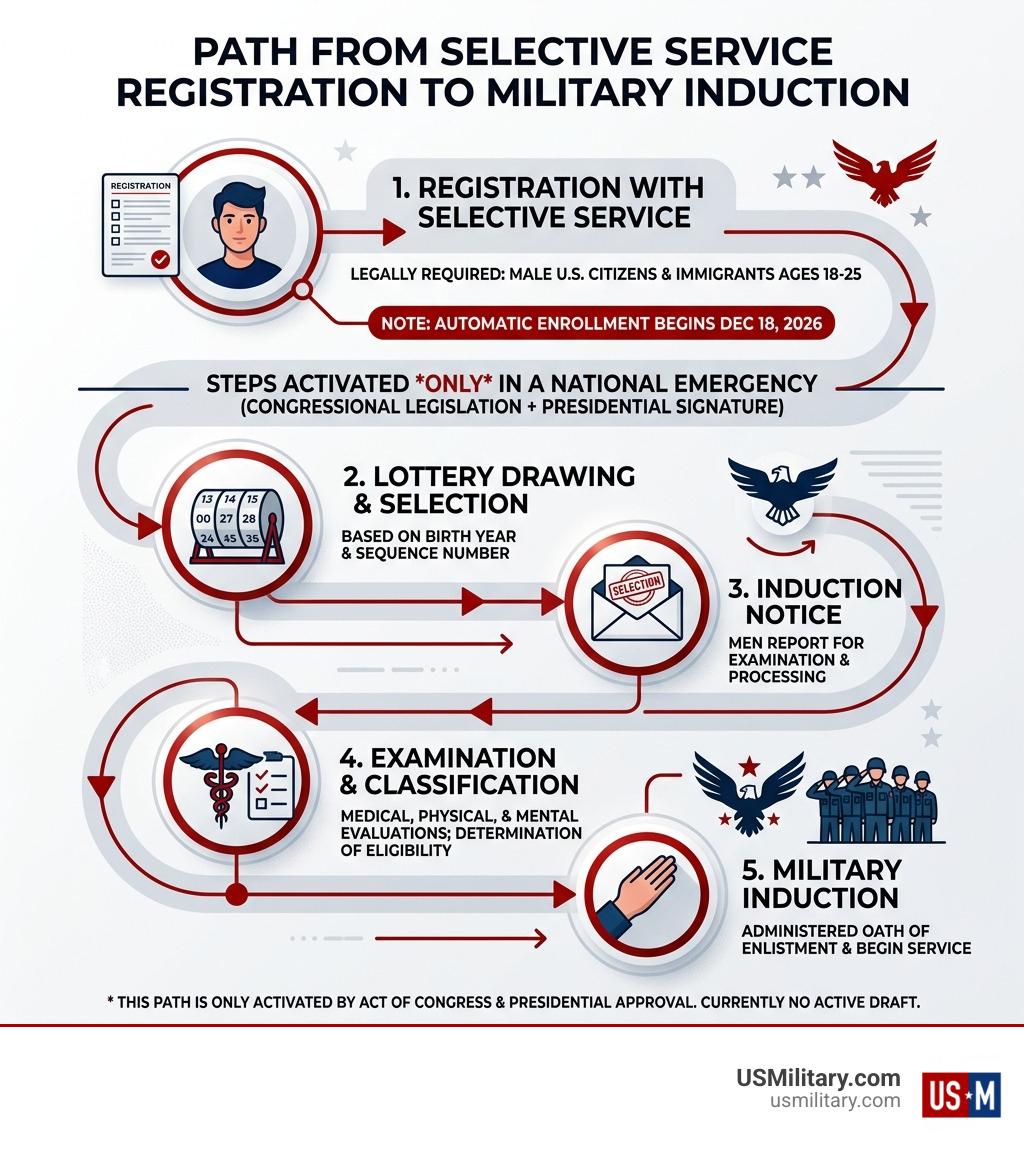
Military draft requirements terms to know:
Understanding the Selective Service System and Military Draft Requirements
The Selective Service System (SSS) is an independent agency of the United States government. Its primary purpose isn’t to run the military, but to maintain a database of names in case a national emergency requires a return to conscription. Think of it as a giant “insurance policy” for national defense.
While we have enjoyed an all-volunteer force for over half a century, the Military Selective Service Act remains the law of the land. This act mandates that the SSS be ready to provide manpower to the Department of Defense should the need arise. It is important to distinguish between “registration” and “induction.” Registration is simply giving the government your contact info; induction is the actual process of being drafted into service.
For more context on how we got here, you can explore the history of Conscription in the United States or read our deep dive into the Us Military Draft/. Currently, the system operates on a standby basis, with a small staff of civilians and over 2,000 local volunteer draft boards across the country ready to activate if called upon.
Registration Eligibility and the 2026 Automatic Registration Shift
The rules for who must follow military draft requirements are quite broad. Generally, almost all male U.S. citizens and male immigrants living in the U.S. who are between the ages of 18 and 25 are required to register. This includes:
- U.S. Citizens: Whether living in the States or abroad (dual nationals included).
- Immigrants: This includes green-card holders, refugees, and asylum seekers.
- Undocumented Residents: Even if an individual is in the country without legal documentation, they are still required to register.
- Territory Residents: Residents of Puerto Rico, Guam, the Virgin Islands, and the Northern Mariana Islands are included.
The current window for registration is within 30 days of your 18th birthday, though late registrations are accepted until you turn 26. You can find the full list of Who Needs to Register : Selective Service System on their official site.
The Massive Shift to Automatic Registration
By December 18, 2026, the way we handle registration will change forever. Following a mandate in the National Defense Authorization Act, the SSS will move to an automatic registration model.
| Feature | Manual Registration (Pre-Dec 2026) | Automatic Registration (Post-Dec 2026) |
|---|---|---|
| Responsibility | On the individual to sign up | On the government to enroll you |
| Data Sources | Online forms, post office cards, DMV | Federal data matching (SSN, DMV, etc.) |
| Compliance | Fluctuating (81% in 2024) | Expected near 100% |
| Notification | Acknowledgment card sent after | Confirmation of enrollment sent after |
This change aims to reduce the administrative burden and ensure that young men don’t accidentally ruin their future eligibility for federal benefits by forgetting to sign up. If you want to know more about the age brackets involved, check out The Draft Age Who Is Eligible For Military Conscription/. For the latest news on this implementation, see how Automatic military draft registration takes effect in December. Here’s … breaking down the timeline.
✉ Get updates like this in your inbox
Weekly VA benefit changes, pay updates, and money tips for service members, veterans, and military families. Free, no spam.
Impact of Gender Identity on Military Draft Requirements
Under current law, military draft requirements are determined by the sex assigned at birth. This means:
- Transgender Women: Individuals assigned male at birth who identify as female are still required to register.
- Transgender Men: Individuals assigned female at birth who identify as male are not required to register.
- Non-binary Individuals: Registration depends entirely on the sex marker assigned at birth.
While there is ongoing debate in Congress about expanding the draft to all genders, no such change has been enacted as of April 2026. For a more detailed look at how age and status intersect, see Beyond The Birthday Unpacking Military Enlistment Age Requirements/.
How a Modern Draft Lottery and Induction Process Works
If a national crisis occurred and the President and Congress authorized a draft, the process would move incredibly fast. The Selective Service System is required to deliver the first draftees within 193 days of authorization.
The heart of the process is a random birthdate lottery. Two air-mix machines are used: one containing 365 balls (one for each day of the year) and another containing numbers 1 through 365. If “January 1” and “Number 1” are drawn together, those born on New Year’s Day are the first to be called.
The Order of the Call:
- Age 20: Those in the calendar year they turn 20 are called first.
- Ages 21-25: Called in ascending order by year.
- Age 19: Called after the older groups.
- Age 18.5: The very last group to be touched.
Once your number is called, you receive an induction notice. This isn’t a ticket to the front lines immediately; it’s a ticket to a Military Entrance Processing Station (MEPS) for physical, mental, and moral evaluations. You can read the official Return to the Draft : Selective Service System guide for more details.
Classifications and Claims
During the induction process, you can file for different classifications. The most common ones include:
- 1-A: Available for unrestricted military service.
- 1-O: Conscientious Objector (opposed to all war; performs civilian alternative service).
- 1-A-O: Conscientious Objector (willing to serve in non-combatant roles like a medic).
- 4-F: Not qualified for military service (due to physical, mental, or moral reasons).
- 3-A: Hardship deferment (if your service would cause extreme hardship to dependents).
The Health Care Personnel Delivery System (HCPDS)
There is also a “Special Skills Draft” for medical professionals. This standby plan can draft doctors, nurses, and specialists up to age 54. Unlike the general draft, the HCPDS would likely include both men and women to ensure the military has the medical expertise needed during a massive conflict.
Legal Penalties for Ignoring Military Draft Requirements
Failing to register for the Selective Service is a serious matter. Until the automatic registration system is fully operational in late 2026, the burden is on you to comply.
The legal penalties for a “knowing and willful” failure to register include:
- A felony conviction.
- Fines up to $250,000.
- Up to 5 years in federal prison.
While actual prosecutions have been rare since the 1980s, the “collateral” penalties are what usually catch people. If you haven’t registered, you are ineligible for:
- Federal Student Aid: No Pell Grants or federal loans.
- Government Jobs: Most federal and many state/local government positions require proof of registration.
- U.S. Citizenship: Immigrant men who fail to register may find their path to naturalization blocked.
- Job Training: Programs like the Workforce Innovation and Opportunity Act (WIOA) are off-limits.
For more on these risks, read No Registration No Education The Penalties For Skipping Selective Service/.
Frequently Asked Questions about Military Draft Requirements
Is there a military draft in effect right now?
No. The United States has not used a draft since June 30, 1973, during the tail end of the Vietnam War. Since then, we have maintained an all-volunteer force. Registration is simply a preparedness measure. If you are curious about your current standing, you can use The Live Tracker For Your Current Draft Status/.
Who is exempt from registering for the draft?
Not everyone in the 18-25 age bracket has to sign up. Exemptions include:
- Women: Under current law, only those assigned male at birth must register.
- Active Duty Military: Men serving full-time in the Army, Navy, Air Force, Marines, or Coast Guard.
- Non-immigrant Visas: Those in the U.S. on valid student, visitor, or diplomatic visas.
- Incarcerated/Hospitalized: Those who are continuously confined or institutionalized from age 18 to 26.
Can I be drafted if I have a disability?
Yes and no. You are still required to register even if you have a disability that you believe would disqualify you from service. The Selective Service does not collect medical data during registration. However, if a draft were ever reinstated, you would be evaluated at MEPS. If your disability prevents you from meeting military standards, you would be classified as 4-F and would not be inducted. To learn more about age limits for various roles, check The Ultimate Guide To Military Enlistment Ages Are You Eligible/.
Conclusion
Understanding military draft requirements is a vital part of being an informed citizen or resident in the United States. While the prospect of a draft can feel intimidating, it remains a contingency plan for extreme national emergencies. The upcoming shift to automatic registration in December 2026 is designed to protect young men from the harsh penalties of non-compliance while ensuring our national defense system remains ready.
At USMilitary.com, we are dedicated to providing you with the most accurate, up-to-date information on everything from Us Military Draft/ history to modern-day benefits. Whether you are wondering Will I Be Drafted By The Military At Age 25/ or need help navigating VA loans, we are here to serve as your central hub for military guidance.
Stay informed, stay prepared, and remember that your registration is a small step that ensures the continued strength of our nation’s defense infrastructure. For a final overview, don’t miss our Ultimate Guide: What is the U.S. Military Draft?
Ready to learn more about your future in the military? Explore Military Careers and Benefits at USMilitary.com
Free for Service Members & Veterans
Get the military benefits intel no one tells you about.
Weekly updates on VA benefits, pay changes, and money tips — free for service members and veterans.
No spam. Unsubscribe anytime. Your info is never shared.


