Understanding Your Path to Naval Service
Requirements to join the Navy include being 17-41 years old, U.S. citizenship or permanent residency, a minimum ASVAB score of 31 (or 26 in some cases), passing a medical exam, and meeting physical fitness standards. Here’s a quick overview of the core requirements:
Basic Navy Enlistment Requirements:
- Age: 17-41 years old (17 requires parental consent)
- Citizenship: U.S. citizen or legal permanent resident with valid Green Card
- Education: High school diploma (or AFQT score of 50+ without diploma as of 2024)
- ASVAB Score: Minimum 31 (sometimes 26 permitted)
- Physical Fitness: Pass the Physical Readiness Test (60 points minimum)
- Medical: Meet common enrolment medical standards
- Character: Pass background check and meet moral standards
The U.S. Navy recently updated several requirements to make enlistment more accessible. In fall 2022, the age limit increased from 39 to 41, and in January 2024, the service dropped the high school diploma requirement for applicants scoring 50 or higher on the Armed Forces Qualification Test. More than 340,000 active-duty men and women currently serve across 150+ different Navy careers, from surface ships and submarines to electronics, engineering, and special operations.
Whether you’re considering enlisted service or an officer commission, understanding these requirements helps you determine your eligibility before contacting a recruiter. The path differs significantly between enlisted sailors (who make up about 83% of the Navy) and officers (about 17%), with officers requiring at minimum a college degree and completing specialized training programs.
I’m Larry Fowler, publisher of the USMilitary.com Network, and since 2007 I’ve helped millions of Americans understand Requirements to join the Navy and other military branches through our comprehensive resources for active-duty personnel and veterans. Below, I’ll walk you through seven specific ways to verify you meet the standards for Navy service.
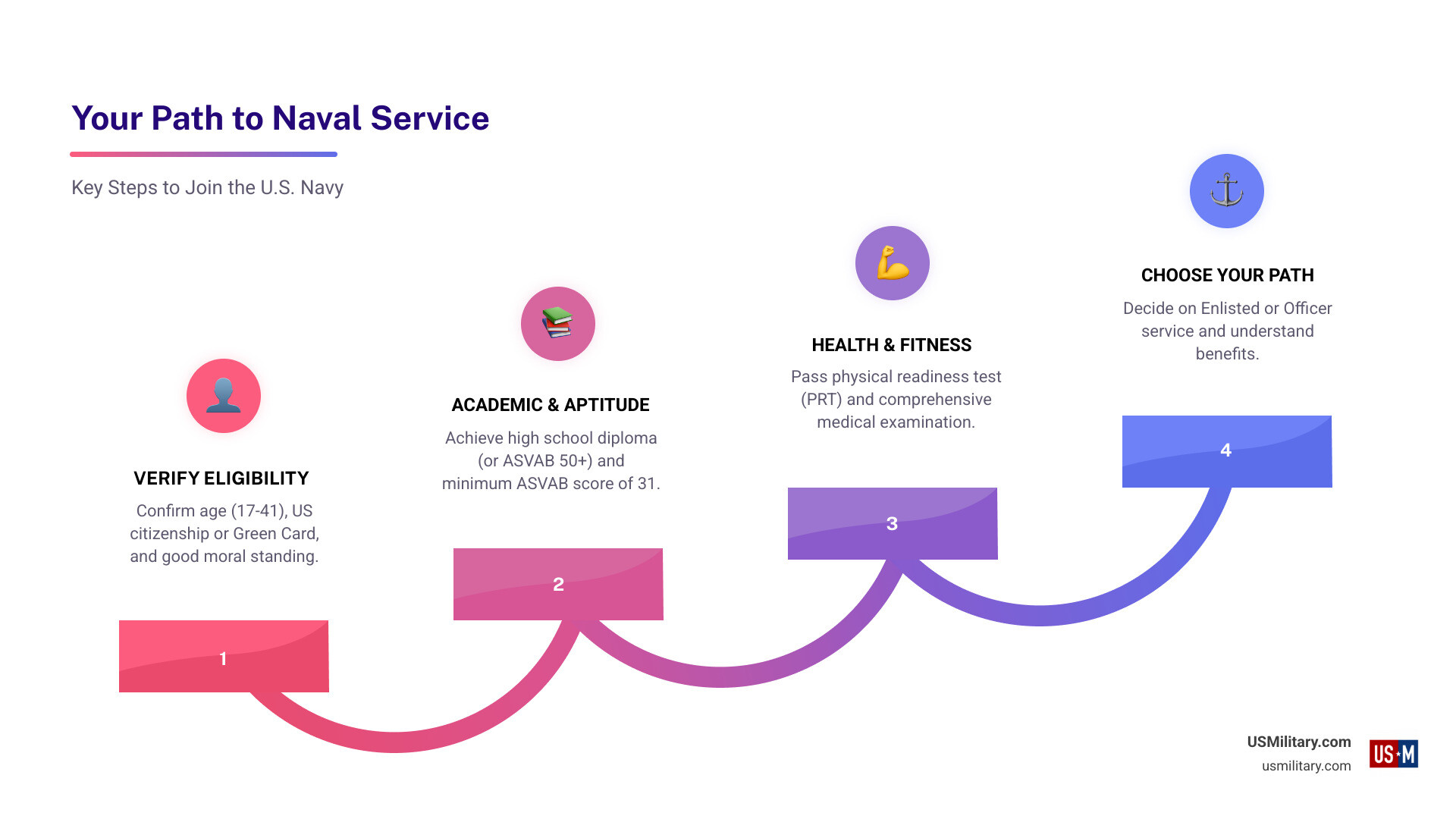
Basic Requirements to join the Navy vocab:
Core Eligibility and Personal Standards
Before you even think about boot camp or what kind of ship you’ll serve on, the Navy needs to know who you are and if you’re legally and personally prepared for military life. These fundamental checks ensure that every recruit can uphold the values and responsibilities that come with serving our nation. It’s not just about what you can do, but also about who you are.

When we talk about the basic Requirements to join the Navy, we’re looking at foundational elements like your age, your citizenship status, and your moral character. These aren’t just checkboxes; they’re critical indicators of your commitment and eligibility. For a comprehensive guide on all requirements, you can visit our Requirements to Join page.
Way 1: Verify Your Age and Citizenship
First things first: let’s talk about age. The U.S. Navy has specific age limits for enlistment, and thankfully, they’ve become a bit more flexible recently. As of fall 2022, the age limit for joining the Navy was raised to 41 from 39. So, if you’re between 17 and 41 years old, you’re generally within the acceptable range for enlisted service. However, if you’re 17, we’ll need parental consent. Officer programs often have different age requirements, usually requiring you to be at least 19, with variations depending on the specific program (like the Naval Academy or Officer Candidate School).
Next up is citizenship and residency. To join the U.S. Navy, you must be a U.S. citizen or a legal permanent resident with a valid Green Card. For officer roles, U.S. citizenship is a firm requirement. This ensures that those serving our country have a fundamental loyalty and connection to the United States.
When you begin the application process, you’ll need to provide documentation to prove your age and citizenship. Here’s a general list of identification documents you might need:
- Birth Certificate: To verify your age and place of birth.
- Social Security Card: For identification and administrative purposes.
- Driver’s License or State ID: For photo identification.
- U.S. Passport: If you have one, it can serve as proof of citizenship and identity.
- Permanent Resident Card (Green Card): If you are a legal permanent resident.
- High School Diploma or GED: To verify educational attainment (we’ll dive deeper into this soon!).
Ensuring these basic requirements are met is your first step toward serving in the Navy.
Way 2: Review Your Moral Standing and Character
The Navy isn’t just looking for physical and mental strength; it’s looking for individuals of strong moral character. This means a thorough background check is part of the process, and certain aspects of your past could be disqualifying. However, not all past mistakes are deal-breakers.
The Navy operates on core values: Honor, Courage, and Commitment. We expect our service members to embody these principles. Things that might raise a red flag include:
- Felony Convictions: Generally, felons cannot join the Navy. However, moral waivers or felony waivers are available in some cases. The waiver procedure isn’t automatic; approval is based on each individual case, and we encourage you to discuss your specific situation with a recruiter.
- Misdemeanors: While less severe, a pattern of misdemeanors can also be an issue. For instance, five or more misdemeanors can lead to disqualification.
- Drug and Alcohol Abuse: The Navy has a zero-tolerance policy for drug use and alcohol abuse. Inability to pass a drug/alcohol test or pending charges will disqualify you. Multiple DUI convictions can also be a significant hurdle; three or more convictions related to driving while intoxicated, drugged, or impaired in the past five years are typically disqualifying.
- Other Serious Offenses: Certain offenses are generally not waivable. These include being under judicial restraint, multiple serious civil court convictions, trafficking narcotics, certain serious sexual offenses requiring registration, previous separation from the military under less-than-honorable conditions, or an unfavorable final determination on a security clearance investigation.
If you have concerns about your moral standing or character, don’t let that deter you from exploring your options. Waivers exist for many character-related disqualifications and are reviewed on a case-by-case basis. The best practice is always to be honest and upfront with your recruiter about your history. They can help you understand if a waiver is possible and guide you through the process.
Academic and Mental Qualifications
Serving in the Navy requires not just physical prowess but also a sharp mind. Our sailors operate complex machinery, make critical decisions under pressure, and learn specialized skills. That’s why academic achievement and mental aptitude are key Requirements to join the Navy. We want to ensure you have the foundational knowledge and the capacity to learn and adapt.
The primary tool we use to assess mental aptitude and guide career placement is the Armed Services Vocational Aptitude Battery (ASVAB) test. This isn’t just about passing; it’s about understanding where your strengths lie so we can place you in a Navy job where you’ll thrive. If you’re looking to prepare, check out our Practice Test Resource.
Way 3: Educational Requirements to Join the Navy
Historically, a high school diploma or a GED certificate was a non-negotiable requirement for Navy enlistment. While a high school diploma remains the preferred standard, the Navy has recently made some adjustments to expand opportunities.
As of January 2024, the service announced that applicants with Armed Forces Qualification Test (AFQT) scores of 50 or higher who do not have a diploma can still enlist. This is a significant change, offering a pathway for individuals who might not have completed high school but demonstrate strong aptitude. For those with a GED, acceptance is possible, though a high school diploma is generally favored.
If you’ve pursued higher education, that’s a plus! College credits or a degree can open doors to different programs, particularly officer pathways. For example, the Naval Reserve Officers’ Training Corps (NROTC) helps pay for tuition and other expenses for recruits who attend college. Other options under the GI Bill help sailors with a wide variety of career training, and the Navy offers a Tuition Assistance program for active-duty and Reserve members.
In summary, while a high school diploma is ideal, demonstrate a strong mental aptitude on the ASVAB, and you might still be eligible!
Way 4: Achieve the Minimum Required Test Score
The ASVAB is a multiple-aptitude test that measures your developed abilities and helps predict future academic and occupational success. It’s composed of several subtests, and your scores on these determine your eligibility for enlistment and which Navy jobs (known as Navy Enlisted Classifications, or NECs) you qualify for.
✉ Get updates like this in your inbox
Weekly VA benefit changes, pay updates, and money tips for service members, veterans, and military families. Free, no spam.
For enlistment into the Navy, you must get a minimum ASVAB score of 31. However, in some cases, a score of 26 is permitted, often depending on other factors like educational attainment or specific job needs. The Armed Forces Qualification Test (AFQT) score, which is derived from sections of the ASVAB, is the primary score used to determine if you meet the minimum entry requirements for military service. As mentioned, an AFQT score of 50 or higher can even waive the high school diploma requirement.
The Navy offers more than 150 different jobs in a wide variety of fields. Your ASVAB scores play a crucial role in determining which of these career specialties you’re eligible for. High scores can open up more technical or specialized roles, while lower scores might limit your options to more general ratings.
Here’s a glimpse at some high-demand Navy career fields that often require specific ASVAB line scores, encompassing diverse interests and skills:
- Aviation: Pilots, aircrew, aviation mechanics, air traffic controllers.
- Information Warfare: Cyber warfare specialists, intelligence analysts, cryptologic technicians.
- Medical: Hospital corpsmen, dental technicians, medical researchers.
- Nuclear: Nuclear power plant operators, electricians, mechanics for nuclear submarines and aircraft carriers.
- Security: Master-at-arms (military police), security forces.
- Special Operations: Navy SEALs, Special Warfare Combatant-craft Crewmen (SWCC).
- Submarine: Sonar technicians, navigators, missile technicians.
Preparing for the ASVAB is crucial. It not only helps you meet the minimum score but also maximizes your opportunities for a fulfilling career in the Navy.
Physical Readiness and Medical Health
The Navy is a physically demanding environment, whether you’re serving on a ship, submarine, or on land. Your physical readiness and overall medical health are paramount to your ability to perform your duties effectively and safely. That’s why these are non-negotiable Requirements to join the Navy. We need to ensure you’re fit for the challenges ahead.
Before you can even think about shipping off to boot camp, you’ll undergo a comprehensive entrance medical exam at a Military Entrance Processing Station (MEPS). This isn’t just a quick check-up; it’s a thorough evaluation to ensure you meet the rigorous physical and mental health standards required for military service.
Way 5: Pass the Physical Readiness Test (PRT)
Physical fitness is foundational to Navy life. You’ll begin building your physical endurance and strength from day one of boot camp, formally known as Recruit Training Command. This intense program lasts about 10 weeks and culminates in the Physical Readiness Test (PRT).
To pass the PRT, recruits must earn an overall score of 60 points. The test typically consists of three components: push-ups, sit-ups, and a 1.5-mile run. The standards vary by age and gender to ensure fairness and account for natural physiological differences.
Let’s look at the minimum requirements to pass the PRT at boot camp for young recruits:
| Age Group | Gender | Sit-ups (2 min) | Push-ups (2 min) | 1.5-mile Run |
|---|---|---|---|---|
| 17-19 | Men | 50 | 42 | 12:30 |
| 17-19 | Women | 50 | 19 | 15:30 |
These are just minimums, and we encourage everyone to strive for excellence. Being in top physical shape before you arrive at boot camp will make the transition smoother and help you excel. This isn’t just about passing a test; it’s about building the resilience and strength you’ll need throughout your naval career.
Way 6: Medical Requirements to Join the Navy
Your medical history and current health status are thoroughly evaluated during the MEPS medical exam. This is where we check for any conditions that could prevent you from safely performing military duties or that might worsen under the stress of service.
Medical waivers are available for many conditions, but they are reviewed on a case-by-case basis. Common medical conditions that might require a waiver or could be disqualifying include:
- Asthma: Asthma could potentially prevent you from joining if you were diagnosed with it after your 13th birthday. However, you can still request an asthma waiver if a doctor denies your application, especially if you can prove it’s well-managed and doesn’t impact your physical performance.
- ADHD: Potentially. It will only prevent you from joining the Navy if you’ve been treated with ADD/ADHD medication within the last year, or if you display obvious signs of the condition. Many individuals with this history successfully obtain medical waivers. Cases are looked at on a case-by-case basis.
- Vision and Hearing Standards: Specific standards for vision and hearing are in place. Poor vision or hearing could be disqualifying, but like asthma, waivers can be requested if a medical professional determines your condition is stable and correctable to meet service requirements.
- Height and Weight Requirements: The Navy has specific height and weight requirements based on your height and gender. These are designed to ensure you can fit into uniforms and equipment, and maintain physical fitness. For instance, a 5’9″ man can weigh no more than 186 pounds. If you exceed these limits, you might be required to meet body fat percentage standards.
It’s crucial to be honest about your medical history during the exam. Any attempt to conceal a condition could lead to disqualification or even more serious consequences down the line. If you have a specific medical condition and are unsure if it disqualifies you, connect with a recruiter. They are your best resource for understanding the waiver process and navigating these complex requirements. If a waiver is denied, pursuing a civilian career within the Navy is also an option.
Professional Path and Benefits
Joining the Navy isn’t just about meeting requirements; it’s about choosing a professional path and understanding the incredible benefits that come with serving our country. Whether you aspire to be an enlisted sailor, the backbone of our fleet, or a commissioned officer, a leader and decision-maker, the Navy offers diverse opportunities for growth, education, and a rewarding career.
Way 7: Choose Your Service Path and Evaluate Benefits
The Navy offers two main professional paths: enlisted personnel and officers. Understanding the differences is key to deciding which path is right for you.
- Enlisted Personnel: Making up about 83% of the Navy, enlisted sailors perform the hands-on work. This path typically requires a high school diploma (or the new AFQT score equivalent) and involves specialized training in one of over 150 Navy jobs.
- Officers: Officers, comprising about 17% of the Navy, are the leaders and managers. This path almost always requires a college degree at minimum, often followed by specialized training through programs like Officer Candidate School (OCS), the U.S. Naval Academy, or Naval Reserve Officers’ Training Corps (NROTC). Direct commissioning is also available for those with specific professional degrees (e.g., medical, legal).
You also have the option to join the Navy Reserve. The Navy Reserve age limit is between 18 and 35 without prior service, and it allows you to serve part-time while maintaining a civilian career, with opportunities for full-time assignments and deployments.
Beyond the sense of purpose and adventure, the Navy offers a robust package of benefits that support you and your family:
- Money and Pay: Newly enlisted sailors usually start out at the E-1 pay grade, earning about $23,000 in 2023. This pay increases with rank and time in service. You’ll also receive housing allowances, food allowances, and other forms of compensation.
- Bonuses: The Navy offers various enlistment bonuses for individuals who commit to certain high-demand jobs, possess advanced skills, or meet specific criteria. These can significantly boost your initial earnings.
- Education: This is a huge perk! The Navy provides extensive educational opportunities, including:
- GI Bill: Helps pay for college, graduate school, and vocational training.
- Tuition Assistance: Provides financial aid for active-duty and Reserve personnel to take college courses while serving.
- NROTC: Offers scholarships and financial support for college students aspiring to be officers.
- Credentialing Opportunities On-Line (COOL) program: Helps sailors obtain certifications and licenses related to their military occupation and civilian careers, making the transition to civilian life smoother.
- Skills and Training: With 251 Naval Education and Training Command (NETC) sites, the Navy provides world-class training that translates directly into valuable civilian skills. You’ll gain expertise in fields like aviation, engineering, IT, and healthcare.
- Health Care: Comprehensive health care benefits are provided for service members and their families through TRICARE.
- Other Benefits: These include travel opportunities, access to commissaries and exchanges, recreational facilities, and a generous retirement plan after 20 years of service.
Choosing to serve is a significant decision, and the Navy strives to make it a rewarding one. For More info about Navy benefits, we encourage you to explore our dedicated resources.
Frequently Asked Questions about Requirements to Join the Navy
We know you might have specific questions as you consider a career in the Navy. Here are some of the most common inquiries we receive:
What is the maximum age to join the Navy?
For enlisted personnel, the Navy age limit was raised to 41 from 39 in the fall of 2022. So, if you’re between 17 and 41, you’re generally eligible for enlisted service. If you’re 17, you’ll need parental consent. Officer programs typically have different age requirements, often requiring applicants to be at least 19 years old, with specific upper limits varying by program (e.g., Naval Academy, OCS, direct commissioning). For the Navy Reserve, the age limit is between 18 and 35 without prior service, with different limits for those with previous military experience.
Can I join the Navy with a GED or no diploma?
While a high school diploma is generally preferred, it’s not always a hard requirement. In some instances, GED certificates can be accepted. Furthermore, the Navy recently updated its policy in January 2024, announcing that applicants with an Armed Forces Qualification Test (AFQT) score of 50 or higher can enlist even if they do not have a high school diploma. This means a strong performance on the ASVAB can open doors even without a traditional diploma.
What medical conditions are disqualifying for Navy service?
Many medical conditions can be disqualifying, but often, waivers are available and reviewed on a case-by-case basis. Some common conditions that could be disqualifying include:
- Asthma: If diagnosed after your 13th birthday, it could be a disqualifier, but an asthma waiver can be requested.
- ADHD: It might prevent you from joining if you’ve been treated with medication within the last year or if you display obvious signs of the condition. However, many individuals with this history successfully obtain medical waivers.
- Vision and Hearing: Specific standards apply, and significant impairments might require a waiver.
- Chronic Conditions: Any chronic illness requiring ongoing treatment or medication that could impact your ability to perform duties or deploy.
- Mental Health Conditions: A history of certain mental health conditions might be disqualifying, especially if they’ve required recent treatment or medications.
It’s important to discuss your complete medical history with a Navy recruiter and the medical professionals at MEPS. They can provide guidance on your specific situation and the waiver process if applicable.
Conclusion
Navigating the Requirements to join the Navy can seem like a complex journey, but with the right information and guidance, it’s entirely achievable. We’ve walked through the seven key areas you need to verify: your age and citizenship, moral standing, educational background, ASVAB scores, physical fitness, and medical health, along with choosing your service path and understanding the benefits.
At USMilitary.com, we’re dedicated to providing comprehensive resources to help you every step of the way. We encourage you to connect with a Navy recruiter, who can offer personalized advice, help you understand specific waiver possibilities, and guide you through the application process. Your journey to a rewarding career in the U.S. Navy begins with understanding these crucial steps.
Ready to take the next step? Explore more about the age limit to join military and other critical information on our site. We’re here to help you plan your military career and make an informed decision about serving our nation.
Free for Service Members & Veterans
Get the military benefits intel no one tells you about.
Weekly updates on VA benefits, pay changes, and money tips — free for service members and veterans.
No spam. Unsubscribe anytime. Your info is never shared.


