One of the Biggest Decisions in Military Life: On Base or Off Base?

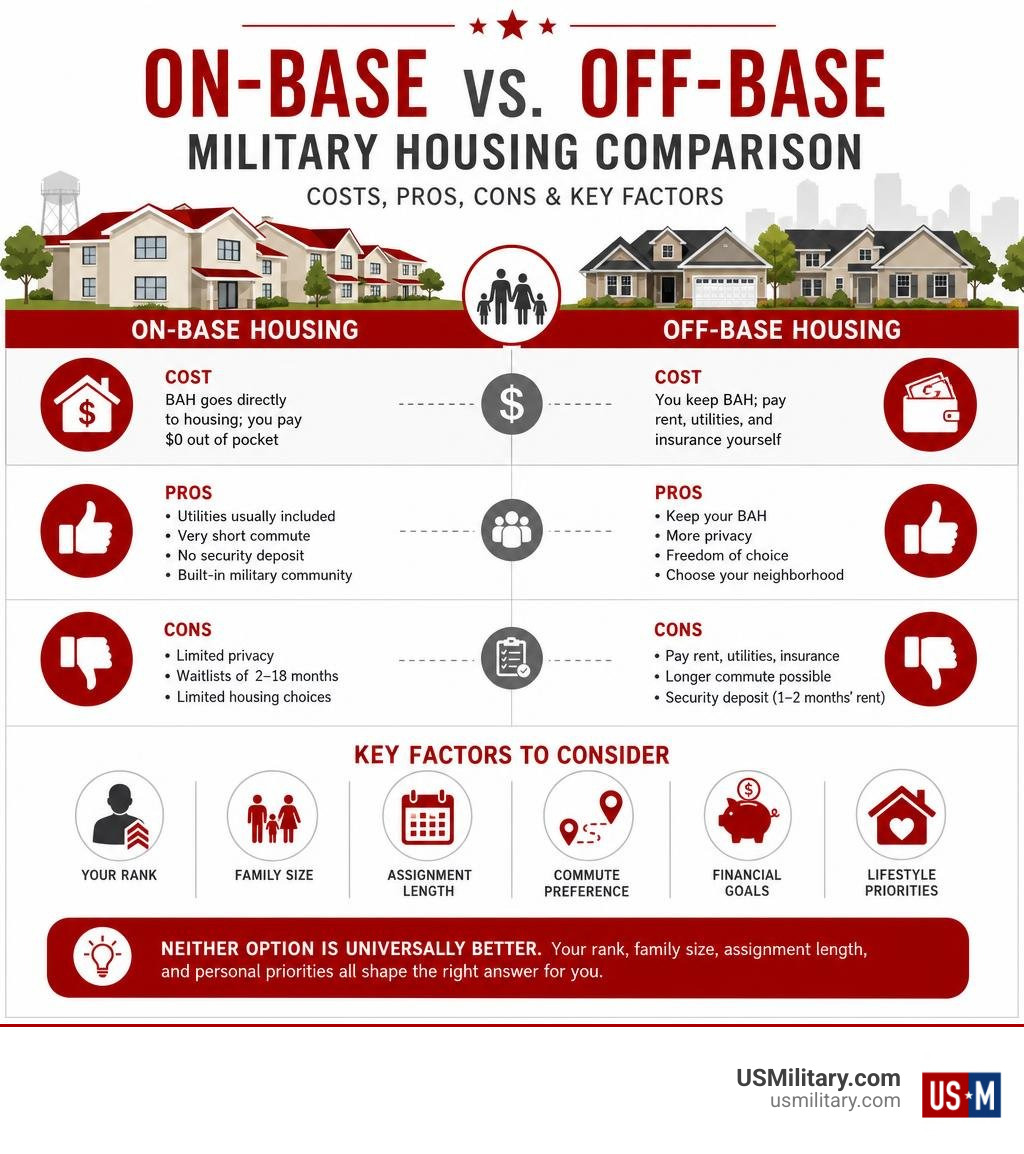
The choice between on base housing vs off base housing for military families is one of the first — and most important — decisions you’ll face after receiving PCS orders. Here’s a quick breakdown to answer the core question right away:
| Factor | On-Base Housing | Off-Base Housing |
|---|---|---|
| Cost | BAH goes directly to housing; you pay $0 out of pocket | You keep BAH; pay rent, utilities, and insurance yourself |
| Utilities | Usually included | Typically $150-$400/month extra |
| Privacy | Limited | Much more |
| Commute | Very short | Varies; can be 20-50+ minutes |
| Availability | Waitlists of 2-18 months | Available immediately |
| Freedom of choice | Limited to what’s assigned | Wide variety of homes and neighborhoods |
| Security deposit | None | Usually 1-2 months’ rent |
| Community | Built-in military community | Civilian neighborhood |
The short answer: About two-thirds of military families choose to live off-base. On-base housing is convenient and low-hassle, but you forfeit your entire BAH for it. Off-base living lets you potentially pocket the difference between your BAH and your actual rent — but comes with more responsibility.
Neither option is universally better. Your rank, family size, assignment length, and personal priorities all shape the right answer for you.
I’m Larry Fowler, publisher of the USMilitary.com Network since 2007 and a long-time resource for active-duty members and veterans navigating decisions exactly like on base housing vs off base housing for military life. Having connected hundreds of thousands of service members with the information they need, I’ve seen how much this one housing choice can affect both financial health and quality of life.
Understanding Your Options: On Base Housing vs Off Base Housing for Military
When we receive Permanent Change of Station (PCS) orders, the scramble to figure out where we will lay our heads begins. The military offers structured options on installation grounds, but we also have the freedom to venture out into the local economy.
Navigating these choices requires understanding the core differences between living on a military installation and finding a place in town. If you are trying to locate installations near your next duty station, checking Military Bases Near Me is a great starting point to map out the surrounding geography.
Types of On-Base Housing
On-base housing generally falls into three main categories:
- Privatized Military Housing: Under the Military Housing Privatization Initiative (MHPI) established in 1996, 99% of military family housing in the continental U.S. is built, owned, and managed by private companies. Private developers build and maintain these communities, but they operate on military land.
- Government-Owned Housing: Primarily found overseas, this housing is owned and directly managed by the Department of Defense (DoD).
- Single or Unaccompanied Housing (Barracks/Dorms): Often called barracks, dorms, or bachelor quarters, these are rent-free accommodations typically reserved for junior enlisted and unmarried service members. They may feature shared rooms or common bathrooms.
To dive deeper into how these structural programs are organized, you can read more about Understanding Military Housing for Service Members.
Types of Off-Base Housing
Venturing outside the gates opens up the civilian real estate market, offering options we can customize to our lifestyles:
- Rental Homes and Apartments: Renting an apartment, townhouse, or single-family home from a civilian landlord is the most common off-base choice.
- Homeownership: For service members staying at a duty station for three or more years, buying a home off-base is a popular wealth-building strategy. Using a 0% down VA home loan allows us to build equity rather than losing our housing allowance entirely to rent.
Financial Breakdown: BAH, Utilities, and Out-of-Pocket Costs
The financial math of on base housing vs off base housing for military comes down to how we utilize our Basic Allowance for Housing (BAH). BAH is a tax-free monthly allowance designed to offset housing costs, calculated based on our rank, geographic duty location, and whether we have dependents.
How BAH Works for On Base Housing vs Off Base Housing for Military
The way BAH is paid differs dramatically depending on where we live:
- On-Base Housing: We forfeit our entire BAH. The military housing office or the private management company receives our full BAH directly from our pay. It feels “free” because nothing comes out of our bank account, but we never actually see that money.
- Off-Base Housing: The military deposits our full BAH directly into our bank account. We are responsible for paying our rent or mortgage, utilities, and renter’s insurance out of this sum. If we find a home that costs less than our BAH, we get to keep and pocket the difference.
For a comprehensive guide on how these rates are calculated and protected, check out Basic Allowance for Housing (BAH) Explained.
To see how this works in practice, let’s look at the financial math of an E-5 with dependents stationed in a medium-to-high cost-of-living area:
| Monthly Expense Category | On-Base Housing (Forfeits BAH) | Off-Base Rental (BAH: $2,800) | Off-Base Purchase (BAH: $2,800) |
|---|---|---|---|
| Rent / Mortgage (P&I) | $2,800 (Full BAH Forfeited) | $2,100 | $2,250 |
| Utilities (Power, Water, Gas) | $0 (Included/Capped) | $250 | $300 |
| Renter’s / Home Insurance | $0 (Included) | $20 | $120 (Homeowners) |
| Maintenance & Repairs | $0 (Covered by base) | $0 (Covered by landlord) | $150 (Set aside) |
| Monthly Out-of-Pocket | $0 | $2,370 | $2,820 |
| Net Monthly Savings/Equity | $0 | +$430 (Pocketed) | +$300+ (Equity paydown) |
As we can see, living off-base can yield substantial monthly savings if we rent below our allowance, or build long-term wealth if we buy. For more details on budgeting strategies, explore Living On-Base vs. Off-Base: How Does Military Housing Work?.
Hidden Costs of Living Off-Base
While pocketing extra BAH sounds fantastic, we must budget for several hidden costs that are automatically covered when living on-base:
- Security Deposits: Landlords typically require first month’s rent, last month’s rent, and a security deposit upfront, which can add up to thousands of dollars in high-cost areas.
- Unpredictable Utility Bills: Off-base utilities average $200 to $400 monthly. Extreme summer heat or winter freezes can cause these bills to skyrocket. On-base housing typically includes utilities, though some privatized communities use a Resident Utility Allocation system that charges residents if they exceed average baseline usage.
- Renter’s Insurance: While inexpensive—averaging $15 to $30 per month for $30,000 in property coverage and $100,000 in liability coverage—it is an extra expense we must pay ourselves.
- Commute Expenses: Driving 20 to 45 minutes to base every day adds wear and tear to our vehicles and increases our monthly fuel budget significantly.

✉ Get updates like this in your inbox
Weekly VA benefit changes, pay updates, and money tips for service members, veterans, and military families. Free, no spam.
Pros and Cons of Living On-Base
Living on a military installation is a unique experience that offers unparalleled convenience, but it also comes with distinct tradeoffs.
The Benefits of On-Base Living
- Unmatched Convenience: Our commute to physical training (PT), work, the commissary, and the exchange is usually under 10 minutes.
- Built-In Support Network: Living surrounded by other military families means our neighbors understand the challenges of deployments, temporary duty assignments (TDYs), and military life. This is one of the major Benefits Being Military Spouse families point to when dealing with long periods of separation.
- Predictable Expenses: With utilities, maintenance, and trash pickup included, we never have to worry about a surprise $400 heating bill in the winter.
- Enhanced Security: Gated access, military police patrols, and a lower speed limit make base neighborhoods exceptionally safe places for children to play.
The Drawbacks of On-Base Living
- Quality Concerns: In a survey of 16,900 military members, 55% said they were not satisfied with their on-base housing, and only 16% said they were satisfied. Issues like dated construction, mold, and slow maintenance response from private management companies have been widely documented. The DoD found that service members who live in high-quality housing are 15% more likely to stay in the military than those in lower-quality, on-base housing.
- Lack of Privacy: We live, work, and play with the same people. If our neighbor is also our supervisor, separating our personal life from our professional life can be incredibly difficult.
- Long Waitlists: Depending on the base, rank, and bedroom requirements, waitlists can range from 2 to 14+ months, forcing families to find temporary lodging or rent off-base anyway.
To evaluate official resources and support programs designed for on-installation living, you can review the official On- and Off-Base Housing & Living guide.
Pros and Cons of Living Off-Base
Living off-base offers a chance to step away from the military environment and integrate into the local civilian community.
Why Choose Off-Base Housing?
- Freedom of Choice: We get to choose our home’s layout, yard size, and neighborhood vibe. We aren’t restricted to a handful of floor plans assigned to us based on our rank.
- Separation of Work and Life: When we drive through the base gates at the end of the day, we can truly decompress and leave work behind.
- Wealth Building: Buying a home off-base allows us to build equity. Over a three-to-four-year tour, principal paydown and home appreciation can net us thousands of dollars in equity that we can cash out or leverage as a rental property when we PCS.
- Access to Top School Districts: If on-base schools aren’t highly rated, living off-base allows us to target specific premier school zones. You can check out some of the Best Cities for Military Families to see which areas offer the best community and educational resources.
For a deeper dive into these lifestyle trade-offs, read Military Housing: The Pros & Cons of Living On & Off-Base.
Challenges of Off-Base Living
- Commuting and Traffic: Depending on where we live, we might face long, stressful commutes, especially during morning gate rushes.
- Landlord and Maintenance Issues: If a pipe bursts or the air conditioning fails, we are at the mercy of a civilian landlord’s timeline or must handle the repairs ourselves if we own the home.
- Financial Risk: If we choose a home that stretches our budget, high utility bills or unexpected repairs can quickly put us in a financial bind.
Key Decision Factors for Military Families
Every family’s housing decision is unique, and what works for a single junior enlisted soldier will not work for an officer with four children.
Evaluating On Base Housing vs Off Base Housing for Military with Families
When deciding on a home, several family-specific factors must take priority:
- School Zones and Child Care: On-base child development centers (CDCs) are highly convenient but often have long waitlists. Off-base neighborhoods may offer better public school options or specialized private schools.
- Exceptional Family Member Program (EFMP): Families enrolled in EFMP often prefer on-base housing because it places them closer to base medical clinics, specialists, and support services.
- Pet Policies: On-base housing has strict rules, including breed restrictions (often banning Pit Bulls, Rottweilers, and Dobermans) and limits on the number of pets (usually capped at two). Off-base rentals may also have pet restrictions, but homeownership gives us complete freedom.
If you are managing these transitions, our Military Spouse Benefits Complete Guide provides excellent resources on schooling, employment, and family support systems.
Legal Protections and Renters Insurance
If we choose to live off-base, we must protect ourselves legally and financially:
- The Servicemembers Civil Relief Act (SCRA): This federal law protects us by allowing us to break a residential lease without penalty if we receive PCS orders or deploy for 90 days or more.
- The Military Clause: Always ensure your lease agreement explicitly includes a military clause. Have the installation’s legal assistance office (JAG) review your lease before signing to avoid any loopholes.
- Renters Insurance: Do not skip this. For $15 to $30 a month, a standard policy covers our personal belongings during a military move, provides liability protection, and even covers temporary living expenses if our rental becomes uninhabitable.
PCS Move
PCSing? You May Be Able to Buy Instead of Rent
Eligible service members can use a VA loan to buy near their next duty station with no down payment. See if you qualify.
USMilitary.com may be compensated when you request quotes from lenders through this link.
Frequently Asked Questions about Military Housing
Can you save money by living off-base?
Yes. If we find a rental or buy a home where the mortgage, utilities, and insurance total less than our monthly BAH, we keep the difference tax-free. Many service members save between $200 and $800 a month by choosing roommates, living slightly further from base, or opting for smaller homes.
How long are the waitlists for on-base housing?
Wait times vary by installation, rank, and the number of bedrooms required. On average, waitlists for a 3-bedroom home run 4 to 9 months, while 4-bedroom homes can take 6 to 14+ months. Peak PCS season (May through August) always causes wait times to spike.
Does BAH cover renters insurance?
No. While BAH is designed to offset the cost of rent, utilities, and insurance, it is paid as a lump sum. We must purchase and pay for our own renters insurance policy out-of-pocket if we live off-base.
Conclusion
The choice between on base housing vs off base housing for military service members ultimately comes down to what you value most during this season of your career. If you prioritize a zero-stress commute, a built-in support system, and predictable monthly expenses, on-base housing is an excellent choice. If you prefer personal privacy, neighborhood variety, and the opportunity to build wealth or pocket extra cash, off-base living is the clear winner.
Before making your final decision, contact your new installation’s housing office, connect with local military spouse groups online, and consult with a personal financial counselor on base.
To explore housing options, base guides, and VA loan resources for your next move, visit USMilitary.com or check our comprehensive directory of Military Bases in the US to start planning your transition today.
Free for Service Members & Veterans
Get the military benefits intel no one tells you about.
Weekly updates on VA benefits, pay changes, and money tips — free for service members and veterans.
No spam. Unsubscribe anytime. Your info is never shared.


