What Is BAH and How Does It Work? A Quick Answer For Men & Women In Uniform and Veterans!
 BAH explained: rates, eligibility, and how it’s calculated in plain terms — Basic Allowance for Housing (BAH) is a tax-free monthly payment the Department of Defense gives eligible service members to help cover civilian housing costs when government quarters aren’t provided.
Here’s the quick version:
| Factor | What It Means |
|---|---|
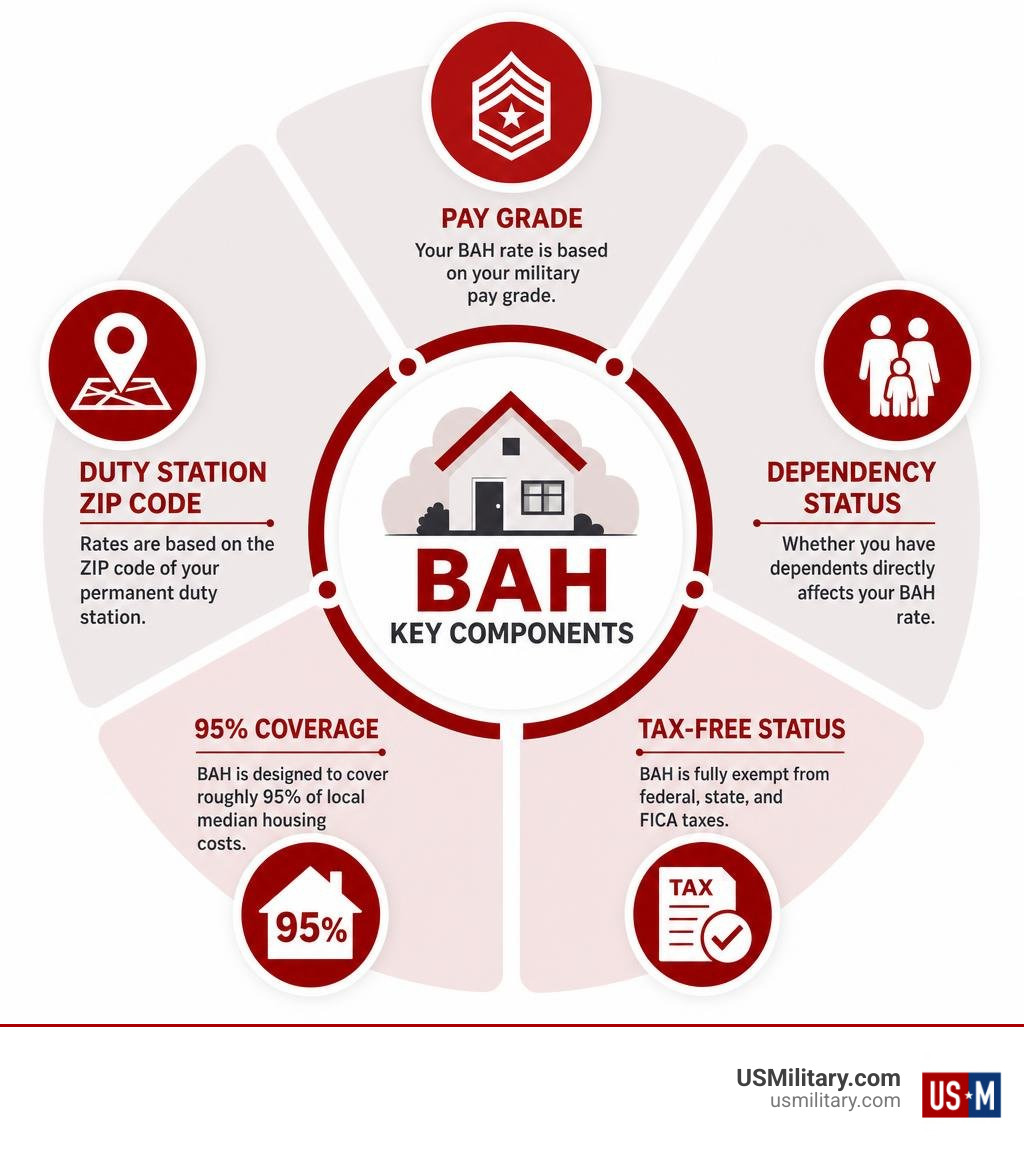
| Who qualifies | Active duty service members at a permanent U.S. duty station without adequate government housing |
| How much you get | Based on your pay grade, duty station ZIP code, and whether you have dependents |
| How often it updates | Annually on January 1 — rates increased an average of 4.2% in 2026 |
| Is it taxable? | No — BAH is fully exempt from federal, state, and FICA taxes |
| Does it cover everything? | Designed to cover roughly 95% of local median housing costs |
 BAH Explained: Rates, Eligibility & How It’s Calculated vocab explained:
BAH Eligibility, Types, and Core Rules
Understanding who qualifies for the housing allowance and which rules govern its distribution is the first step to maximizing this benefit. The program was established to replace the older Basic Allowance for Quarters (BAQ) and ensure equitable housing compensation across the United States.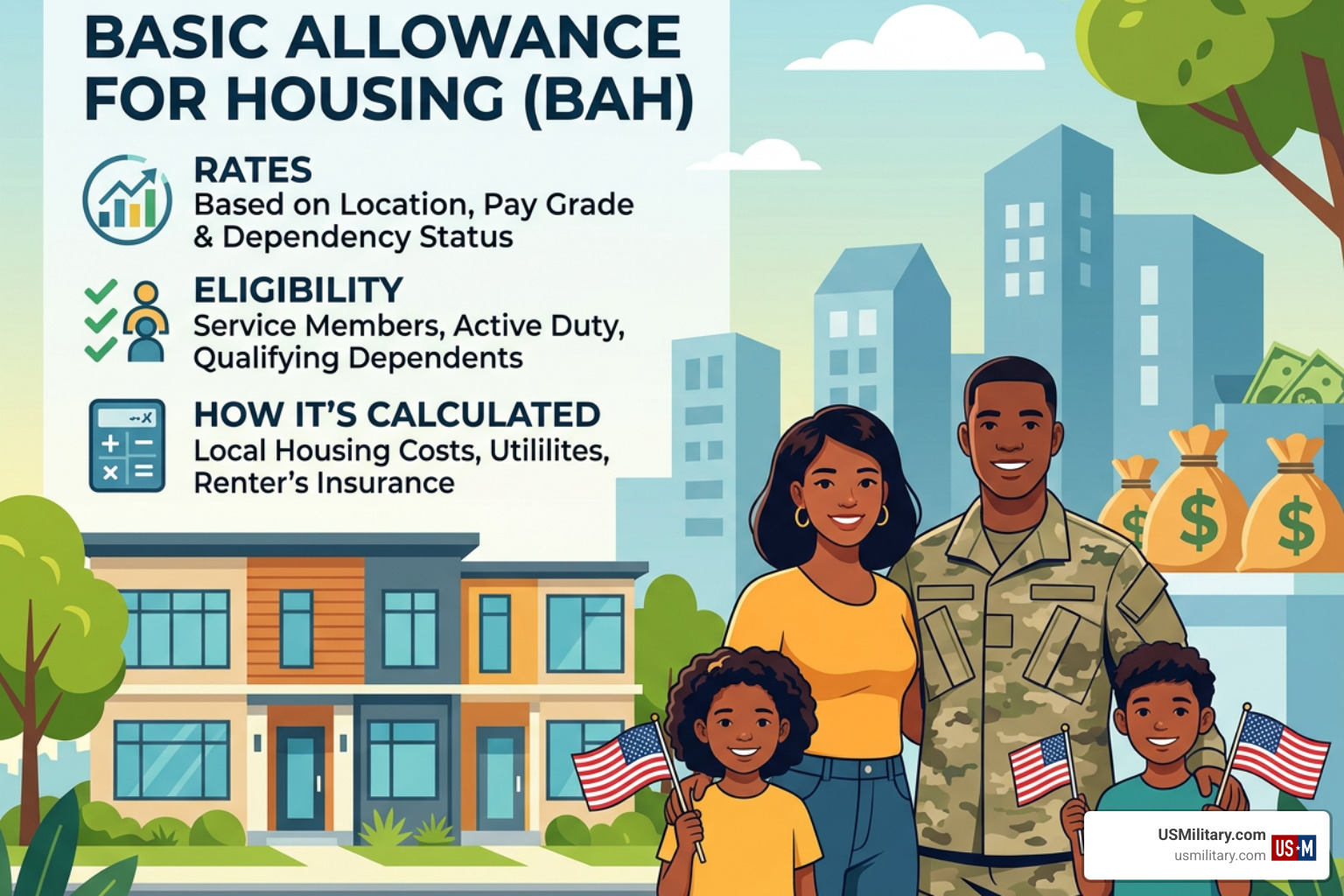 To qualify for standard Basic Allowance for Housing, you must be a uniformed service member on active duty who is not provided government-owned quarters. If you live off-base, or if you reside in privatized military housing where your allowance is directly allotted to a private management company, you are eligible to receive BAH.
BAH Explained: Rates, Eligibility & How It’s Calculated for Active Duty
For active duty personnel, standard BAH (sometimes called Type I BAH) is based on your permanent duty station ZIP code, not where you actually choose to live. This means if you are stationed in a high-cost area but choose to commute from a cheaper outlying town, you still receive the higher rate associated with your duty station. More about VA Home Loans Here! Your active duty status must be verified through your command and finance office. Your baseline earnings are outlined on the 2026 Military Pay Chart and the 2026 Military Pay Chart Enlisted Guide, but BAH remains a distinct, non-taxable allowance separate from your basic pay.Eligibility for National Guard and Reserve Components
Members of the National Guard and Reserve components are also eligible for housing allowances, but the rules depend heavily on the length and type of their orders.- Active Duty Orders of 31 Days or More: When mobilized or called to active duty for more than 30 consecutive days, Guard and Reserve members receive standard BAH based on their home ZIP code (or duty station ZIP code, depending on the nature of the orders). This ensures their civilian housing expenses remain covered while deployed. You can learn more about base pay rules on the National Guard Pay Chart.
- Active Duty Orders of 30 Days or Fewer: For short-term active duty service, members receive a flat, non-locality housing allowance known as BAH Reserve Component/Transit (BAH RC/T), formerly called BAH II. This rate does not change based on geographic location; instead, it is a fixed national rate updated annually based on the average growth of national housing costs.
Standard BAH vs. Overseas Housing Allowance (OHA)
A common point of confusion is the difference between domestic BAH and Overseas Housing Allowance (OHA).- Standard BAH: Applies to the 50 United States (CONUS). It is a fixed monthly allowance. If your BAH is $2,500 and you find an apartment for $2,100, you keep the remaining $400 tax-free.
- Overseas Housing Allowance (OHA): Applies to duty stations outside the United States (OCONUS). OHA is a reimbursement-style system. You are paid up to your maximum rental cap based on your lease agreement, plus a utility allowance. If your rent is less than your cap, you do not get to keep the difference.
BAH Explained: Rates, Eligibility & How It’s Calculated
Now, let’s dive into the core mechanics of how your monthly housing allowance is determined. The Department of Defense uses a precise three-factor model to calculate individual BAH rates:- Pay Grade (Rank)
- Geographic Location (Duty Station ZIP Code)
- Dependency Status (With or Without Dependents)
| Pay Grade | Dependency Status | San Diego, CA | Fort Liberty, NC | Camp Lejeune, NC |
|---|---|---|---|---|
| E-5 | Without Dependents | $2,950 | $1,380 | $1,290 |
| E-5 | With Dependents | $3,975 | $1,692 | $1,584 |
| O-3 | Without Dependents | $3,480 | $1,610 | $1,510 |
| O-3 | With Dependents | $4,450 | $1,995 | $1,850 |
Pay Grade and Housing Profiles
Your rank dictates the “housing profile” the DoD uses to determine your rate. The Defense Travel Management Office (DTMO) has established six standard housing profiles that map directly to specific pay grades. For example, junior enlisted members (E-1 to E-3) without dependents are mapped to a standard one-bedroom apartment profile. Mid-level enlisted members and junior officers are mapped to townhouses or two-bedroom apartments, while senior officers and senior enlisted members with families map to three- or four-bedroom single-family detached homes. Your branch-specific pay scales, such as those found on the Army Pay Chart 2025 or the Navy Pay Chart 2025, determine your overall compensation, but your BAH housing profile is standardized across all branches of the Armed Forces.Geographic Location and Military Housing Areas (MHAs)
The United States is divided into 338 Military Housing Areas (MHAs) covering 40,959 ZIP codes. Each year, the DTMO conducts extensive rental market surveys in these areas to gather data on local median housing costs, including rent and average utility expenses (electricity, gas, water, and sewer). To ensure accuracy, the DTMO works with local military housing offices and independent contractors to verify rental listings, screen out high-crime neighborhoods, and target areas where 90% of local service members actually reside. You can verify your local housing area details directly at the Basic Allowance for Housing | BAH | Defense Travel Management Office.Dependency Status: Binary Classification
Unlike many civilian benefits that scale with the number of children you have, BAH uses a simple binary classification:- Without Dependents: For single service members who do not have legal dependents.
- With Dependents: For service members who have at least one qualifying dependent (a spouse, child, or parent recognized as a dependent by the military).
How BAH Rates are Updated, Protected, and Used for VA Loans
The Department of Defense constantly monitors civilian housing markets to ensure military housing allowances keep pace with real-world economic changes. Let’s look at how rates are adjusted, how your individual rate is legally protected, and how you can leverage BAH to build long-term wealth.The Annual Update Cycle and 2026 Rate Changes
BAH rates are updated annually, with new rates taking effect on January 1 of each year. For 2026, BAH rates increased by an average of 4.2% nationwide. This increase reflects rising rental and utility costs in civilian markets across the United States. The annual rate-setting process is a massive undertaking, utilizing local rental data to distribute approximately $29.9 billion to roughly 1 million service members annually. These updates are automatically applied to your Leave and Earnings Statement (LES) at the start of the calendar year.Individual Rate Protection and Decreasing Rates
One of the most important consumer protections for military members is Individual Rate Protection, codified under 37 U.S.C. § 403. This law guarantees that once you are stationed at a specific base, your BAH rate cannot decrease as long as you maintain your status. If local rental prices drop and the official BAH rate for your area decreases on January 1, your allowance is “grandfathered” at the higher rate. Your BAH will only decrease if:- You execute a Permanent Change of Station (PCS) move to a new MHA.
- You experience a reduction in pay grade.
- Your dependency status changes (e.g., divorcing and no longer having dependents).
BAH Explained: Rates, Eligibility & How It’s Calculated in Special Scenarios
Real military life can get complicated, and the DoD has specific rules to cover unique household structures:- Dual-Military Couples: If you are married to another active duty service member, both of you are entitled to receive BAH. If you have no children, both members receive the “Without Dependents” rate. If you have children, the higher-ranking spouse typically receives the “With Dependents” rate, while the other spouse receives the “Without Dependents” rate.
- Divorced Service Members & Child Support (BAH-Diff): If you are divorced and pay court-ordered child support, you may qualify for BAH-Differential (BAH-Diff). This allowance is paid to members assigned to single-type government quarters (like barracks) whose child support payments are at least equal to the monthly BAH-Diff rate.
- Partial BAH: Paid to service members without dependents who reside in government-owned quarters (barracks or shipboard) to help cover incidental expenses.
Using BAH for Home Purchases and VA Loans
Many service members don’t realize they can use their tax-free housing allowance to purchase a home. Mortgage lenders absolutely recognize BAH as stable, qualifying income when you apply for a home loan. When you apply for a VA loan, lenders can perform a process called “grossing up” your BAH. Because your housing allowance is completely tax-free, lenders may increase its value by 15% to 25% for calculation purposes to match the pre-tax equivalent of civilian income. This significantly improves your debt-to-income (DTI) ratio, allowing you to qualify for a larger home loan.
If you are planning to transition or settle down, reviewing the VA Home Loan Eligibility Requirements is an excellent way to turn your monthly allowance into long-term home equity.
VA Home Loan
Your Service Earns a $0-Down Home Loan Benefit
Eligible service members and veterans can buy a home with no down payment and no PMI. Check your VA loan eligibility in a few minutes.
USMilitary.com may be compensated when you request quotes from lenders through this link.
Frequently Asked Questions About BAH
To help clear up any remaining confusion, we have compiled answers to some of the most common questions about housing allowances. For personal calculations, you can always consult the official Basic Allowance for Housing Calculators | Defense Travel Management Office.Does BAH cover 100% of housing expenses?
No. By design, BAH is intended to cover approximately 95% of local median housing costs. The remaining 5% is considered an out-of-pocket absorption rate, which typically equates to $93 to $212 per month depending on your rank and location. Furthermore, the DoD removed renter’s insurance from the BAH calculation formula in FY2018. Service members are highly encouraged to purchase their own renter’s insurance policies, which generally cost less than $20 per month, to protect their personal belongings.Is BAH taxable?
No. BAH is an allowance, not basic pay. Because of this distinction, it is completely exempt from:- Federal income tax
- State income tax
- FICA (Social Security and Medicare) taxes
How is BAH determined for locations without direct data collection?
For remote locations, recruiting stations, or areas without a concentrated military presence, direct rental surveys may not be feasible. In these instances, the DTMO utilizes County Cost Groups and interpolation methods. They look at the nearest established MHAs and apply statistical models to ensure service members receive fair, localized compensation even in rural or non-traditional duty stations.Conclusion
The Basic Allowance for Housing is a cornerstone of military compensation, designed to protect your quality of life while you serve our country. Whether you are budgeting for a rental off-base, preparing for a PCS, or looking to buy your first home, knowing how your rates are determined is vital to your financial health. At USMilitary.com, we are committed to helping active duty personnel, Guard and Reserve members, and veterans navigate their benefits with confidence. From understanding the 2024 BAH Rates to comparing career paths or analyzing the Proposed Military Pay for 2025, we are here to support you at every stage of your military journey. To learn more about your health coverage options, check out our guide on Tricare Health Plans: A Complete Overview. If you are transitioning out of active duty, you can also explore our resources on VA Disability Pay. Ready to make the most of your service benefits? Explore VA Benefits and Housing Resources today to secure your financial future. For additional guidance on leadership, resilience, and personal growth during and after your military career, check out Dare to Live Greatly on Amazon.Free for Service Members & Veterans
Get the military benefits intel no one tells you about.
Weekly updates on VA benefits, pay changes, and money tips — free for service members and veterans.
No spam. Unsubscribe anytime. Your info is never shared.


