Step 5 of the VA Claim Process: What to Do While You Wait

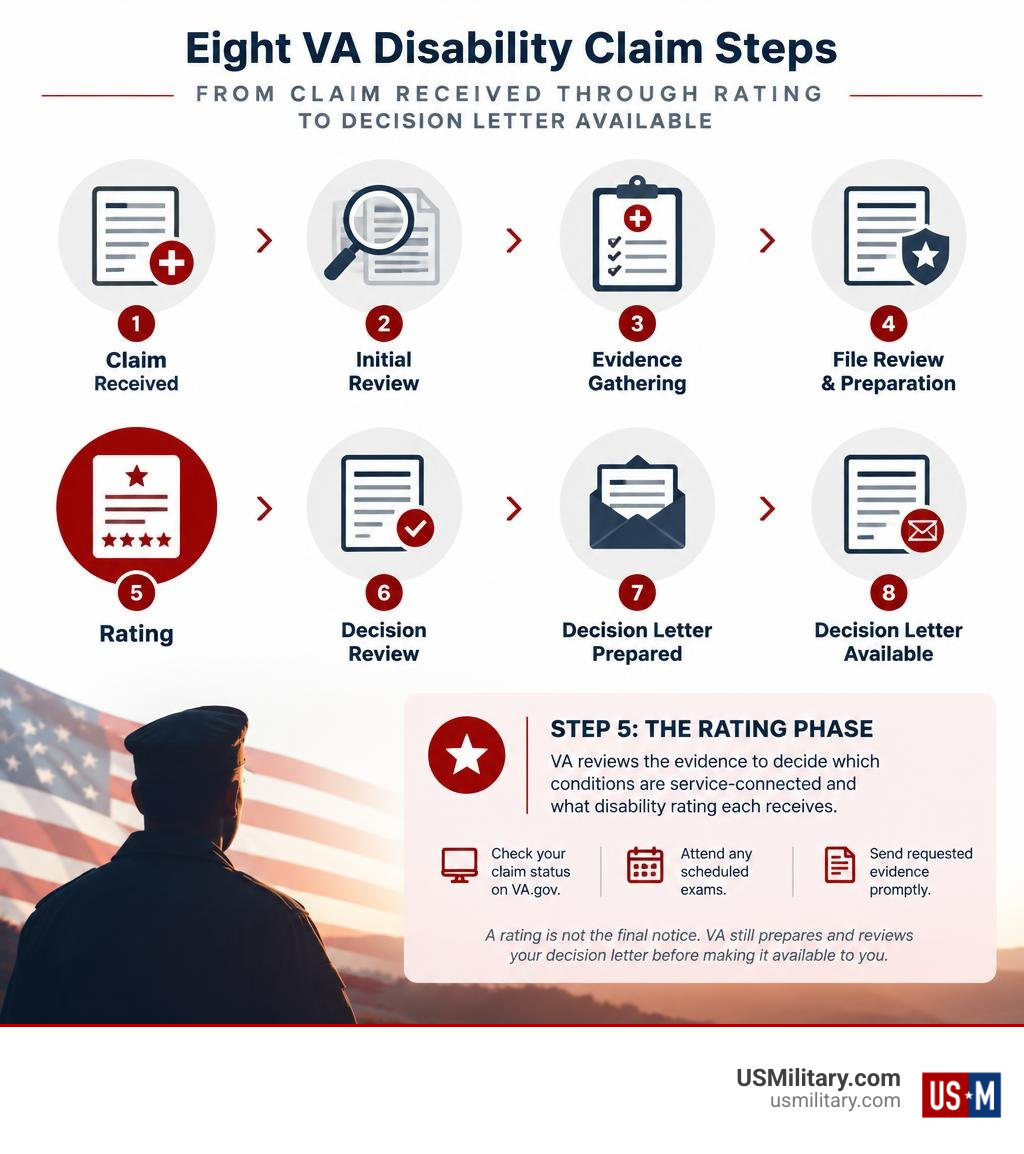
Step 5 of the VA claim process is the rating phase. During this vital stage, the Department of Veterans Affairs carefully reviews your compiled evidence to decide which conditions are service-connected and what specific disability rating percentage each condition receives. While you wait, check your claim status on VA.gov, attend any scheduled exams, and send requested evidence promptly. If VA raters require additional medical clarification, your claim may return to an earlier development step before rating continues.
A completed rating is not your final notice. The VA still prepares, carefully approves, and reviews your official decision letter packet before making it available to you.
I’m Larry Fowler, a Navy veteran and publisher of the USMilitary.com Network, where I’ve covered VA disability trends, claims navigation, and military benefits since 2007. This comprehensive guide to step 5 of the VA claims process explains what to watch for now and what happens after the rating review.
Key step 5 of VA claim process vocabulary:
- VA claims back pay
- 7 Critical Steps You Must Take To Successfully Increase Your VA Disability Rating
- What To Do If The VA Lowers Your VA Disability Rating
Step 5 of the VA Claim Process Explained: The Rating Phase
When your disability compensation claim reaches Step 5, all preliminary evidence gathering and initial reviews have concluded. Your private medical files, military service personnel records, service treatment records, and Compensation and Pension (C&P) examination reports are organized into a digital file. This comprehensive folder is assigned directly to a specialized adjudicator called a Rating Veterans Service Representative (RVSR).
As outlined in The Complete Guide to VA Disability Claims, the RVSR evaluates your complete claim file against the statutory criteria established in Title 38 of the Code of Federal Regulations, specifically 38 CFR Part 4 (the VA Schedule for Rating Disabilities). The rater’s primary objective is to verify legal service connection, assess the chronicity and severity of each disabling condition, and assign an appropriate disability rating percentage based on established diagnostic codes.

What Happens During Step 5 of the VA Claim Process
During this evaluation, the RVSR thoroughly synthesizes every piece of factual documentation in your record. They examine the standardized Disability Benefits Questionnaires (DBQs) submitted by medical examiners, review lay statements and buddy letters, and scrutinize the formal medical nexus linking your diagnosed condition to military service.
If the objective medical findings satisfy the regulatory requirements, the rater assigns a disability percentage from 0% up to 100%. However, if the evidence contains ambiguities, conflicting medical opinions, or unaddressed diagnostic elements, the rater will suspend the rating phase and return the file for further development.
How the VA Calculates Ratings and Monthly Compensation Amounts
Disability percentages are not combined using standard addition. Instead, the Department of Veterans Affairs relies on a non-additive calculation model known as whole person efficiency or “VA Math.” Under this formula, each successive disability rating percentage is applied only to your remaining non-disabled percentage.
Veterans can consult our VA Disability Rating Chart 2026 Guide to learn how multiple distinct ratings combine into a single final rating rounded to the nearest 10%. Your final combined percentage determines your monthly tax-free compensation payment, along with added allowances for eligible dependents such as a spouse, dependent children, or aging parents.
Timeline Expectations and Processing Variables
Waiting for a completed rating determination can feel challenging, but modern electronic processing systems continue to improve overall turnaround times. According to published agency performance metrics, the average duration to process disability claims in September 2026 stands at approximately 68.2 days.
Individual processing timeframes still fluctuate depending on case complexity, including whether your application involves statutory presumptive conditions, intricate toxic exposure considerations, or multiple complex physical and psychiatric claims. Veterans can review the official VA claims process overview to track broader administrative standards across national regional offices.
✉ Get updates like this in your inbox
Weekly VA benefit changes, pay updates, and money tips for service members, veterans, and military families. Free, no spam.
Processing Speed: Fully Developed Claims vs. Standard Claims
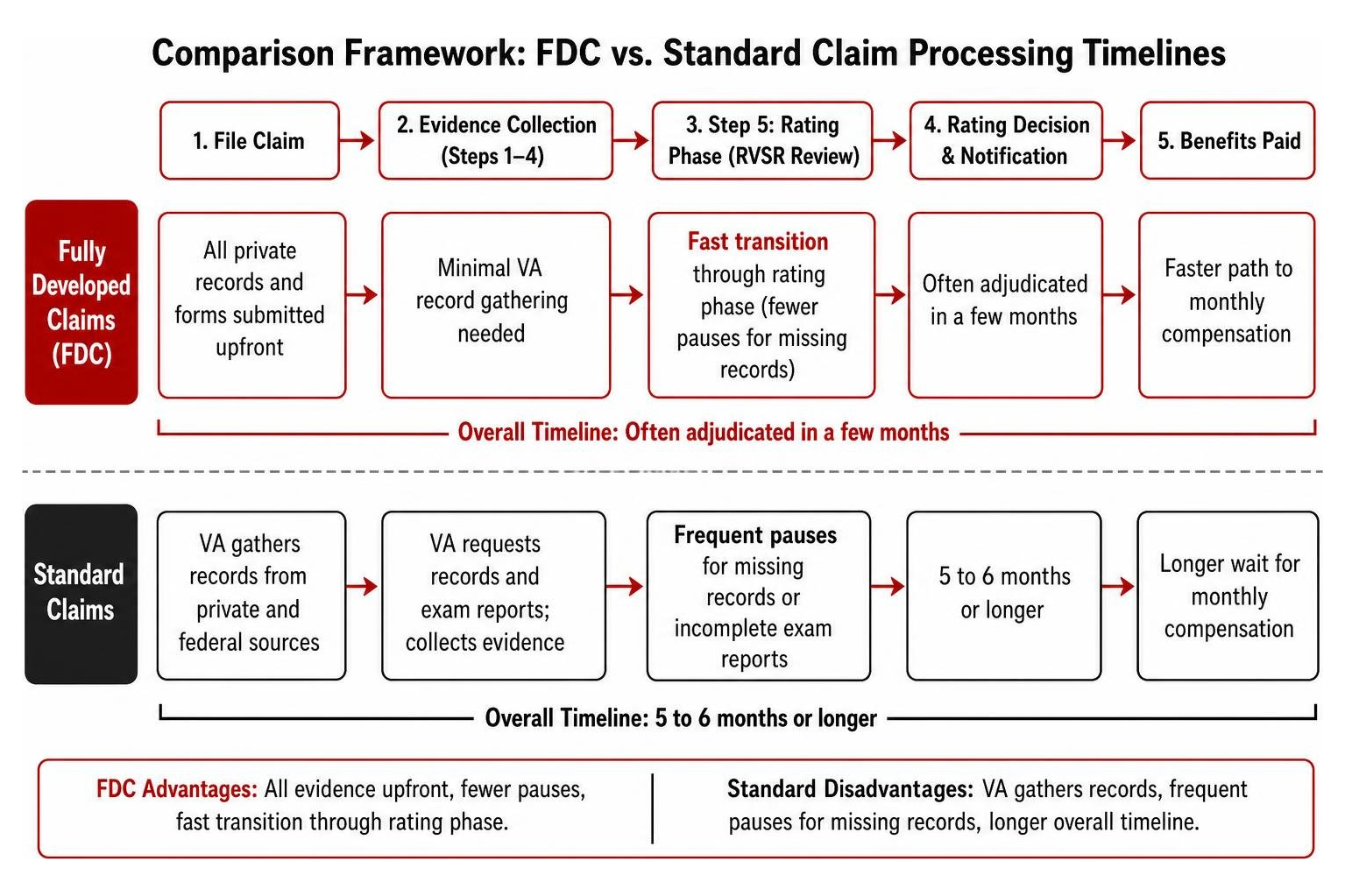
The specific filing route you select when submitting your application directly impacts the velocity of your claim through Step 5.
| Feature | Fully Developed Claims (FDC) | Standard Claims |
|---|---|---|
| Evidence Submission | All private records and forms submitted upfront | VA gathers records from private and federal sources |
| Average Timeline | Often adjudicated in a few months | 5 to 6 months or longer |
| Veteran Responsibility | High upfront document gathering | Minimal upfront legwork, higher wait times |
| Step 5 Efficiency | Fast transition through rating phase | Frequent pauses for missing records |
Key Factors that Delay Step 5 of the VA Claim Process
Several common procedural factors can extend the time an application spends inside Step 5:
- Delayed C&P Examination Reports: Third-party medical contractor networks may take additional weeks to upload finalized DBQs.
- Late Evidence Submissions: Submitting supplemental medical records while your file sits in Step 5 requires raters to return the claim to Step 3 or Step 4.
- Deferred Issue Adjudication: If several conditions are ready for a decision while one requires supplemental testing, raters may decide the completed conditions and defer the unresolved issue.

Moving from Rating to Decision: Tracking, Letters, and Payments
After the RVSR completes the disability rating decision, your file moves forward to Step 6 (Preparing Decision Letter) and Step 7 (Final Review). During these closing administrative stages, a senior authorizer conducts a quality review to confirm regulatory compliance and statutory accuracy before releasing your official benefits decision. For broader insight regarding institutional policies, the Veterans Guide to Disability Claims provides helpful perspective on federal and state veteran support structures.
Decision Letters and Effective Dates
Your formal decision letter delivers an extensive breakdown for each condition claimed. It specifies the assigned diagnostic codes, explains why service connection was granted or denied, and identifies your formal effective date.
Your effective date is typically established as the date the VA received your completed formal claim or your prior Intent to File submission. This critical calendar date determines your retroactive compensation award, ensuring you receive back pay covering the entire period from your effective date through your final rating determination.
How to Monitor Claim Status Online
You can easily track your claim’s development through VA.gov utilizing the automated online Claim Status Tool. The dashboard details your current processing phase and flags whether the agency requires additional records under the “Files” tab. To ensure your documentation remains fully compliant, explore our detailed walkthrough on How to Do the VA Claim Process the Right Way.
Options for Disagreeing with the VA Rating Decision
If your completed decision notification contains an unfavorable outcome, a denied service connection, or a percentage rating that falls short of your symptom severity, you possess straightforward appeal rights. Under the Appeals Modernization Act, claimants have exactly one year from the date listed on the decision notice to pursue an administrative review path:
- Supplemental Claim: Submit new and relevant medical or service records that were not previously reviewed by the agency adjudicator.
- Higher-Level Review (HLR): Request an experienced senior adjudicator evaluate your existing evidence to identify clear errors of fact or misapplications of law, without providing new documentation.
- Board of Veterans’ Appeals (BVA): Take your appeal directly to a Veterans Law Judge through Direct Review, an Evidence Submission docket, or a formal hearing.
To learn effective strategies for contesting unfavorable decisions, read our guide on How to Turn Your VA Denial Into a Winning Appeal.
Frequently Asked Questions About VA Claim Ratings
What should I do if I missed my scheduled C&P exam?
Immediately contact the VA at 1-800-827-1000 and reach out directly to the assigned contract medical examination provider, such as Optum Serve, QTC, or VES. Explain the good cause reason for your absence and request a prompt reschedule. Missing a C&P exam without notifying the agency often leads to an immediate claim denial for that specific condition due to insufficient current medical evidence.
Can a claim move backward from Step 5 to Step 3 or 4?
Yes. Under federal law, the VA has a mandatory legal “duty to assist” every claimant. If the rating specialist identifies incomplete examination reports, missing service personnel records, or contradictory medical opinions, they will return the claim file to Step 3 (Evidence Gathering) or Step 4 (Evidence Review) to request clarifying statements or schedule a supplemental medical exam.
How quickly are disability compensation payments issued after a decision?
Once your claim successfully reaches Step 8 (Claim Decided), retroactive back pay deposits are generally transmitted to your direct deposit bank account within 3 to 7 business days. Your official physical decision letter and detailed narrative explanation will typically arrive in your mailbox within 10 to 14 business days.
Conclusion
Navigating Step 5 of the VA claim process requires patience, but understanding how rating specialists evaluate medical evidence and calculate disability percentages takes the uncertainty out of the waiting period. By remaining proactive, attending every scheduled examination, and tracking your dashboard updates, you can ensure your claim moves efficiently toward a successful final rating determination.
At USMilitary.com, our ongoing mission is to deliver dependable, practical insights that help veterans, active-duty service members, and military families successfully access the compensation, healthcare, and hard-earned benefits they have earned through honorable service.
Free for Service Members & Veterans
Get the military benefits intel no one tells you about.
Weekly updates on VA benefits, pay changes, and money tips — free for service members and veterans.
No spam. Unsubscribe anytime. Your info is never shared.



Leave a Reply