How to Start a US Military Disability Claim

To start a US military disability claim, identify the condition you believe is linked to your service, gather your medical and service records, and file with VA. You can apply online, by mail, by fax, or in person. After you file, watch for requests for evidence or a compensation and pension (C&P) exam, and check your claim status online.
Not sure which claim to file? Your next step depends on whether this is your first claim, a new condition, a condition that has worsened, or a request to review an earlier decision. This guide walks you through those choices and what to do after VA responds.
Whether you are still serving, preparing to separate, or have been out for years, getting VA disability benefits right from the start matters. A clear diagnosis, strong service records, and a well-organized filing can help VA understand your case faster, protect your effective date, and reduce delays during review.
I’m Larry Fowler, a Navy veteran and BUD/S Class 89 graduate. Since 2007, I’ve published veteran benefits information through USMilitary.com, including guidance on US military disability claims.
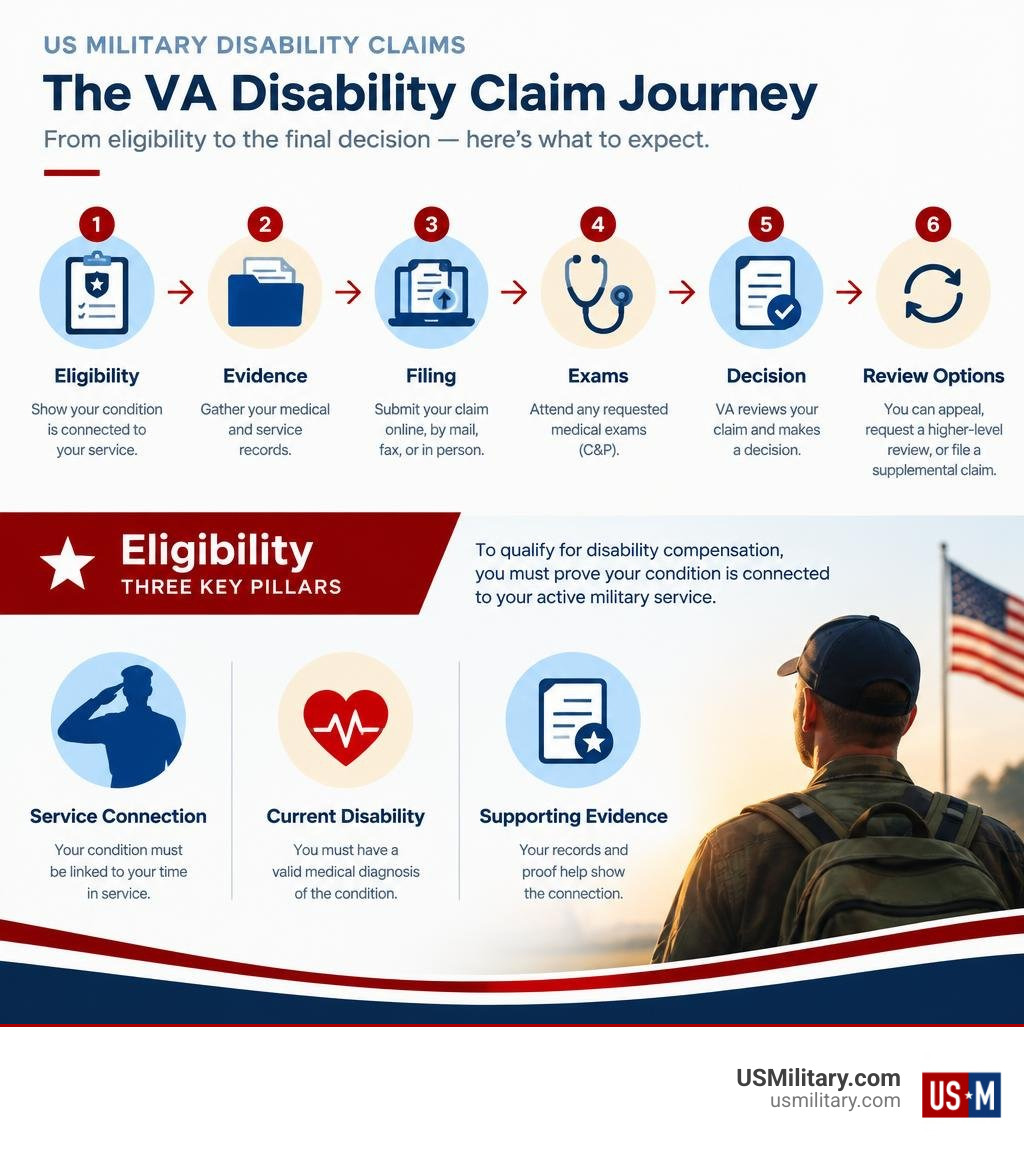
US military disability claims: eligibility and claim types
How US military disability claims establish eligibility
To qualify for disability compensation, you must prove your medical condition is connected to your active military service. We look at this through three essential pillars:
- A current, diagnosed disability: You need an official medical diagnosis of an ongoing physical or mental condition.
- An in-service event, injury, or exposure: Documentation showing something happened during your military service, such as a combat trauma, training accident, or toxic exposure.
- A medical nexus: A credible medical link connecting your current diagnosed condition directly to that in-service event.
In practice, VA wants to see a clear story in your records. A diagnosis today, a documented event or complaint during service, and a medical opinion tying the two together make a claim much easier to approve. If one piece is missing, VA may still develop the claim for you, but it often leads to more questions, more exams, and longer waits. That is why reviewing your service treatment records and current treatment notes before you file is so important for veterans and military personnel.
Some conditions do not require proof of a specific in-service incident. Under presumptive rules, including the PACT Act, exposure to burn pits, Agent Orange, or hazardous chemicals automatically links certain illnesses to your service. National Guard and Reserve members must also provide active duty orders and unit medical records. Reviewing what conditions qualify for veteran disability benefits helps identify if your health issue meets these criteria.
Choose the right type of disability claim
Filing the correct claim category ensures faster processing and protects your effective date:
| Claim Type | Purpose | When to File |
|---|---|---|
| Original Claim | Your very first disability claim submitted to VA | Up to 180 days before separation or anytime post-service |
| New Claim | A new, unrated condition connected to service | Anytime after your original claim decision |
| Increased Claim | Higher compensation for an already rated condition that worsened | Whenever medical evidence shows your disability has worsened |
| Secondary Claim | A new condition caused or aggravated by an existing service-connected disability | When a secondary health problem arises from a rated issue |
| Special Claim | Extra support for specific needs (Aid & Attendance, vehicle grants) | When specialized care or equipment is required |
| Supplemental Claim | Requesting review of a denied claim with new and relevant evidence | After a denial, or when laws like the PACT Act create new eligibility |
Choosing the right lane also affects what evidence you can submit and how VA reviews your case. For example, an increased claim should focus on how symptoms have worsened, while a secondary claim should explain how one service-connected condition caused or aggravated another. Filing under the wrong type can create confusion and delay a decision, even when the underlying condition is valid.
You can explore official types of disability claims and when to file through VA regulations. If your rated conditions worsen over time, check our VA disability rating increase guidance to properly request higher compensation.
Gather evidence and file your claim
Build evidence for a strong claim
Submitting thorough documentation up front is the single best way to avoid processing delays. We recommend gathering:
- VA medical records and private treatment records showing ongoing symptoms and diagnosis.
- Service treatment records (STRs) and your DD214 discharge paperwork.
- Nexus letters from qualified physicians linking your condition to active service.
- Buddy statements and lay evidence from fellow service members, family, or coworkers describing how the injury occurred and affects your daily activities.
Strong evidence does more than prove a diagnosis. It shows how often you are treated, what symptoms you experience, what activities are limited, and how the condition affects work and daily life. Personal statements can be especially helpful when service records are incomplete, because VA is required to consider your own lay description of symptoms. Organizing records by condition, with the most relevant pages first, also helps reviewers find the key facts quickly.
While VA gives you up to one year to submit supporting documentation, they may decide your claim after 30 days if you provide no evidence. Following the complete VA disability claims guide ensures your evidence packet is fully developed before submission.
✉ Get updates like this in your inbox
Weekly VA benefit changes, pay updates, and money tips for service members, veterans, and military families. Free, no spam.
How to file US military disability claims online or by other methods

You can submit your application using VA Form 21-526EZ through several channels:
- Online: File directly at VA.gov. When you begin your application online, your intent-to-file date is locked in automatically.
- By Mail: Send your completed VA Form 21-526EZ to the Department of Veterans Affairs Claims Intake Center, PO Box 4444, Janesville, WI 53547-4444.
- By Fax: Fax documents to (844) 531-7818 inside the U.S.
- In Person: Visit your nearest VA Regional Office.
- Accredited Assistance: Work with a Veterans Service Organization (VSO) representative or accredited claims agent.
Online filing is often the fastest option because you can upload evidence, receive confirmation, and track progress in one place. Paper filing still works well if you prefer to work with a VSO or want to hand-deliver copies, but keep proof of submission either way. If filing on paper, submit an Intent to File form first to lock in your effective date for retroactive back pay, giving you up to one year to complete your package. Master the submission steps with our VA claim process guidance.
File before leaving service when eligible

If you have 180 to 90 days remaining on active duty, submit your claim through the Benefits Delivery at Discharge (BDD) program. BDD allows you to complete medical exams before discharge, enabling VA to finalize your decision shortly after separation. If you have fewer than 90 days left, you can still file a standard or Fully Developed Claim before separation, which VA processes immediately once your discharge paperwork is finalized. Filing early also gives you time to gather records while they are still easy to obtain from your unit and military treatment facility.
What happens after you file: exams, ratings, and status
Prepare for the VA decision process
Once received, VA reviews your records and verifies service connection. If your medical records lack sufficient detail, VA will schedule a Compensation and Pension (C&P) exam. Never miss a scheduled C&P exam; failing to attend can lead to an immediate denial. Keep your address and contact details current on VA.gov so exam notices reach you promptly. For detailed rules on scheduling and evidence deadlines, review the official Filing a Disability Claim FAQ.
At a C&P exam, the examiner will review your history, ask about symptoms, and may test range of motion or other functions related to your condition. Be honest and complete about your worst days, not just your best days, and describe how symptoms affect daily activities. Bring a list of medications, prior treatment, and any private medical records you want the examiner to consider. If you cannot attend a scheduled exam, contact VA as soon as possible to reschedule rather than simply not showing up.
Track your claim and understand your rating
Log in to check claim or appeal status to see your current stage, uploaded evidence, and decision letters. When granted, VA assigns a percentage from 0% to 100%.
VA calculates combined ratings using non-additive math based on your remaining whole person efficiency:
| Condition | Rating | Calculation of Efficiency | Combined VA Rating |
|---|---|---|---|
| Knee Injury | 50% | 50% disabled, 50% healthy | 50% |
| Tinnitus | 10% | 10% of remaining 50% = 5% (Total 55%) | 60% (rounded up) |
| Sleep Apnea | 30% | 30% of remaining 45% = 13.5% (Total 68.5%) | 70% (rounded up) |
That is why two separate ratings do not simply add together. Each additional condition is applied only to the portion of you that remains healthy after earlier ratings, which is why combined ratings often look lower than a simple sum. Consult our VA disability rating chart guide and the latest VA disability pay guide to calculate your tax-free monthly compensation.
If VA denies your claim or assigns a rating you disagree with
Choose a decision review or appeal
If your claim is denied or assigned an improper rating, you have one year from your decision letter to file a review:
| Review Lane | Requirements | Best Used For |
|---|---|---|
| Supplemental Claim | Must submit new and relevant evidence | Adding new medical diagnoses or nexus letters |
| Higher-Level Review | De novo review by senior adjudicator; no new evidence allowed | Clear errors in law or misread existing evidence |
| Board Appeal | Case heard by a Veterans Law Judge at Board of Veterans’ Appeals | Complex claims needing formal legal hearings |
A denial does not mean your case is over, but the lane you choose matters. A supplemental claim lets you add new evidence, a higher-level review asks a senior reviewer to look again at the same evidence, and a Board appeal provides a more formal review process. In each lane, meeting the one-year deadline is critical to preserving your original effective date and any back pay you may be owed if the decision changes in your favor.
Learn how to dispute decisions with how to turn a VA denial into a winning appeal and access required forms with our guide to VA disability reconsideration forms.
Frequently asked questions about disability claims
- How long does a claim take? Decisions generally take several months depending on evidence complexity and exam availability.
- Does every claim need a C&P exam? No. If your private medical records and service documents provide sufficient evidence, VA can rate the claim without an exam.
- Can I file after discharge? Yes. Post-service claims have no deadline, though gathering records is easier closer to separation.
- What if my condition gets worse after I file? Tell VA, keep getting treatment, and submit updated medical evidence so your rating reflects your current symptoms.
For additional strategies, check our top VA disability claim tips.
Conclusion
Securing your earned benefits requires preparation, clear evidence, and strict attention to VA deadlines. File your intent to file early, attend all scheduled exams, maintain copies of all records, and work with accredited representatives when needed. Taking these steps gives your claim the best chance for a timely, accurate decision. For comprehensive guidance on maximizing your benefits, explore benefits for 100% disabled veterans through USMilitary.com today.
Free for Service Members & Veterans
Get the military benefits intel no one tells you about.
Weekly updates on VA benefits, pay changes, and money tips — free for service members and veterans.
No spam. Unsubscribe anytime. Your info is never shared.



Leave a Reply