Overview of the VA Disability Rates 2026 and COLA Increase

Navigating your benefits can sometimes feel like trying to read a map in the dark, but we are here to shed some light on the situation. As of May 2026, we are well into the payment cycle for the current year, and veterans across the country are seeing the impact of the latest adjustments on their monthly bank statements.
The Department of Veterans Affairs implemented a 2.8% Cost-of-Living Adjustment (COLA) for the VA disability rates 2026 cycle. This adjustment is legally tied to the Social Security Administration’s annual COLA determination. By law, the VA is required to match the percentage increase designated for Social Security benefits. This ensures that your hard-earned benefits do not lose their purchasing power as the cost of groceries, housing, and gas fluctuates.
How is this percentage calculated? The adjustment is determined using the Consumer Price Index for Urban Wage Earners and Clerical Workers (CPI-W). The Bureau of Labor Statistics tracks this index, comparing the third-quarter average of the previous year to the third-quarter average of the prior year. When inflation is high, the COLA rises to help you keep pace.
The 2.8% increase for 2026 officially went into effect on December 1, 2025. Because the VA pays its monthly benefits in arrears (meaning you are paid for December’s coverage at the start of January), the very first check reflecting this boost arrived in late December 2025 or on January 1, 2026. If you want a deeper dive into how these economic factors come together, you can read our guide on Understanding VA disability rates and COLA in 2026.
2026 VA Disability Compensation Pay Charts
When you look at the official pay structures, your monthly compensation is determined by two primary factors: your combined disability rating (from 10% to 100% in 10% increments) and your dependency status.
To help you visualize how much your monthly pay has changed, let’s look at a comparison of the base rates (for a veteran with no dependents) between the previous payment cycle and the current VA disability pay 2026 guide rates.
| Disability Rating | 2025 Monthly Rate (Base) | 2026 Monthly Rate (Base) | Monthly Increase |
|---|---|---|---|
| 10% | $175.51 | $180.42 | $4.91 |
| 20% | $346.95 | $356.66 | $9.71 |
| 30% | $537.42 | $552.47 | $15.05 |
| 40% | $774.16 | $795.84 | $21.68 |
| 50% | $1,102.04 | $1,132.90 | $30.86 |
| 60% | $1,395.93 | $1,435.01 | $39.08 |
| 70% | $1,759.18 | $1,808.44 | $49.26 |
| 80% | $2,044.88 | $2,102.14 | $57.26 |
| 90% | $2,297.96 | $2,362.30 | $64.34 |
| 100% | $3,831.30 | $3,938.58 | $107.28 |
For a comprehensive breakdown of these figures and historical comparisons, check out our resource on 2026 VA disability rates everything you need to know.
10% to 20% VA Disability Rates 2026
If your combined service-connected disability rating is evaluated at 10% or 20%, the VA utilizes a simplified payment structure. For these two tiers, the monthly compensation is a flat rate.
- 10% Disability Rating: $180.42 per month
- 20% Disability Rating: $356.66 per month
At these lower rating levels, the VA does not provide additional compensation for dependents. Whether you are single, married, or have multiple children, your monthly payment remains the same. Dependent-based compensation only becomes active once a veteran reaches a combined rating of 30% or higher. For more details on these specific tiers, see our page on 2026 VA disability rates.
30% to 100% VA Disability Rates 2026 with Dependents
Once you cross the 30% threshold, your family size plays a significant role in your monthly payment. Eligible dependents include a spouse, children under 18, children between 18 and 23 who are enrolled in a qualifying school program, and dependent parents.
Below is an extensive breakdown of the monthly rates for ratings from 30% to 100% based on common dependency scenarios.
30% to 60% Disability Rating Chart (With and Without Children)
| Rating | Veteran Alone | Veteran + Spouse | Veteran + Spouse + 1 Parent | Veteran + Child Only | Veteran + Spouse + 1 Child |
|---|---|---|---|---|---|
| 30% | $552.47 | $617.79 | $670.48 | $605.15 | $673.79 |
| 40% | $795.84 | $883.30 | $952.84 | $865.38 | $957.57 |
| 50% | $1,132.90 | $1,242.48 | $1,329.94 | $1,205.60 | $1,322.56 |
| 60% | $1,435.01 | $1,566.73 | $1,672.10 | $1,522.47 | $1,662.61 |
70% to 100% Disability Rating Chart (With and Without Children)
| Rating | Veteran Alone | Veteran + Spouse | Veteran + Spouse + 1 Parent | Veteran + Child Only | Veteran + Spouse + 1 Child |
|---|---|---|---|---|---|
| 70% | $1,808.44 | $1,961.23 | $2,084.51 | $1,910.65 | $2,073.98 |
| 80% | $2,102.14 | $2,277.06 | $2,417.20 | $2,219.10 | $2,405.61 |
| 90% | $2,362.30 | $2,559.34 | $2,717.40 | $2,494.01 | $2,703.70 |
| 100% | $3,938.58 | $4,158.17 | $4,334.41 | $4,085.43 | $4,318.98 |
For a complete look at how a maximum rating impacts your household finances, read our detailed analysis of the 100 VA disability rating what it means for your wallet in 2026.
Additional Dependent Allowances (At the 100% Rating Level)
If you have a large family or unique caretaking responsibilities, you can add specific allowances to your base compensation. At the 100% rating level, these additions include:
- Each additional child under age 18: Adds $109.11 per month.
- Each additional schoolchild over age 18 (enrolled in an approved educational program): Adds $352.45 per month.
- Spouse receiving Aid and Attendance (A&A): If your spouse requires assistance with daily living activities, this adds an additional $201.41 per month.
For the most authoritative and comprehensive tables, you can always refer directly to the Current Veterans Disability Compensation Rates | Veterans Affairs portal.
How the VA Calculates Combined Disability Ratings
If you have multiple service-connected conditions, you might assume that the VA simply adds the percentages together. For example, if you have a 50% rating for PTSD and a 30% rating for a knee injury, simple addition says you should have an 80% rating.
Unfortunately, that is not how “VA Math” works. The VA uses the Whole Person Theory to calculate combined ratings.
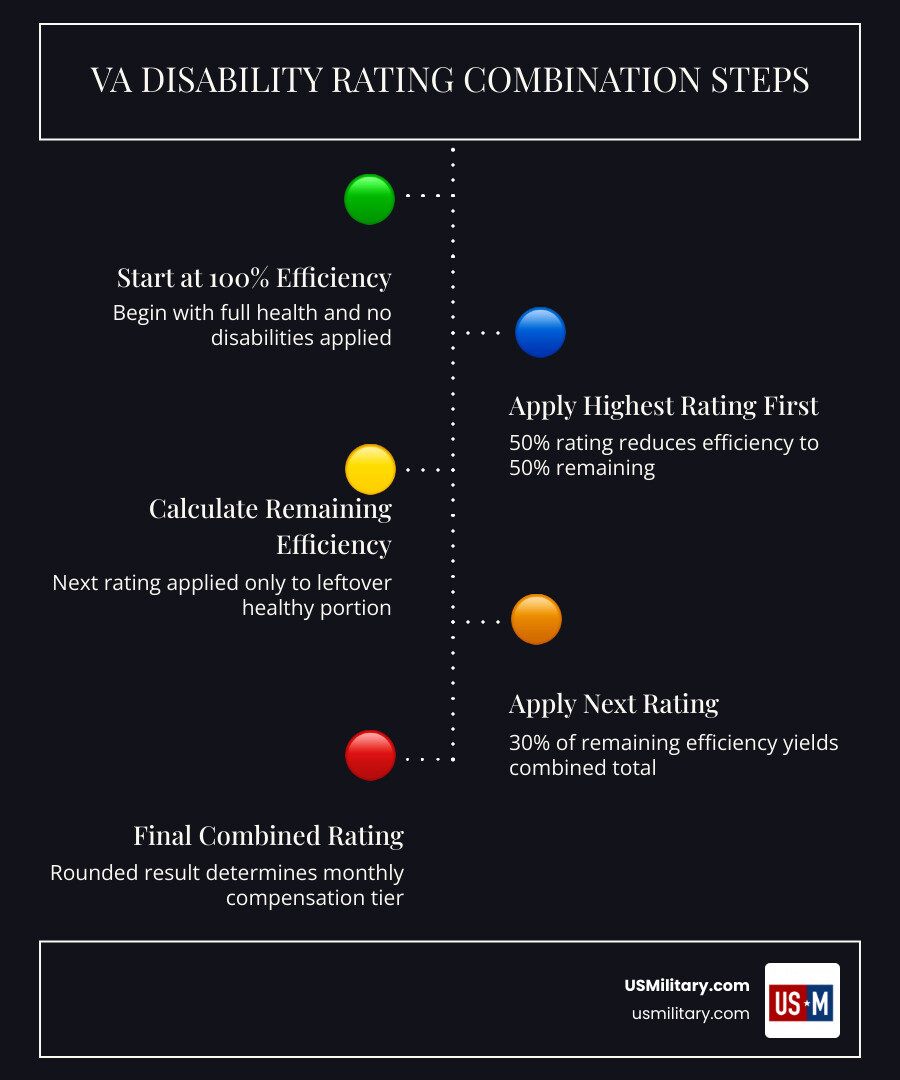
The logic is that a person can never be more than 100% efficient or “whole.” Each disability percentage is applied to what is left of your healthy, unaffected body.
- Start with a clean slate (100% efficiency): You have no rated disabilities yet.
- Apply the highest rating first: If your highest-rated condition is 50%, you are now considered 50% disabled and 50% “efficient.”
- Apply the next highest rating to the remaining efficiency: Your next rating is 30%. Instead of adding 30% directly, the VA takes 30% of your remaining 50% efficiency.
- $50\% \times 30\% = 15\%$
- Combine the figures: Add that 15% to your initial 50% rating to get a combined rating of 65%.
- Round to the nearest 10%: Because the VA only pays at 10% increments, a 65% rating rounds up to 70%. If the calculation had resulted in 64%, it would round down to 60%.
To avoid doing these complex calculations on a napkin, you can use the official tables described in our VA disability rating chart 2026 guide.
Special Monthly Compensation (SMC) and Tax Status
For veterans with severe injuries, standard disability compensation may not fully cover their care needs. The VA offers Special Monthly Compensation (SMC) as an additional tax-free benefit. SMC is designed to provide extra financial assistance for the loss or loss of use of specific organs or limbs, or because a veteran is housebound or requires Aid and Attendance.
Some of the common SMC rates for 2026 include:
- SMC-K: This is an “add-on” benefit typically awarded for the loss or loss of use of a single creative organ or limb. For 2026, the SMC-K rate is $139.87 per month, which is added directly to your standard monthly compensation.
- SMC-S (Housebound): Designed for veterans who are permanently housebound due to their service-connected conditions. The 2026 rate is $4,408.53 per month (for a veteran with no dependents).
- SMC-L (Aid and Attendance): Awarded to veterans who require the regular assistance of another person to perform daily activities like bathing, dressing, or feeding. The 2026 rate is $4,900.83 per month (for a veteran with no dependents).
To see how these special rates are structured across different medical scenarios, consult the 2026 VA Disability Rates: Updated Compensation Pay Chart .
Additionally, if your service-connected conditions prevent you from maintaining “substantially gainful employment,” you may qualify for Total Disability Based on Individual Unemployability (TDIU). TDIU allows veterans to receive monthly payments at the 100% rate even if their combined rating is lower than 100%.
Best of all, all VA disability payments are 100% tax-free at both the federal and state levels. You do not need to report your disability compensation as income on your tax returns.
How to Increase Your VA Disability Rating
If your service-connected condition has worsened since your last evaluation, you do not have to settle for your current payment tier. You have the right to file a claim for an increased rating.

To secure a rating increase, you must provide medical evidence showing that your condition has deteriorated and matches the criteria for a higher percentage rating under the VA’s rating schedule.
Here are the best practices for filing a successful increase:
- Gather Medical Evidence: Obtain recent medical records, doctor’s notes, imaging results, and treatment logs showing the progression of your condition.
- File a Fully Developed Claim (FDC): By submitting all your supporting evidence at the same time you submit your application (using VA Form 21-526EZ), you can significantly speed up the processing time.
- Write a Personal Statement: Explain in plain language how the worsening condition directly impacts your daily life, your social interactions, and your ability to work.
- Prepare for a C&P Exam: The VA will likely schedule a Compensation and Pension (C&P) exam. Be honest and descriptive during this exam—do not try to “tough it out” or downplay your symptoms on a bad day.
For a step-by-step walkthrough of this process, check out our comprehensive How to increase my VA disability rating guide.
Frequently Asked Questions About 2026 VA Disability
Are VA disability payments taxable?
No. All VA disability compensation payments are completely exempt from federal income tax. Additionally, the vast majority of states do not tax VA disability benefits. You do not need to report these payments to the IRS.
When do the 2026 VA disability rates take effect?
The 2026 rates went into effect on December 1, 2025. Because the VA pays benefits in arrears, the first monthly check to reflect the 2.8% COLA increase was distributed on January 1, 2026.
How do dependents affect my monthly VA compensation?
Dependents only increase your monthly compensation if your combined disability rating is 30% or higher. If your rating is 10% or 20%, you receive a flat rate regardless of your family size. At 30% and above, you can add a spouse, children under 18, school-aged children up to 23, and dependent parents to your claim to receive additional monthly funds.
Conclusion
Understanding the VA disability rates 2026 structure is vital to ensuring you and your family receive the full financial support you earned through your service. With the 2.8% COLA increase now active, keeping your dependent status up-to-date and knowing how to navigate “VA Math” can make a significant difference in your monthly budget.
At USMilitary.com, we are committed to being your central hub for military resources, VA home loan benefits, and veteran support. If you believe your current rating no longer reflects the severity of your injuries, we encourage you to take action. You can begin the process of securing your deserved benefits today by applying for VA disability benefits.
Want more military info? Find your nearest military recruiter here!


