Draft Dodger Consequences: Legal and Financial Risks Explained

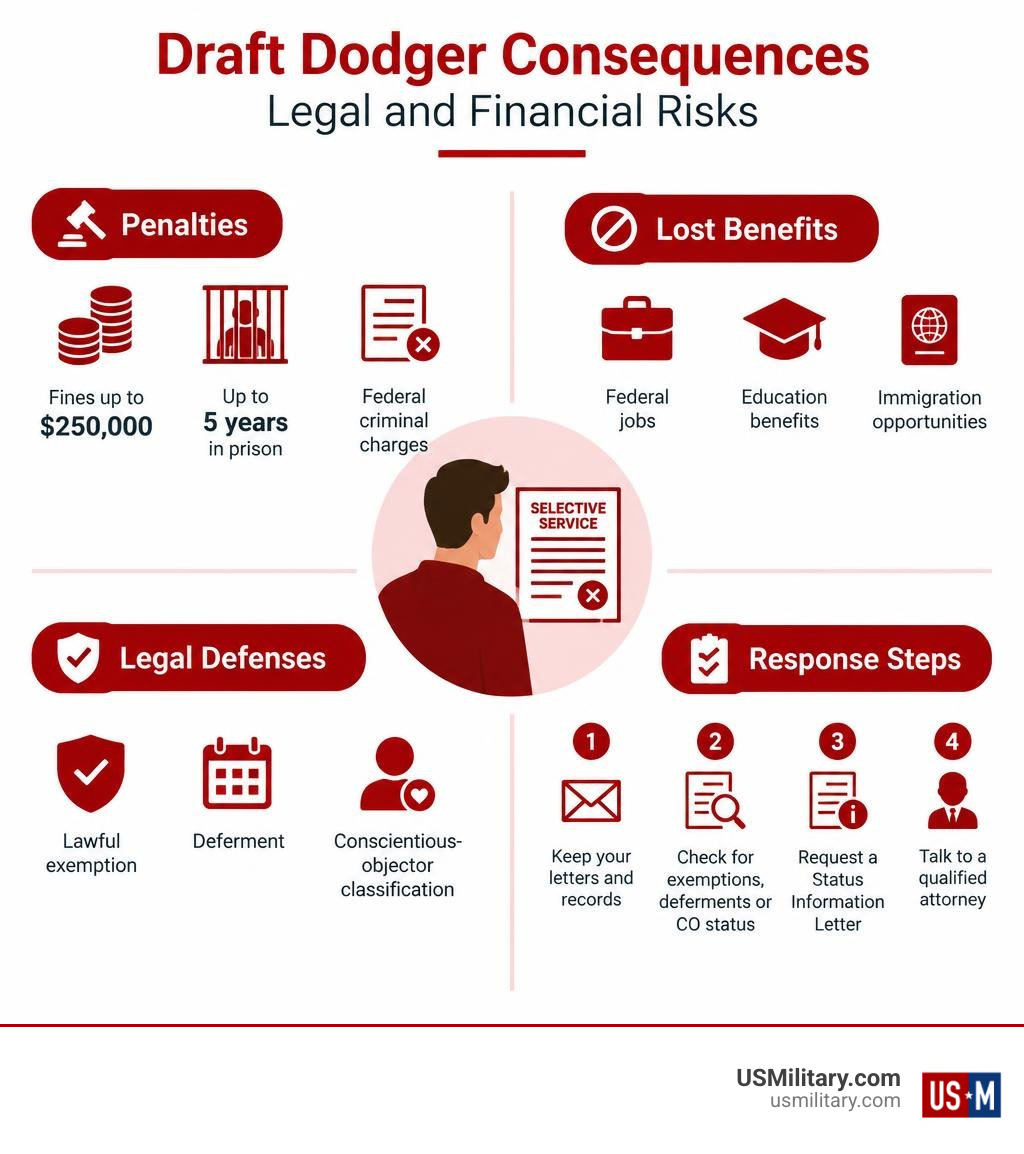
In the United States, knowingly failing to register for Selective Service or refusing a lawful induction order can carry serious consequences. Draft dodger consequences may include federal criminal charges, fines up to $250,000, up to five years in prison, and loss of access to certain federal jobs, education benefits, or immigration opportunities.
If you receive a notice or believe you missed registration, do not ignore it. Take these steps:
- Keep every letter and record from Selective Service.
- Check whether you qualify for a lawful exemption, deferment, or conscientious-objector classification.
- Request a Status Information Letter if you are past the registration age.
- Speak with a qualified attorney or legal-aid organization before missing a deadline or making a statement to authorities.
The United States does not currently have an active draft, but Selective Service registration remains a legal duty for most men ages 18 through 25. Draft evasion is not the same as lawful conscientious objection, medical disqualification, or an approved hardship claim. The difference often comes down to whether a person followed the legal process or deliberately refused it.
History shows both the scale and uneven impact of enforcement. During the Vietnam War, roughly 570,000 men were classified as draft offenders, yet about 8,750 were convicted and 3,250 imprisoned. Even when prosecution is unlikely, unresolved registration or evasion issues can still affect education, government employment, citizenship, travel, and future legal matters.
I am LARRY FOWLER, publisher of the USMilitary.com Network since 2007, where I have helped active-duty members, veterans, and military families understand service-related rules, benefits, and career decisions. In this guide, I break down Draft dodger consequences in plain language so you can recognize the risks and identify lawful next steps.
Draft dodger consequences vocab to learn:
- What disqualifies you from the military draft
- Exemptions military draft
- what happens if you don’t register for selective service
Legal Classifications: Draft Dodger vs. Conscientious Objector vs. Resister
To fully understand the legal landscape of military conscription, we must separate lawful mechanisms from unlawful refusal. While public conversation often groups non-serving individuals together under a single label, federal law strictly distinguishes between someone who evades their obligations, someone who registers a sincere moral objection, and someone who openly challenges conscription through civil disobedience.
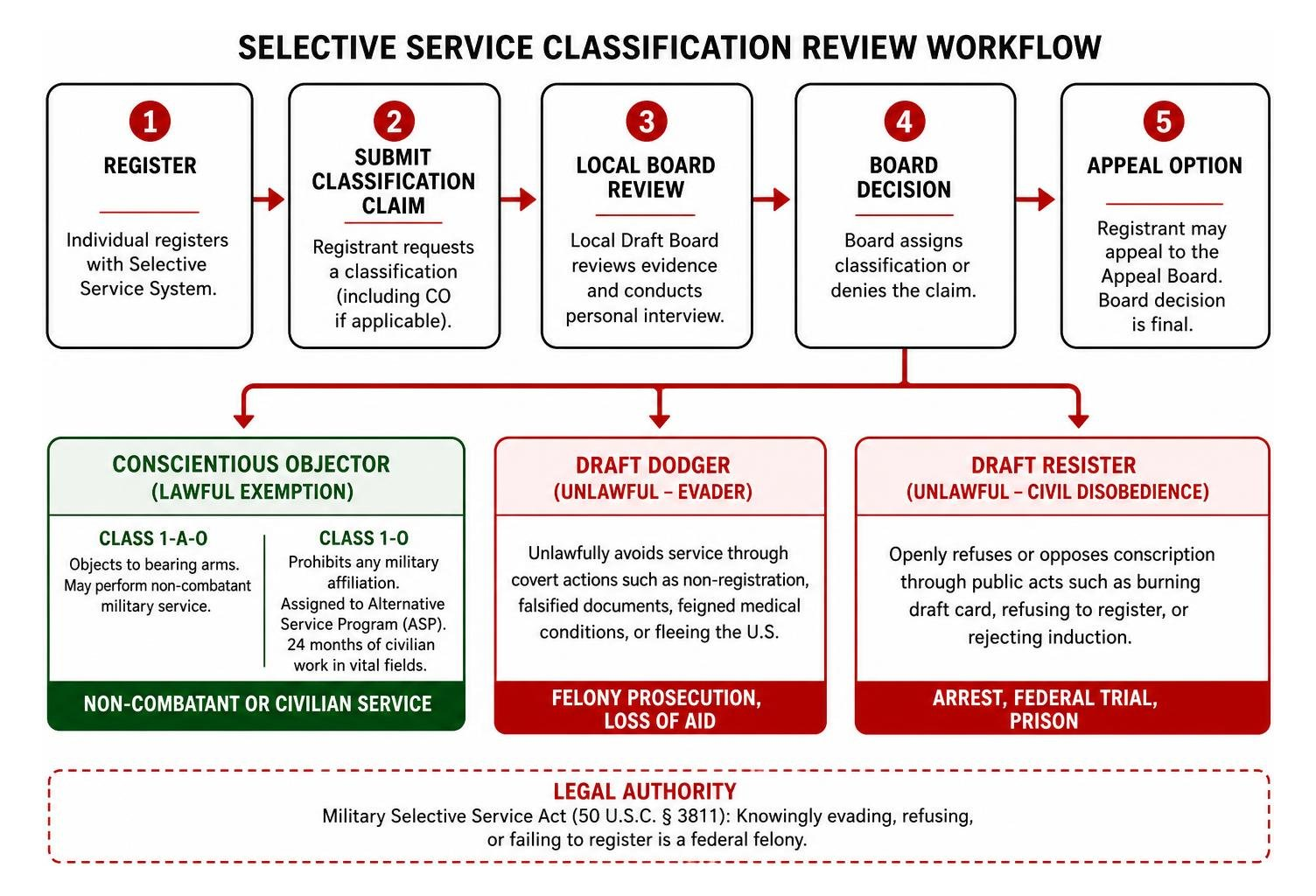
A draft dodger (or draft evader) is an individual who unlawfully attempts to escape compulsory military service through covert actions, intentional non-registration, falsified documents, feigned medical conditions, or by fleeing the jurisdiction of the United States. Draft dodging focuses on personal circumvention of statutory mandates without publicly challenging the underlying policy.
A conscientious objector (CO) is someone who seeks a lawful administrative exemption based on deeply held religious, ethical, or moral beliefs that prohibit participation in war. A recognized CO works directly within the regulatory framework of the Selective Service System rather than breaking the law. To review the legal criteria and historical standards governing these classifications, read The Essential Guide To Conscientious Objector Definitions.
A draft resister takes an overt, public stance against conscription policy through intentional civil disobedience. Rather than quietly disappearing or fleeing across national borders, a resister openly burns their draft card, refuses to register, or publicly turns down an induction order to protest the morality or constitutionality of a conflict. Resisters accept the likelihood of arrest and trial as part of their political confrontation with the state.
Lawful Exemptions and Alternative Civilian Service
Federal statutes provide clear avenues for those who cannot participate in combat due to genuine moral convictions. The law establishes two main classifications for conscientious objection:
- Class 1-A-O: Individuals who object to bearing arms but agree to perform non-combatant military service, such as serving as an unarmed combat medic.
- Class 1-O: Individuals whose ethical or religious beliefs prohibit any military affiliation. These registrants are assigned to the Alternative Service Program (ASP), completing 24 months of civilian work in fields vital to national health, safety, or environmental protection.
Securing CO status requires formal documentation using SSS Form 22 and appearing before a local draft board to demonstrate the sincerity and origin of your moral framework. For a detailed walkthrough of this administrative process, follow The Step By Step Conscientious Objector Application Roadmap. If you are evaluating how these rules apply during national mobilizations, explore our guide on whether Can You Refuse To Go To War If Drafted.
Modern Legal Penalties and Draft Dodger Consequences in the United States
Under the Military Selective Service Act (codified under 50 U.S.C. § 3811), knowingly evading, refusing, or failing to register for the draft is a major federal felony. The Department of Justice possesses the statutory authority to bring criminal indictments against any non-compliant male residing in the United States.

The direct statutory penalties for a conviction under federal draft evasion laws include:
- Federal Imprisonment: Up to five years in a federal penitentiary.
- Monetary Fines: Criminal fines reaching up to $250,000.
- Felony Record: A permanent criminal record that results in the loss of core civil rights, including the right to vote in many jurisdictions and the right to possess firearms.
Beyond courtroom sentencing, draft evasion and non-registration trigger administrative and collateral penalties that can derail personal finances and careers indefinitely.
Federal Felonies and Financial Draft Dodger Consequences
The federal government enforces compliance through administrative restrictions that block access to key civic and educational programs.
- Denial of Federal Financial Aid: Men who fail to register with the Selective Service within the legal statutory window (between their 18th and 26th birthdays) historically faced immediate disqualification from Title IV financial assistance, including Pell Grants, Direct Subsidized and Unsubsidized Loans, and federal work-study programs.
- Federal Employment Disqualification: Non-registered individuals are permanently barred from executive branch civil service employment, including positions within the Department of Defense, the Postal Service, and federal intelligence agencies.
- Security Clearance Ineligibility: A felony indictment or an unresolved, willful failure to register prevents an individual from obtaining the security clearances required for defense contractors and sensitive technology jobs.
- Naturalization Denials for Immigrant Males: Non-citizen males residing in the U.S. who fail to register between ages 18 and 26 cannot satisfy the “good moral character” mandate enforced by U.S. Citizenship and Immigration Services (USCIS), creating a statutory bar to naturalization.
To learn more about how non-registration alters academic and economic opportunities, read our report on No Registration No Education The Penalties For Skipping Selective Service.
State-Level Statutory Differences and Benefit Restrictions
Enforcement extends beyond Washington. Individual states tie compliance directly into state administrative codes, creating significant regional variation in penalties:
- Driver’s License Linkages: Over 40 states and U.S. territories have statutory provisions that automatically register male applicants with the Selective Service when they apply for or renew a driver’s license or state ID card.
- State-Level Employment and University Bans: States such as Ohio, Georgia, and Alabama prohibit unregistered men from holding state government positions or enrolling in state-supported universities at in-state tuition rates.
- Regional Judicial Approaches: State penal systems approach evasion with varying degrees of severity. In California, draft evasion laws generally emphasize alternative community service options and diversion programs. In contrast, Texas enforces stricter penalties and prosecutorial standards, including potential local confinement alongside federal proceedings.
Historical Precedents: Vietnam War Evasion, Demographic Shifts, and Presidential Pardons
The Vietnam War serves as the modern benchmark for examining draft evasion on a national scale. Between 1964 and 1973, an estimated 60 percent of draft-eligible American men took deliberate steps to avoid conscription, using legal deferments, medical claims, or covert flight.
The gap between the 570,000 men classified as draft offenders and the 3,250 who actually served prison time highlights how difficult broad conscription laws were to enforce. Those who were drafted and refused direct orders faced the military justice system under the Uniform Code of Military Justice (UCMJ). In the landmark military appellate case United States v. Pendergrass (1968), the Court of Military Appeals addressed the legal boundaries of Article 90, illustrating how military courts-martial treated insubordination and disputed inductions.
The 1960s Paternity Deferment Notch and Demographic Impact
One of the most consequential legal methods of draft avoidance during the Vietnam era was the III-A hardship (paternity) deferment. Established under Executive Order 11098, this provision granted an automatic draft deferment to men who were fathers and lived with their dependents.
The demographic impact of this rule was immense. In 1969, more than 4 million U.S. men held paternity deferments—more than twice the number holding II-S undergraduate college deferments. Men across the country hurried to start families to avoid military service (Bailey & Chyn, 2020).
Recognizing that the paternity deferment was skewing national birth patterns and shielding millions of men from the draft pool, President Richard Nixon issued an Executive Order in April 1970 eliminating paternity as an independent ground for future III-A deferments. Following this change, national fertility rates dropped noticeably back toward baseline levels.
Ford’s Conditional Clemency vs. Carter’s 1977 Presidential Pardon
Between 40,000 and 100,000 American men fled the country to avoid the Vietnam draft, settling primarily in Canada and Sweden. Those who left faced life in exile, cut off from family and under constant threat of arrest should they cross back into U.S. territory.
Resolving their legal status required executive intervention across two presidential administrations:
While President Jimmy Carter’s blanket pardon granted legal protection to draft dodgers, it drew fierce criticism from veterans’ organizations, and public support fell from 56 percent to 20 percent after its passage.
Crucially, Carter’s pardon did not cover military deserters—service members who abandoned their posts after enlistment or induction. Deserters remained subject to court-martial under UCMJ Article 85, leading to arrests and prosecutions decades after the war ended. Furthermore, an estimated 50,000 men chose to remain permanently in Canada, having established careers and families abroad.
International Conscription Realities and Lawful Navigation Steps
Mandatory conscription is not just a historical topic; it remains active policy in many countries around the world. Examining foreign conscription frameworks illustrates the legal and personal costs of draft evasion globally:
- South Korea: Mandatory service remains strictly enforced. Evasion results in immediate incarceration, permanent career disqualification, and intense social stigma. The government has historically issued lifetime entry bans and deportations for public figures and celebrities who attempted to evade service.
- Russia and Ukraine: Following the outbreak of large-scale hostilities, both nations enacted strict mobilization controls. Russia implemented digital draft notices, asset freezes, and up to ten-year prison terms for evaders, prompting hundreds of thousands of men to emigrate. Ukraine restricted foreign travel for military-aged men, prosecuting unauthorized border crossings and evasion.
- Syria: Draft evasion carries severe prison sentences and mandatory assignment to frontline combat units, driving millions of young men into permanent international displacement.
For an overview of international practices, read the reference analysis on Draft evasion.
Resolving Non-Registration and Navigating Selective Service Issues
If you failed to register with the Selective Service System before your 26th birthday, criminal prosecution is unlikely, but administrative disqualifications from federal jobs and benefits can still affect you.
Follow these steps to address non-registration:
- Request a Status Information Letter (SIL): If you are 26 or older, download and submit the official SIL request form from the Selective Service System.
- Provide Documentary Evidence: If your failure to register was non-willful (for instance, living outside the country, continuous medical hospitalization, or military service), submit sworn affidavits and supporting records.
- Review Medical and Mental Standards: If you are subject to an active draft inquiry or need to establish an exemption, consult the list of 10 Disqualifying Disabilities For Military Draft.
- Explore Administrative Relief Options: Learn the established legal mechanisms through our resource on How To Legally Avoid The Draft Without Leaving The Country.
- Consult Legal Counsel: If you face formal administrative denials or active military justice inquiries, consult an attorney who specializes in military and federal administrative law before submitting statements.
Frequently Asked Questions About Draft Evasion and Military Service
What is the maximum criminal penalty for draft evasion in the United States?
Under federal law (50 U.S.C. § 3811), knowingly evading the draft or failing to register is a felony punishable by up to five years in federal prison and criminal fines of up to $250,000. Convictions also carry permanent collateral consequences, such as losing the right to vote in select jurisdictions and losing eligibility for federal civil service employment.
What is the difference between draft dodging and military desertion?
The core distinction lies in an individual’s legal status:
- Draft Dodging (Draft Evasion) is committed by a civilian who fails to register or refuses a lawful induction order before entering military service. It falls under the civilian jurisdiction of the Department of Justice and the federal court system.
- Desertion is committed by a sworn service member who abandons their military unit without authority and with the intent to remain away permanently. Desertion is prosecuted under Article 85 of the Uniform Code of Military Justice (UCMJ) by military court-martial, carrying penalties that include confinement, dishonorable discharge, and, during declared wartime, the death penalty.
Can draft evasion prevent an immigrant from obtaining U.S. citizenship?
Yes. Non-citizen males residing in the United States between the ages of 18 and 26 (including green card holders, refugees, and undocumented immigrants) are required by law to register with the Selective Service. Knowingly and willfully failing to register violates the “good moral character” requirement enforced by USCIS, creating a statutory bar that can prevent approval of an Application for Naturalization (Form N-400).
Conclusion
The legal framework of conscription relies on strict compliance, clear administrative categories, and enforceable penalties. Draft dodging carries lifelong criminal, financial, and professional consequences—from federal felony indictments to permanent disqualification from civil service careers and public benefits.
If you are navigating an active induction order, an unresolved registration notice, or an administrative exemption, handling the matter through official legal channels is critical.
- Start by understanding military draft and Selective Service rules to protect your civil rights.
- Review our complete library of guidance at USMilitary.com for detailed insights into military law, service branch careers, and veteran benefits.
Medical and Demographic References
Bailey MJ, Chyn E. “The Demographic Effects of Dodging the Vietnam Draft..” AEA papers and proceedings. American Economic Association, 2020. PMCID PMC8095165.
Free for Service Members & Veterans
Get the military benefits intel no one tells you about.
Weekly updates on VA benefits, pay changes, and money tips — free for service members and veterans.
No spam. Unsubscribe anytime. Your info is never shared.


