
What You Can Expect With the Military Draft in 2027 is not an active return to conscription. The United States remains an all-volunteer military force, and it has not used an active draft since 1973.
Here is the quick answer:
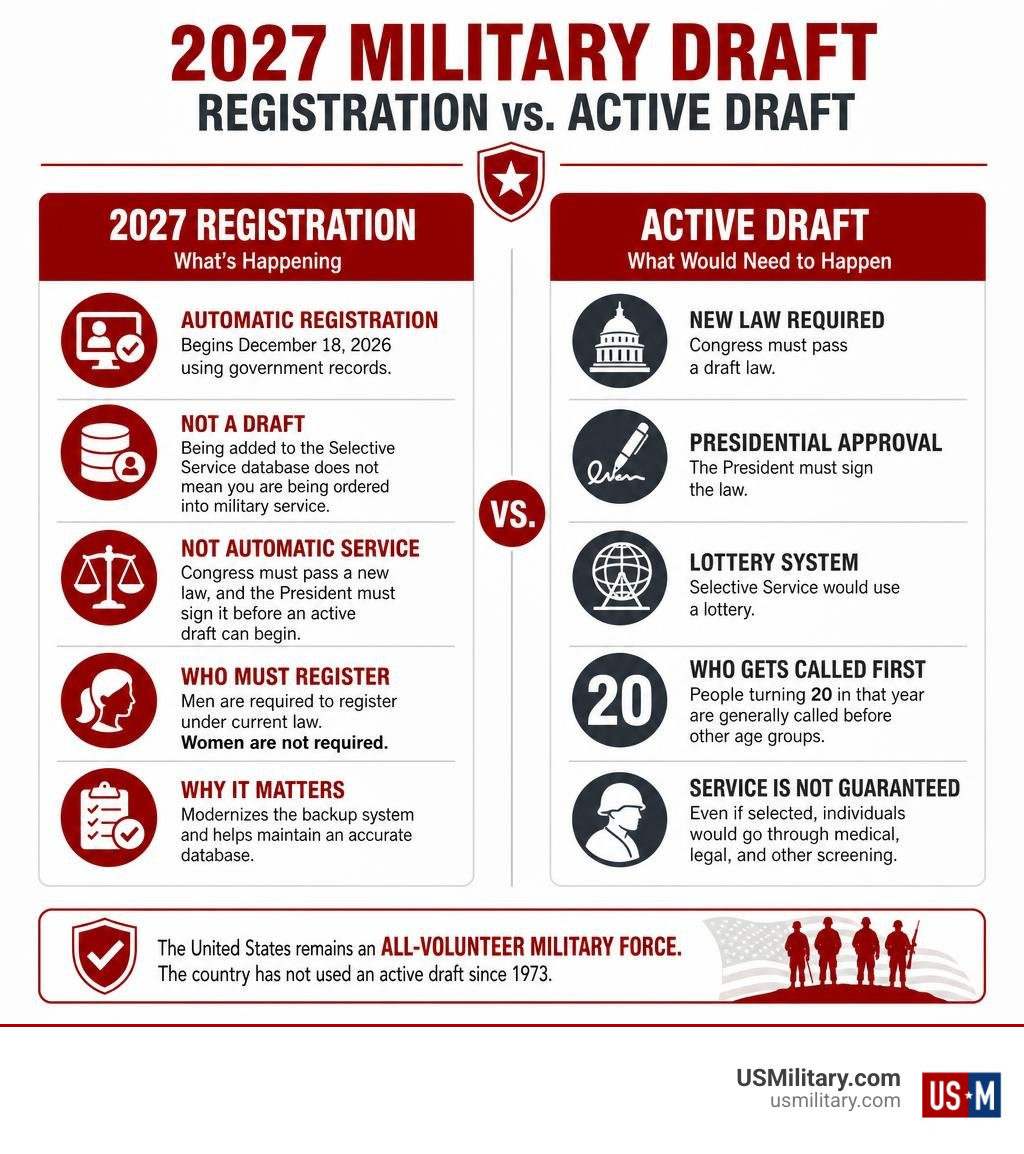
- Automatic Selective Service registration begins December 18, 2026 for eligible men, using government records rather than relying only on individual sign-ups.
- Registration is not a draft. Being added to the Selective Service database does not mean someone is being ordered into military service.
- Congress would need to pass a new law, and the President would need to sign it, before an active draft could begin.
- Women are not required to register under current general Selective Service law.
- If Congress restored a draft, Selective Service would use a lottery, with people turning 20 in that year generally called before other age groups.
The 2027 change is mainly about modernizing a backup system. It follows years of lower registration compliance after the Selective Service question was removed from the FAFSA process. It also raises fair questions about database accuracy, privacy, and what eligible people should do to check their status.
I am Larry Fowler, publisher of the USMilitary.com Network since 2007, where I have helped service members, veterans, and future recruits make sense of military information and benefits. In this guide to What You Can Expect With the Military Draft in 2027, I will separate verified rules from online rumors so you can understand what may affect you.
**What You Can Expect With the Military Draft in 2027 ** word roundup:
- How The Military Draft Works
- Who gets pulled first in a draft?
- What disqualifies you from the military draft
What You Can Expect With the Military Draft in 2027: Automatic Registration and Modernization

As we enter 2027, the biggest change surrounding the U.S. Selective Service System is administrative rather than operational. For decades, young men turned 18 and filled out paper post office cards or registered online. Starting in late December 2026, the federal government shifts to an automated, background database system.
This modernization effort is designed to ensure that the Selective Service maintains an accurate list of draft-eligible individuals without putting the entire burden on teenagers to self-report. However, automatic draft registration takes effect in December purely as a record-keeping overhaul, not as a sign that troop call-ups are around the corner.
How the December 2026 NDAA Mandate Automates Draft Registration
The legal basis for this transformation comes directly from Section 535 of the Fiscal Year 2026 National Defense Authorization Act (NDAA). Under this federal statutory mandate, the Selective Service System transitions from manual registration to automated cross-agency data matching.
The automated process relies on established state and federal government databases, including:
- State Departments of Motor Vehicles (DMVs): Historically, state driver’s license applications accounted for over 60% of all Selective Service sign-ups. The new mandate fully integrates state records across all participating states.
- Social Security Administration (SSA): Evaluates citizenship status, age verification, and sex assigned at birth.
- Internal Revenue Service (IRS) and Census Bureau: Ensures current residential address data is matched against federal records.
This legislative overhaul became urgent after registration compliance dropped significantly. Between 2009 and 2019, nearly 24% of all draft registrations occurred through a simple check-box on the Free Application for Federal Student Aid (FAFSA). When Congress removed that checkbox in 2021, overall compliance among 18-year-old men plummeted from 89% down to roughly 81% by 2024.
By removing the self-registration requirement, the government automatically populates the roster while protecting young men from unintentionally losing access to future federal benefits. If you want to verify your listing or learn how manual entries used to work, check out our guide on How to Register for Selective Service.
Selective Service System FY2027 Budget and Digital Mobilization
To support this automated database shift, Congress increased funding for the agency. The Selective Service System budget request for FY2027 stands at $32.3 million—up from $31.3 million in FY2026—with an extra $6 million specifically earmarked to replace legacy mainframe computer networks.
Part of these updated funds allows the agency to run advanced digital draft mobilization simulations. These computer-based test runs simulate a full mobilization pipeline to ensure that, if a national crisis ever occurred, the system could handle millions of records seamlessly within days. While news of these digital drills makes headlines, defense officials emphasize that testing software is standard operational readiness. You can explore how these modern tech upgrades sparked public interest in Fears Of A US Draft Grow As The Selective Service Modernizes.
How Draft Mechanics Work: Triggers, Priority Groups, and Demographics
To understand what you can expect with the military draft in 2027, it helps to distinguish administrative record-keeping from actual conscription. The draft cannot be triggered by a single government official or defense agency.
| Feature | Automatic Selective Service Registration | Active Military Draft |
|---|---|---|
| Current Status | Active baseline policy starting Dec 2026 | Inactive (No active draft since Feb 1973) |
| Legal Mandate | FY2026 NDAA (Section 535) | New Act of Congress + Presidential Signature |
| What It Requires | Automated database registration for men 18–25 | Physical/mental evaluation and forced military induction |
| Authority | Selective Service System administrative duty | Joint Congressional and Presidential authority |
| Target Audience | Male U.S. citizens & residents turning 18 | Selected age cohorts via random lottery |
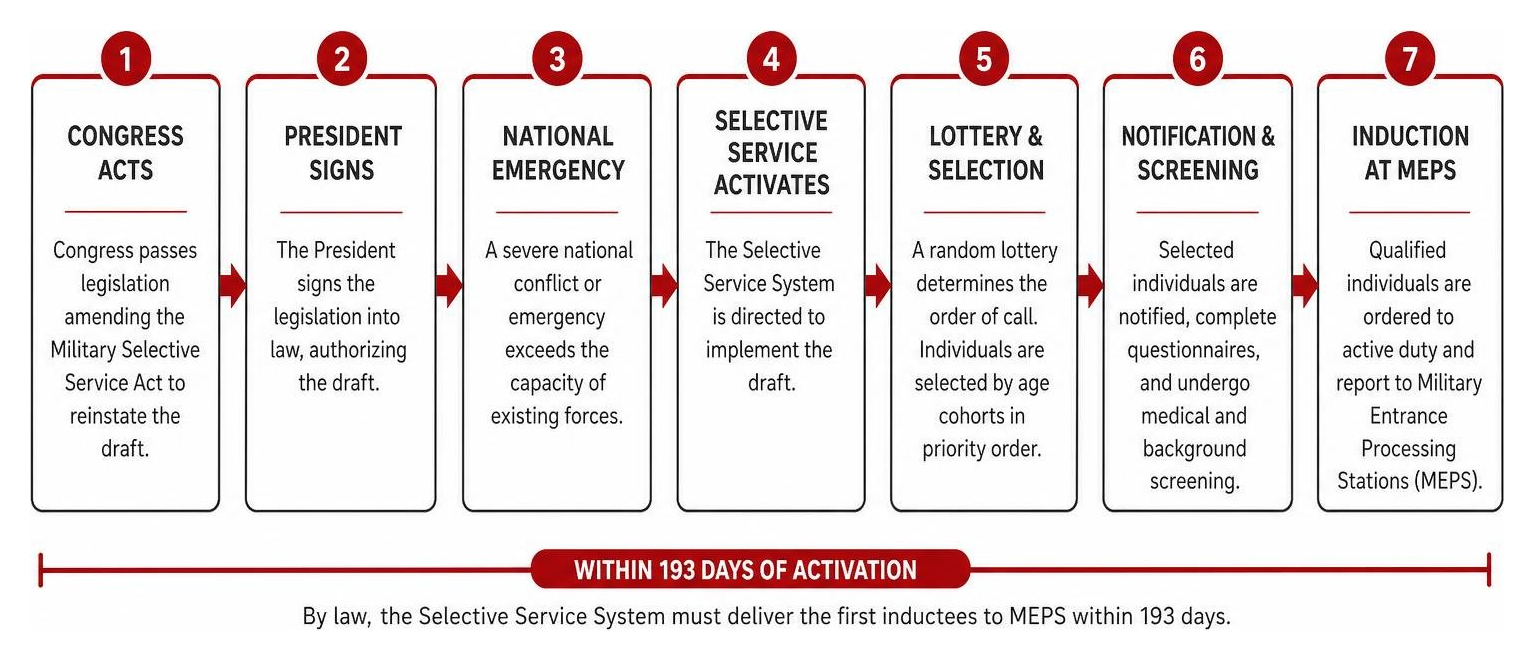
Reinstating conscription requires what defense analysts call a “Triple Lock” framework:
- A National Emergency: A severe national conflict or emergency that exceeds the capacity of the current 1.3 million active-duty, Reserve, and National Guard forces.
- Congressional Legislation: Both the House of Representatives and the Senate must pass an explicit law amending the Military Selective Service Act to reinstate draft authority.
- Presidential Authorization: The President must sign the passed legislation into law.
If this Triple Lock is ever engaged, statutory law requires the Selective Service System to deliver the very first inductees to Military Entrance Processing Stations (MEPS) within 193 days. For a complete breakdown of this statutory sequence, read How Does a Military Draft Work?.
What You Can Expect With the Military Draft in 2027 for Age Eligibility
If Congress ever authorized a draft, conscription would not pull people at random across all age brackets. Instead, the Selective Service follows a strict, mathematical sequence based on birth year and age cohorts.
The lottery sequence operates in the following priority order:
- 20-Year-Old Cohort (Priority Tier 1): The very first people called are those who turn 20 during the calendar year of the draft lottery.
- 21-Year-Old Cohort: If more troops are required, the draft moves to those turning 21.
- 22 through 25-Year-Olds: The system progresses upward sequentially through age 22, 23, 24, and 25.
- 19-Year-Olds: Drafted only after all eligible 20- to 25-year-olds have been processed.
- 18.5-Year-Olds (Lowest Priority): Young men who are 18 and a half are the absolute last group considered.
Once a man reaches his 26th birthday, he passes the legal ceiling of draft liability under general Selective Service law.
The lottery itself is designed to be completely impartial. The Selective Service uses two physical transparent drums managed under National Institute of Standards and Technology (NIST) oversight. One drum contains capsules representing all 365 days of the year (plus February 29 for leap years). The second drum contains sequence numbers from 1 to 365. If “August 4” is drawn alongside “1,” everyone born on August 4 in that 20-year-old priority age group receives induction orders first. Discover more about this selection mechanism in Who Gets Pulled First in a US Military Draft?.
Mandatory Registration Rules for Men and the Exclusion of Women
Under current federal law, mandatory Selective Service registration applies strictly to male citizens and male non-citizen residents (including lawful permanent residents, refugees, and undocumented immigrants) between ages 18 and 25. Eligibility is determined based on sex assigned at birth.
While women serve in all active combat roles across every branch of the military, Congress has repeatedly excluded women from general draft registration requirements. Past legislative amendments proposing to require women to register were removed from final defense authorization bills before passage.
The legal foundation for male-only registration dates back to the 1981 Supreme Court decision Rostker v. Goldberg, which upheld Congress’s authority to limit registration to men based on the legislative focus of combat readiness at the time. Although the Pentagon lifted all restrictions on women serving in direct combat roles in 2015, Congress has chosen not to alter the core statutory text of the Military Selective Service Act. To check detailed requirements for residency and status, consult Who Is Eligible for the US Draft?.
Exemptions, Deferments, and Special Medical Draft Protocols
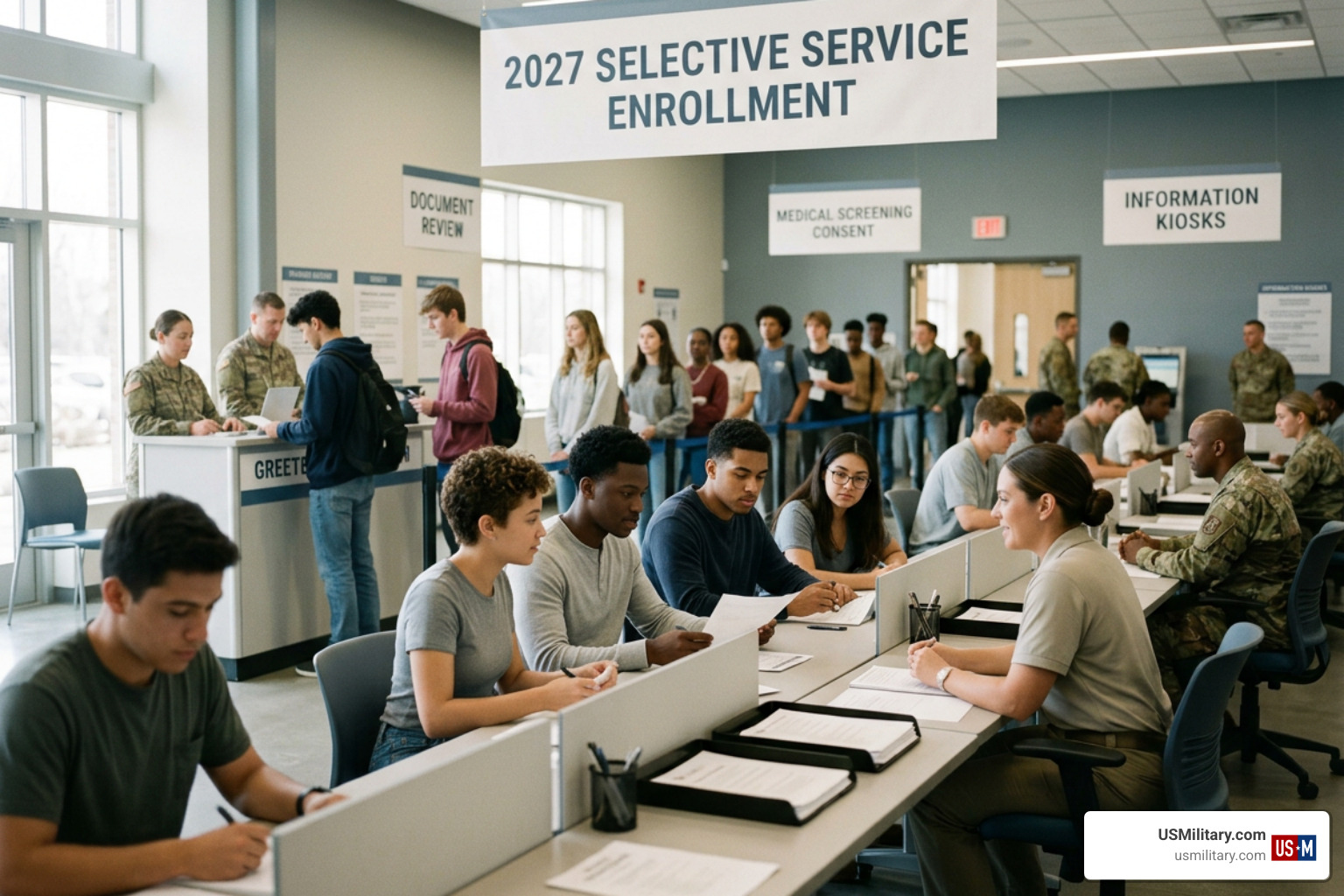
Being drawn in a lottery does not mean immediate deployment to a battle zone. Receiving an induction order simply means reporting to a local Military Entrance Processing Station (MEPS) for physical, mental, and moral evaluations.
Upon initial mobilization, every registrant is assigned a default classification of 1-A (“available immediately for military service”). However, draftees have a strict 10-day window from the date their induction notice is issued to submit claims for deferments, postponements, or exemptions to local draft boards. Over 2,000 local draft boards—staffed by civilian volunteers appointed by the Selective Service Director—are maintained across the country to review these claims locally. You can review all basic operational standards in Everything You Need to Know About the Military Draft.
Conscientious Objectors, Student Postponements, and Hardship Deferments
If an active draft were reinstated, federal law guarantees several formal protection pathways:
- Conscientious Objectors (Class 1-O and 1-A-O): Individuals who sincerely oppose participation in war in any form due to deep moral, ethical, or religious beliefs can file for Conscientious Objector status. If approved, Class 1-A-O draftees serve in non-combatant military roles (such as medical personnel), while Class 1-O draftees perform alternative civilian service (such as healthcare, environmental, or community conservation work) for two years.
- High School Student Postponements: High school students receiving an induction order are granted a postponement until they graduate or reach age 20, whichever comes first.
- College Student Postponements: College students can defer induction until the end of their current semester. College seniors in their final academic year can receive a postponement until the end of the full academic year.
- Hardship Deferments (Class 3-A): Granted if an individual’s induction would cause severe financial, physical, or emotional hardship to dependent family members.
- Sole Surviving Son Exemption: Protects individuals if a parent or sibling died in the line of duty or as a result of military service.
For full lists of medical standards and legal disqualifications, read Military Draft Disqualifications.
The Health Care Personnel Delivery System (HCPDS)
Separate from the general military draft, the Selective Service System maintains a standby plan known as the Health Care Personnel Delivery System (HCPDS). If authorized by Congress during a severe medical mobilization, the HCPDS would draft licensed healthcare workers into military service.
The medical draft features distinct operational rules:
- Age Range: Covers licensed healthcare professionals between ages 20 and 45 (and can extend up to age 54 in specialized fields).
- Pool Size: Targets a standby pool of roughly 3.4 million licensed healthcare professionals across over 60 medical specialties, including doctors, registered nurses, trauma specialists, and medical technicians.
- Inclusion of Women: Unlike the general draft, women who are qualified healthcare professionals are subject to the HCPDS medical draft unless Congress specifically orders otherwise.
- Service Commitment: Inducted healthcare workers are ordered to serve a two-year tour of duty in military medical facilities.
For official historical framework guidelines on standby mobilization, visit Return to the Draft : Selective Service System.
Modern Realities: Likelihood of Conscription, Privacy Concerns, and Action Steps
When evaluating what you can expect with the military draft in 2027, practical reality is far more reassuring than online speculation. The U.S. military has relied entirely on the All-Volunteer Force since 1973, and defense leaders consistently prefer professional, highly trained volunteers over forced conscripts.
What You Can Expect With the Military Draft in 2027 Regarding Likelihood and Recruitment
Military recruitment challenges are real. Department of Defense data reveals that only about 23% of young Americans ages 17 to 24 meet basic military entry standards without needing administrative waivers. The primary disqualifying factors include medical conditions, physical fitness limitations, prior drug use, and educational requirements.
Despite these recruiting shortfalls, military leaders and defense policy experts agree that an active draft in 2027 remains extremely unlikely for several clear reasons:
- High-Tech Military Requirements: Modern warfare relies heavily on advanced cyber capabilities, specialized technology, and complex weapons systems. Training draftees who serve for only two years is inefficient compared to retaining career professional soldiers.
- Recruitment Waivers and Incentives: The armed forces address recruitment gaps by raising enlistment bonuses up to $50,000, adjusting administrative waivers, and expanding preparatory academic and physical fitness camps.
- Political Resistance: Reinstating conscription is widely viewed by political analysts as virtually impossible without a direct, catastrophic foreign invasion or existential national threat.
To read a detailed breakdown of how conscription models are analyzed by defense journalists, see US military draft: What 2026 conscription could look like.
Data Privacy Issues and Steps to Protect Your Status
While automatic draft registration simplifies compliance, it introduces real data privacy and accuracy concerns. Civil liberties groups have highlighted Privacy Act issues regarding automated data matching between state DMVs, the IRS, and the Social Security Administration.
Automated systems can inadvertently scrape outdated residential addresses or pull mismatched records. If an automated database matches outdated information, an individual might miss critical correspondence in the unlikely event of a mobilization.
Here are practical, proactive steps young men should take in 2027:
- Verify Your Selective Service Record: Visit the official Selective Service System website (SSS.gov) after turning 18 to confirm your automatic record shows correct contact details.
- Keep Address Information Current: Ensure your state driver’s license and Social Security records reflect your correct residential address.
- Document Beliefs Early (For Conscientious Objectors): Under current law, you cannot formally apply for Conscientious Objector status during peacetime registration. However, if you hold personal beliefs against military service, maintain written personal records, journal entries, or letters with personal mentors that document your convictions over time.
- Understand the Issues: Read civil policy analysis like Automatic Draft Registration: What Comes Next and Why it’s a Problem to stay informed on civil liberties updates.
Frequently Asked Questions About the 2027 Military Draft
Is an active military draft returning in 2027?
No. An active military draft is not returning in 2027. The United States continues to rely exclusively on its all-volunteer armed forces. The December 2026 change is an administrative database update to automate Selective Service registration, not an activation of mandatory military service. Reinstating a draft requires a formal act passed by Congress and signed by the President.
What are the penalties for failing to register with Selective Service?
Failing to register with the Selective Service is legally classified as a federal felony punishable by fines up to $250,000 and up to 5 years in prison. In practice, the federal government has not criminally prosecuted anyone for non-registration since 1986. Instead, non-compliance carries strict administrative penalties: ineligibility for federal civil service jobs, potential delays in U.S. citizenship naturalization for immigrants, and restrictions on certain state-funded student aid and state employment. The new automatic registration system largely eliminates these penalties by automatically registering eligible individuals through state and federal database records.
Are women required to register for the Selective Service in 2027?
No. Under current federal law, women are not required to register for the general Selective Service draft. Legislative proposals to include women in draft registration have been repeatedly removed from final versions of defense bills. The only scenario where women could currently be drafted is under the standby Health Care Personnel Delivery System (HCPDS) for licensed healthcare professionals aged 20 to 45, if authorized by Congress during a severe medical emergency.
Conclusion
Understanding What You Can Expect With the Military Draft in 2027 boils down to a clear distinction: the federal government is updating its administrative records, not calling citizens to war. Automatic Selective Service registration simply streamlines background data collection so young men do not face penalties for forgetting a paper form.
The U.S. military remains fully committed to its all-volunteer force, backed by modern technology and professional career personnel. Knowing your rights, keeping your address updated, and understanding how national backup systems function gives you total peace of mind.
For ongoing military policy updates, career path comparisons, VA benefits guidance, and educational resources, explore our complete Comprehensive USMilitary Draft Overview and bookmark USMilitary.com as your trusted hub for reliable military information.
Free for Service Members & Veterans
Get the military benefits intel no one tells you about.
Weekly updates on VA benefits, pay changes, and money tips — free for service members and veterans.
No spam. Unsubscribe anytime. Your info is never shared.


