What the 2026 Military Draft Disqualifications Mean for You

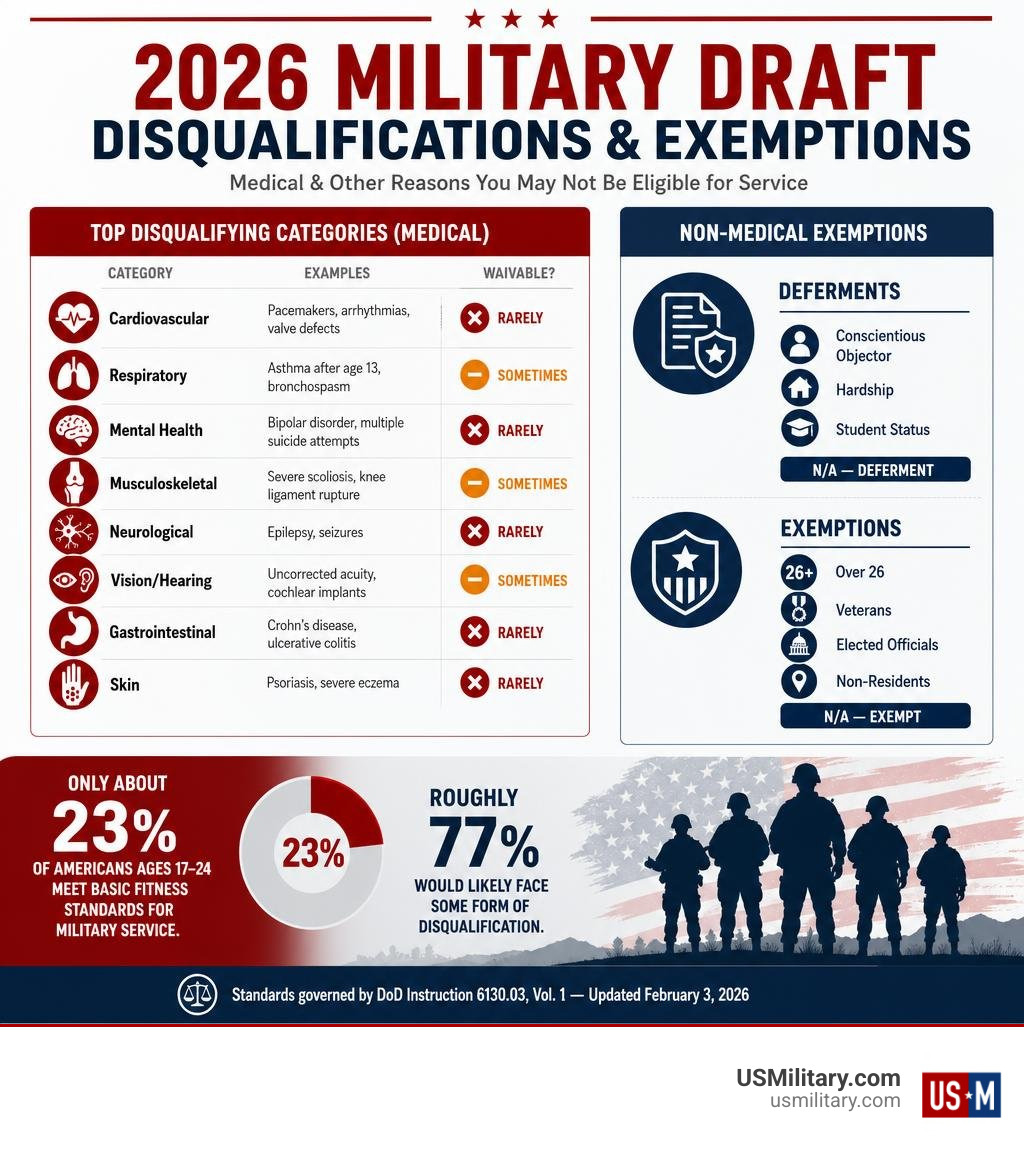
Military draft disqualifications in 2026 — medical and other exemptions cover a wide range of conditions and circumstances that can prevent someone from being inducted if a draft is activated. Here is a quick overview of the main categories:
Top Disqualifying Categories at a Glance:
| Category | Examples | Waivable? |
|---|---|---|
| Cardiovascular | Pacemakers, arrhythmias, valve defects | Rarely |
| Respiratory | Asthma after age 13, bronchospasm | Sometimes |
| Mental Health | Bipolar disorder, multiple suicide attempts | Rarely |
| Musculoskeletal | Severe scoliosis, knee ligament rupture | Sometimes |
| Neurological | Epilepsy, seizures | Rarely |
| Vision/Hearing | Uncorrected acuity, cochlear implants | Sometimes |
| Gastrointestinal | Crohn’s disease, ulcerative colitis | Rarely |
| Skin | Psoriasis, severe eczema | Rarely |
| Non-Medical | Conscientious objector, hardship, student status | N/A — deferment |
| Age/Status | Over 26, veterans, elected officials, non-residents | N/A — exempt |
Right now, there is no active draft. But with U.S. military tensions running high in 2026 and the NDAA 2026 mandating automatic Selective Service registration via DMV and Social Security records by December 2026, the question is more relevant than ever.
Here is a striking reality: only about 23% of Americans ages 17–24 meet basic fitness standards for military service. That means roughly 77% would likely face some form of disqualification — whether medical, psychological, or otherwise.
During World War II, nearly 4 million men were rejected for medical or educational reasons alone — everything from poor eyesight to tooth decay. The standards today are just as detailed, governed primarily by DoD Instruction 6130.03, Vol. 1, which was updated as recently as February 3, 2026.
This guide breaks down exactly which conditions disqualify you, which can be waived, and what non-medical exemptions exist.
I’m Larry Fowler, publisher of the USMilitary.com Network — a resource I’ve been building since 2007 to help individuals navigate complex military topics, including the evolving landscape of military draft disqualifications in 2026 and medical and other exemptions. Over nearly two decades, I’ve helped hundreds of thousands of service members, veterans, and military-eligible individuals find clear, reliable answers to questions exactly like these.
Important military draft disqualifications 2026: medical & other exemptions terms:
- What disqualifies you from the military draft
- Military Draft For Selective Service To Begin
- Does the US currently have a military draft
The 2026 Selective Service Landscape and MEPS Process
The way the United States handles draft preparedness is undergoing its most significant shift in over fifty years. Under the National Defense Authorization Act (NDAA) for Fiscal Year 2026, the federal government is transitioning to an automatic registration mandate. By December 18, 2026, the Selective Service System will automatically register male U.S. citizens and immigrant non-citizens between the ages of 18 and 25 using existing federal databases, including Department of Motor Vehicles (DMV) records and Social Security Administration data.

This upgrade to the Selective Service System overview eliminates the traditional self-registration requirement. However, registration is not enlistment. If Congress and the President were to activate a draft, registered individuals would receive orders to report to a Military Entrance Processing Station (MEPS) for evaluation.
At MEPS, the military determines your physical, mental, and moral fitness for service. Recently, the Department of Defense shifted its strategy to identify medical issues much earlier in the recruitment pipeline. According to a report on how the military moves to issue medical disqualifications earlier in the recruitment process, the Pentagon now prescreens applicants for 28 specific medical conditions before they even report for a physical exam.
This prescreening protocol, detailed in reports about how the military begins prescreening recruits for 28 medical conditions, is designed to save administrative resources and spare applicants false hope. If an individual’s medical records flag one of these 28 conditions, processing is paused immediately unless a service waiver authority grants a rare exception. This means a modern draft would weed out disqualified individuals long before they reached basic training. For a complete look at what this looks like, you can read our guide on what disqualifies you from the military draft.
military draft disqualifications 2026: medical & other exemptions
If the draft were reinstated, the Pentagon would apply the exact same medical standards used for voluntary enlistment today. These criteria are defined under DoD Instruction 6130.03, Volume 1. While some minor issues might qualify for a waiver, many conditions are permanently disqualifying.
To help you understand where you might stand under the current 2026 rules, we have compiled an exhaustive breakdown of the medical conditions that impact draft eligibility. For deeper details, you can view our comprehensive military draft disqualification list or read about the specific medical conditions that keep you out of the draft.
Primary Medical Disqualifications and the 4-F Classification
If a draft board or MEPS medical officer finds you unfit for military service due to a physical, mental, or learning disability, you are assigned the historical 4-F classification. This status means you are fully deferred and not qualified for military duty.
Several major body systems trigger an automatic 4-F classification:
- Cardiovascular Conditions: Any history of heart disease, valvular abnormalities, or active cardiac issues will keep you out. If you have a pacemaker or suffer from significant cardiac arrhythmias, you are permanently disqualified.
- Gastrointestinal Disorders: Chronic inflammatory bowel conditions like Crohn’s disease and ulcerative colitis are flagged during early prescreening and are highly unlikely to receive waivers. Severe gastroesophageal reflux disease (GERD) that requires constant clinical management can also be disqualifying.
- Endocrine System: If you are wondering, can you join the military with diabetes, the answer is generally no. Active, insulin-dependent diabetes is an automatic disqualifier.
- Musculoskeletal Issues: Severe joint, bone, or spine deformities will prevent induction. Conditions like severe scoliosis (with significant spinal curvature) or a history of knee ligament ruptures (such as an unreconstructed or unstable ACL) are major red flags. While an ACL reconstruction is common, it remains disqualifying until you are fully healed, free of pain, and have documented normal joint function.
For a closer look at the most common physical issues, check out our list of the 10 disqualifying disabilities for military draft.
Sensory, Respiratory, and Systemic Conditions
Beyond major organ systems, the military maintains strict guidelines regarding your senses, breathing, and systemic allergies:
- Vision Standards: Your distant visual acuity must correct to at least 20/40 in each eye. Severe refractive errors (extreme near-sightedness or far-sightedness) are disqualifying. If you have had refractive surgery (like LASIK or PRK), you are disqualified unless the surgery was performed more than 180 days before your medical exam, your eyes have fully stabilized, and you meet specific pre-operative criteria.
- Hearing Thresholds: Hearing loss is measured precisely using calibrated audiometers. If your hearing thresholds exceed 25 dB on average across key speech frequencies, you will be disqualified. Additionally, having a cochlear implant or unhealed tympanic membrane (eardrum) perforations will stop your processing.
- Dental Standards: While the military won’t disqualify you for a single cavity, severe dental decay, active orthodontic treatment (like braces that require ongoing adjustment), or severe malocclusion that prevents you from chewing normal food will hold up your induction.
- Respiratory Conditions: A common question we receive is, can you join the military with asthma. Under current standards, any diagnosis of asthma or reactive airway disease (bronchospasm) after your 13th birthday is disqualifying.
- Systemic and Skin Conditions: Severe food allergies — especially peanut allergies that cause systemic symptoms or anaphylaxis — are strictly disqualifying. Chronic, systemic skin diseases such as psoriasis are not waivable because they require specialized, continuous care that cannot be easily managed in austere field environments. Severe eczema or atopic dermatitis requiring prescription systemic therapies will also prevent enlistment.
For more details on these systemic issues, you can read the US military draft disqualifications list: See if you’re exempt | KTVU FOX 2 or explore the Medical exemptions that could prevent Americans from being drafted – Wilderness Marksman .
Mental Health, ADHD, and Neurological Standards
Modern warfare is incredibly stressful, which is why the Department of Defense enforces strict psychiatric and neurological benchmarks.

Psychiatric Disorders and military draft disqualifications 2026: medical & other exemptions
In previous conflicts, mental health was often overlooked until draft boards realized its impact on combat readiness. During World War II, nearly 2 million men were rejected by draft boards for neuropsychiatric reasons. Today, mental health conditions are evaluated with high scrutiny during the MEPS process.
Under the current rules for military draft disqualifications 2026: medical & other exemptions, the following psychiatric conditions are disqualifying:
- Bipolar Disorder and Psychotic Disorders: A confirmed diagnosis of bipolar disorder, schizophrenia, or any other psychotic disorder is an absolute barrier to service.
- Active Mood Stabilizers or Antipsychotics: If you require ongoing medication to manage depression, anxiety, or mood stability, you will be disqualified.
- Suicide Attempts: A history of multiple suicide attempts or self-mutilation is a permanent disqualifier.
- Depression and Anxiety: While mild, situational depression or anxiety can sometimes be waived, you must demonstrate a long period of clinical stability (usually at least 12 to 36 months) off all medications without any academic or professional accommodations.
ADHD, Learning Disabilities, and Cognitive Standards
The military has updated its policies regarding neurodivergence, but strict boundaries remain. Under the current military ADHD policy, a history of Attention Deficit Hyperactivity Disorder (ADHD) or Attention Deficit Disorder (ADD) is disqualifying unless you can meet specific waiver criteria:
- You must demonstrate at least 15 months of continuous academic or professional success while completely off all ADHD medications.
- You must not have required any special educational or workplace accommodations during that time.
- Your medical records must prove that your symptoms are fully managed without clinical intervention.
Learning disabilities and cognitive delays are also evaluated. If an applicant has a documented history of severe learning disorders that prevent them from passing the Armed Services Vocational Aptitude Battery (ASVAB) or require ongoing accommodations, they will be classified as 4-F.
Non-Medical Exemptions, Deferments, and Legal Penalties
If a draft is activated, not everyone who is physically fit will be sent to basic training. The Selective Service System maintains a clear structure of non-medical exemptions, temporary postponements, and deferments.
Conscientious Objectors, Hardship, and Student Deferments
If you receive an induction notice, you have the right to file a claim for reclassification with your local draft board. These boards are staffed by civilian volunteers in communities across the country.
- Conscientious Objectors: If your moral, ethical, or religious beliefs prevent you from participating in war, you can apply for conscientious objector status.
- Class 1-A-O: If you object only to combat, you can be drafted to serve in non-combatant roles (such as medical personnel).
- Class 1-O: If you object to any form of military service, you will be assigned to civilian alternative service (such as community service, conservation, or healthcare programs).
- Hardship Deferments (Class 3-A): If your induction would cause severe, irreplaceable emotional or financial hardship to your dependents (such as children, elderly parents, or a disabled spouse), you may receive a temporary deferment.
- Student Postponements:
- High school students can have their induction postponed until they graduate or reach age 20.
- College students can postpone their induction until the end of their current semester. If they are in their senior year, they can postpone until the end of the academic year.
For a deeper dive into the sequence of events during a draft reactivation, review the official Return to the Draft : Selective Service System page.
Automatic Exemptions, Age Limits, and military draft disqualifications 2026: medical & other exemptions
Under current federal law, several categories of individuals are automatically exempt or deferred from draft registration and induction:
- Age Limits: The draft pool is strictly limited to young adults. If you are wondering, can you be drafted at age 40, the answer is a definitive no. The maximum age for draft eligibility is 26. Once you turn 26, you are permanently exempt from the general draft.
- Elected Officials: Certain high-ranking federal and state officials (such as governors, members of Congress, and judges) are deferred while in office.
- Active Duty and Cadets: Active-duty military personnel and cadets at the federal service academies are already serving and are exempt from draft processing.
- Non-Residents: Foreign nationals on valid, temporary non-immigrant visas (such as students, tourists, or temporary workers) are exempt from registration as long as they maintain their legal status.
- Veterans: Generally, veterans who have completed their active-duty service obligation are exempt from being drafted again, except in extreme national emergencies.
- Sole Surviving Son: Historically, if a family has lost a child in military service, the remaining children may be exempt under specific “sole survivor” rules, a policy with roots dating back to the Tydings Amendment of World War II.
Frequently Asked Questions about Draft Eligibility
Can women be drafted?
Under current law, only biological males are required to register with the Selective Service. For a full breakdown of the legal history and current status of this policy, you can read our article on can women be drafted. The Selective Service bases registration requirements on the sex assigned at birth, meaning transgender women (assigned male at birth) must register, while transgender men (assigned female at birth) are not required to do so. While there have been legislative debates in Congress to expand registration to women, no such provision has passed into law as of 2026.
Can you join the military with a felony?
A felony conviction is generally disqualifying for both voluntary enlistment and draft induction. However, the military can issue moral waivers for certain offenses depending on the nature of the crime, the time elapsed since the conviction, and your post-conviction conduct. If you want to know the exact details of how criminal records impact your eligibility, check out our guide on can you join the military with a felony.
What are the penalties for failing to register with the Selective Service?
Failing to register with the Selective Service is a federal felony. If convicted, draft offenders can face up to five years in federal prison and a fine of up to $250,000. Beyond criminal prosecution, failing to register before age 26 carries lifetime consequences:
- Permanent loss of eligibility for federal student financial aid.
- Disqualification from federal job training programs.
- Ineligibility for federal employment and many state government jobs.
- Significant delays or outright denial of U.S. citizenship for immigrants.
During the Vietnam War, approximately 570,000 people were classified as draft offenders, showing how seriously the federal government treats compliance when a draft is active.
Conclusion
At USMilitary.com, we are dedicated to keeping you informed on everything from VA home loan benefits and disability ratings to draft laws and military career paths. While the prospect of a draft can feel stressful, the reality is that the all-volunteer force remains the primary pillar of American defense.
If you want to understand the history, mechanics, and legal framework of conscription in the United States, we recommend reading our foundational article, what is the US military draft.
For those who want to prepare for their own future, we highly recommend reading the inspiring lessons in the book Dare to Live Greatly to build the physical and mental resilience required for any life challenge. Keep your medical records organized, understand your rights, and stay tuned to USMilitary.com for the latest updates on military policy.
Free for Service Members & Veterans
Get the military benefits intel no one tells you about.
Weekly updates on VA benefits, pay changes, and money tips — free for service members and veterans.
No spam. Unsubscribe anytime. Your info is never shared.


