Will a military draft be necessary on the slight chance of a World War is a question more Americans are asking right now — and for good reason.
Here is a quick answer:
- A draft is not active today. The U.S. has relied on an all-volunteer force since 1973.
- It could return — but only if Congress passes a law and the President signs it.
- A large-scale war involving China, Russia, or multiple simultaneous conflicts is the most likely trigger.
- The current force may not be enough. Active-duty strength has dropped from 2 million in 1991 to about 1.3 million today.
- Only 23% of young Americans are currently eligible to serve due to obesity, drug use, or poor test scores.
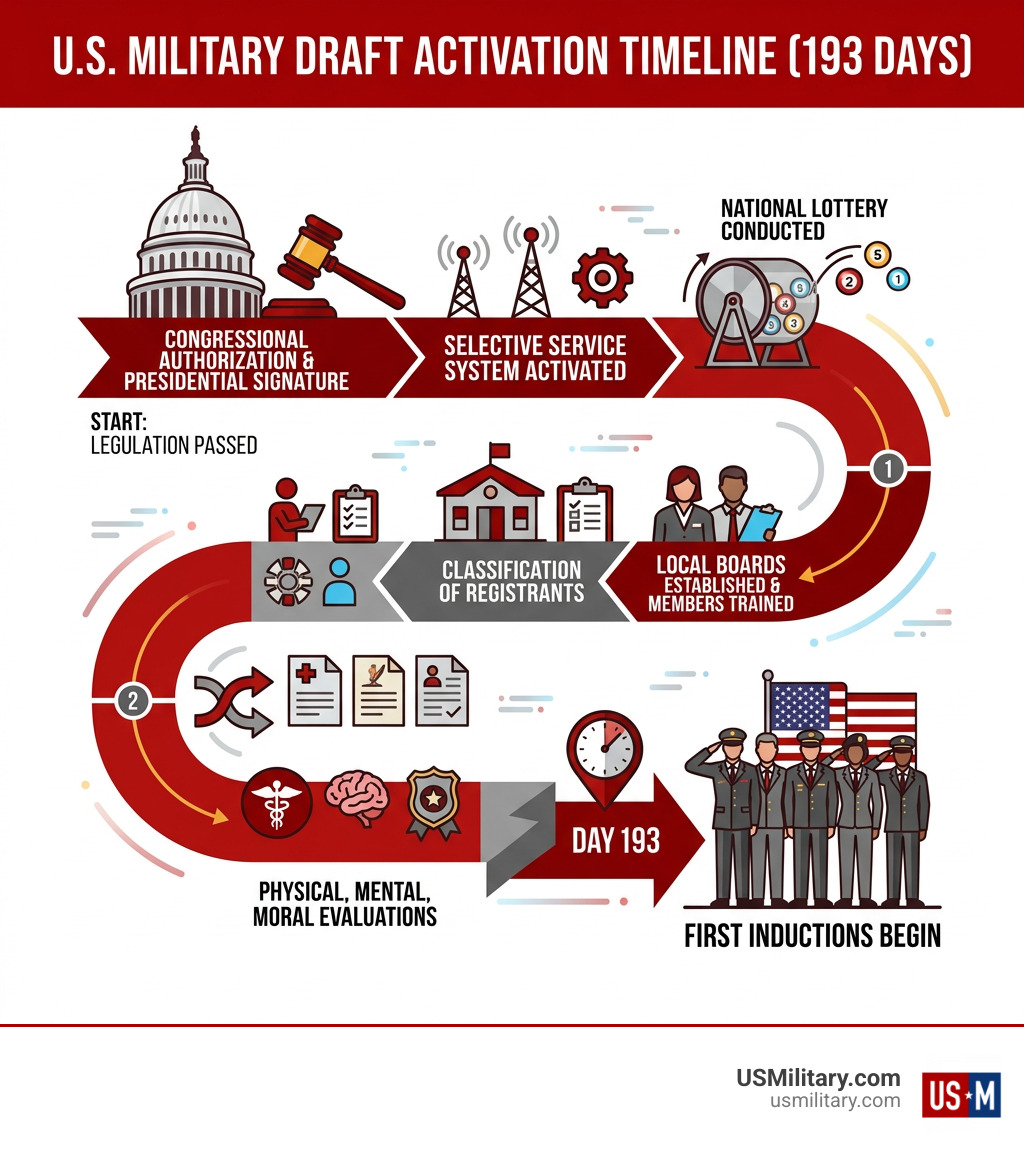
- If activated, the Selective Service System is designed to induct draftees within 193 days.
- Women are not currently required to register, but that debate is ongoing in Congress.
The bottom line: a draft is unlikely right now, but the infrastructure is in place and global tensions are making this question more relevant than it has been in decades.
I’m Larry Fowler, publisher of USMilitary.com and a longtime advocate for active-duty service members and veterans navigating military policy and benefits. I’ve spent years helping Americans understand complex military systems — including what will a military draft be necessary on the slight chance of a World War really means for everyday people. In the sections below, we break down exactly how a draft would work, who would be called first, and what your options are.
Will A Military Draft Be Necessary On The Slight Chance Of A World War terms to remember:
- Does the US currently have a military draft
- What disqualifies you from the military draft
- age for military draft
The Current Status of the Selective Service System

While the headlines might make it feel like a draft is around the corner, we have to look at the facts. Currently, the United States does not have an active military draft. What we do have is the Selective Service System, which is essentially a giant “insurance policy” for the country. It is a standby agency that keeps a list of names just in case a national emergency requires a rapid expansion of our armed forces.
Under federal law, nearly all male U.S. citizens and male immigrants living in the U.S. who are between the ages of 18 and 25 are required to register. This isn’t a suggestion; it’s a legal mandate. Even if you don’t think a conflict is coming, the law requires you to be in the system. As we look toward the future and discuss the military-draft-2026 landscape, it’s important to note that over 15 million men are already registered nationwide, maintaining a registration rate of about 84% as of 2023.
Who is Required to Register for the Draft?
The rules for who needs to register are quite broad. If you are a male citizen, you must register within 30 days of your 18th birthday. This also applies to:
- U.S. Immigrants: This includes documented and undocumented immigrants, refugees, and asylum seekers.
- Dual Citizens: Even if you live abroad, if you hold U.S. citizenship, you are required to register.
- Transgender Individuals: Currently, the law is based on the gender assigned at birth. Individuals assigned male at birth must register, while those assigned female at birth are not required to do so.
- Disabled Individuals: Even if a person has a disability that would likely disqualify them from service, they must still register if they are capable of doing so.
The age-to-be-drafted liability officially ends when a man turns 26. After that, you are generally “over the hill” in the eyes of the Selective Service.
Penalties for Failing to Register
We cannot stress this enough: failing to register is a federal felony. While the government rarely prosecutes people solely for failing to register, the “silent penalties” can ruin your future. If you are required to register and don’t, you could face:
- A fine of up to $250,000.
- A prison sentence of up to 5 years.
- Loss of Federal Benefits: You will be ineligible for federal student loans, Pell grants, and federal job training.
- Employment Restrictions: Many federal and state agencies require registration for employment.
- Citizenship Delays: For immigrants, failing to register can permanently block the path to U.S. citizenship.
Even veterans must register if they are under 26 and haven’t done so. If you served and are now over 26 but failed to register, your DD Form 214 acts as evidence that your failure wasn’t “knowing and willful,” but it’s always better to be compliant from the start.
Will A Military Draft Be Necessary On The Slight Chance Of A World War?
The million-dollar question is whether Will A Military Draft Be Necessary On The Slight Chance Of A World War. To answer this, we have to look at the sheer scale of a global conflict. In a “Great Power” war—think a direct clash with a peer competitor like China or Russia—the manpower needs would be astronomical.
During World War II, the U.S. fielded a force of 14 million people, which was about 12.5% of the total population at the time. Today, our active-duty force is roughly 1.3 million. In a modern World War, the attrition rates (the number of soldiers lost or wounded) could quickly overwhelm an all-volunteer force. A Foreign Policy analysis on conscription suggests that despite high-tech drones and satellites, “boots on the ground” remain the deciding factor in holding territory.
| Conflict Era | Total Active Duty Personnel | % of U.S. Population |
|---|---|---|
| World War II | ~14,000,000 | 12.5% |
| Gulf War (1991) | ~2,000,000 | < 1% |
| Current (2024) | ~1,300,000 | ~0.4% |
As the table shows, we are currently operating with a much smaller percentage of our population in uniform than in previous global crises.
Geopolitical Triggers and World War Scenarios
What could actually push the button on a draft? Several “flashpoints” currently keep military planners awake at night:
- The Ukraine-Russia Stalemate: If this conflict spills over into NATO territory, the U.S. would be treaty-bound to intervene.
- Iran-Israel Tensions: Recent drone and missile exchanges have shown how quickly the Middle East could escalate into a regional, then global, war.
- China-Taiwan Deterrence: A move on Taiwan would likely involve the U.S. Navy and Air Force on a massive scale, potentially requiring a surge in personnel.
- The Indo-Pacific Posture: Our strategy is shifting toward homeland defense and deterring China, which requires a massive logistical and human footprint.
Interestingly, there has been talk of how to automate-military-draft-passed-by-congress through HR 8070. This bill isn’t about starting a draft; it’s about making registration automatic through federal databases to ensure the “insurance policy” is up to date.
The All-Volunteer Force vs. Great Power Conflict
The All-Volunteer Force (AVF) has served us well for 50 years, but it is currently facing a “crisis” of recruitment. A 2020 Pentagon study found that only 23% of young Americans (ages 17-24) are even eligible to join. The rest are disqualified due to:
- Obesity: The leading medical disqualifier.
- Drug Use: Including past use of substances that remain federally illegal.
- Test Scores: Falling scores on the ASVAB entrance exam.
- Criminal Records: Which limit the pool of “morally qualified” candidates.
A Washington Post report on national service highlighted that some former officials believe the AVF cannot sustain a peer-level war. If we entered a sustained conflict with high casualties, the military-draft-disqualification-list might even be narrowed to get more people into uniform.
How a Modern Draft Lottery and Induction Would Work
If the unthinkable happens and Will A Military Draft Be Necessary On The Slight Chance Of A World War becomes a “yes,” the process is very specific. It doesn’t happen overnight. First, Congress must pass legislation to authorize the draft, and the President must sign it into law.
Once authorized, the lottery process and sequence begins. This would likely be a nationally televised and live-streamed event. Two large air-filled drums would be used: one containing all 365 days of the year (and Feb 29), and the other containing numbers 1 through 365. If “January 1” is drawn with the number “1,” then every registered man born on January 1 is the first to be called.
After the lottery, those called receive an induction order. They report to a Military Entrance Processing Station (MEPS) for a battery of physical and mental evaluations to ensure they are fit for service.
Age Priorities in a Modern Draft Lottery
Unlike some historical drafts that took older men first, the modern system is designed to take the youngest, most capable individuals first. The priority sequence is:
- 20-Year-Olds: Men whose 20th birthday falls during the calendar year of the lottery.
- 21 to 25-Year-Olds: The lottery continues through the older brackets in ascending order.
- 19-Year-Olds: Only called if the older brackets are exhausted.
- 18.5-Year-Olds: The absolute last resort.
The age-to-be-drafted rules are strictly enforced to ensure the military gets recruits who are at their physical peak.
Will A Military Draft Be Necessary On The Slight Chance Of A World War for Women?
This is one of the hottest debates in Washington. Currently, women are not required to register for Selective Service. However, since all military combat roles were opened to women in 2015, many argue that the draft should be gender-neutral.
The Selective Service has stated they are ready to can-women-be-drafted if the law changes. There is significant women-draft discussion in the National Defense Authorization Act (NDAA) every year. While some see it as a matter of gender equality in service, others oppose it on traditional or practical grounds. For now, the answer to can-women-get-drafted is “no,” but that could change with a single vote in Congress.
Exemptions, Deferments, and Conscientious Objection
Being drafted does not automatically mean you are headed to a foxhole. There are several legal ways to be exempted or deferred. The military has strict physical fitness and mental health standards. If you have a disqualifying condition on the military-draft-disqualification-list, you will be sent home from MEPS.
Legal Options for Those Unfit for Service
If you are called, you can file a claim for a different classification. Common options include:
- Conscientious Objectors: These are individuals who, for religious or moral reasons, are opposed to war in any form. If approved, Conscientious Objectors may be assigned to non-combatant roles (like medics) or alternative service in civilian jobs that contribute to the national interest.
- Hardship Deferments: If your induction would cause extreme hardship to your dependents (like a wife or children who rely solely on your care).
- Ministerial Exemptions: For full-time ministers or divinity students.
- Student Deferments: College students can usually finish their current semester, and seniors can often finish their full academic year before being inducted.
Appeals are handled by local draft boards made up of civilian volunteers in your community. If they deny your claim, you can take it to a district or even a national appeals board.
Frequently Asked Questions about the Military Draft
Is a military draft likely in 2025 or 2026?
Based on current official statements and expert analysis, a draft in 2025 or 2026 is highly unlikely. The U.S. government is committed to the all-volunteer force. A draft would only be triggered by a massive national emergency that the current military and reserves could not handle. While tensions are high, we are not currently at that breaking point.
What is the maximum age to be drafted?
The maximum age for draft liability is 26. Once you blow out the candles on your 26th birthday, you are no longer eligible to be drafted under current Selective Service regulations.
Will A Military Draft Be Necessary On The Slight Chance Of A World War if I am a conscientious objector?
Even if a draft is necessary, you will not be forced to carry a weapon if you can prove you are a sincere conscientious objector. You would still be drafted, but you would serve in a capacity that does not require you to kill, such as medical services or civilian work like conservation or health care.
Conclusion
At the end of the day, the question of Will A Military Draft Be Necessary On The Slight Chance Of A World War reminds us that national defense is a collective responsibility. While we all hope for peace, the Selective Service System ensures our country isn’t caught off guard. Our military preparedness is our greatest strategic deterrence.
If you are interested in serving on your own terms rather than waiting for a lottery, the best move is to talk to a recruiter now. You can choose your career path, get your education paid for, and serve with pride. For more information on how the system works, check out our guide on What is the US Military Draft? and stay informed with us here at USMilitary.com.
Free for Service Members & Veterans
Get the military benefits intel no one tells you about.
Weekly updates on VA benefits, pay changes, and money tips — free for service members and veterans.
No spam. Unsubscribe anytime. Your info is never shared.


