Why Veterans Miss VA Aid and Attendance

Why do so many veterans ignore the amazing VA benefit called Aid And Attendance? Many have never heard of it. Others assume they earn too much, need a service-connected disability, or must live in a nursing home. The paperwork can also be hard to navigate. Yet eligible wartime veterans and surviving spouses may receive a higher monthly VA pension when they need regular help with daily life.
Before ruling it out, check the veteran’s service record, care needs, income after eligible medical expenses, and assets. High care costs can change the income picture.
I’m Larry Fowler, a Navy veteran and BUD/S Class 89 graduate who has covered VA benefits through USMilitary.com since 2007. That experience shapes how I answer the question, “Why do so many veterans ignore the amazing VA benefit called Aid And Attendance?” and explain what to check next.
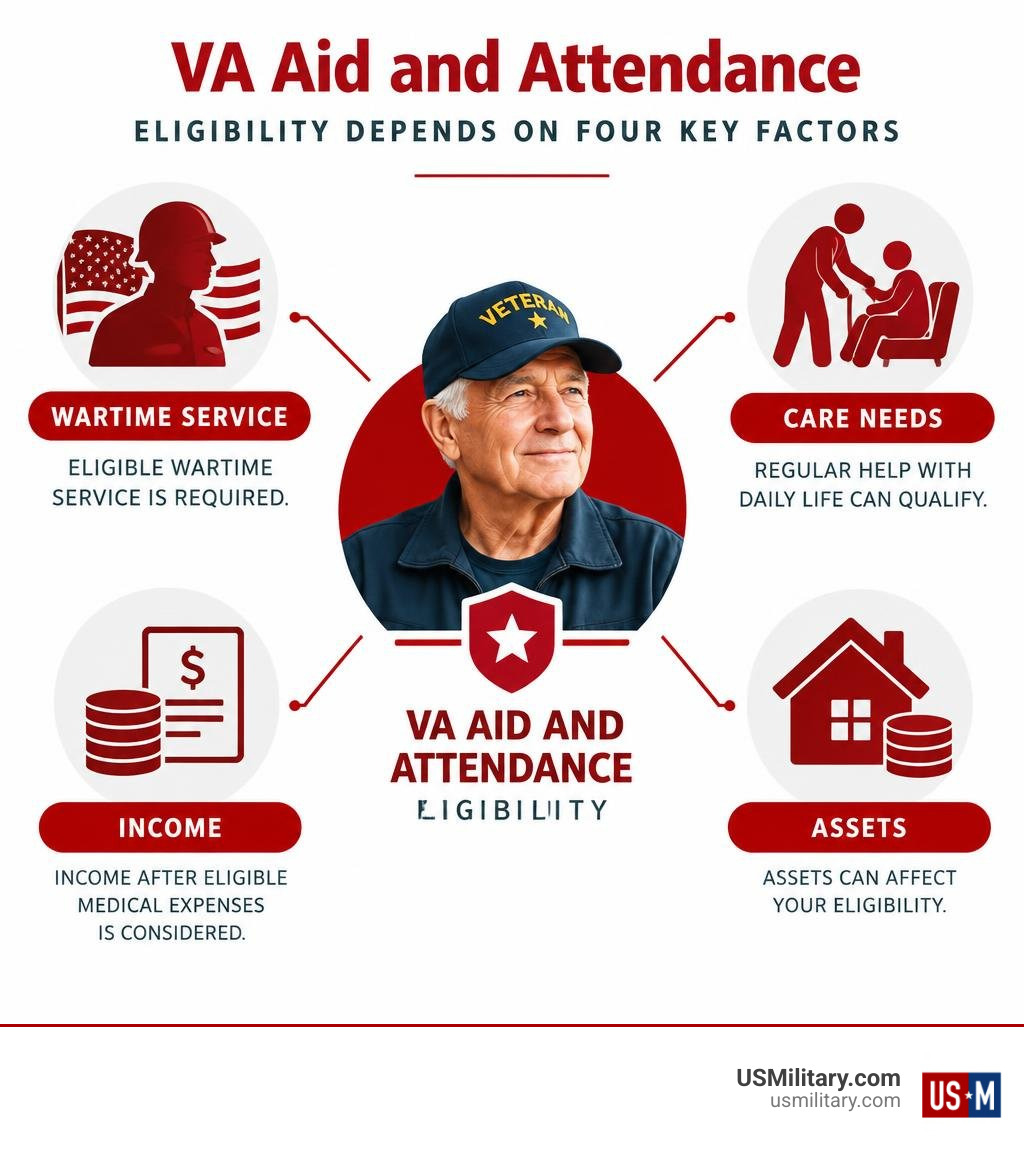
Why do so many veterans ignore the amazing VA benefit called Aid And Attendance? terms to know:
Why do so many veterans ignore the amazing VA benefit called Aid And Attendance?
Mostly because they don’t know it exists. Social workers and attorneys call it a “hidden gem” and a “best kept secret,” and the research backs that up. VA’s own outreach has said it is under-used because many people don’t realize they may qualify.
The name doesn’t help. “Aid and Attendance” sounds like a standalone program, but it is really an add-on to the VA needs-based pension. It is tied to a medical rating, so veterans often can’t tell what they’re looking at. Add a complex application, a quiet fear of being turned down, and a sense that asking for help is “not for me,” and many families never file.
Access is also uneven. Research on factors affecting Aid and Attendance access found that medical centers with strong ties to VA benefits staff and veterans service organizations (VSOs) enroll far more people. Research on enrollment disparities found that Black and Hispanic pension recipients were less likely to receive the benefit than White recipients, even after accounting for need.
Why do so many veterans ignore the amazing VA benefit called Aid And Attendance? Awareness and access barriers
The numbers are striking. In 2011, only about 38,000 veterans and 39,000 surviving spouses received it, out of 1.7 million World War II veterans. An earlier VA report found only about one-third of eligible veterans were getting it.
Where you live matters too. In 2017, the share of pension recipients receiving Aid and Attendance ranged from 0% to 22% across 129 VA medical centers. A mixed-methods study tied the gap to staff education, outreach, and relationships with VSOs, not to differences in veteran need.
Researchers also point to a few practical problems:
- Few outreach materials mention the benefit.
- Some social workers feel out of practice and just point veterans to a phone number.
- Processing can take months, and some claims take up to a year.
Why do so many veterans ignore the amazing VA benefit called Aid And Attendance when they may qualify?
These are the myths we hear most:
- “I make too much.” VA looks at income after medical costs, not gross income.
- “I never used the VA.” You don’t have to be enrolled in VA health care.
- “It’s for service-connected disabilities.” It is a non-service-connected pension benefit.
- “I needed combat service.” You don’t. Wartime service is enough.
- “My savings are too high.” Your home and vehicle are excluded, and planning options exist.
- “Care has to be in a facility.” Home care counts.
- “They’ll just deny me.” Denials are often about missing paperwork and can be fixed.
Surviving spouses can qualify too. The benefit supplements the pension, so you must qualify for the pension first.
Who qualifies, how does VA calculate income, and how much can the benefit pay?
You generally need:
- At least 90 days of active duty, with at least one day during a wartime period, and a discharge other than dishonorable. Later entrants have additional minimum-service rules.
- Age 65 or older, or a permanent and total disability.
- Income and net worth under VA limits.
- A qualifying care need.
Surviving spouses must have been married to the veteran and not remarried. Our VA Aid and Attendance complete guide and Aid and Attendance filing guide for 2026 go deeper.
What medical needs qualify for Aid and Attendance or Housebound?
For Aid and Attendance, you need at least one of these:
✉ Get updates like this in your inbox
Weekly VA benefit changes, pay updates, and money tips for service members, veterans, and military families. Free, no spam.
- Regular help with daily activities such as bathing, dressing, eating, toileting, or mobility, including supervision for safety, as with dementia.
- Being bedridden.
- Living in a nursing home because of a disability.
- Severely limited vision: corrected acuity of 5/200 or less in both eyes, or a visual field narrowed to 5 degrees or less.
Housebound applies when you are substantially confined to your immediate home because of a permanent disability.
How does VA calculate IVAP, and why do veterans think they earn too much?
VA uses Income for VA Purposes (IVAP), which is gross income minus recurring unreimbursed medical expenses. Those can include assisted living or in-home care, prescriptions, health insurance premiums, and incontinence supplies. Only the portion above 5% of the maximum pension rate counts as a deduction. If IVAP falls below the maximum rate for your category, you can qualify on income, and a negative IVAP is treated as zero.
Here is an example from the research. A single veteran has $4,300 in monthly income and $4,350 in care and medical costs. Income for VA purposes is zero, so a $4,300 income no longer blocks the claim.
Net worth is income plus countable assets. Your home and vehicle are excluded. VA also applies a 36-month look-back to gifts and transfers, and these can trigger a penalty. Talk to an accredited professional before moving money. The American Bar Association’s overview covers asset strategies and their trade-offs.
What are the current income limits, asset limits, and monthly payment amounts?
Limits rise each December with the Social Security cost-of-living adjustment. The most recent figures in our research are below. Confirm current numbers on VA’s benefits page for elderly veterans, because the net worth ceiling and rates change every year. The most recent net worth ceiling in our research was $138,489.
| Claimant | Maximum annual pension with A&A | Added A&A amount |
|---|---|---|
| Surviving spouse | $18,697 | $6,998 |
| Single veteran | $29,030 | $11,589 |
| Veteran with one dependent | $34,488 | $11,649 |
| Two married veterans, both qualifying | $46,143 | $23,304 |
These are ceilings. Your actual payment is the maximum rate minus your IVAP, paid monthly, tax-free, usually by direct deposit. The benefit has no spending restrictions. Families use it for home care, assisted living, memory care, or nursing home costs.
How are Aid and Attendance and Housebound different?
Both are add-ons to a VA pension, and VA does not pay both at once. A&A typically pays more, so Housebound is a fallback if you can’t meet the stricter A&A standard. Neither is the same as VA disability compensation, which is based on service-connected conditions.
| Feature | Aid and Attendance | Housebound |
|---|---|---|
| Core test | Needs regular help, is bedridden, lives in a nursing home, or has severe vision loss | Substantially confined to home by a permanent disability |
| Evidence | Medical examiner findings, plus nursing home form if applicable | Medical evidence of permanent disability and confinement |
| Payment | Higher add-on to pension | Smaller add-on to pension |
| Both at once? | No | No |
How do veterans apply, avoid common denials, and appeal a decision?
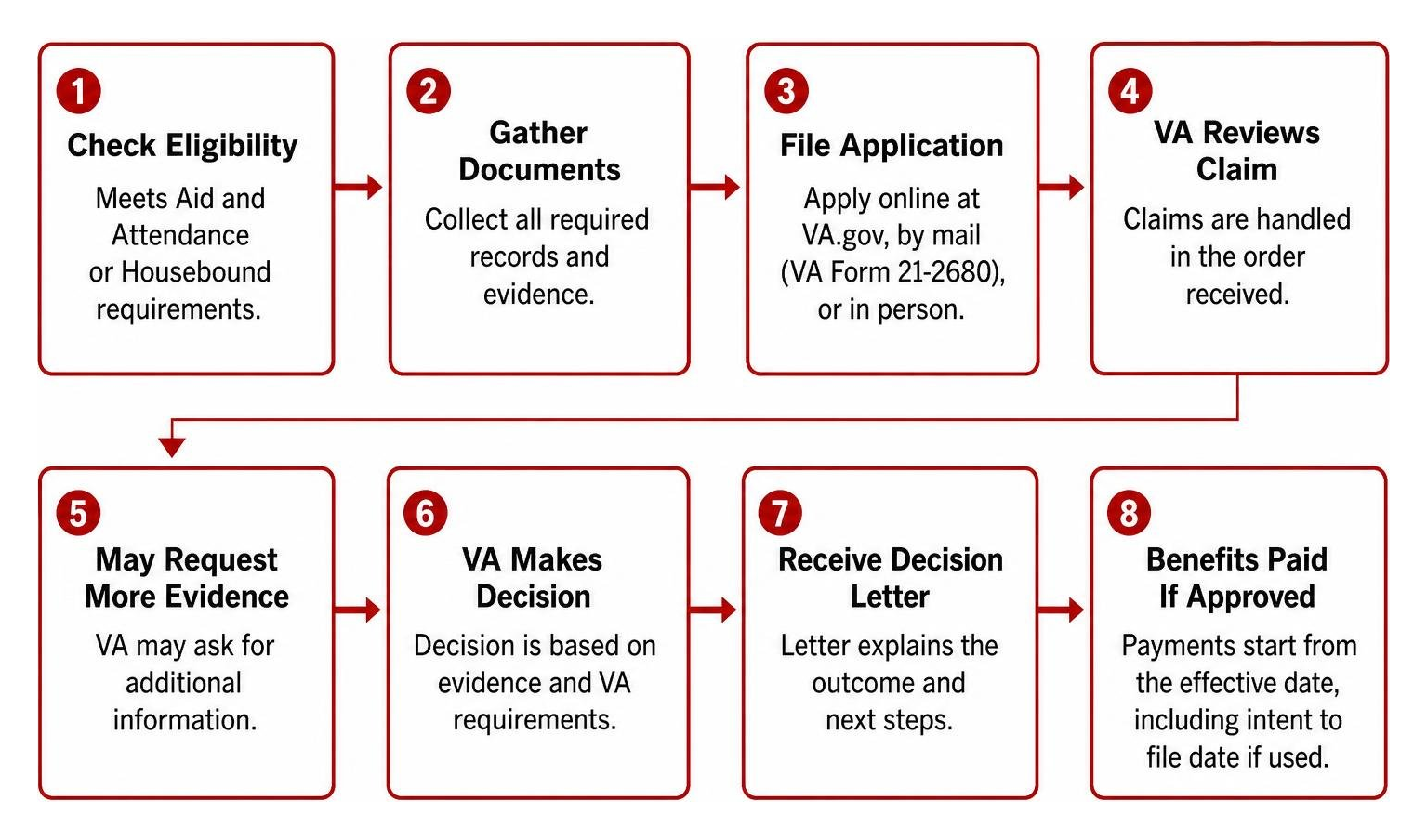
You can apply online at VA.gov, by mail, or in person at a VA regional office. Mail applications use VA Form 21-2680, which a medical examiner completes. Nursing home residents also need VA Form 21-0779. Our VA Aid and Attendance form guide walks through them. Claims are generally handled in the order received, unless one qualifies for priority processing.
If you’re still gathering paperwork, filing an intent to file (VA Form 21-0966) can lock in your start date, so approved benefits can be paid back to it. Our post on common reasons for Aid and Attendance denial shows how to avoid the usual traps.
What should applicants include to make a stronger claim?
Specifics matter. A doctor’s note that says “needs help” isn’t enough. It should describe which daily tasks the person can’t do, how often, and what safety risks exist. Keep consistent answers across forms and make copies of everything. No one can guarantee approval, but a complete file helps.
Gather these before filing:
- Discharge papers and service dates
- Marriage and death records, for survivors
- Medical examiner findings and treatment records
- Proof of care costs, including any written caregiver agreement
- Income statements and official bank statements
- Records of other assets and recurring medical expenses
What should a veteran do if an initial claim is denied?
Don’t give up. Read the decision letter, work out what evidence was missing or wrong, and fix any factual errors. You generally have one year to choose a review: a supplemental claim with new evidence, a higher-level review, or an appeal to the Board of Veterans’ Appeals. An accredited representative can help you pick. Our Aid and Attendance approval guide covers the next steps.
Where can veterans and families get application help?
Start with a VA social worker, who can often point you to benefits staff. VA-accredited VSOs such as the VFW, American Legion, and Disabled American Veterans help with forms for free. Accredited claims agents and attorneys are also options. An elder-law attorney is most useful when assets are above the limit.
Be wary of anyone who asks for upfront fees or promises approval. Only VA decides eligibility. To get moving, see our post on how to start an Aid and Attendance claim.
Frequently Asked Questions about VA Aid and Attendance
Can Aid and Attendance money pay for in-home care or assisted living?
Yes. It is an unrestricted cash benefit. Veterans use it for caregivers, home services, assisted living, memory care, medical foster homes, or nursing homes. Keep expense records, since they also support your income calculation.
Can a surviving spouse qualify, and can a claimant receive both A&A and Housebound?
A surviving spouse can qualify for the Survivors Pension with an A&A add-on. They need to meet the veteran’s service history, marital requirements, financial limits, and a clinical need. The two pension allowances can’t be paid together. Neither replaces VA disability or DIC.
Does VA Aid and Attendance have a fixed monthly payment?
No. VA pays the gap between your category’s maximum rate and your IVAP, so payments differ by claimant type, dependents, and medical expenses. Rates change each year.
Conclusion: Check eligibility before ruling out Aid and Attendance
Most people skip this benefit because of myths, confusion, or never hearing of it. Screen your service, income after medical costs, assets, and care needs, and get the medical documentation in order. Use accredited help, not anyone charging upfront fees. For more, visit our VA Aid and Attendance overview. We at USMilitary.com are here to help you find the next step.
Free for Service Members & Veterans
Get the military benefits intel no one tells you about.
Weekly updates on VA benefits, pay changes, and money tips — free for service members and veterans.
No spam. Unsubscribe anytime. Your info is never shared.



Leave a Reply