The Top 12 VA Benefits to Check in 2026

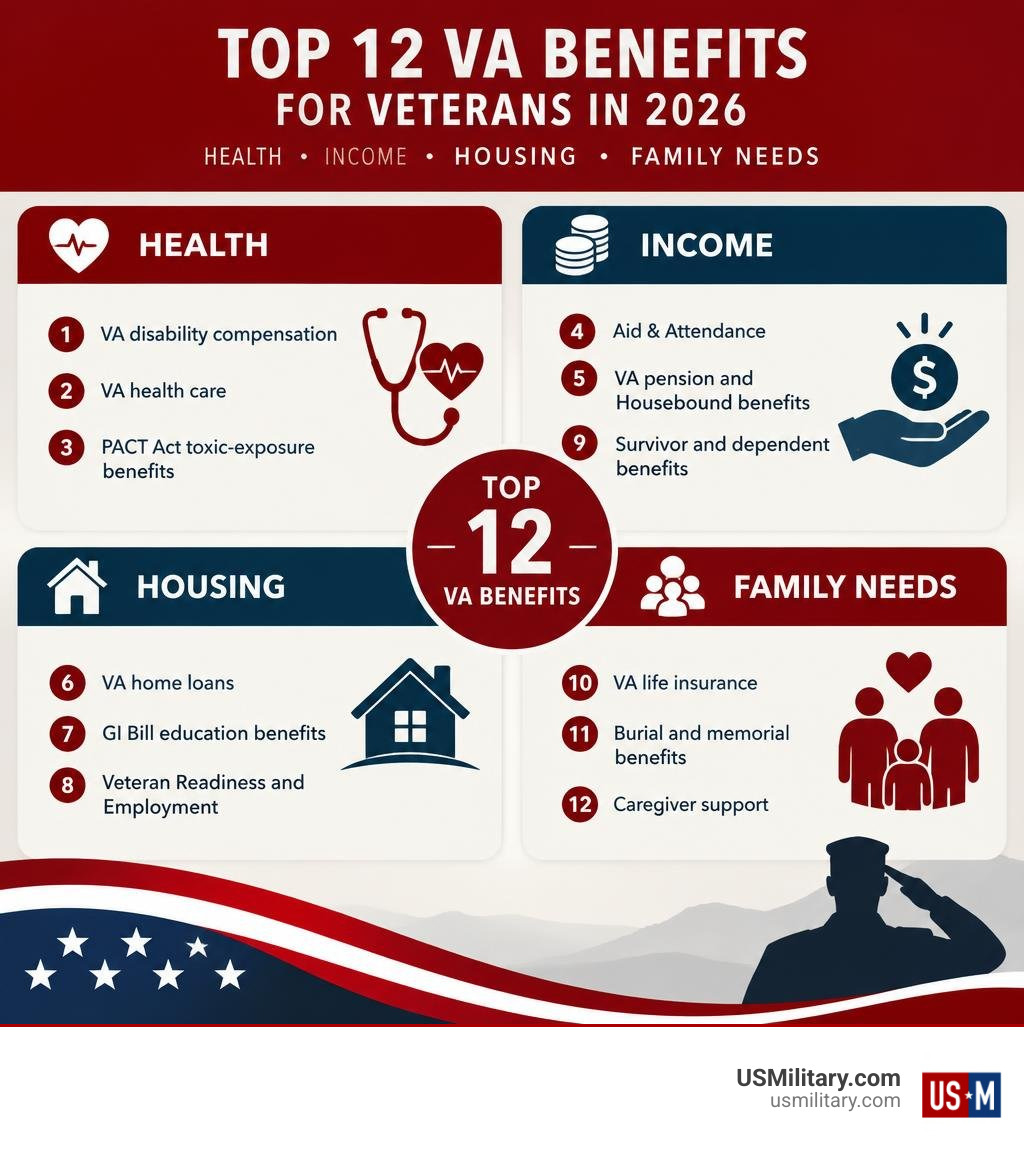
USMilitary.com ranks the top 12 VA benefits for veterans in 2026 by how they can support health, income, housing, and family needs:
- VA disability compensation
- VA health care
- PACT Act toxic-exposure benefits
- Aid & Attendance
- VA pension and Housebound benefits
- VA home loans
- GI Bill education benefits
- Veteran Readiness and Employment
- Survivor and dependent benefits
- VA life insurance
- Burial and memorial benefits
- Caregiver support
Start with the benefits that fit your service and current needs. For example, Aid & Attendance can help an eligible wartime veteran pay for care, while disability compensation requires a condition linked to military service. Each program has its own rules, so qualifying for one does not mean you qualify for all 12.
I’m Larry Fowler, a Navy veteran, BUD/S Class 89 graduate, and publisher of USMilitary.com. In USMilitary.com Ranks Top 12 VA Benefits For Veterans in 2026, I draw on my experience covering VA disability, Aid & Attendance, and military benefits to help you decide what to check first.
USMilitary.com Ranks Top 12 VA Benefits For Veterans in 2026: Core Healthcare and Financial Entitlements
Understanding the core financial programs managed by the Department of Veterans Affairs gives you a foundation for long-term stability. The VA provides direct, tax-free financial compensation to balance service-connected impairments, along with needs-based pensions designed to support aging wartime heroes.
| Benefit Program | Primary Eligibility Trigger | 2026 Key Financial Metric / Rate | Tax Status |
|---|---|---|---|
| VA Disability Compensation | Service-connected injury, illness, or toxic exposure event | Tiered monthly payments by percentage (0% to 100%) | 100% Tax-Free |
| Basic Wartime Pension | 90+ days active duty (1 wartime day) + limited income / age 65+ | Needs-based offset up to Maximum Annual Pension Rate | 100% Tax-Free |
| Aid & Attendance (Enhanced) | Medical need for daily living assistance + wartime service | Up to $2,874/month (Veteran with 1 dependent) | 100% Tax-Free |
| Housebound Benefit | Substantially confined to home premises due to disability | Added tier to basic monthly pension | 100% Tax-Free |
These monthly disbursements adjust annually based on Social Security cost-of-living adjustments (COLA), ensuring your purchasing power keeps up with real-world living costs.
Why USMilitary.com Ranks Top 12 VA Benefits For Veterans in 2026 Around Disability and Toxic Exposure Coverage
Disability compensation stands at the very top of our rankings because it delivers recurring monthly income and serves as the gateway to numerous derivative benefits. When you receive a service connection, you unlock state property tax relief, employment preferences, and access to specialized programs.
Even a 0% non-compensable disability rating carries major value. It provides a 10-point federal hiring preference, no-cost care for that specific condition, and access to military commissary, exchange, and MWR facilities nationwide. Under 38 CFR 3.324, having multiple non-compensable conditions can combine to award a compensable 10% cash rating.
The passage of the PACT Act marks the largest expansion of veteran benefits in over three decades. It established presumptive service connection for dozens of respiratory conditions, rare cancers, and illnesses tied to burn pits and toxic environments across the Gulf, Southwest Asia, and post-9/11 theaters. To see how each rating level scales your financial entitlements, check out our disability percentage benefits breakdown.
Maximizing Priority Groups and VA Health Care Access
VA health care provides an extensive clinical network ranging from routine primary care and mental health services to specialized surgeries and prescription coverage. When you enroll using VA Form 10-10EZ, the VA places you into one of eight Priority Groups based on your service history, disability rating, income, and combat service.
Veterans rated at 50% or higher, or those awarded the Medal of Honor, fall into Priority Group 1, which guarantees cost-free care, no copayments, and travel reimbursement. For those transitioning out of combat zones, post-9/11 veterans receive a 10-year enhanced enrollment window under Priority Group 6.
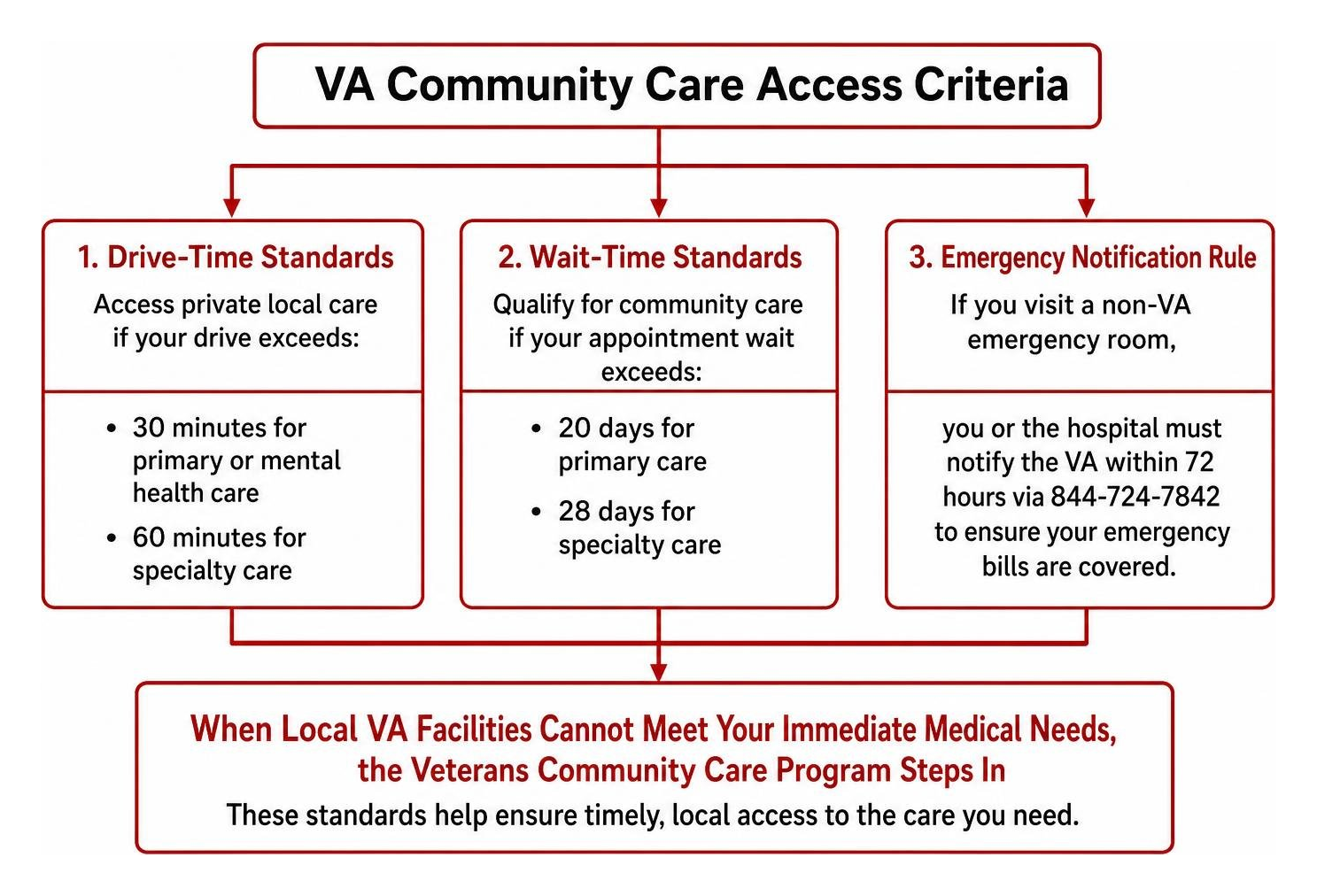
When local VA facilities cannot meet your immediate medical needs, the Veterans Community Care Program steps in:
- Drive-Time Standards: Access private local care if your drive exceeds 30 minutes for primary or mental health care, or 60 minutes for specialty care.
- Wait-Time Standards: Qualify for community care if your appointment wait exceeds 20 days for primary care or 28 days for specialty care.
- 72-Hour Emergency Notification Rule: If you visit a non-VA emergency room, you or the hospital must notify the VA within 72 hours via 844-724-7842 to ensure your emergency bills are covered.
You can verify the latest clinical updates by checking that The 2026 Veterans Benefits Guide is now available online – VA News, or consult our comprehensive VA veteran healthcare guide to navigate your clinical network.
How USMilitary.com Ranks Top 12 VA Benefits For Veterans in 2026 for Long-Term Pension and Long-Term Care
Aid & Attendance is an enhanced wartime pension designed for veterans and surviving spouses who require personal assistance with activities of daily living (ADLs), such as bathing, dressing, or medication management.
In 2026, Aid & Attendance pays up to:
✉ Get updates like this in your inbox
Weekly VA benefit changes, pay updates, and money tips for service members, veterans, and military families. Free, no spam.
- $2,424 per month for a single wartime veteran ($29,093 annually)
- $2,874 per month for a veteran with one dependent or spouse ($34,483 annually)
- $3,845 per month for two married qualifying wartime veterans ($46,143 annually)
- $1,558 per month for a surviving spouse without dependents ($18,694 annually)
To qualify, your household net worth cannot exceed the 2026 cap of $163,699 (which excludes your primary home, basic personal vehicle, and everyday household goods). The VA subtracts out-of-pocket, unreimbursed medical expenses—like assisted living fees, home health aides, and adult day care—from your countable income. If your medical expenses exceed 5% of your Maximum Annual Pension Rate, your countable income drops to zero, securing the maximum monthly cash payment. You must submit VA Form 21-2680 completed by a physician to establish clinical need. For additional options, review our breakdown of unclaimed VA disability benefits.
Unlocking Housing, Education, and Derivative Family Protections
Beyond direct compensation, the VA delivers life-changing protections for your family, career, and housing goals.

Leveraging VA Home Loans and Funding Fee Exemptions
The VA Home Loan Guaranty program lets you purchase, build, or refinance a residential property with terms conventional lenders cannot match:
- Zero Down Payment: Finance 100% of your home’s purchase price without coming up with tens of thousands in cash.
- No Private Mortgage Insurance (PMI): Save hundreds every month by skipping the mandatory insurance premiums conventional loans demand.
- Funding Fee Waivers: The standard VA funding fee is waived entirely if you have a service-connected disability rating of 10% or higher, or a compensable 0% rating.
For disabled veterans requiring home accessibility modifications, Specially Adapted Housing (SAH) and Special Home Adaptation (SHA) grants offer direct capital to install wheelchair ramps, widen doorways, and adjust bathrooms. Learn how to secure your property entitlements in our housing and healthcare benefit guide.
Expanding GI Bill, DEA, and Career Readiness Entitlements
Education benefits open doors to civilian employment, academic degrees, and trade certifications:
- Post-9/11 GI Bill (Chapter 33): Covers full in-state tuition at public universities, supplies a monthly housing allowance (MHA) pegged to local E-5 with dependents BAH rates, and gives you up to $1,000 annually for books and supplies.
- Veteran Readiness and Employment (VR&E – Chapter 31): Provides career counseling, job training, adaptive equipment, and full tuition coverage for veterans with a service-connected disability rating of 10% or higher facing employment barriers.
- Survivors’ and Dependents’ Educational Assistance (DEA – Chapter 35): Offers monthly education stipends directly to spouses and children of veterans who are permanently and totally (100% P&T) disabled or passed away from a service-connected injury.
Review our ultimate military benefits breakdown to compare chapters and pick the best path for your career.
Protecting Dependents with CHAMPVA, DIC, and Life Insurance
When service-connected disabilities are deemed permanent and total, your dependents qualify for CHAMPVA (Civilian Health and Medical Program of the Department of Veterans Affairs). This program shares the cost of covered medical services, prescription medications, and hospital visits with your family.
If a veteran passes away from a service-connected condition, surviving spouses and minor children can receive Dependency and Indemnity Compensation (DIC), a tax-free monthly benefit.
For life insurance, separating service members can convert Servicemembers’ Group Life Insurance (SGLI) to Veterans’ Group Life Insurance (VGLI) within 1 year and 240 days from discharge. Applying within the first 240 days allows you to secure coverage without taking a medical exam or proving good health. Explore these options further in our guide to overlooked veteran benefits.
Strategic Filing Tactics to Avoid Delays and Claim Back-Pay
Securing your VA benefits requires smart planning and clean documentation. Every day you wait to submit your initial paperwork is money left on the table.

Follow these steps to protect your effective date and speed up claim processing:
- Submit an Intent to File: Submitting an Intent to File locks in your effective date for up to 12 full months. If your claim takes months to process, you receive back-pay from that original filing date.
- Work with an Accredited VSO: Accredited representatives from Veterans Service Organizations (such as the DAV, VFW, or American Legion) provide free help with filing claims, gathering service records, and assembling medical evidence.
- Beware of the 36-Month Look-Back Period: For Aid & Attendance, the VA reviews all asset transfers made within 36 months of your application date. Giving away money or selling assets below fair market value triggers penalty periods of ineligibility.
- Leverage the Veterans Crisis Line: If you or someone you know faces an emotional or mental health crisis, call 988 and press 1, text 838255, or chat online at VeteransCrisisLine.net/Chat for 24/7 confidential support.
To build an airtight application package, read our step-by-step benefit application strategy and discover practical ways for avoiding lost veteran compensation.
Frequently Asked Questions About VA Benefits
What is the maximum monthly payout for VA Aid and Attendance in 2026?
In 2026, the maximum monthly payout for a wartime veteran with one dependent receiving Aid & Attendance is $2,874 (or $34,483 annually). Single veterans receive up to $2,424 monthly, while eligible surviving spouses without dependents can receive up to $1,558 monthly. These payments are tax-free and based on unreimbursed medical expenses reducing your countable income.
At what disability rating do you qualify for concurrent receipt and full dental care?
Concurrent Retirement and Disability Pay (CRDP), which allows military retirees to draw both military retirement pay and VA disability pay without an offset, begins at a 50% service-connected disability rating. Comprehensive, no-cost VA dental care requires a 100% service-connected disability rating or an Individual Unemployability (TDIU) rating.
How does the PACT Act impact VA health care and presumptive disability claims?
The PACT Act adds over 20 presumptive conditions for toxic exposures, burn pits, and environmental hazards encountered in combat zones. If you served in a covered location, you no longer need to prove your military duties directly caused your diagnosis. Combat veterans also receive a 10-year Priority Group 6 health care enrollment window following their discharge.
Conclusion
Getting the VA benefits you earned takes preparation, patience, and clear records. Whether you are pursuing disability compensation, enrolling in priority health care, or applying for long-term care relief, staying organized makes all the difference. Check your benefit ratings each year to make sure you take full advantage of annual cost-of-living adjustments, state-level tax perks, and dependent programs. For a deeper look at top-tier entitlements, visit our full review of 100 percent disabled veteran benefits.
Free for Service Members & Veterans
Get the military benefits intel no one tells you about.
Weekly updates on VA benefits, pay changes, and money tips — free for service members and veterans.
No spam. Unsubscribe anytime. Your info is never shared.



Leave a Reply