Understanding America’s Army Elite Special Operations Forces
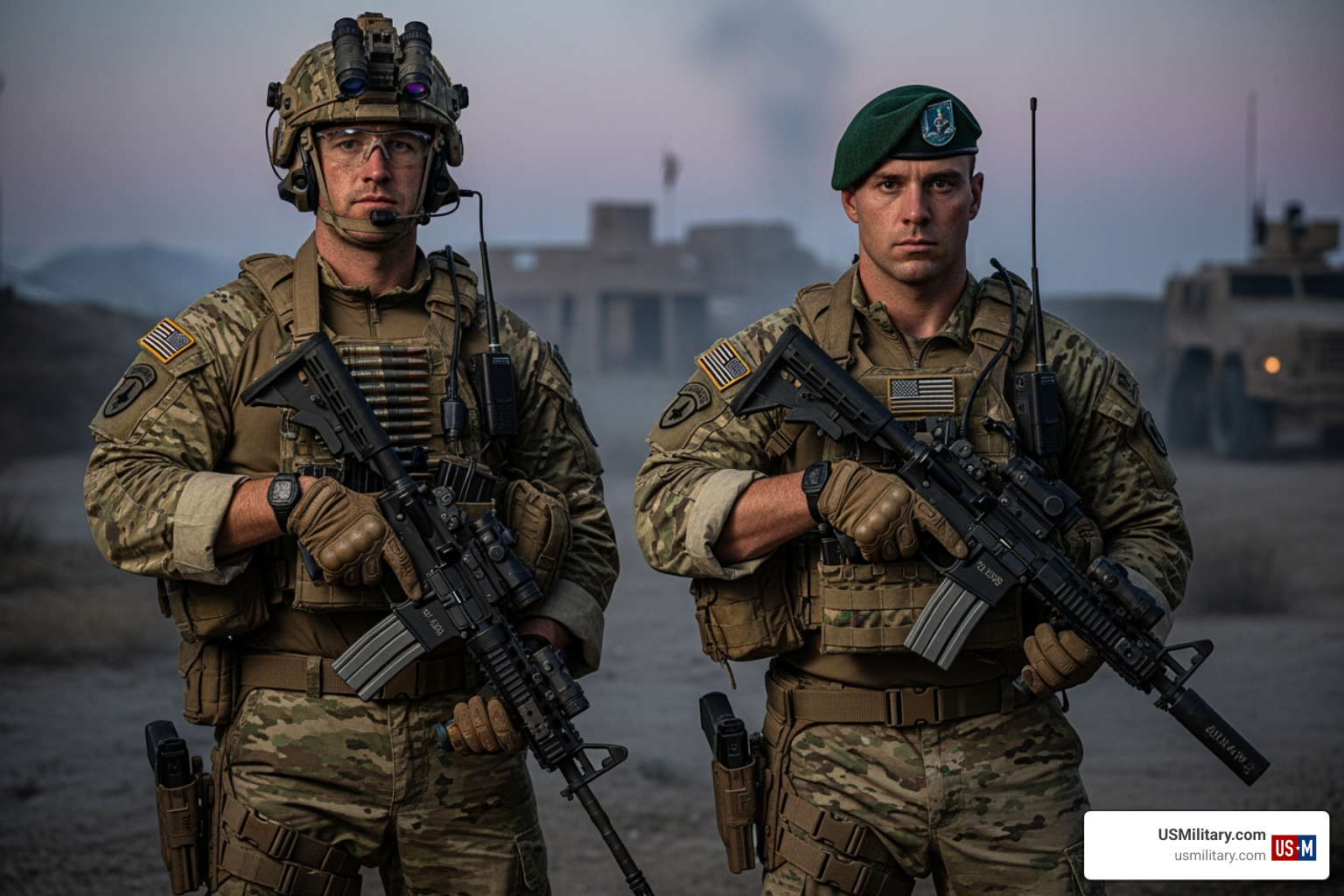
Army Ranger vs Green Beret is one of the most common questions for anyone interested in joining America’s elite special operations forces. Both units represent the pinnacle of military excellence, but they serve distinctly different roles within the U.S. Army’s Special Operations Command.
Quick Answer: Army Ranger vs Green Beret
| Aspect | Army Rangers | Green Berets (Special Forces) |
|---|---|---|
| Primary Mission | Direct action raids, airfield seizures, rapid deployment | Unconventional warfare, training foreign forces, long-term operations |
| Training Duration | 8-week RASP + 61-day Ranger School | 1-2 year Special Forces Qualification Course |
| Team Size | Battalion-level operations (hundreds) | 12-man Operational Detachment Alphas (ODAs) |
| Prerequisites | 18 years old, no prior service required | 3 years Army service (or 18X contract) |
| Operational Focus | High-intensity, short-duration missions | Strategic influence, cultural immersion, language proficiency |
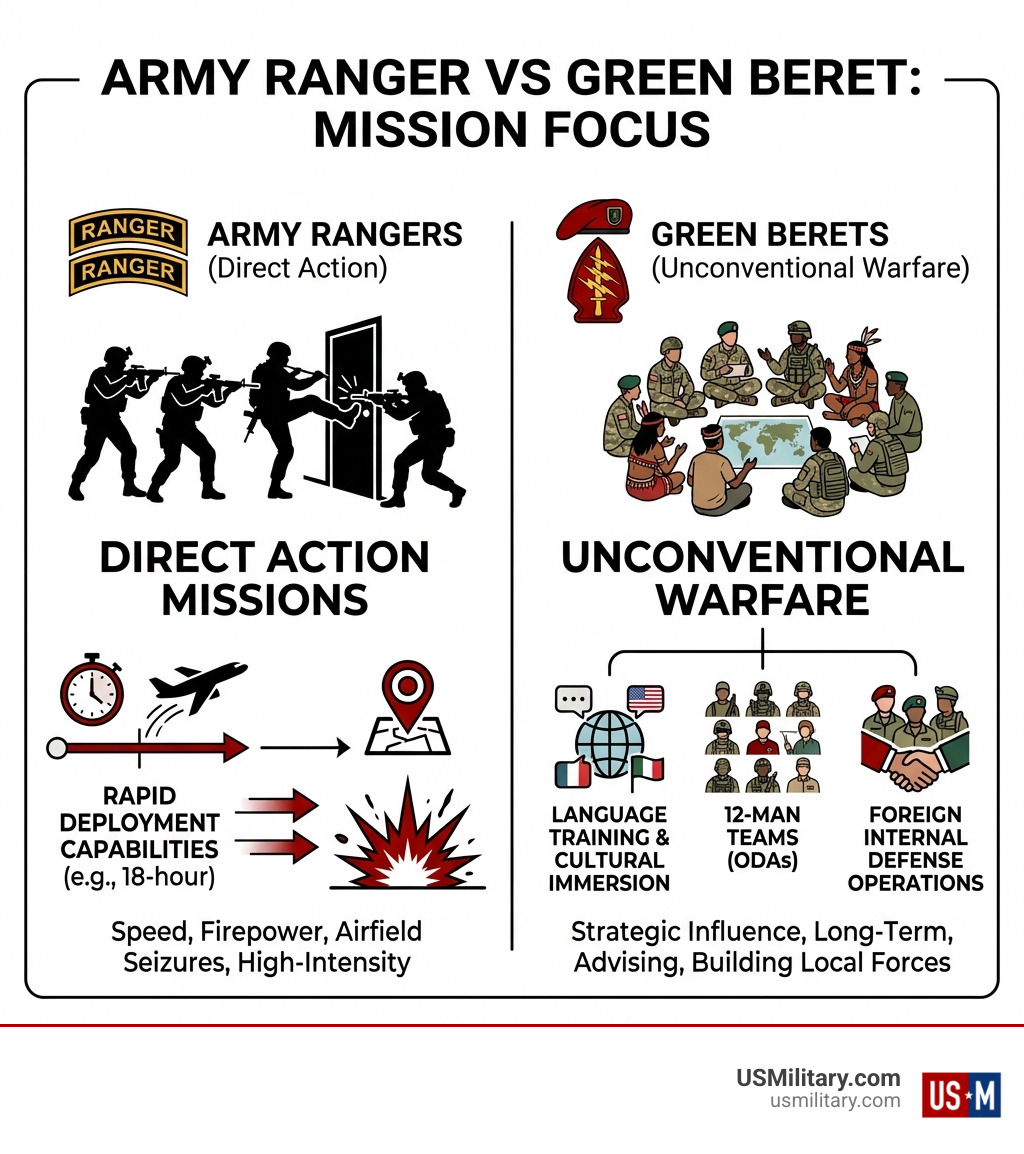
Rangers are the Army’s premier direct-action force—they kick down doors, seize objectives, and execute rapid-response missions with overwhelming force. Think large-scale raids and airfield seizures with 18-hour deployment capability.
Green Berets are unconventional warfare specialists—they train foreign armies, build local militias, and operate behind enemy lines for months at a time. They’re teachers, diplomats, and warriors rolled into one, fluent in foreign languages and cultures.
The distinction isn’t about which unit is “better.” Both are elite. Both are essential. Rangers bring speed and firepower. Green Berets bring strategic influence and cultural expertise. The real question is: which mission appeals to you?
I’m Larry Fowler, publisher of the USMilitary.com Network, and I’ve spent over 15 years helping service members and veterans steer their military careers, including understanding the unique paths to elite units like those in the Army Ranger vs Green Beret comparison. My goal is to give you the clear, actionable information you need to make informed decisions about your military future.
Learn more about army ranger vs green beret:
Historical Origins and Core Identity
When we dig into the history of the Army Ranger vs Green Beret, we uncover two distinct lineages, each forged in the crucible of different conflicts and evolving to meet specific strategic needs. Their origins define their core identities and missions even today.
U.S. Army Rangers: “Rangers Lead the Way”
The history of the U.S. Army Rangers is a long and storied one, with roots stretching back well before the formal establishment of the modern units. Our Rangers trace their lineage to frontiersmen like Robert Rogers, whose unit in the 1700s employed unconventional yet highly effective battle tactics. These tactics, outlined in his “28 Rules of Ranging,” laid a foundational philosophy for light infantry operations that still influences Ranger doctrine.
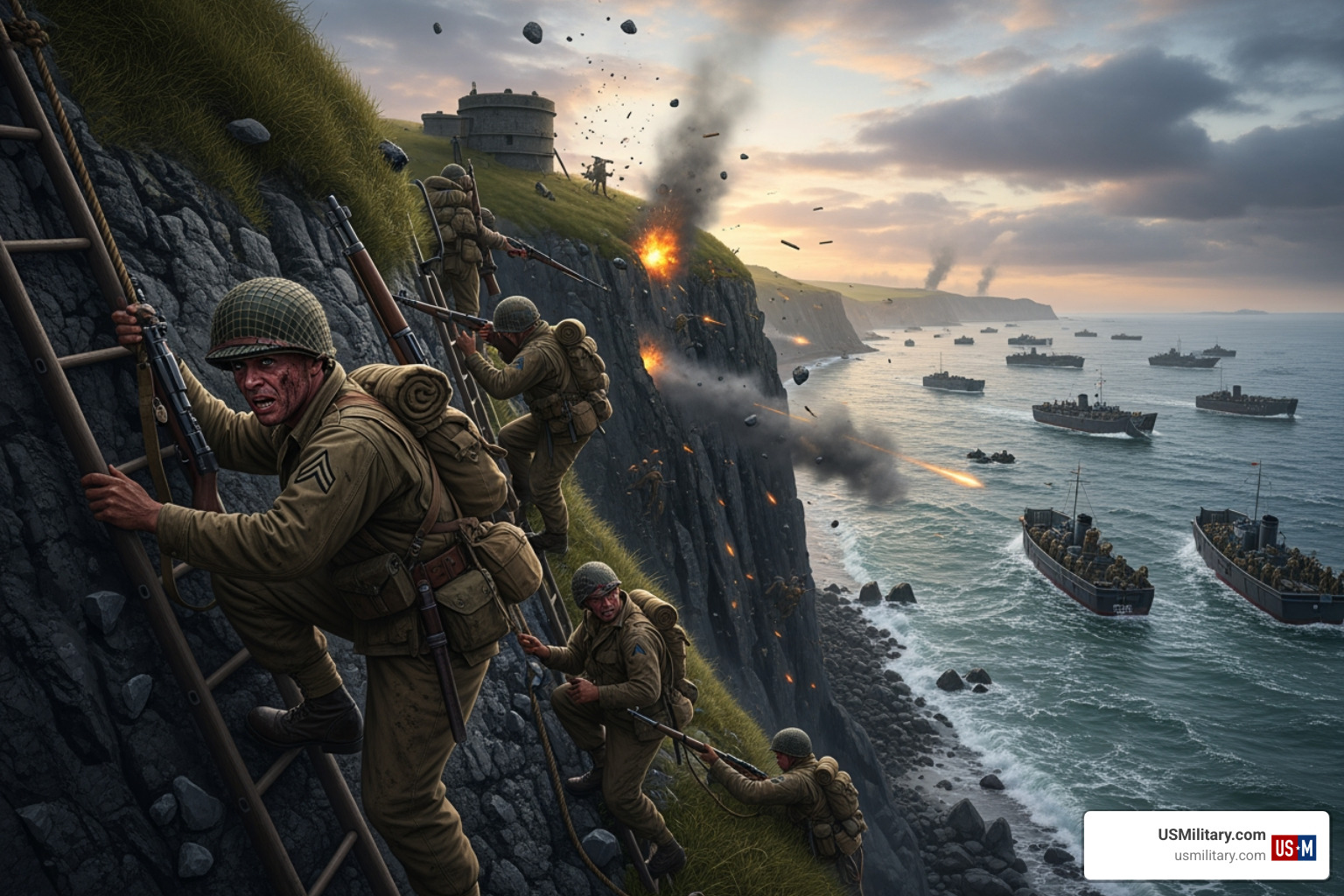
Throughout American history, Ranger-like units have emerged in conflicts from King Philip’s War and the French and Indian War to the Revolutionary War, the War of 1812, and the Civil War. The first modern Ranger battalion was officially activated in 1942 during World War II, playing crucial roles in battles across Europe and the Pacific. One of their most iconic moments came during the D-Day landings on June 6, 1944, when Rangers scaled the cliffs of Pointe Du Hoc to destroy German gun emplacements. It was during this bitter fighting that the famous motto, “Rangers, lead the way!” was born, solidifying their reputation for courage and spearheading daring operations.
The modern 75th Ranger Regiment, as we know it today, was established in 1974, consolidating the legacy of these elite light infantry units. Our Rangers are defined by core values of discipline, courage, and excellence, all encapsulated within the revered Army Ranger Creed. This creed serves as a moral compass, guiding every Ranger in their demanding duties and fostering an unwavering commitment to their fellow soldiers and their mission.
U.S. Army Special Forces (Green Berets): “De Oppresso Liber”
The U.S. Army Special Forces, famously known as the Green Berets, emerged from a different strategic necessity. While their official establishment dates to 1952, their lineage can be traced back to World War II’s Office of Strategic Services (OSS) Jedburgh Teams and Detachment 101, as well as Revolutionary War figures like Francis Marion, known as the “Swamp Fox” for his guerrilla tactics. These predecessors laid the groundwork for what would become the Green Berets’ unique focus: unconventional warfare.
The Green Berets truly came into their own during the Korean War era, and their capabilities were further refined during the Vietnam War, where they distinguished themselves through numerous acts of valor, earning 17 Medals of Honor. During this period, they often fought their own war in places like Laos, Cambodia, and the central highlands, engaging in secret operations and training indigenous forces.
The Green Beret motto, “De Oppresso Liber,” which means “To Free the Oppressed,” perfectly encapsulates their mission. Our Green Berets are specialists in unconventional warfare, focusing on training and organizing indigenous resistance movements and foreign militaries. Their core values center on adaptability, intelligence, and a deep cultural expertise. They are masters of relationship building, exhibiting creativity and adaptability to operate effectively in complex, often politically sensitive environments. This emphasis on cultural understanding and long-term engagement sets them apart.
You can learn More on the Army Green Beret and their unique contributions to national security.
Mission Sets and Deployment Scenarios
The most significant distinction in the Army Ranger vs Green Beret comparison lies in their primary mission sets and the scenarios in which they are typically deployed. While both are elite special operations forces, their operational philosophies are quite different, designed to achieve distinct strategic outcomes.
Army Rangers: The Premier Direct-Action Force
Our Army Rangers are the nation’s premier direct-action force, specializing in high-intensity, short-duration missions that often involve engaging the enemy in close combat. Their operational focus is on speed, overwhelming force, and precision execution.
The primary missions of Army Rangers include:
- Large-scale raids: Rangers excel at executing complex raids to seize critical targets, dismantle enemy strongholds, or eliminate high-value threats.
- Airfield seizures: They are frequently tasked with seizing and securing airfields, often through daring airborne assaults, to facilitate follow-on forces or establish forward operating bases.
- Special reconnaissance: While not their primary role, Rangers conduct reconnaissance missions to gather critical intelligence in support of their direct-action objectives.
- Personnel and special equipment recovery: They are adept at recovering personnel or sensitive equipment from hostile territory.
What truly sets Rangers apart is their rapid deployment capability. Each Ranger battalion is capable of deploying anywhere in the world with only 18 hours’ notice. This means they are often the first boots on the ground, delivering devastating firepower and spearheading operations. During the War on Terror, both Rangers and Green Berets deployed nearly non-stop, with Rangers often focusing on hunting high-value targets and executing direct action raids. They also frequently serve in a Quick Reaction Force (QRF) capacity, ready to support other Special Operations Forces (SOF) units, including Green Berets, if they encounter overwhelming opposition.
For those interested in the history of their impactful missions, there’s More on Army Ranger Careers.
Green Berets: Masters of Unconventional Warfare
In contrast, our Green Berets are masters of unconventional warfare, often operating behind enemy lines or in politically sensitive regions where subtle influence is preferred over overt confrontation. Their missions are typically long-duration, sometimes lasting months or even years, and require a deep understanding of local cultures and languages.
The Green Berets are tasked with six primary missions, making them incredibly versatile:
- Unconventional Warfare (UW): This is their bread and butter – enabling resistance movements and undermining hostile regimes through unconventional means. They train and organize insurgents, surrogate fighters, and indigenous forces to achieve strategic objectives.
- Foreign Internal Defense (FID): They train and advise foreign militaries, helping partner nations build their capacity to defend themselves against threats and maintain stability. This often involves building special operations units from the ground up, as they did in Iraq and Afghanistan.
- Special Reconnaissance: Green Berets conduct deep reconnaissance to gather intelligence in denied areas, often blending in with local populations.
- Direct Action: While not their primary focus, Green Berets are highly capable of executing direct action missions when necessary, such as raids or ambushes.
- Counter-terrorism: They engage in quiet, guerrilla war-style missions to disrupt terrorist networks and neutralize threats.
- Hostage Rescue: Green Berets are also trained for complex hostage rescue operations.
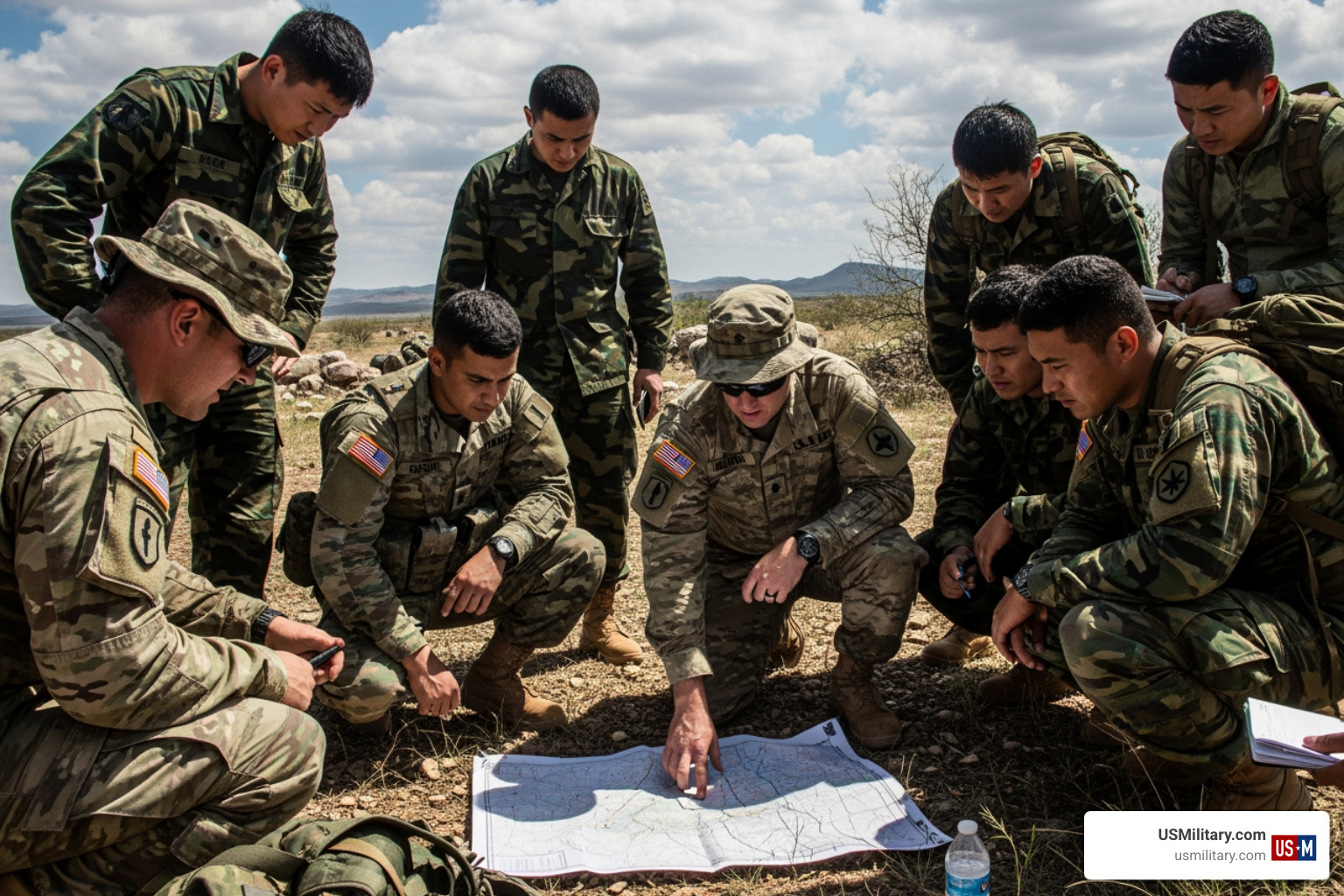
Their approach emphasizes strategic influence, cultural adaptation, and building long-term relationships. Every Green Beret must learn to speak a foreign language, enabling them to integrate and operate effectively within host communities. They are teachers, diplomats, and warriors, often working by, through, and with partner forces to achieve strategic goals that larger conventional forces cannot.
The Grueling Path: Selection and Training
Both Army Rangers and Green Berets are among the most highly trained soldiers in the world, but their selection and training pipelines are vastly different, reflecting their distinct mission sets. The journey to earn either the Ranger Tab or the Green Beret is incredibly demanding, testing physical, mental, and emotional limits.
How to Become an Army Ranger
The path to becoming an Army Ranger is open to a wide range of soldiers, but it is by no means easy. Unlike the Green Berets, there are no prerequisites for a soldier to enlist in Ranger School beyond being 18 years old and a member of the U.S. Army. Even civilians can sign a contract that lets them try the tests right after Basic Training, often through an Option 40 contract which funnels recruits directly into the Ranger pipeline.
However, earning the coveted Ranger Tab from Ranger School does not automatically make a soldier a member of the elite 75th Ranger Regiment. To join the Regiment, candidates must also pass the Ranger Assessment and Selection Program (RASP). This is an intense eight-week test designed to identify individuals with the physical and mental fortitude required for the Regiment.
RASP involves a battery of rigorous physical tests, including:
- A demanding six-to-12-mile march wearing a 35-pound rucksack.
- A timed five-mile run, pushing candidates to their limits.
- A 15-meter swim in their full uniform, a test of waterborne proficiency and composure under duress.
- Extensive evaluations of mountaineering and swamp skills.
Once a candidate successfully completes RASP, they move on to Ranger School. This is a grueling 61-day leadership course, divided into three distinct phases (Camo, Mountain, and Florida), each designed to sharpen different skills essential to becoming a Ranger leader. The first phase alone lasts 20 days. Ranger School is less about making you a Ranger (RASP does that) and more about forging you into a competent small-unit combat leader capable of operating in any environment.
Do you think you have what it takes? Find out more about the rigorous path to becoming one of our nation’s elite at Do you have what it takes to be an army ranger?
How to Become a Green Beret
Training to become a Green Beret is significantly more difficult and extensive than Ranger training, reflecting the broader scope of their missions. For active soldiers, there’s a prerequisite of at least three years of service with the Army and having reached the rank of E-3 (Private First Class) before applying. However, aspiring soldiers without prior service can sign an 18X contract, allowing them to attempt Green Beret training after Basic Training and the Basic Airborne Course.
The Green Beret pipeline begins with the two-week Special Operations Preparation Course (SOPC), followed by the notorious Special Forces Assessment and Selection (SFAS). SFAS is a three-week evaluation that doesn’t just test physical endurance but critically assesses a candidate’s intelligence, physical fitness, motivation, trainability, judgment, and influence. It’s designed to weed out those who aren’t mentally or emotionally prepared for the unique demands of Special Forces.
Those who pass SFAS then start on the Special Forces Qualification Course (SFQC), affectionately known as the “Q” Course. This is a comprehensive, one-to-two-year process that develops the diverse skill set required of a Green Beret. Key phases of the “Q” Course include:
- Language and Culture Phase: Lasting 18-24 weeks, this phase is critical. Every Green Beret must learn to speak a foreign language, a testament to their role in foreign internal defense and unconventional warfare.
- Small-Unit Tactics Phase: A 13-week segment focusing on advanced combat skills.
- MOS Training: Candidates are assigned to their respective Military Occupational Specialty (MOS), such as detachment commander, engineer sergeant, medical sergeant, weapons sergeant, or communications sergeant.
- Unconventional Warfare Culmination Exercise – Robin Sage: This capstone exercise takes four weeks and is a realistic simulation of unconventional warfare, where candidates must organize and train a guerrilla force to “liberate” an oppressed region.
The Green Beret pipeline, taking about two years in total, is designed to produce highly adaptable, culturally astute, and tactically proficient operators capable of independent, long-term operations.
Army Ranger vs Green Beret: Training Pipeline Comparison
To truly appreciate the distinction in the Army Ranger vs Green Beret training, let’s look at a side-by-side comparison:
| Aspect | Army Rangers (75th Ranger Regiment) | Green Berets (Special Forces) |
|---|---|---|
| Initial Entry | No prior service required (18X option) | 3 years Army service or 18X contract |
| Assessment | Ranger Assessment and Selection Program (RASP) – 8 weeks | Special Forces Assessment and Selection (SFAS) – 3 weeks |
| Core Training | Ranger School – 61 days (leadership focused) | Special Forces Qualification Course (SFQC) – 1-2 years |
| Key Components | Physical endurance, small unit tactics, leadership, mountaineering, waterborne operations | Language/culture (18-24 weeks), UW, FID, MOS specialization, Robin Sage |
| Total Pipeline | ~2-3 months (RASP + Ranger School) | ~2 years (SFAS + SFQC) |
| Primary Focus | Direct action, tactical leadership, rapid deployment | Strategic influence, cultural immersion, foreign partner training, unconventional warfare |
This table highlights that while both paths are incredibly challenging, they prepare soldiers for fundamentally different roles. Ranger training is shorter but focused on physical and tactical leadership for direct action. Green Beret training is significantly longer, emphasizing cognitive skills, cultural understanding, and the ability to train and advise foreign forces.
Unit Structure, Culture, and Life on the Job
The organizational structure and cultural aspects of the Army Ranger vs Green Beret units are as distinct as their missions and training, profoundly shaping the day-to-day life and operational approach of their members.
The 75th Ranger Regiment: Structure and Discipline
The 75th Ranger Regiment is a highly structured, disciplined, and cohesive force, designed for rapid deployment and coordinated large-force engagements. Rangers are part of the 75th Ranger Regiment, which consists of several battalions capable of fielding hundreds of highly trained soldiers for complex operations.
Their organizational structure is characterized by a rigid hierarchy, where young Rangers are molded into leaders from day one and tasked with leadership duties early on. This emphasis on hierarchical leadership ensures precision in execution and seamless coordination during high-speed, high-stakes missions.
Culturally, the Ranger Regiment is often described as having an “armed frat” atmosphere. This stems from the fact that many Rangers are younger, single soldiers who live in barracks, fostering a strong sense of camaraderie and a vibrant social life. The focus is on unit cohesion, physical prowess, and maintaining peak readiness for immediate deployment.
In terms of equipment, Rangers are outfitted for rapid assault and direct action. This includes precision weapons, breaching tools, advanced night vision capabilities, and gear optimized for swift movement and aggressive posture. Their equipment choices reflect their mission to deliver overwhelming force with speed and precision.
The Special Forces ODA: Autonomy and Expertise
In stark contrast, the U.S. Army Special Forces operate on a model of autonomy and distributed expertise. Green Berets operate in tightly knit 12-man teams known as Operational Detachment Alphas (ODAs). Each ODA is engineered for autonomy and agility, capable of operating independently for extended periods in remote or politically sensitive regions where larger forces would draw too much attention or create diplomatic complications.
The team dynamics within an ODA are unique. Every member is a cross-trained specialist, meaning they possess not only their primary MOS but also a broad range of other skills (e.g., medical, communications, demolitions, intelligence). This cross-training allows the ODA to function effectively and adapt to unforeseen challenges even if members are incapacitated. Special Forces operators are typically more experienced Non-Commissioned Officers (NCOs) who operate in a more autonomous, self-managing team environment, where initiative and tactical creativity are highly valued.
Culturally, Special Forces units tend to be more mature. Most operators are older, often married, and live off base with their families. Team gatherings often have a family-friendly atmosphere, reflecting a different kind of camaraderie built on shared experience and mutual respect rather than barracks life. The culture values relationship building, creativity, and adaptability, essential traits for their long-term, unconventional warfare missions.
Their equipment philosophy is also distinct. While they have access to state-of-the-art gear, Green Berets prioritize mission-specific equipment and adaptability. They often use a mix of standard and specialized gear, chosen for its versatility across multiple environments and its ability to support discreet, prolonged operations.
Life After Service and Related Elite Units
Serving as an Army Ranger or Green Beret instills a unique set of skills and experiences that are highly valued both within the military and in civilian life. Understanding how these elite units fit into the broader Special Operations community is also key to appreciating their distinct contributions.
Career Opportunities for Ranger and Green Beret Veterans
Veterans of both the Army Rangers and Green Berets possess an extraordinary array of transferable skills that make them highly sought after in the civilian job market.
For Army Ranger veterans, the emphasis on rigorous training, direct action, and leadership development translates into excellent opportunities in:
- Corporate leadership and management: Their ability to lead under pressure, make decisive decisions, and execute complex plans is invaluable.
- Law enforcement and emergency management: Their tactical expertise, discipline, and physical fitness are a natural fit for police, SWAT teams, and disaster response organizations.
- Security consulting: Providing high-level security advice and services to corporations and individuals.
Green Beret veterans, with their unique blend of combat skills, cultural acumen, and strategic thinking, often find success in fields requiring complex problem-solving and interpersonal skills:
- Strategic planning and advisory roles: Their experience in foreign internal defense and unconventional warfare makes them ideal for government agencies, think tanks, and international organizations.
- International relations and diplomacy: Their language proficiency and cultural expertise are highly valued in diplomatic postings, intelligence agencies, and international business.
- Security consulting and risk management: Operating in challenging environments, they bring a nuanced understanding of global threats.
- Non-governmental organizations (NGOs): Their ability to work with and train local populations is incredibly useful in humanitarian and development work.
An employer wins by hiring individuals from either Green Beret or Ranger units due to their acquired skills, work ethic, and proven ability to perform under extreme pressure. We are proud of the continued impact our veterans have on our nation and the world.
How do Army Ranger vs Green Beret fit within the broader Army Special Operations community?
Both Army Rangers and Green Berets are integral components of the U.S. Army Special Operations Command (USASOC), headquartered at Fort Bragg, N.C. This means they operate under a unified command structure, working alongside other specialized units to achieve strategic objectives that conventional forces might find difficult or impossible. Special Ops teams are trained to support conventional Army operations or undertake missions of their own when standard troops are stymied.
Within this broader community, the Army Ranger vs Green Beret distinction becomes clearer as they often complement each other’s roles:
- Rangers primarily function as the rapid-response, direct-action arm, capable of seizing key objectives quickly and decisively. They are often deployed to create conditions for follow-on forces or to rapidly neutralize immediate threats.
- Green Berets provide the long-term, nuanced approach, focusing on building partnerships, training indigenous forces, and conducting unconventional warfare to achieve sustained strategic effects. They are the “Global Scouts” for the U.S. military, often the first on the ground at crisis locations, working discreetly to shape the environment.
Beyond these two, USASOC also includes other highly specialized units like the 160th Special Operations Aviation Regiment (SOAR), known as the “Night Stalkers,” who conduct international nighttime operations from helicopters. And then there’s the highly secretive Joint Special Operations Command (JSOC) units, such as Delta Force. Delta Force, which recruits fewer than 50 per year and has fewer than 1,200 members, primarily handles counterterrorism assignments and often culls its recruits from both Ranger and Green Beret ranks, indicating a progression of elite skills. The roles are distinct, but the collective capabilities of these units provide the U.S. with an unparalleled special operations capability.
Frequently Asked Questions about Army Ranger vs Green Beret
We often hear questions about the Army Ranger vs Green Beret comparison, especially from those considering a career in special operations. Let’s address some of the most common ones.
Which is harder to get into, Rangers or Green Berets?
This is a subjective question, as “harder” can mean different things to different people. Both paths are incredibly demanding, designed to push individuals to their absolute limits.
- Green Beret training is longer: The Special Forces pipeline, including SFAS and the Q Course, can take up to two years. This extended duration involves not just physical endurance but intense academic study (language, culture) and the development of complex problem-solving and leadership skills. The mental fortitude required for such a prolonged, high-stakes training regimen is immense.
- Ranger selection is physical: The Ranger Assessment and Selection Program (RASP) and Ranger School are shorter in duration but are physical crucibles. RASP is an eight-week test, and Ranger School is a 61-day leadership course renowned for extreme physical and sleep deprivation. It’s designed to break you down physically and mentally to see if you can still lead and perform under the most adverse conditions.
So, while Green Beret training is longer and more intellectually demanding in many ways, Ranger selection is often described as a more concentrated burst of extreme physical and psychological stress. Neither is “easy,” and both require an exceptional individual. It truly depends on the specific challenges that an individual finds most difficult.
Can a Ranger become a Green Beret?
Absolutely, yes! In fact, it’s a common and well-respected career path within the Army Special Operations community. Many individuals who start as Rangers later pursue the Green Beret path.
This progression makes a lot of sense:
- Gaining direct action experience first: Serving as a Ranger provides invaluable experience in direct action, small-unit tactics, and operating in high-intensity combat environments. This foundational tactical experience is an excellent base for any special operator.
- Transitioning to a strategic role: After gaining significant combat experience and leadership skills as a Ranger, a soldier might seek the broader, more strategic, and culturally oriented challenges offered by the Special Forces. It’s often seen as moving from being a “shooter” to also being a “teacher” and “diplomat.” As one veteran put it, “Like many Rangers of the era, Denman sought a career in Special Forces, thinking that was how he would get into the fight.”
This path allows soldiers to build a diverse skill set, combining the rapid-response capabilities of a Ranger with the unconventional warfare expertise of a Green Beret.
Who is more “elite,” a Ranger or a Green Beret?
This is perhaps the most common question, and the answer is simple: both are elite. The comparison isn’t about superiority but about specialization. We consider both units to be among the finest fighting forces in the world, integral to our national security.
- Rangers are elite light infantry: They are the absolute best at what they do: direct action, rapid deployment, and high-intensity combat. Their precision, speed, and aggression in seizing objectives are unparalleled.
- Green Berets are elite unconventional warriors: They are masters of influence, cultural integration, and building capacity in foreign lands. Their ability to operate independently, train others, and conduct long-term strategic missions makes them uniquely elite.
As we’ve explored, comparing them is like comparing different types of elite athletes – a Super Bowl champion to a World Cup soccer player, as one veteran suggested. They excel in different arenas with different skill sets. Each unit fills a critical, distinct niche within our military’s special operations capabilities. The question of “more elite” misses the point; both are essential and represent the pinnacle of military professionalism and dedication.
If you are curious about the broader landscape of elite forces, you can explore What is the most elite military force in the U.S..
Conclusion
In our exploration of the Army Ranger vs Green Beret, we’ve seen that while both are undeniably elite components of the U.S. Army’s Special Operations Command, their roles, training, and operational philosophies diverge significantly.
To summarize the core differences:
- Army Rangers are the premier direct-action force. They bring speed, overwhelming firepower, and disciplined execution to high-intensity, short-duration missions like raids, airfield seizures, and close-quarters combat. Their motto, “Rangers Lead the Way,” reflects their role as the tip of the spear in rapid deployments.
- Green Berets are the masters of unconventional warfare. They bring strategic influence, cultural expertise, and language proficiency to long-term missions focused on foreign internal defense, training indigenous forces, and operating discreetly in politically sensitive environments. Their motto, “De Oppresso Liber,” speaks to their mission of empowering the oppressed.
Both units are absolutely vital to national security, each contributing a unique and indispensable capability to our nation’s defense strategy. The choice between these paths often depends on an individual’s goals, temperament, and the type of challenges they wish to pursue. Whether you’re drawn to the decisive action of the Rangers or the strategic influence of the Green Berets, both offer a career of profound impact and service.
We at USMilitary.com are committed to providing valuable resources for those considering these extraordinary paths. We encourage you to explore our site for more information, including how to prepare for selection, understanding military life, and the benefits of service.
To continue your journey into understanding our nation’s elite forces, you can Compare other elite forces within the Army.


