The True Story Behind Marcus Luttrell Lone Survivor
Marcus Luttrell lone survivor is one of the most remarkable — and debated — stories in U.S. military history. Here’s a quick summary:
Who is Marcus Luttrell? A retired U.S. Navy SEAL, born November 7, 1975, in Houston, Texas. He is the sole survivor of a four-man SEAL reconnaissance team ambushed during Operation Red Wings on June 28, 2005, in Afghanistan.
Key facts at a glance:
- Mission: Operation Red Wings — a mission to capture or kill Taliban leader Ahmad Shah in Kunar Province, Afghanistan
- Team: Luttrell plus three teammates — Lt. Michael Murphy, Danny Dietz, and Matthew Axelson
- Trigger: The team released three goat herders who then reportedly alerted Taliban forces
- Battle: The team was overwhelmed; Luttrell was the only one who survived
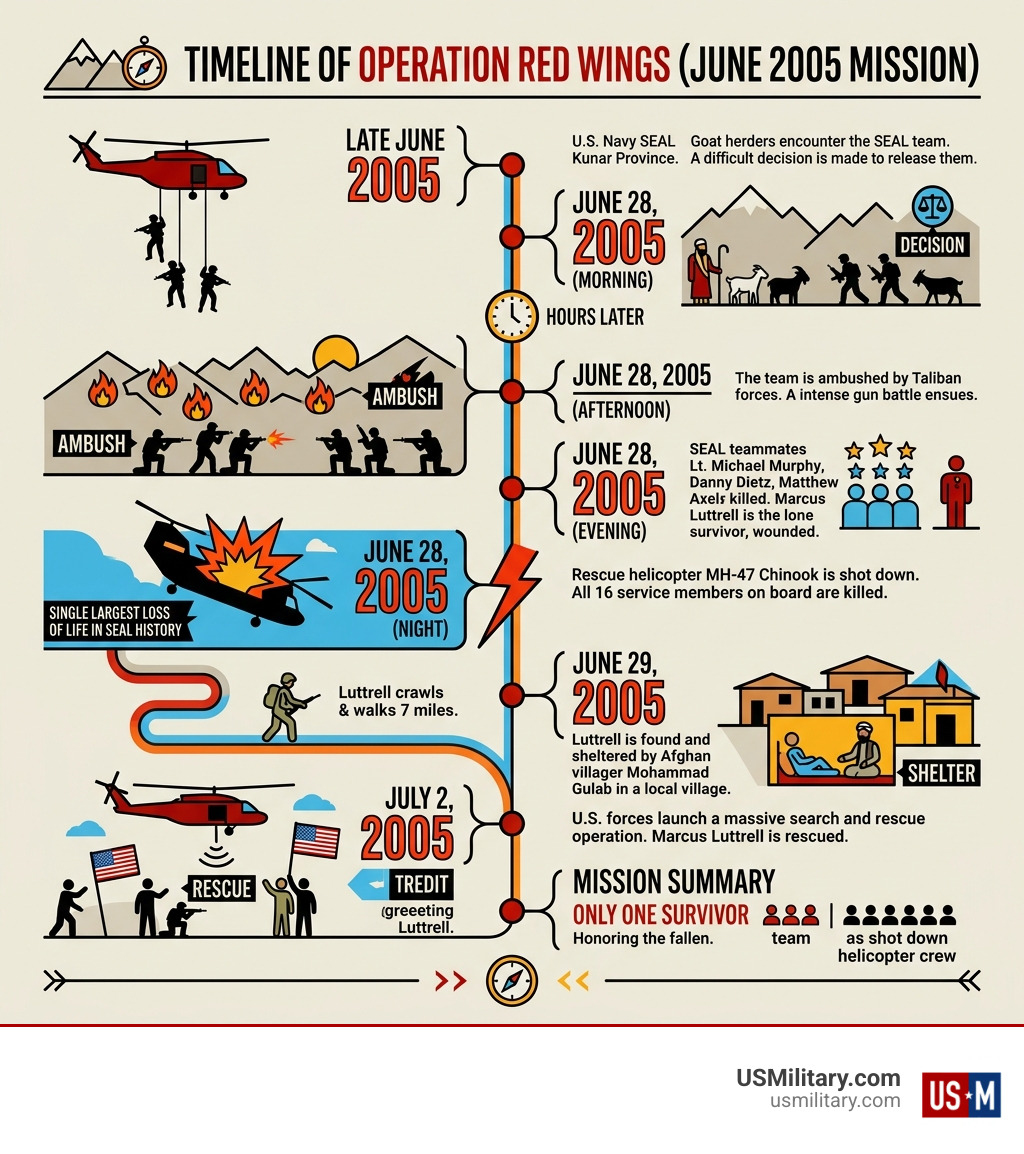
- Rescue helicopter: An MH-47 Chinook with 16 rescuers was shot down, making it the single largest loss of life in Navy SEAL history
- Survival: Luttrell crawled and walked seven miles through rugged mountains before being sheltered by Afghan villager Mohammad Gulab
- Rescue: U.S. forces extracted Luttrell on July 2, 2005 — six days after the battle
- Awards: Navy Cross, Bronze Star with “V” device, and Purple Heart
- Book: Lone Survivor (2007), a New York Times #1 bestseller
- Film: 2013 movie starring Mark Wahlberg, grossing over $150 million worldwide
The story is powerful. But it is also controversial — with disputes over enemy numbers, key details, and the book’s origins that we’ll cover in full below.
I’m Larry Fowler, publisher of the USMilitary.com Network, and since 2007 I’ve been covering military stories, veteran benefits, and service-related topics — including the marcus luttrell lone survivor account that continues to resonate with active-duty members and veterans alike. Read on for a complete, honest breakdown of everything you need to know.
Must-know marcus luttrell lone survivor terms:
The Heroic Account of the Marcus Luttrell Lone Survivor Mission
To understand the Marcus Luttrell Lone Survivor story, we have to go back to the rugged, unforgiving peaks of the Hindu Kush mountains in late June 2005. The mission was dubbed Operation Red Wings. Its primary objective was the “kill or capture” of Ahmad Shah, a high-ranking Taliban leader linked to Osama bin Laden who headed a group of insurgents known as the “Mountain Tigers.”
Marcus Luttrell was part of a four-man Navy SEAL reconnaissance and surveillance team. Joining him were Lieutenant Michael P. Murphy (the team leader), Petty Officer 2nd Class Danny Dietz, and Petty Officer 2nd Class Matthew Axelson. These men weren’t just teammates; they were elite operators trained to handle the most extreme conditions on Earth. Luttrell himself was a graduate of BUD/S Class 228 and had trained as a Special Operations Combat Medic (18 Delta), a role that would prove vital in the days to come.
According to Marcus Luttrell’s official biography, the team was inserted by helicopter into the Kunar Province under the cover of darkness. Their job was to find Shah’s position and relay that intelligence back to base. However, the mission took a turn for the worse almost immediately due to the treacherous terrain and a chance encounter that would spark one of the most intense moral debates in modern military history.

The Moral Dilemma: Releasing the Goat Herders
While the team was concealed in a “hide site,” they were stumbled upon by three local goat herders—two men and a boy. Suddenly, the SEALs faced a crisis of conscience and a breach of security. Under the Rules of Engagement (ROE), these individuals were technically non-combatants. However, the SEALs knew that if they released them, the herders would likely run straight to the Taliban.
In his book, Marcus Luttrell Lone Survivor describes a “vote” that took place among the four SEALs. According to his account, they debated three options: kill the herders to protect the mission, tie them up and leave them to freeze, or release them. Luttrell famously stated that he cast the deciding vote to release them, later calling it the “stupidest, most southern-fried, lame-brained decision I ever made in my life.”
This “vote” has become a staple of military ethics discussions. However, it’s worth noting that many military experts and even some of the families of the fallen SEALs have questioned whether a formal vote actually occurred, as SEAL teams typically operate under a strict chain of command where the officer in charge—in this case, Michael Murphy—makes the final call. Regardless of how the decision was reached, the herders were released. Within an hour, the team was surrounded by Taliban fighters. For more on the man behind the story, you can visit our page on marcus luttrell.
The Battle of Murphy’s Ridge
The ensuing firefight was what Luttrell described as “steel rain.” The SEALs were trapped on a steep, rocky slope, forced to retreat down the mountain while being engaged from three sides. Despite being heavily outnumbered and outgunned, the four SEALs fought with legendary tenacity.
Danny Dietz was the first to be mortally wounded but continued to operate the radio until he could no longer stand. Matthew Axelson sustained multiple gunshot wounds but kept firing his weapon to cover his teammates. Michael Murphy, realizing their radio wouldn’t work in the deep ravines, famously moved into open ground—exposed to direct enemy fire—to use a satellite phone to call for help. He succeeded in making the call but was killed shortly after. For this act of extraordinary valor, Murphy was posthumously awarded the Medal of Honor.
One of the most significant points of contention in the Marcus Luttrell Lone Survivor narrative involves the number of enemy fighters. The table below highlights the stark differences in various accounts:
| Source | Estimated Taliban Fighters |
|---|---|
| Luttrell’s Official After-Action Report | 20–35 |
| Naval Medal of Honor Citation | 30–40 |
| Military Intelligence Reports | 8–10 |
| Lone Survivor (The Book) | 80–200 |
While the numbers vary, the outcome was the same: three of the four SEALs were killed in action. Luttrell was blown over a ridge by an RPG, suffering a broken back, a broken nose, and multiple shrapnel wounds, yet he remained alive.
Survival, Rescue, and the Pashtun Code
Badly injured and alone, Luttrell began a grueling survival journey. He crawled and walked nearly seven miles through the mountains, licking moisture off rocks to stay hydrated and using his survival training to evade Taliban patrols. He was eventually discovered by Mohammad Gulab, a villager from Sabray.
Gulab and his fellow villagers took Luttrell in, but they didn’t just give him food and water. They protected him under a 2,000-year-old Pashtun cultural code known as Pashtunwali. Specifically, they practiced Nanawatai (asylum), which dictates that a person in need must be protected at all costs, even against one’s own enemies. When the Taliban arrived at the village demanding Luttrell be handed over, the villagers refused, risking their lives to shield the American. This incredible cross-cultural bond is a cornerstone of the Detailed Navy SEAL background found in historical archives.
The Tragedy of Turbine 33
While Luttrell was being sheltered, a rescue mission was already underway—and it met with disaster. In response to Michael Murphy’s distress call, two MH-47 Chinook helicopters from the 160th Special Operations Aviation Regiment (Night Stalkers) rushed to the scene.
As the lead helicopter, call sign Turbine 33, attempted to insert a team of eight SEALs and eight Army Night Stalkers, it was struck by a rocket-propelled grenade (RPG). The helicopter crashed, killing all 16 service members on board. It was a staggering blow, marking the largest single-day loss of life in Navy SEAL history at that time. The loss of these 16 heroes added a layer of profound tragedy to the Marcus Luttrell Lone Survivor story, ensuring that the mission would never be forgotten.
The Rescue of the Lone Survivor
On July 2, 2005, six days after the initial ambush, a massive joint rescue operation involving Army Rangers, Air Force Pararescuemen, and Afghan National Army troops finally reached Sabray. Luttrell was extracted and flown to Bagram Air Base for medical treatment.
For his actions during Operation Red Wings, Marcus Luttrell was awarded the Navy Cross, the second-highest decoration for valor in the U.S. military. His citation notes his “extraordinary heroism” and his “undaunted courage” in the face of a numerically superior enemy. He also received the Purple Heart for his extensive injuries. After a period of recovery, Luttrell remarkably returned to service and completed one more tour in Iraq before being medically retired in 2007.
Media and Legacy: From Page to Screen
The story of Marcus Luttrell didn’t end with his rescue. In 2007, he released the book Lone Survivor: The Eyewitness Account of Operation Redwing and the Lost Heroes of SEAL Team 10. The book was ghostwritten by British novelist Patrick Robinson and quickly became a cultural phenomenon.
The Literary Success of the Marcus Luttrell Lone Survivor Book
Lone Survivor hit the New York Times Bestseller list in July 2007 and stayed at the top for weeks. It was more than just a war story; it was a deeply personal tribute to Luttrell’s fallen “brothers.” The book’s raw, patriotic tone resonated with millions of Americans. However, it also served as a polemic against the “liberal media” and strict military Rules of Engagement, which Luttrell argued put soldiers’ lives at risk.
The book has since been used in various capacities, including as an Ethics case study on the mission at the U.S. Naval Academy. It forced a public conversation about the impossible choices soldiers face on the battlefield.
Controversies and Accuracy of the Marcus Luttrell Lone Survivor Story
As the story’s fame grew, so did the scrutiny. Investigative journalists and military historians, such as Ed Darack, began to point out discrepancies between the book and the official military record.
One of the most significant “Substack revelations” and investigative reports highlighted that when Luttrell was rescued, he reportedly had all 11 of his ammunition magazines intact. This contradicted the book’s claim that he had fired nearly all his rounds in a desperate last stand. Furthermore, Mohammad Gulab, the man who saved him, later gave interviews suggesting that the number of Taliban fighters was much lower—closer to 10 than 200—and that the “vote” to release the goat herders never happened.
Luttrell has addressed some of these claims in recent years, including a 2024 podcast appearance where he mentioned that the book was an “assignment” from his superiors at Naval Special Warfare Command to tell the story of the mission, which some have interpreted as a nuance in how the narrative was shaped. Despite these debates, the core of the story—the sacrifice of 19 American service members and the survival of one against all odds—remains undisputed.
In 2013, the story was adapted into a major motion picture directed by Peter Berg and starring Mark Wahlberg as Luttrell. The film was a box office hit, grossing over $150 million. While the movie took some creative liberties (such as the dramatized final battle at the village), it succeeded in bringing the story of Operation Red Wings to a global audience.
Frequently Asked Questions about Marcus Luttrell
How many Taliban fighters were involved in the battle?
Official after-action reports estimated 20–35 fighters, while intelligence reports suggested 8–10; however, the book ‘Lone Survivor’ claimed the team faced 80–200 insurgents. The discrepancy is often attributed to the “fog of war” and the dramatic nature of the book’s ghostwritten narrative.
Who saved Marcus Luttrell after the ambush?
Luttrell was saved by Mohammad Gulab and the villagers of Sabray, who protected him under the Pashtunwali code of hospitality despite threats from the Taliban. Gulab even traveled to the United States later in life, though his relationship with Luttrell eventually became strained due to differing accounts of the events.
What awards did Marcus Luttrell receive for his service?
Luttrell was awarded the Navy Cross for extraordinary heroism, the Bronze Star with a “V” device for valor, and the Purple Heart for injuries sustained in combat. His twin brother, Morgan Luttrell, also served as a Navy SEAL and later became a U.S. Congressman.
Conclusion
The legacy of the marcus luttrell lone survivor story is one of resilience, sacrifice, and the “Never Quit” mindset. Today, Luttrell is a husband, father, and motivational speaker. He founded the Lone Survivor Foundation, which provides health and wellness support to veterans struggling with PTSD and other “invisible wounds” of war.
Luttrell’s post-military achievements include:
- Becoming a #1 New York Times Bestselling author.
- Hosting the “Team Never Quit” podcast.
- Establishing a successful career as a motivational speaker.
- Appearing in various films and TV shows, including a cameo in the Lone Survivor movie.
At USMilitary.com, we believe in providing veterans with the resources they need to thrive after service, from VA disability information to career guidance. Whether you are interested in the elite world of Special Operations or simply looking for veteran support, we are here to help. If you’ve ever wondered how different units compare, check out our guide to Compare Army Delta vs Navy SEALs.
Marcus Luttrell’s journey reminds us that even in our darkest hours, the human spirit—and the bonds of brotherhood—can pull us through. We owe it to the 19 men who didn’t come home from Operation Red Wings to remember their names and their courage.
Free for Service Members & Veterans
Get the military benefits intel no one tells you about.
Weekly updates on VA benefits, pay changes, and money tips — free for service members and veterans.
No spam. Unsubscribe anytime. Your info is never shared.


