Military Jobs With Strong Civilian Earning Potential. Think Smart and Long-Term When Enlisting.

USMilitary.com ranks the top 15 military jobs that offer high-paying civilian careers by looking at civilian wages, job growth, transferable skills, and credentials. Cyber operations, military IT, intelligence, air traffic control, aviation, nuclear power, and healthcare stand out. Some paths can lead to six-figure pay, but military experience alone does not guarantee it. Civilian licenses, degrees, and experience may still be required.
Your best choice also depends on your ASVAB line scores, the job available when you enlist, and the work you want to do after service.
I’m Larry Fowler, a Navy veteran, BUD/S Class 89 graduate, and publisher of USMilitary.com. In USMilitary.com Ranks Top 15 Military Jobs That Offers High Paying Civilian Careers, I use that background to help you weigh military training against real civilian career requirements.
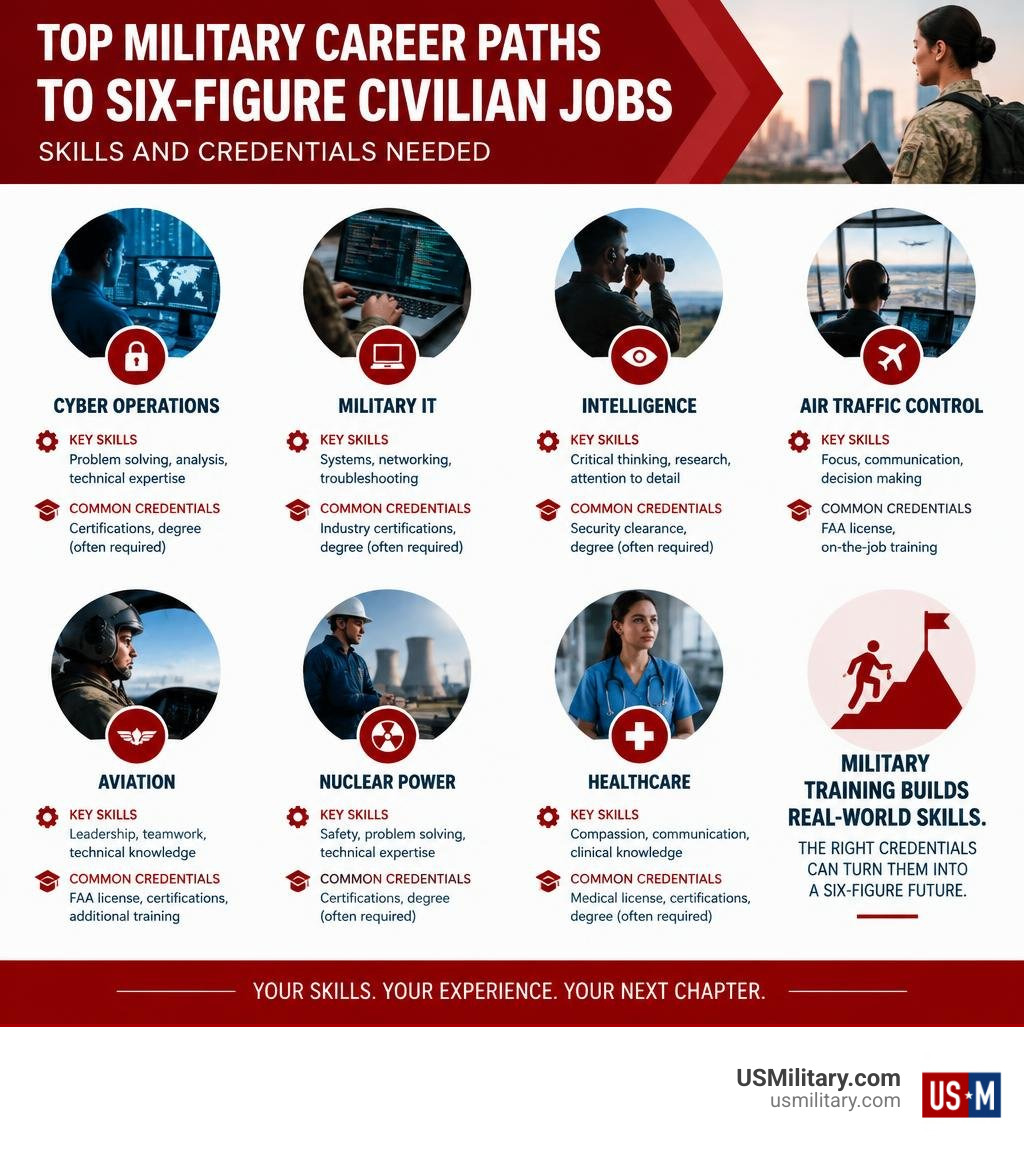
Simple guide to USMilitary.com Ranks Top 15 Military Jobs That Offers High Paying Civilian Careers:
- 20 Navy Jobs That Can Set You Up For FInancial Success For Life
- Top 20 Career Jobs in the Space Force
- military jobs
How USMilitary.com Ranks the Top 15 Military Jobs That Offer High-Paying Civilian Careers
Every year, roughly 200,000 service members transition from the armed forces into the private sector. When we evaluated military specialties across the Army, Navy, Air Force, Marine Corps, Space Force, and Coast Guard, we established a rigorous benchmark. A great military occupational specialty (MOS, AFSC, or rating) must do more than look impressive in uniform—it must build clear post-service marketability.
Our ranking system weighs four core criteria:
- Civilian Earning Power: Above-average median wages benchmarked against the national median wage ($48,060).
- Projected Job Market Growth: Occupational outlooks exceeding the baseline 4% national growth projection through 2033, utilizing data from the BLS military-to-civilian career outlook.
- Direct Credential Portability: Built-in industry certifications (such as CompTIA Security+, FAA licenses, or NREMT credentials) that bypass civilian entry-level gates.
- Active Security Clearance Value: Possession of Secret or Top Secret/Sensitive Compartmented Information (TS/SCI) clearances.
To understand the full scope of branch options, review our military career paths complete guide.
| Rank | Military Specialty Field | Primary Civilian Occupation Match | Civilian Median Salary | Projected 10-Year Growth | Key Transferable Credential / Clearance |
|---|---|---|---|---|---|
| 1 | Cyber Operations Specialist | Information Security Analyst | $120,360 | 33% | CompTIA Security+, CISSP, TS/SCI |
| 2 | Intelligence Analyst | Intelligence / Threat Analyst | $80,000–$120,000 | 11% | TS/SCI Clearance, GEOINT/SIGINT |
| 3 | Air Traffic Control Operator | Air Traffic Controller | $134,000 | 4% | FAA Air Traffic Control Specialist (ATCS) |
| 4 | Nuclear Power / Propulsion Plant Operator | Nuclear Reactor Operator / Power Tech | $104,000–$130,000 | 6% | NAVSEA Nuclear Tech Certification, DOE Clearance |
| 5 | Military Pilot / Aviator | Commercial Airline Pilot | $113,080–$170,000 | 6% | FAA Commercial Pilot / ATP Certificate |
| 6 | Data Science & Operations Research Analyst | Data Scientist | $108,020 | 36% | Python, SQL, Operations Research Modeling |
| 7 | Information Technology Specialist | Computer Systems / Network Architect | $103,800–$129,840 | 11%–13% | CCNA, Network+, Security+ |
| 8 | Practical Nursing & Healthcare Specialist | Registered Nurse / Healthcare Professional | $86,070–$126,260 | 6%–46% | NCLEX-RN / LPN, NREMT |
| 9 | Aviation Program Manager / Aerospace Tech | Aviation Program Manager | $120,000–$160,000 | 7% | PMP Certification, FAA Airframe & Powerplant |
| 10 | Satellite Communications & Space Systems Operator | Telecommunications / Space Tech | $98,580–$134,700 | 11% | TS/SCI, SATCOM Operations Certification |
| 11 | Criminal Investigations (CID / NCIS / OSI) | Federal Special Agent / Corporate Investigator | $115,000–$160,000 | 8% | FLETC Certification, Top Secret Clearance |
| 12 | Biomedical / Laboratory Equipment Technician | Medical Equipment Repairer / Lab Tech | $60,610–$84,470 | 15% | CBET Certification, Clinical Lab Licensure |
| 13 | Logistics & Supply Chain Manager | Logistician / Supply Chain Director | $79,400–$99,410 | 19% | Lean Six Sigma, PMP, Supply Chain Logistics |
| 14 | Construction Engineering Project Manager | Construction Project Manager | $99,510–$130,720 | 11% | FE/PE Licensure, OSHA 30, Project Management |
| 15 | Dental Laboratory Technician | Dental Prosthetics Specialist | Up to $175,000 | 8% | CDT (Certified Dental Technician) |
Why USMilitary.com Ranks Top 15 Military Jobs That Offers High Paying Civilian Careers by Market Demand
We map service roles to private industry using the O*NET Military Occupational Classification (MOC) crosswalk. By identifying Standard Occupational Classification (SOC) categories experiencing severe talent shortages, we ensure these picks reflect high civilian demand. Data science positions, for example, are projected to expand by 36%, while information security analysts project a 33% expansion. Selecting a high-demand MOC gives you leverage in the private sector.
How USMilitary.com Ranks Top 15 Military Jobs That Offers High Paying Civilian Careers for Technical Growth

Modern military operations rely heavily on technical mastery. We evaluate how well branches train personnel in cyber defense, electronic warfare, high-pressure aviation systems, and reactor physics. When the DoD invests hundreds of thousands of dollars training you in sophisticated systems, defense contractors and corporate enterprises compete aggressively to hire you upon separation.
Top Military Occupations for Six-Figure Civilian Success
Securing a lucrative civilian job starts with selecting the right specialty. For an in-depth breakdown of high-compensation opportunities, read our top military jobs six figures guide.
Cyber Operations Specialists and Information Security Analysts
Cyber roles across the Army (17C), Navy (CWT), Air Force (1B4X1), and Space Force train service members to defend digital infrastructure and run complex offensive cyberspace operations. Transitioning cyber specialists routinely step into private roles earning between $120,000 and $160,000. Military training provides foundational certifications like CompTIA Security+, CEH, and CISSP alongside an active TS/SCI clearance. Learn more about these opportunities in our overview of high-paying civilian jobs with military training.
Intelligence Analysts and Counterintelligence Agents
Intelligence specialists (Army 35F/35L, Navy IS, Air Force 1N0X1) process sensitive intelligence data and brief strategic leaders. In the civilian marketplace, defense contractors and intelligence agencies hire former military analysts at salaries ranging from $80,000 to $120,000. Special agents transitioning to federal entities like the FBI or corporate threat intelligence units frequently earn $115,000 to $160,000.
Military Air Traffic Control Operators
Military Air Traffic Controllers (such as Army 15Q or Navy AC) manage high-volume, high-stress airspaces. Because their military schooling mirrors FAA curriculum requirements, military controllers can test directly for their FAA Air Traffic Control Specialist certificate. Civilian controllers earn a median salary of roughly $134,000, making this one of the most direct non-degree paths to an immediate six-figure income.
Nuclear Propulsion Engineers and Power Plant Operators
The Navy’s Nuclear Propulsion Program produces reactor operators and nuclear technicians who operate shipboard reactors. Commercial utility providers, regional energy grids, and specialized manufacturing plants prize their rigorous procedural discipline. Enlisted nuclear operators routinely command civilian base salaries between $104,000 and $130,000 immediately after their service enlistment.
Healthcare Specialists, Nurses, and Medical Technicians
Military medical training yields substantial dividends. Practical nurses (68C) and medical laboratory technicians gain clinical hours that transfer into registered nursing or advanced medical technology paths. Registered nurses command median earnings of $86,070 with 194,500 annual openings nationwide, while Nurse Practitioners boast a median wage of $126,260 and 46% projected job growth. Explore top career choices for female recruits in our best military jobs for women.
✉ Get updates like this in your inbox
Weekly VA benefit changes, pay updates, and money tips for service members, veterans, and military families. Free, no spam.
Aviation Program Managers and Commercial Pilots
Military aviators leave the service with thousands of documented multi-engine turbine hours, qualifying them directly for commercial Airline Transport Pilot (ATP) ratings. Commercial airline pilots enjoy median compensation exceeding $113,000, with top legacy carriers paying experienced captains $170,000 to $300,000+. Aviation maintenance personnel and aviation project leaders can discover lucrative military paths in our guide to the best Air Force jobs for long-term financial success.
Space Operations, Telecommunications, and Data Science Specialists
Space Systems Operations (Space Force 5S0X1) and data scientists work with orbital tracking architectures, high-bandwidth satellite constellations, and statistical algorithms. Commercial aerospace firms and enterprise software platforms heavily recruit these specialists at salaries exceeding $108,000 to $134,000. Review available paths across the newest branch in our Space Force career jobs compared article.
ASVAB Line Scores, Bonuses, and Non-Combat Work-Life Balance

Your entry score on the Armed Services Vocational Aptitude Battery (ASVAB) dictates which military occupations you can choose. If you are seeking low-risk career paths, check our review of the safest military jobs in 2026 compared.
Unlocking Technical Roles with High ASVAB Line Scores
The military does not rely solely on your overall Armed Forces Qualification Test (AFQT) percentile; it uses composite “line scores” to establish specific job eligibility:
- General Technical (GT): Verbal Expression + Arithmetic Reasoning. A GT score of 110+ is required for intelligence, cyber, and special agent roles.
- Surveillance & Communications (SC) and Skilled Technical (ST): Crucial for advanced IT, cyber systems (requiring ST 110+), and avionics.
- Electronics (EL): Required for nuclear field mechanics, radar techs, and space systems.
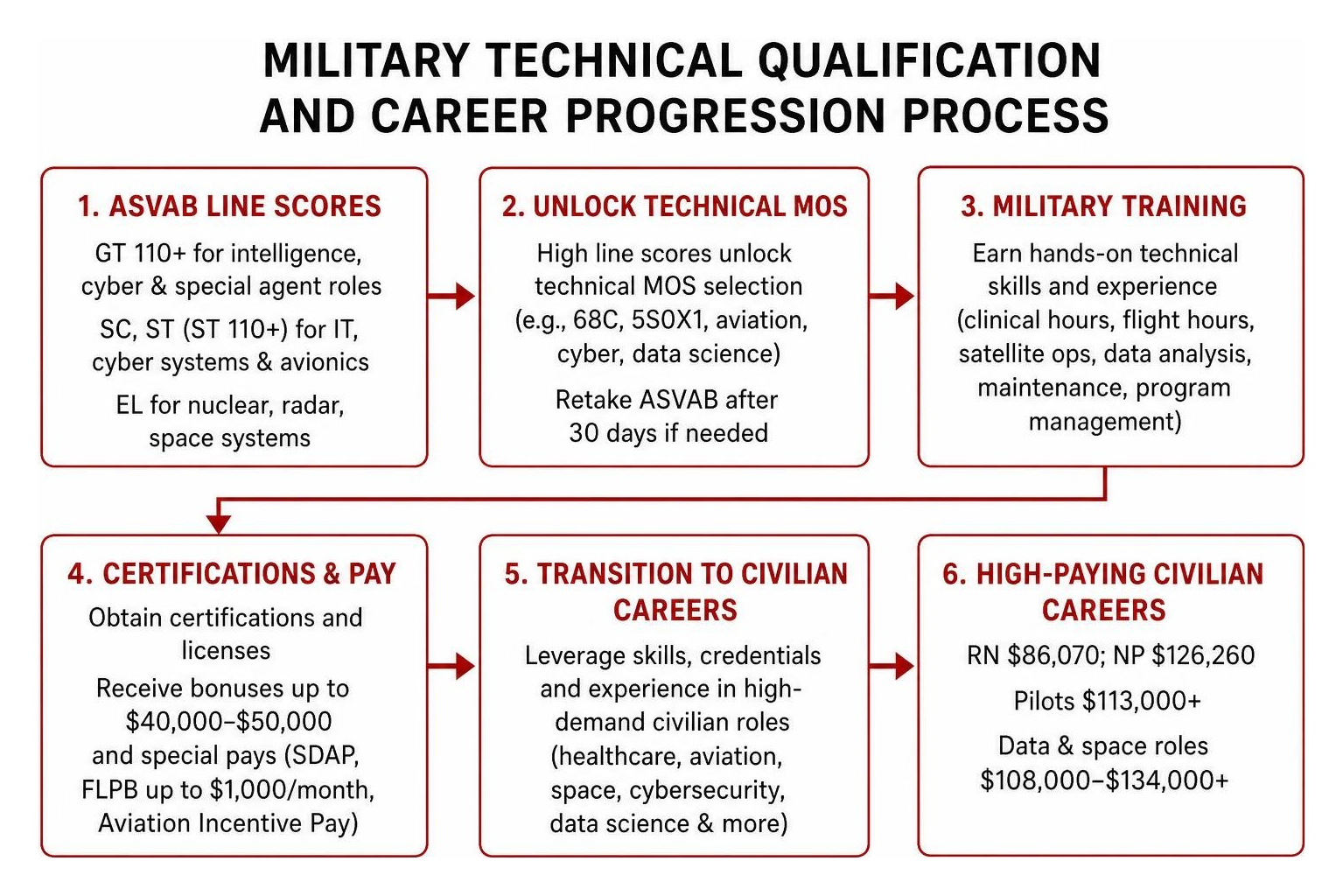
If your initial scores miss target prerequisites, study and retake the test. Testing regulations permit retakes after 30 days.
Enlistment Bonuses and Special Duty Pay
High-demand technical rates often feature initial enlistment bonuses up to $40,000 to $50,000 depending on branch staffing needs. Service members in specialized assignments also receive Special Duty Assignment Pay (SDAP), Foreign Language Proficiency Bonus (FLPB) up to $1,000 monthly, or Aviation Incentive Pay.
High-Paying Non-Combat Roles with Predictable Schedules
You do not need to enlist in combat arms to build a rewarding military career. Support roles like Financial Management Technician (36B), Human Resources Specialist (42A), and Paralegal Specialist (27D) operate within structured office hours. These specialties teach personnel corporate enterprise software, compliance auditing, and contract law—skills that transfer easily to civilian project coordination. Learn how to identify your optimal career match with our guide on how to find a military job that actually fits you.
Transition Strategies: Security Clearances, DoD SkillBridge, and the GI Bill
Converting military expertise into a civilian career requires a clear transition plan. Start laying the groundwork at least 18 months before your separation date. Compare institutional options across the service using our evaluation of the best military branches for education.
Leveraging Top Secret Clearances and Defense Contracting
Maintaining an active TS/SCI clearance is a substantial financial asset. For defense contractors and federal intelligence organizations, hiring an applicant with an existing clearance saves tens of thousands of dollars and avoids months of background investigation backlogs. Cleared veterans often command a $15,000 to $30,000 salary premium over uncleared civilian peers.
Maximizing GI Bill Benefits and Credentialing Programs
Pair your operational background with formal qualifications using military funding programs:
- Credentialing Assistance (Army COOL, Navy COOL, AF COOL): Pays exam and training fees for industry certifications like PMP, CISSP, and FAA licenses while on active duty.
- DoD SkillBridge: Permits service members to spend their final 180 days of active service participating in civilian apprenticeships and corporate internships while drawing full military base pay and allowances.
- Post-9/11 GI Bill: Provides 36 months of full tuition coverage, a monthly housing allowance (BAH), and a textbook stipend to help you earn a bachelor’s or master’s degree.
Common Mistakes Recruits Make When Choosing a Military Specialty
Avoid these three frequent pitfalls when enlisting:
- Selecting for Combat Prestige Over Market Portability: Combat arms build outstanding leadership attributes, but they lack direct civilian credential equivalents.
- Accepting Open Contracts or Unwritten Promises: Never accept recruiter assurances regarding job selection. Ensure your exact MOS/AFSC and bonus incentives are explicitly documented on your enlistment contract (DD Form 4).
- Failing to Track Certifications During Service: Do not wait until outprocessing. Log all military training hours into the Joint Services Transcript (JST) and complete civilian certification exams well before separation.
Frequently Asked Questions About Military Jobs and Civilian Careers
What is the highest-paying civilian job transitioning veterans can get?
Commercial airline pilot, chief information security officer (CISO), nuclear plant operator, and aviation program manager rank highest. Veterans entering these fields frequently earn between $120,000 and $170,000+ within several years of separating.
How do ASVAB scores affect my civilian career potential?
Your ASVAB subtest results dictate the military specialties you can enter. Achieving high GT (110+), ST, and EL scores qualifies you for cyber, intelligence, biomedical, and engineering roles that offer direct civilian licensing pipelines.
Can non-combat military jobs lead to six-figure civilian salaries?
Yes. Specialties in enterprise IT, logistics analytics, cyber defense, air traffic management, and intelligence analysis operate in non-combat office environments and consistently lead to six-figure salaries in the civilian job market.
Conclusion
Choosing a military specialty is a major career decision. By selecting roles that teach high-demand technical skills, securing professional certifications, and maintaining security clearances, you can turn your military service into a fast track toward six-figure civilian earnings.
At USMilitary.com, we are committed to helping active duty service members, reservists, and veterans achieve long-term financial security. Ready to plan your service trajectory? Use our interactive tools to explore career military training options and build a solid foundation for your future today.
Free for Service Members & Veterans
Get the military benefits intel no one tells you about.
Weekly updates on VA benefits, pay changes, and money tips — free for service members and veterans.
No spam. Unsubscribe anytime. Your info is never shared.



Leave a Reply