Why Military Retirement Pay Is One of the Best Benefits in Uniform

Military retirement pay is a monthly, inflation-protected pension paid to service members who meet specific eligibility requirements — most commonly 20 or more years of service.
Here is a quick breakdown of the four main retirement systems:
| Plan | Who It Covers | Multiplier | COLA |
|---|---|---|---|
| Final Pay | Entered service before Sep. 8, 1980 | 2.5% per year | Full CPI |
| High-36 | Entered on/after Sep. 8, 1980 (before Jan. 1, 2018) | 2.5% per year | Full CPI |
| REDUX | Opted in between Aug. 1, 1986 – Dec. 31, 2017 | 2.5% minus 1% per year under 30 | Reduced CPI |
| BRS | Entered on/after Jan. 1, 2018 (or opted in) | 2.0% per year + TSP matching | Full CPI |
So at 20 years of service, your monthly pay equals:
- 50% of base pay under Final Pay or High-36
- 40% of base pay under REDUX or BRS
- Plus TSP investment savings under BRS
This guide covers every plan in detail — calculations, COLA adjustments, disability options, Reserve and Guard rules, and tax implications — so you can make the most informed decision about your military future.
I’m Larry Fowler, publisher of USMilitary.com since 2007 and a longtime resource for active duty members and veterans navigating complex benefits like military retirement pay. My team has helped hundreds of thousands of service members cut through the confusion and find reliable, accurate information to protect their financial future.
Understanding the Main Military Retirement Pay Systems
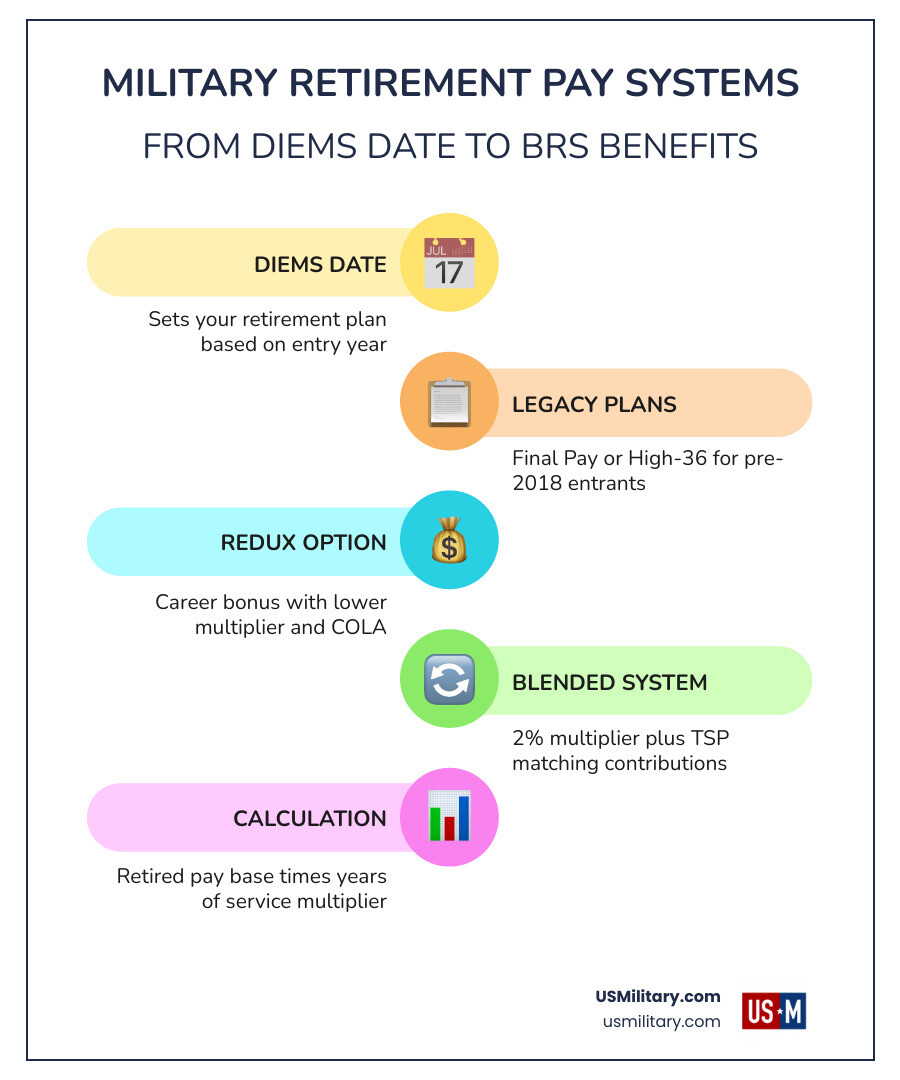
When we talk about military retirement pay, the first thing we have to look at is your DIEMS—the Date of Initial Entry into Military Service. This date is the “golden key” that determines which retirement plan you fall under. It doesn’t matter if you had a break in service; that original entry date stays fixed.
For those few still serving who entered before September 8, 1980, the Final Pay system is the standard. It’s the most straightforward: your retirement is based on your final basic pay.
Most of our mid-to-late career service members fall under the High-36 plan. If you entered between September 1980 and the end of 2017, this is likely your home. Instead of using your very last paycheck, the government averages your highest 36 months of basic pay to create your “retired pay base.”
Then there is the REDUX plan. This was an optional choice for those who entered between 1986 and 2017. It offered a $30,000 “Career Status Bonus” at the 15-year mark in exchange for a lower retirement multiplier and reduced inflation protection. It’s a classic “money now vs. money later” scenario. If you’re looking for more details on who qualifies for what, check out our guide on Military Pension Eligibility 101. You can also find the Official guide to retirement systems for a deep dive into the legal definitions.
The Blended Retirement System (BRS) and Military Retirement Pay
If you joined the ranks on or after January 1, 2018, you are automatically enrolled in the Blended Retirement System (BRS). This was the biggest shift in military compensation in decades. We like to think of it as a “hybrid” plan.
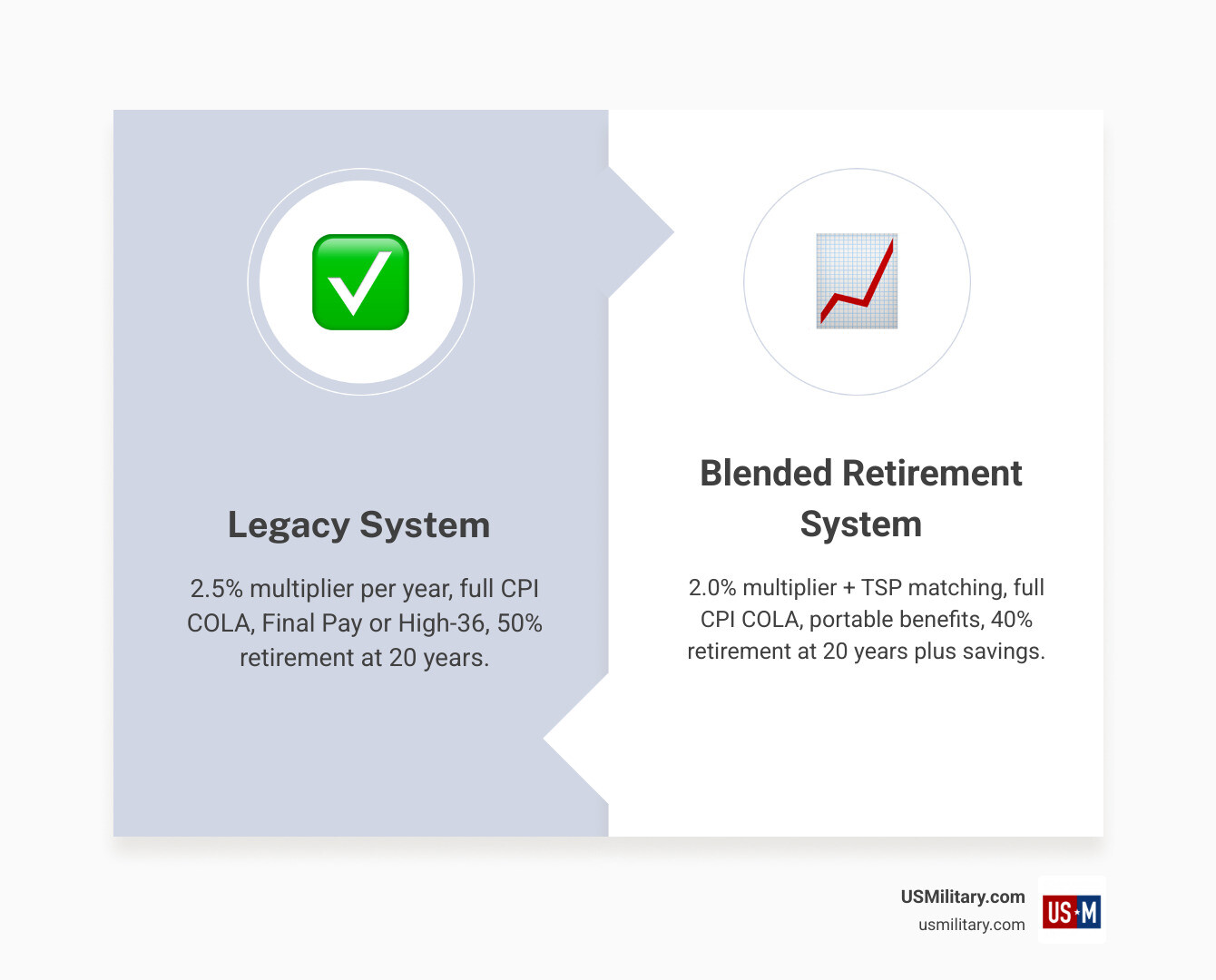
Under BRS, the traditional pension multiplier is reduced from 2.5% to 2.0% per year. This means at 20 years, you get 40% of your High-36 average instead of 50%. However, the “blended” part comes from the Thrift Savings Plan (TSP). The government gives you an automatic 1% contribution and will match your contributions up to an additional 4%.
Another perk of the BRS is the mid-career “Continuation Pay”—a one-time bonus offered between 8 and 12 years of service in exchange for more time on the clock. For a look at how this fits into your overall earnings, see our 2026 Military Pay Chart Enlisted Guide.
Legacy vs. BRS Decision Factors
For those who were in the “opt-in” window back in 2018, the choice was tough. The Legacy (High-36) plan offers a larger guaranteed monthly check for life, but it’s an “all or nothing” deal. If you leave at 19 years and 11 months, you get zero pension.
The BRS, on the other hand, provides portable benefits. Even if you don’t stay for 20 years, you get to keep the government’s TSP contributions. It’s a great safety net for the 80% of service members who don’t make it to a full 20-year career. To see how these benefits scale from your first day to retirement, read From E-1 to O-4: Active Duty Pay and Benefits.
Calculation Methods and the Retired Pay Multiplier
Calculating your military retirement pay involves two main ingredients: the Retired Pay Base and the Retired Pay Multiplier.
The Retired Pay Base is either your final basic pay (Final Pay plan) or the average of your highest 36 months of pay (High-36 and BRS).
The Retired Pay Multiplier is where your years of service really shine. For every year you serve, you earn a percentage.
| Years of Service | Legacy Multiplier (2.5%) | BRS Multiplier (2.0%) |
|---|---|---|
| 20 Years | 50% | 40% |
| 25 Years | 62.5% | 50% |
| 30 Years | 75% | 60% |
| 40 Years | 100% | 80% |
As you can see, staying longer pays off significantly. To estimate your specific numbers based on current rates, check the Military Pay Chart 2026.
Cost of Living Adjustments (COLA) in 2026
One of the greatest features of military retirement pay is that it doesn’t lose its “buying power.” Every year, the government looks at the Consumer Price Index (CPI) to see how much the cost of milk, gas, and rent has gone up.
For 2026, a 2.8% Cost of Living Adjustment (COLA) was applied to retired pay, effective December 1, 2025. This means your January 2026 check should have reflected that boost.
If you are on the REDUX plan, your COLA is usually 1% lower than the standard rate. However, at age 62, the government does a one-time “catch-up” adjustment to bring your pay back in line with what it would have been under the High-36 system. For the most up-to-date figures on these adjustments, visit the Official DFAS retirement data portal.
Calculating the Multiplier for High-36 and Final Pay
For the majority of retirees, the 2.5% multiplier is the standard. It’s a simple math problem:
Years of Service x 2.5% = Your Multiplier.
- 20 years gets you 50%
- 24 years gets you 60%
- 30 years gets you 75%
While 75% used to be the “cap,” current rules allow those who serve longer than 30 years to continue increasing that multiplier (except in certain disability cases). With the Projected Military Pay Raise for 2026, these percentages translate into a very comfortable lifestyle for many veterans.
Disability Retirement and Concurrent Receipt Options
Not every retirement happens after 20 years of service. Sometimes, a service member is found “unfit for duty” due to a physical or mental disability. This is known as a Chapter 61 retirement.
To qualify for disability retirement, you generally need a disability rating of at least 30% from the military. Your pay is then calculated using one of two methods:
- Your years of service (2.5% or 2.0% x years of service)
- Your disability percentage (e.g., a 50% rating = 50% of base pay)
The military will give you whichever one is higher, but it is capped at 75% of your base pay. For a deeper look at how this works specifically for soldiers, see The Ultimate Guide to Army Pension Eligibility and Retirement Pay.

Concurrent Retirement and Disability Pay (CRDP)
In the old days, you couldn’t “double dip.” If you received VA disability pay, it was subtracted from your military retirement check. This was known as the “VA Waiver.”
Thankfully, Concurrent Retirement and Disability Pay (CRDP) changed that for many. If you have 20+ years of service and a VA disability rating of 50% or higher, you are entitled to receive both your full retirement pay and your full VA disability compensation. It’s an automatic entitlement—no application needed! This is a huge win for Marching Toward Fairer Pay with Military Pay Equity in 2026.
Combat-Related Special Compensation (CRSC)
If your disabilities are directly related to combat, training for combat, or “instrumentalities of war” (like exposure to Agent Orange or hazardous materials), you might qualify for CRSC.
Unlike CRDP, you must apply for CRSC through your specific branch of service. The big benefit here? CRSC is tax-free. It essentially replaces the money lost to the VA waiver with a tax-exempt payment from the Department of Defense.
Tax Considerations for Military Retirement Pay
We all have to pay the Piper. Generally, military retirement pay is considered taxable income at the federal level. However, there are some important exceptions:
- Disability Pay: If your retirement is based on a combat-related disability, it may be tax-exempt.
- State Taxes: Many states (like Florida, Texas, and increasingly others) do not tax military retirement pay at all.
- Retroactive Ratings: If the VA gives you a disability rating that goes back several years, you might be able to file a Form 1040X to get a refund on taxes you previously paid on your retirement income.
For a specific look at how pay grades affect these numbers, see the Estimated 2026 Navy Pay Chart.
Active Duty vs. Reserve and Guard Retirement
Retiring from the Reserves or National Guard is a different beast. Instead of counting days, we count points. You earn points for drills, annual training, and active duty deployments.
The biggest difference? You usually can’t start drawing your check until age 60. However, for every 90 days you spend on certain active duty orders in a fiscal year, you can “buy down” that age requirement. Some lucky retirees start drawing pay in their early 50s! Learn more about the timing in The Golden Years Countdown and Pension Eligibility Age Limits.
Non-Regular Retirement Eligibility
To earn a “non-regular” retirement, you need 20 “qualifying years” (years where you earned at least 50 points). Once you hit that 20-year mark, you receive your “20-year letter.”
At that point, you enter the “Gray Area”—you are retired, but not yet receiving pay. During this time, keep your contact info current in myPay so DFAS can find you when it’s time to start the direct deposits. When you’re ready to apply, you’ll use DD Form 2656. For a peek into the future of reserve pay, check the Early Look 2027 Military Pay Chart Guide.
Frequently Asked Questions about Military Retirement
Which retirement plan applies to me based on my entry date?
It all comes down to your DIEMS date.
- Before Sept 8, 1980: Final Pay.
- Sept 8, 1980 – Dec 31, 2017: High-36 (unless you chose REDUX).
- Jan 1, 2018 – Present: Blended Retirement System (BRS).
Can I receive both VA disability and military retirement pay?
Yes, if you meet the criteria for CRDP (20+ years of service and 50%+ VA rating) or if you qualify for CRSC for combat-related injuries.
How does the 2026 COLA affect my monthly payment?
Most retirees saw a 2.8% increase in their monthly gross pay starting with the check delivered on January 1, 2026. This adjustment helps your pension keep up with inflation.
Conclusion
At USMilitary.com, we know that navigating military retirement pay can feel like trying to read a map in a sandstorm. Whether you are just starting your career under the BRS or you are a “gray area” reservist waiting for that 60th birthday, understanding these systems is the key to your long-term financial security.
Don’t forget to manage your accounts through myPay, and always consider the Survivor Benefit Plan (SBP) to ensure your loved ones are taken care of after you’re gone. Retirement isn’t just an end to your service; it’s the beginning of a new chapter that you’ve earned through years of sacrifice. We are here to help you every step of the way!

Free for Service Members & Veterans
Get the military benefits intel no one tells you about.
Weekly updates on VA benefits, pay changes, and money tips — free for service members and veterans.
No spam. Unsubscribe anytime. Your info is never shared.



Leave a Reply