Which U.S. military retirement benefits could you qualify for?

U.S. military retirement benefits depend on how you served. Active-duty members generally qualify for monthly retired pay after 20 years. Reserve and National Guard members generally need 20 qualifying years, but usually start receiving pay at age 60. Members found medically unfit may qualify for disability retirement with fewer than 20 years. The VA’s Veterans Pension is different: it is a needs-based benefit for eligible wartime veterans, not military retired pay.
Your entry date and retirement plan affect how much you may receive. This guide will help you identify your path, estimate your benefits, and find the steps to apply.
I’m Larry Fowler, a Navy veteran and BUD/S Class 89 graduate. Since 2007, I’ve published military and veteran guidance through USMilitary.com, including information on us military retirement benefits.

How U.S. military retirement benefits work: eligibility and plan choice
Which U.S. military retirement benefits plan applies to you?
Your plan depends on your DIEMS (Date of Initial Entry to Military Service), sometimes called DIEUS for the uniformed services. It’s the date you first entered service in any capacity. It doesn’t change if you leave and rejoin. Service academy cadets use their report date, ROTC scholarship members use their start date, and delayed-entry enlistees use their delayed-entry date.
- Final Pay: entered before September 8, 1980.
- High-36: entered September 8, 1980 through the end of 2017.
- REDUX: an option for some who entered August 1, 1986 or later, with a $30,000 Career Status Bonus at year 15. Elections ended December 31, 2017.
- Blended Retirement System (BRS): required for anyone entering on or after January 1, 2018.
Those who joined between 2006 and 2017 had a choice, and some opted in to BRS. Active-duty members needed fewer than 12 years of service on December 31, 2017. Reservists needed fewer than 4,320 retirement points. You can check the details in the retirement plan rules.
| Plan | Multiplier per year | 20 years | 30 years |
|---|---|---|---|
| Final Pay | 2.5% | 50% | 75% |
| High-36 | 2.5% | 50% | 75% |
| REDUX | 2.5%, minus 1 point for each year under 30 | 40% | 75% |
| BRS | 2.0% | 40% | 60% |
How U.S. military retirement benefits are calculated
Active-duty retirement requires 20 years of service, and pay can start right away. Two numbers drive your check: the retired-pay base and the multiplier.
- Base: Final Pay uses your last basic pay. High-36 and BRS use the average of your highest 36 months of basic pay, usually your last three years.
- Multiplier: years of service times the plan percentage.
In plain terms: monthly pay = base × years × percentage. Say your High-36 base is $6,000 and you serve 20 years. That’s 50%, or $3,000 a month. Under BRS, the same 20 years gives 40%, or $2,400, but you also have a TSP with government contributions.
Retirees get a yearly cost-of-living adjustment (COLA) tied to the Consumer Price Index. The most recent one was 2.8% effective December 1, 2025. REDUX gets about one point less each year, with a one-time catch-up at age 62. Use the official pay tables and our 2026 military pay chart guide to find your base pay.

How BRS TSP matching works
BRS pairs a smaller pension with a Thrift Savings Plan, which works like a 401(k).
- The government automatically adds 1% of your basic pay after 60 days.
- It matches your contributions up to another 4%, so contributing 5% gets you the full 5% in government money.
- Matching runs from your second through 26th year of service.
- Your government contributions are fully vested after two years, and the account is portable when you leave.
- Continuation pay is a mid-career bonus, claimable between years 8 and 12 with a service commitment.
Withdrawals follow TSP rules, and taking money early can bring taxes and penalties. Retirees can also choose a reduced-rate lump sum in exchange for a smaller pension. Don’t skip this step, because the match is free money.
Reserve, Guard, and disability retirement pathways
Reserve and National Guard retirement eligibility and calculation
You need 20 qualifying years, meaning years with at least 50 retirement points. Points come from drills, annual training, and active duty, with 360 points equaling a full active-duty year. Retired pay is based on total points, and the multiplier is the same as for active duty.
Pay typically begins at age 60. Qualifying active duty can lower that age, with a reduction of three months for each 90 days of qualifying service in a fiscal year. Payment isn’t automatic. You must apply to the branch you last served. Our complete guide to military reserve pension rules goes deeper.
✉ Get updates like this in your inbox
Weekly VA benefit changes, pay updates, and money tips for service members, veterans, and military families. Free, no spam.

Chapter 61 military disability retirement
Chapter 61 covers members found medically unfit for duty with a DoD disability rating of at least 30%. You don’t need 20 years if you meet that standard. Some members with fewer than 20 years qualify under the Temporary Early Retirement Authority.
Members may first go on the Temporary Disability Retired List, then move to the Permanent Disability Retired List. Pay is the higher of your disability percentage or years of service times your plan multiplier, capped at 75%.
Other benefits and support for military retirees
Veterans Pension versus military retirement pay
The Veterans Pension is not earned retirement pay. It’s a needs-based VA benefit. You generally need:
- Wartime service (at least 90 days for those who started before September 8, 1980, or 24 months for most later enlistees), with at least one day in a wartime period.
- No dishonorable discharge.
- Age 65 or older, or a permanent and total disability, nursing home care, or Social Security disability benefits.
- Income and net worth within congressional limits. Your home, car, and most furnishings don’t count.
Dependents can increase payments. Survivors may qualify for a Survivors Pension. Apply online, by mail, in person, or with a trained professional.
Healthcare, survivor, tax, and Social Security benefits
Retirees keep access to TRICARE health coverage, and TRICARE For Life supplements Medicare at 65. The Survivor Benefit Plan (SBP) lets you provide a monthly annuity to a spouse or child, and you make that election at retirement. Since January 1, 2023, SBP is no longer reduced by VA Dependency and Indemnity Compensation.
Military retired pay is generally taxable as federal income. State treatment varies, so check your state’s rules. Military service also earns Social Security credits. Research on retirees suggests steady pension income may help some people delay claiming, though the findings were not statistically significant.
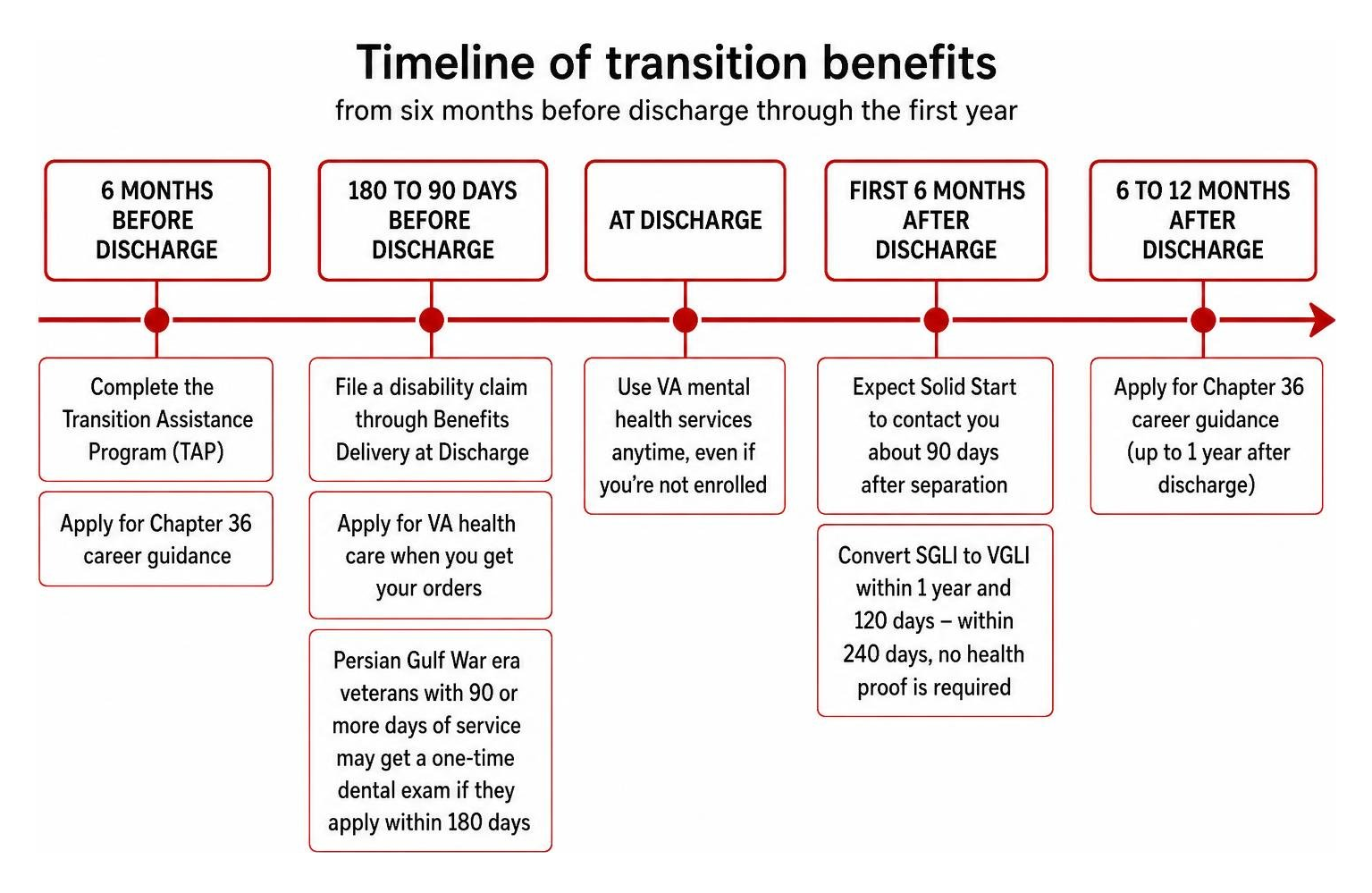
Separating or retiring within your first year
Many VA benefits are time-sensitive.
- Complete the Transition Assistance Program (TAP).
- File a disability claim through Benefits Delivery at Discharge 180 to 90 days before separation.
- Apply for VA health care when you get your orders. Combat veterans get 10 years of enhanced eligibility.
- Use VA mental health services anytime, even if you’re not enrolled.
- Persian Gulf War era veterans with 90 or more days of service may get a one-time dental exam if they apply within 180 days.
- Convert SGLI to VGLI within 1 year and 120 days. Within 240 days, no health proof is required.
- Apply for Chapter 36 career guidance from 6 months before to 1 year after discharge.
- Expect Solid Start to contact you about 90 days after separation.
Our ultimate guide to military benefits covers more.
Applying for benefits: steps and common questions
How to apply for military retired pay
Start with your service retirement office, which gives branch-specific instructions. You’ll submit DD Form 2656, which includes your SBP election, and keep your DD Form 214 and retirement orders handy. DFAS now offers a guided Smart Wizard for the form. Direct deposit is required, and you’ll manage your account through myPay. Reservists must request pay when eligible. The Retired Military & Annuitants site has forms and tools.
Frequently asked questions
Can you retire from active duty before age 60?
Yes. After 20 years, you can collect immediately. Someone who enlists at 18 could retire at 38.
Can you receive military retired pay and VA disability compensation?
Usually yes, but VA compensation may offset retired pay through a VA waiver. Concurrent Retirement and Disability Pay (CRDP) and Combat-Related Special Compensation (CRSC) can restore it if you qualify.
Does military retirement pay affect Social Security?
Not directly. Your retired pay doesn’t reduce your Social Security from military or civilian work. Your claiming age matters most, since waiting raises your monthly benefit.
Conclusion
Start by confirming your DIEMS and plan, then check your path: active duty, Reserve, disability, or Veterans Pension. Get a personalized estimate and note your deadlines. For more, explore the military retirement pay guide and the other resources at USMilitary.com.
Free for Service Members & Veterans
Get the military benefits intel no one tells you about.
Weekly updates on VA benefits, pay changes, and money tips — free for service members and veterans.
No spam. Unsubscribe anytime. Your info is never shared.



Leave a Reply