What Military SERE Training Is — And Why It Matters

What is military SERE training? It stands for Survival, Evasion, Resistance, and Escape — a specialized program that prepares high-risk military personnel to survive hostile environments, avoid capture, resist interrogation, and escape if taken prisoner.
Here’s a quick breakdown:
| Letter | Stands For | What It Means |
|---|---|---|
| S | Survival | Stay alive in remote or hostile environments |
| E | Evasion | Avoid detection and escape enemy forces |
| R | Resistance | Resist interrogation and exploitation if captured |
| E | Escape | Plan and execute escape from captivity |
The program’s guiding principle is simple: Return with Honor.
That phrase means more than just getting home. It means upholding the U.S. Code of Conduct under extreme pressure — even when facing torture, isolation, or coercion.
The stakes are real. During World War II, roughly 75% of U.S. Navy pilots who were shot down survived the initial incident — but only about 5% made it home, because they lacked basic survival skills. Stories like Admiral Jeremiah Denton blinking the word “TORTURE” in Morse code during a forced enemy press conference show what trained resistance looks like under the worst conditions.
SERE training exists so that today’s service members never face those situations unprepared.
I’m Larry Fowler, publisher of USMilitary.com — a network I’ve run since 2007 to help active duty members, recruits, and veterans navigate complex military topics, including what is military SERE training and how it shapes military careers. In this guide, I’ll walk you through everything: the history, curriculum, training levels, and what it takes to become a SERE Specialist.

Relevant articles related to what is military sere training:
What is Military SERE Training?
At its core, Survival, Evasion, Resistance and Escape training is the Department of Defense’s primary tool for Personnel Recovery (PR). We often think of the military in terms of offensive power, but SERE is about the individual soldier’s defensive psychological and physical armor.
When we ask, What is SERE Training, we are looking at a program built around the Code of Conduct. This is a set of six articles that define the moral obligations of U.S. service members in combat and captivity. It’s not just about finding berries in the woods; it’s about maintaining situational awareness and a “will to survive” that keeps a person functioning when they are isolated from their unit.
The training is designed to be as realistic as possible because, in the real world, the environment is just as much an enemy as the opposing force. Personnel are taught that their “moral obligation” doesn’t end if they are captured—it simply changes. They move from being active combatants to being “battlefield survivors” who must deny the enemy any propaganda or intelligence value.
The Core Objectives of Military SERE Training
The ultimate goal of SERE is to ensure that every high-risk individual has the skills to facilitate their own Personnel Recovery. This involves:
- Developing a Survival Mindset: Understanding that the mind is the most important tool for staying alive.
- Capture Avoidance: Using stealth and camouflage to remain free until recovery forces arrive.
- Exploitation Resistance: Learning how to handle interrogation without giving up sensitive information.
- Escape Planning: Identifying weaknesses in enemy security to regain freedom.
As noted by the SERE Specialist – U.S. Air Force career description, these specialists don’t just survive; they empower others to return with honor.
Who Receives Military SERE Training?
Not every service member goes through the full “Level C” SERE course. It is specifically reserved for Who Attends Military SERE Training: those at a high risk of isolation. This includes:
- Aviation Aircrew: Pilots and flight crews are often the most likely to be isolated behind enemy lines.
- Special Operations: SEALs, Delta Force, and Green Berets often operate in small teams in hostile territory.
- Intelligence Officers: Personnel who carry sensitive information that the enemy would love to exploit.
- Snipers: These individuals often work in “hide” sites deep in enemy territory.
The History and Evolution of Survival Training
The roots of SERE go back to World War II. The British were the pioneers, establishing MI9, a department dedicated to helping POWs escape and helping downed airmen evade capture. The U.S. followed suit with the MIS-X program. At that time, the focus was almost entirely on the “S” and “E”—Survival and Evasion.
However, the Korean War changed everything. Data showed a staggering 40% mortality rate for U.S. prisoners of war in Korea. Even more troubling was the psychological toll; between 88% and 96% of survivors experienced significant mental health conditions. The enemy used sophisticated propaganda and “brainwashing” techniques that the U.S. military wasn’t prepared for.
According to research on Survival, Evasion, Resistance, and Escape (SERE) Training, this led the Air Force to formalize training in 1961 to include “Resistance.” During the Vietnam War, these skills were put to the ultimate test at the Hanoi Hilton. POWs like Jeremiah Denton used “tap codes” (a 5×5 grid of letters) to communicate through stone walls, maintaining a chain of command and high morale despite brutal conditions.
The Core Curriculum: Survival, Evasion, Resistance, and Escape
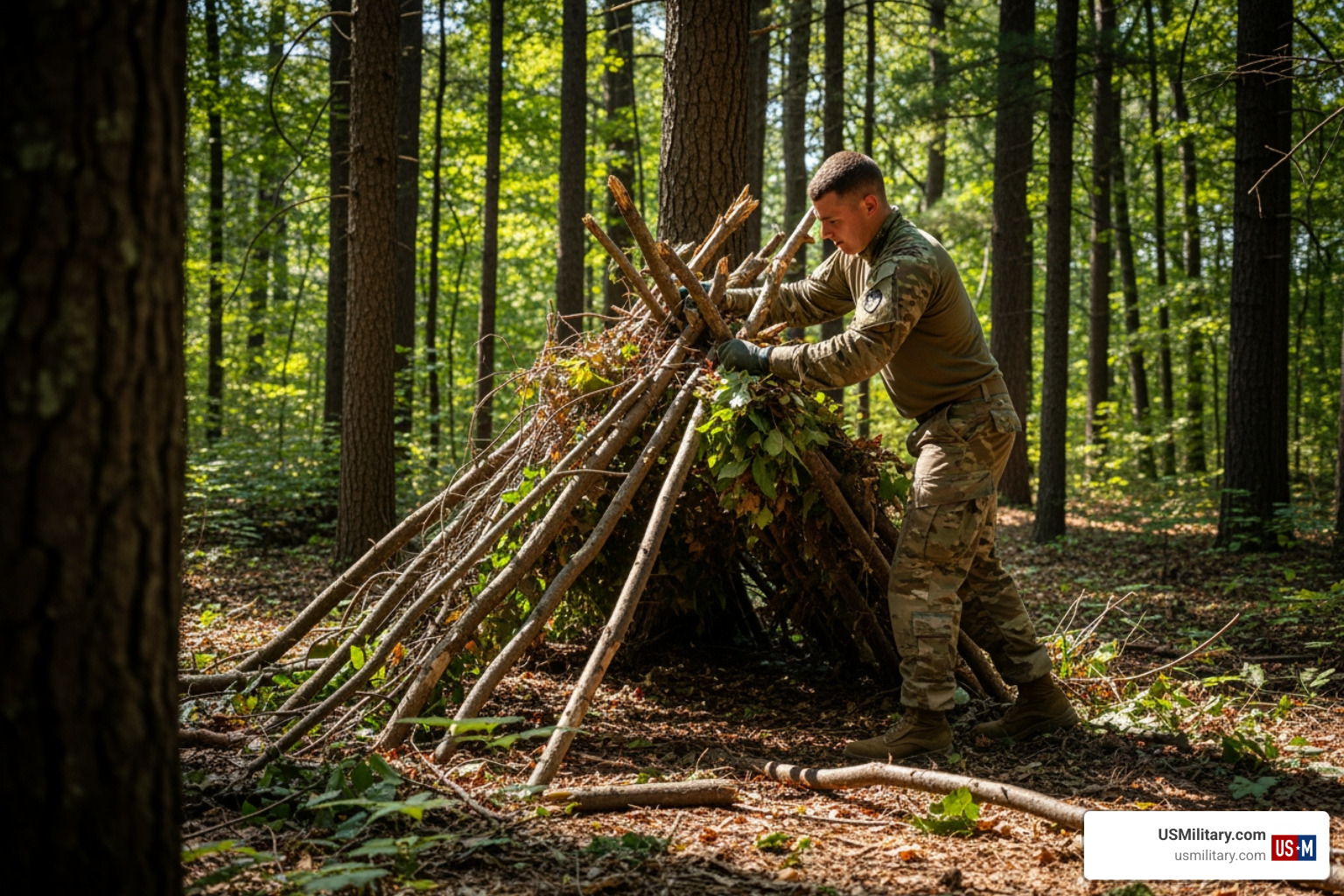
The curriculum is a grueling progression from classroom theory to high-stakes field exercises. We break it down into the four pillars:
Survival: This is the “primitive” side of the house. Students learn land navigation using the stars and compass, how to procure water from vines or solar stills, and fire craft (making fire without matches). They also learn how to build shelters that provide protection from the elements while remaining hidden from the enemy.
✉ Get updates like this in your inbox
Weekly VA benefit changes, pay updates, and money tips for service members, veterans, and military families. Free, no spam.
Evasion: This is where things get tactical. Trainees learn camouflage, how to move silently through various terrains, and how to avoid “tracking” by enemy dogs or scouts. This phase often culminates in a “live evasion” exercise where instructors try to hunt the students down.
Resistance: This is often the most talked-about (and most secretive) part of the course. It takes place in the Resistance Training Laboratory (RTL), a mock POW camp. Students are subjected to simulated interrogations, sleep deprivation, and psychological pressure. The goal is “stress inoculation”—teaching the body and mind how to handle the “shock of capture.” You can find more details in our 10 Insane Facts About SERE Training article.
Escape: Even in a cage, the mission continues. Students learn how to analyze their surroundings for escape opportunities, how to pick locks or bypass restraints, and how to signal friendly forces once they are free. For a look at how faith and training intersect in these moments, check out our Cheat Sheet to Faith SERE Training and Special Forces F-15 Rescue.
Levels of Training and Branch-Specific Schools
Training is categorized by the level of risk a service member faces.
| Training Level | Focus | Target Audience |
|---|---|---|
| Level A | Academic/Classroom | All entry-level service members |
| Level B | Field Evasion/Moderate Risk | Personnel operating in lower-threat areas |
| Level C | High-Risk/Captivity Simulation | Aircrew, Special Ops, Intelligence |
While all branches use the same standards, the schools vary. The U.S. Air Force is the Executive Agency for SERE, and their 336th Training Group at Fairchild AFB in Washington is the “gold standard.” They train over 20,000 students annually across 19 different courses.
Other branches have their own specialized schools to meet their unique needs:
- U.S. Navy/Marines: The Training Soldiers to Survive is the Goal of Navy SERE School at Warner Springs, CA, focuses heavily on coastal and water survival.
- U.S. Army: Conducts training at Fort Novosel, AL (for aviators) and Camp Mackall, NC (for Special Forces).
For a deep dive into the specific locations and requirements, see our Slugmilitary SERE Training Complete Guide.
The Path to Becoming a SERE Specialist

Becoming a student is hard, but becoming an instructor (Career Field 1T0X1) is legendary. The Air Force is the only branch with a dedicated career field for this. It is a grueling 5.5-month pipeline with a graduation rate of less than 10%.
The journey starts with a 19-day orientation and the Physical Ability and Stamina Test (PAST). To even get a foot in the door, you need:
- 8 pull-ups
- 48 sit-ups
- 40 push-ups
- 1.5-mile run in under 11 minutes
- Swimming proficiency
Once they pass the orientation, candidates move through 17 training phases. They don’t just learn one environment; they must master them all. This includes Arctic survival at Eielson AFB in Alaska, where temperatures can drop to -60°F, and tropical environments where the humidity and insects are constant threats. As the About Us page for the Air Force SERE school notes, these specialists are the world’s experts in keeping people alive in the most “austere” conditions on Earth.
Psychological Resilience and Modern Controversies
SERE is not just physical; it is a masterclass in operational psychology. The program uses “stress inoculation”—the idea that by exposing someone to a controlled amount of stress in training, they will be more resilient when the real thing happens.
However, this level of realism requires oversight. SERE psychologists monitor the training to prevent “behavioral drift.” This is a phenomenon (seen in the famous Stanford Prison Experiment) where people in positions of power—like mock guards—can become overly aggressive or lose sight of the training goals.
In the early 2000s, Survival, Evasion, Resistance and Escape training faced controversy when it was alleged that some of its “resistance” techniques were adapted for use in real-world interrogations. This led to a major review of the program. Today, the focus remains strictly on defensive training, with multiple safety observers present at all times to ensure the well-being of the students.
The process doesn’t end when the training (or the captivity) is over. The military uses a three-phase repatriation process to help service members transition back to normal life, providing psychological support and medical care to ensure they are truly “home.”
Frequently Asked Questions about Military SERE Training
How long does the standard Level C SERE course last?
A standard Level C course typically lasts about three weeks. This is broken down into an academic phase (one week), a field evasion phase (one week), and the captivity simulation/resistance phase (one week). It is designed to be a “sprint” of high-intensity learning.
Is SERE training considered the most difficult in the military?
While “difficulty” is subjective, SERE is widely considered one of the most mentally taxing courses. The combination of sleep deprivation, calorie restriction, and the psychological pressure of the Resistance Training Laboratory creates a unique kind of stress that even seasoned Special Forces operators find challenging.
How often do personnel need to take SERE refresher courses?
For those in high-risk positions, SERE is not a “one and done” deal. Level C personnel are generally required to take a refresher course every three years. This ensures their survival skills remain sharp and they are updated on the latest Personnel Recovery technologies and enemy exploitation tactics.
Conclusion
At USMilitary.com, we believe that understanding the depth of programs like SERE is essential for anyone considering a career in the armed forces. It is the ultimate testament to the military’s commitment to its people: that no matter how bad things get, we will give you the tools to Return with Honor.
Whether you are looking at the Air Force, Navy, or Army, the goal of SERE remains the same—elite preparedness for the mission’s most dangerous moments. If you are ready to see how these skills fit into different units, you can Compare Elite Career Paths on our site to find the right fit for your future.
In SERE, your most powerful weapon isn’t your rifle—it’s your will to survive.
Free for Service Members & Veterans
Get the military benefits intel no one tells you about.
Weekly updates on VA benefits, pay changes, and money tips — free for service members and veterans.
No spam. Unsubscribe anytime. Your info is never shared.


