Why Elite Military Training Matters for America’s Defenders
Who Has The Hardest Training: Navy SEALs vs Army Rangers is a question that sparks debate among military enthusiasts, aspiring service members, and veterans alike. Both units represent the pinnacle of American special operations forces, yet their training pipelines differ dramatically in focus, duration, and philosophy.
Quick Answer:
| Training Program | Duration | Attrition Rate | Primary Challenge |
|---|---|---|---|
| Navy SEAL BUD/S | 24 weeks (plus 26 weeks SQT) | 75-80% | Water operations, Hell Week (5.5 days, ~4 hours total sleep) |
| Army Ranger RASP | 8 weeks | 47-60% | Land navigation, ruck marches, team endurance |
| Ranger School | 61 days | 40-60% | Leadership under stress, minimal food/sleep |
The Bottom Line: Navy SEAL training statistically has higher attrition rates and longer duration, but both programs forge elite warriors through distinct methods—SEALs emphasize maritime operations and individual mental resilience, while Rangers focus on leadership, land warfare, and direct action raids.
The debate over which training is harder often misses the point. These programs serve different missions within America’s special operations community. Navy SEALs specialize in maritime special operations, counterterrorism, and reconnaissance in water environments. Army Rangers excel at direct action raids, airborne operations, and serving as the Army’s premier light infantry force.
Understanding these training pipelines helps prospective service members make informed decisions about their military careers. It also reveals the extraordinary commitment required to earn a place among America’s most elite warriors. As I’m Larry Fowler, publisher of the USMilitary.com Network since 2007, I’ve worked closely with thousands of active duty and veteran special operations forces, providing critical information about Who Has The Hardest Training: Navy SEALs vs Army Rangers to help service members navigate their career paths and benefits.

Who Has The Hardest Training: Navy SEALs vs Army Rangers word roundup:
- Navy SEALs
- Navy SEAL Training
- SEAL Team Six
The Navy SEAL Pipeline: BUD/S and Hell Week
Navy SEAL training; BUD/S phases; Hell Week duration; attrition rates; maritime operations; SQT; water competency
The journey to earning the Navy SEAL Trident is one of the most publicized and physically demanding processes in the world. It begins with the Basic Underwater Demolition/SEAL (BUD/S) course in Coronado, California. This 24-week crucible is designed to find those with a refusal to quit.
The Three Phases of BUD/S
BUD/S is divided into three distinct phases, each testing a different aspect of an operator’s potential:
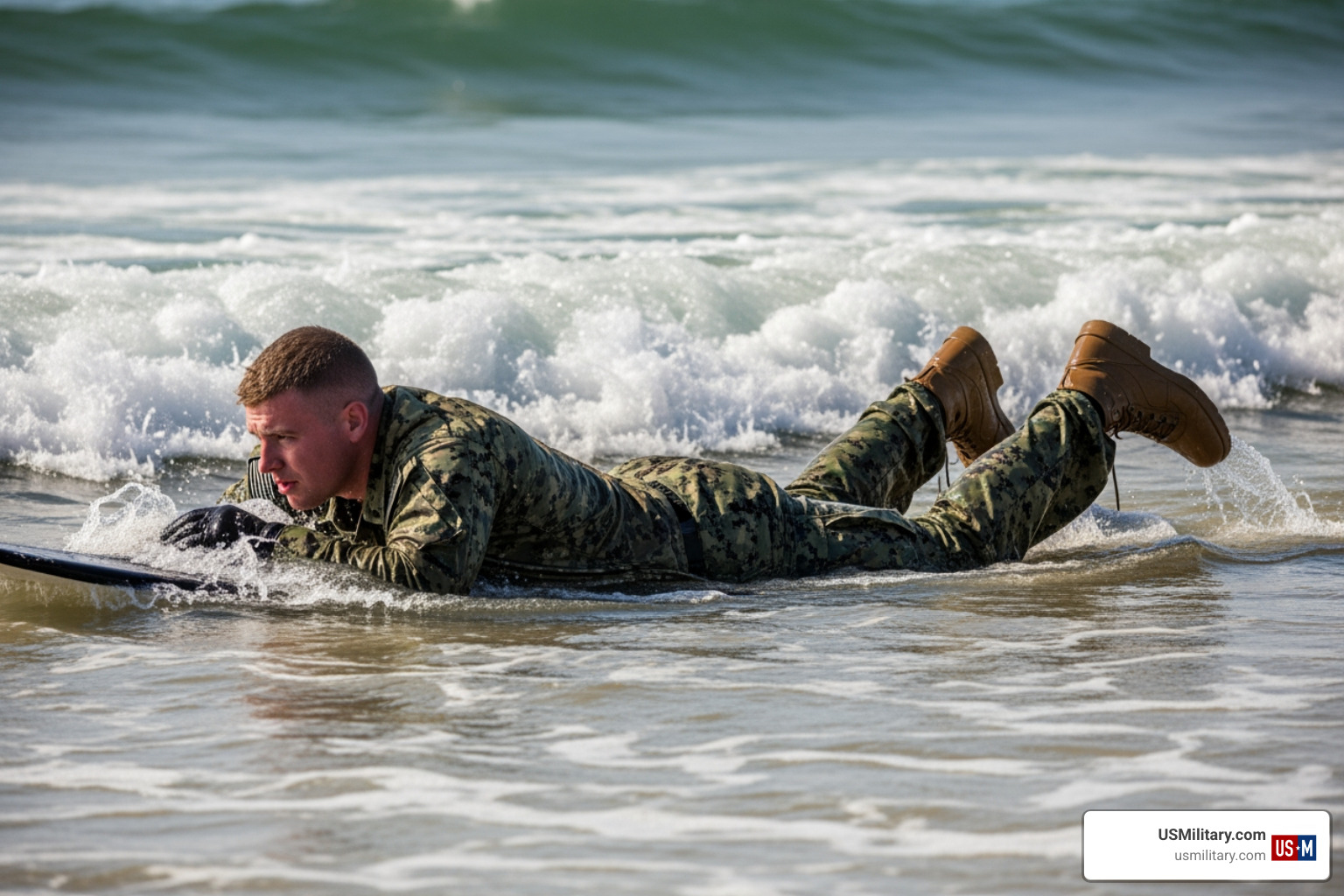
- First Phase (Basic Conditioning): This is the “gut check.” For seven weeks, candidates endure endless running in soft sand, swimming in the cold Pacific, and “surf torture.” It culminates in the infamous Hell Week, where candidates average just 4.5 hours of sleep over five and a half days while running over 200 miles and performing physical training with heavy logs.
- Second Phase (Diving): This phase focuses on combat diving. SEALs must become experts in open and closed-circuit SCUBA. The primary challenge here is “pool competency,” where instructors simulate underwater emergencies to ensure candidates remain calm under extreme duress.
- Third Phase (Land Warfare): Candidates move to San Clemente Island to learn basic weapons, demolitions, and small-unit tactics. This phase tests the ability to process technical information while physically exhausted.
Beyond BUD/S: SEAL Qualification Training (SQT)
Surviving BUD/S is only the first step. Graduates move on to SEAL Qualification Training (SQT), a 26-week program that provides the tactical skills needed for a SEAL platoon. This includes parachute jump school, cold weather survival, and advanced medical training. Only after completing SQT does a sailor earn the Trident and become a Navy SEAL.
The Army Ranger Path: RASP vs. Ranger School
Army Ranger training; RASP 1; RASP 2; Ranger School phases; 75th Ranger Regiment; leadership under stress; airborne school
The path to becoming an Army Ranger is often misunderstood because there are actually two different “Ranger” designations: being a member of the 75th Ranger Regiment and being Ranger-qualified (earning the Tab).
RASP: The Gateway to the Regiment
To serve in the 75th Ranger Regiment—the Army’s premier raid force—soldiers must pass the Ranger Assessment and Selection Program (RASP).
- RASP 1: An 8-week course for junior enlisted soldiers (E-1 through E-5). It has a historical attrition rate of 47%.
- RASP 2: A 21-day program for senior enlisted and officers.
RASP focuses on “raw” toughness: ruck marches, land navigation, and the Ranger Creed. It ensures that every member of the Regiment, including support personnel, meets a baseline elite standard.
Ranger School: The Leadership Crucible
Ranger School is a 61-day leadership course open to all branches. It is designed to push soldiers to their breaking points through starvation and sleep deprivation.
✉ Get updates like this in your inbox
Weekly VA benefit changes, pay updates, and money tips for service members, veterans, and military families. Free, no spam.
- Darby Phase: Focuses on squad operations and basic patrolling.
- Mountain Phase: Conducted in the Appalachians, testing endurance in rugged terrain.
- Florida Phase: Conducted in the swamps, focusing on amphibious operations and jungle warfare.
Rangers in the 75th Regiment are expected to attend Ranger School eventually to lead, but passing RASP is what makes you a member of the unit.
Who Has The Hardest Training: Navy SEALs vs Army Rangers
Comparative rigor; attrition rate statistics; physical demands; mental toughness; water vs land; veteran opinions
When we look at Who Has The Hardest Training: Navy SEALs vs Army Rangers, we have to compare the statistics, the environment, and the duration.
Attrition and Duration
The numbers suggest that the SEAL pipeline is statistically more difficult to enter. BUD/S has a consistent dropout rate of 75–80%, whereas RASP averages around 50%. Furthermore, the total SEAL pipeline (BUD/S + SQT) lasts over a year, while the Ranger pipeline (Airborne + RASP) is closer to 12 weeks, with Ranger School adding another two months later.
H3: Environmental Stressors: Who Has The Hardest Training: Navy SEALs vs Army Rangers?
The “type” of pain differs between the two.
- The SEAL “Pain”: It is characterized by the cold. Water temperatures in Coronado (65-68°F) steal body heat, leading to shivering that exhausts the body twice as fast as land exercise. The psychological fear of “drown-proofing” and underwater panic drills is a unique SEAL hurdle.
- The Ranger “Pain”: It is characterized by weight and hunger. Rangers live under a rucksack. RASP and Ranger School involve constant movement with 60–100 lb packs. In Ranger School, soldiers often lose 20–30 pounds due to living on one meal a day while patrolling 20 hours a day.
H3: Mission Focus: Who Has The Hardest Training: Navy SEALs vs Army Rangers?
We must also consider what they are being trained for.
- SEALs: Small-unit surgical strikes, maritime sabotage, and high-value target snatch-and-grabs. Their training emphasizes individual mastery and “slow is smooth” precision.
- Rangers: Large-scale direct action, airfield seizures, and joint forcible entry. Their training emphasizes the “hammer” approach—overwhelming the enemy with disciplined, aggressive light infantry tactics.
Comparing the Rigor of Other Elite SOF Units
Green Berets; Air Force PJs; Marine Recon; Delta Force; special operations forces comparison; attrition rates
While the SEAL vs. Ranger debate is the most common, other units in the U.S. Special Operations Command (SOCOM) have pipelines that are arguably just as tough.
- Air Force Pararescue (PJ): Known as “Superman School,” this pipeline lasts nearly two years. It combines combat diving, jump school, and advanced trauma medicine. With a 75% attrition rate, many insiders consider the PJ pipeline to be the most academically and physically diverse.
- Army Green Berets: The Special Forces Qualification Course (SFQC) can last up to two years. While SFAS (Assessment) is shorter than BUD/S, the Green Beret must master unconventional warfare and foreign languages, making it a “thinking man’s” selection.
- Marine Recon: Marine Recon training blends amphibious excellence with land rucking. It is often a stepping stone to MARSOC Raiders.
- Delta Force (1st SFOD-D): This is a “Tier 1” unit. Their selection is secretive but known to have a 90%+ washout rate, even though applicants are already elite soldiers from the Rangers or Special Forces.
Conclusion and Frequently Asked Questions
USMilitary.com resources; veteran advice; military career guidance; SOF selection tips
In the end, determining Who Has The Hardest Training: Navy SEALs vs Army Rangers comes down to personal physiology. If you are a world-class swimmer who hates the cold, BUD/S will be your nightmare. If you are a marathon rucker who can’t stand being hungry, Ranger School will break you.
At USMilitary.com, we believe both units represent the very best of the American spirit. Whether you choose the path of the Frogman or the Ranger, you are signing up for a life of extraordinary challenge and service.
FAQs
Q: Can a Navy SEAL go to Ranger School?
A: Yes. Many SEALs attend Ranger School later in their careers to sharpen their land leadership and patrolling skills. It is highly respected in both communities.
Q: Do Rangers ever rescue SEALs?
A: Historically, yes. Because Rangers operate in larger “platoon-plus” sizes, they often serve as the Quick Reaction Force (QF) for smaller SEAL teams. There is a common saying in the community that “Rangers lead the way in rescuing SEALs.”
Q: Which unit has more members?
A: The 75th Ranger Regiment is larger, with just over 3,500 Rangers. There are approximately 2,900 active-duty Navy SEALs.
Q: Is there a female Navy SEAL?
A: While women have entered the pipeline, as of now, none have graduated BUD/S. However, multiple women have graduated RASP and serve in the 75th Ranger Regiment, and several have earned the Ranger Tab.
Q: What is the “easiest” way into Special Ops?
A: There is no easy way. However, Air Assault School is a 10-day course often called the “10 toughest days in the Army,” which provides a small taste of the discipline required for elite units.
For more information on preparing for these elite pipelines or understanding your benefits as a future veteran, visit us at USMilitary.com. We are your central hub for military-related guidance and career paths.
Free for Service Members & Veterans
Get the military benefits intel no one tells you about.
Weekly updates on VA benefits, pay changes, and money tips — free for service members and veterans.
No spam. Unsubscribe anytime. Your info is never shared.


