Which Military Branch Offers the Best Career Opportunities for Long-Term Civilian Financial Pay in 2026?

Which military branch offers the best jobs for long term financial pay is one of the smartest questions you can ask before signing an enlistment contract. The answer might surprise you.
Quick Answer: No single branch pays more than the others at the same rank. Base pay is standardized across all six branches by federal law. However, total lifetime earnings vary significantly depending on your branch, job specialty, location, and career choices.
Here is a fast breakdown of what sets each branch apart financially:
| Branch | Financial Strength | Top Bonus Potential |
|---|---|---|
| Navy | Nuclear and technical bonuses | Up to $140,000 enlistment |
| Army | Fastest promotions, largest force | Up to $50,000 enlistment |
| Air Force | Highest tech pay, best post-service earnings | Up to $40,000 aviation bonuses |
| Coast Guard | Specialized maritime roles | Up to $75,000 enlistment |
| Space Force | Fastest-growing tech field | Competitive cyber bonuses |
| Marine Corps | Combat incentive pay | Up to $15,000 enlistment |
The real financial difference comes from what you do, not just which branch you join. Roles in cybersecurity, nuclear engineering, aviation, and special operations can dramatically increase your lifetime earnings — in any branch.
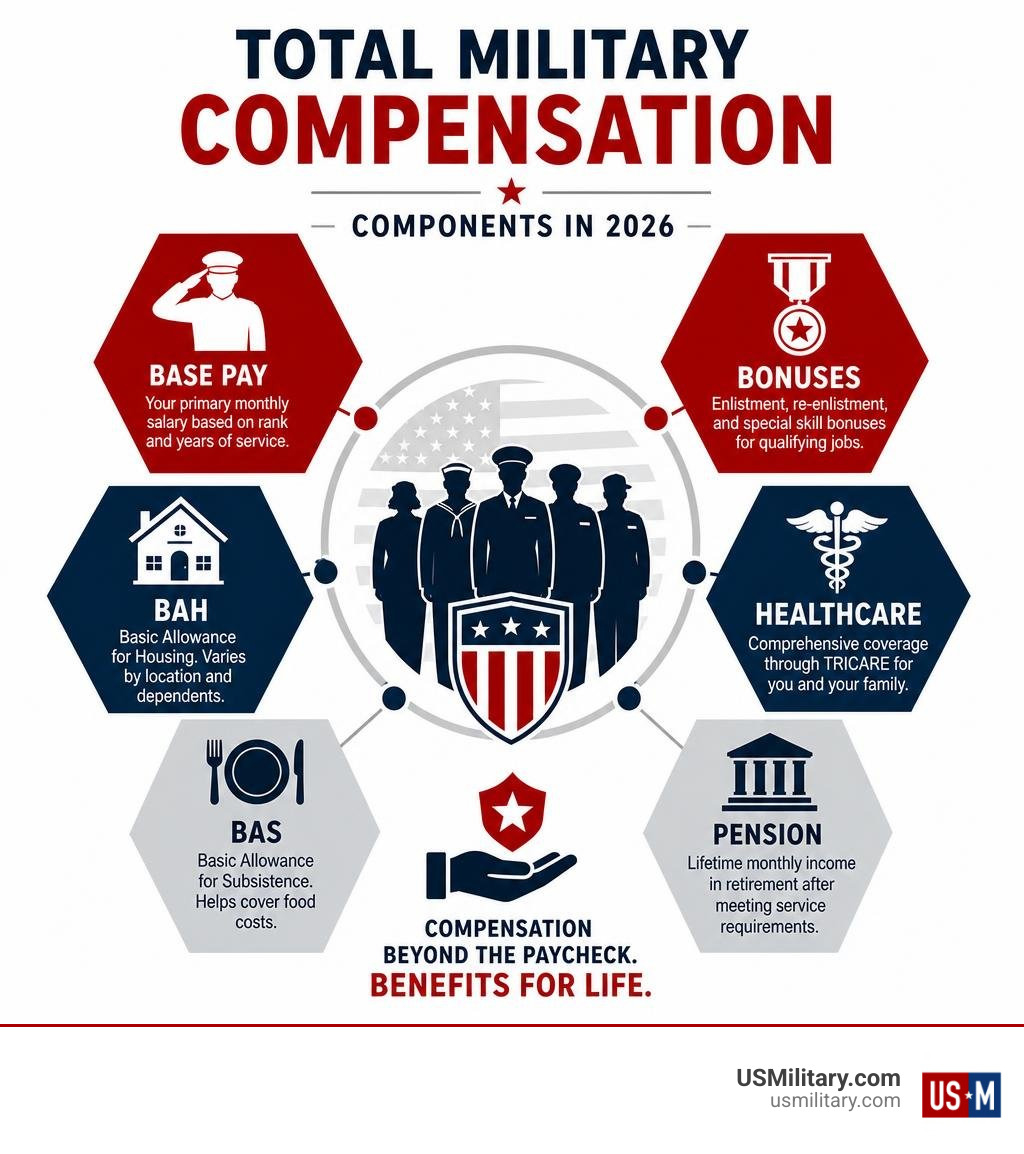
When you factor in tax-free allowances, free healthcare through TRICARE, and a pension worth $720,000 to $1,350,000 over a lifetime, military total compensation often equals a $70,000–$120,000 civilian salary package — even at mid-enlisted grades.
I’m Larry Fowler, publisher of USMilitary.com since 2007, and I’ve spent nearly two decades helping active-duty members, veterans, and recruits navigate military pay, VA benefits, and career decisions — including the critical question of which military branch offers the best jobs for long term financial pay. Let’s break it all down so you can make the most informed choice for your financial future.
Explore more about Which Military Branch Offers The Best Jobs For Long Term Financial Pay:
Understanding the Standardized Military Pay Structure
To understand how to maximize your long-term earnings, we first have to clear up a major myth: that one branch inherently pays a higher starting salary than another. In reality, whether you are an Airman in a support role or a Marine infantryman, if you share the same pay grade and years of service, your base pay is identical.

Standardized Base Pay Across All Branches
Military base pay is set by Congress each year, often calculated using the Employment Cost Index. In 2026, active-duty service members received a 3.8% basic pay increase.
Under the 2026 Military Pay Chart, an E-1 with less than 2 years of service earns approximately $2,017 per month in base pay (though with the 2026 adjustments, starting E-1 basic pay reaches up to $2,407 per month). Meanwhile, an officer at grade O-3 (Captain in the Army/Air Force/Marine Corps or Lieutenant in the Navy) with 4 years of service earns $6,112 per month in base pay.
As detailed in our guides on How Much You Will Earn on Active Duty in 2026 and The Ultimate Guide to 2026 Military Pay Chart, base pay scales up predictably based on your rank and time in service. For more details on specific branch charts, you can reference the Army Pay Chart 2026 and the Navy Pay Chart 2026.
The Role of Allowances in Total Compensation
While base pay is identical across branches, the allowances you receive can make a massive difference in your take-home pay. Unlike base pay, many military allowances are completely tax-free, which drastically lowers your effective tax bracket.
- Basic Allowance for Housing (BAH): This is designed to cover your housing costs if you live off-base. BAH rates increased by an average of 4.2% in 2026. Because BAH is based on your geographic location, pay grade, and whether you have dependents, two identical captains can receive wildly different BAH amounts. A captain stationed in a high-cost area like San Francisco or New York will receive thousands of dollars more per month than one stationed in a rural area.
- Basic Allowance for Subsistence (BAS): This allowance covers your meals. In 2026, BAS rates are $476.95 per month for enlisted personnel and $328.48 per month for officers.
- Dislocation Allowance (DLA) & CONUS COLA: Designed to offset the costs of moving (PCSing) or living in high-cost continental U.S. locations.
According to a Branch Comparison on Indeed.com, factoring in these tax-free allowances is crucial because they easily push total military compensation past 70% of equivalent civilian salaries.
Which Military Branch Offers The Best Jobs For Long Term Financial Pay?
Since base pay is standardized, the answer to which military branch offers the best jobs for long term financial pay depends entirely on the career path (MOS, AFSC, or Rating) you choose and how well those skills translate to the civilian sector.

Air Force and Space Force: High-Tech and Cyber Careers
If your goal is to secure high-paying jobs both during and after your service, the Air Force and Space Force are premier choices. These branches focus heavily on technology, intelligence, and aerospace.
In the Air Force, pursuing 15 Best Air Force Jobs for Long Term Financial Success or looking into Best Air Force Jobs will lead you toward roles like 1B4X1 Cybersecurity Engineer. These positions often require a Top Secret / Sensitive Compartmented Information (TS/SCI) security clearance. In the civilian world, this clearance alone can boost your salary by 10% to 15%, leading to starting civilian salaries between $95,000 and $160,000.
The Space Force, our newest branch, offers incredible opportunities. By reviewing the Top 20 Best Space Force Career Jobs Compared, you will find highly technical roles in satellite systems operations and space systems engineering. These positions translate directly to lucrative defense contractor roles, with post-service salary potentials reaching up to $150,000.
Navy: Nuclear Engineering and Maritime Technical Roles
The Navy is highly regarded for its technical training, particularly in propulsion and electronics. If you are looking for the Best Navy Jobs, the Nuclear Field is historically the most financially rewarding.
✉ Get updates like this in your inbox
Weekly VA benefit changes, pay updates, and money tips for service members, veterans, and military families. Free, no spam.
Navy nuclear engineers (such as Nuclear Machinist’s Mates) can receive up to $38,000 in annual bonus pay. The rigorous training in the Navy’s nuclear program is so respected that transitioning sailors often walk directly into civilian nuclear power plant operations or high-end electrical engineering positions making upwards of $120,000 per year.
Additionally, Navy Cryptologic Technicians (CT) and Cyber Warfare Technicians (CWT) enjoy high demand, minimal deployment rotations, and exceptional civilian transition rates. According to analysis on the Best Navy Jobs in 2026, these technical ratings boast a 90% placement rate with aerospace and defense contractors.
Army: Fast Promotions and Leadership Opportunities
The Army’s primary financial advantage is its sheer size. Because the Army is twice the size of any other branch, it typically offers more promotion opportunities and faster advancement.
If you choose the right path using our guide on the Best Jobs in the Army, you can climb the ranks much faster than in the Air Force, where promotion timelines are notoriously slower. Fast promotion means reaching higher pay grades (like E-5 or E-6) years ahead of your peers in other branches, directly increasing your cumulative active-duty earnings.
High-demand Army roles, such as 17C Cybersecurity Analyst or various logistics and medical specialties (like Combat Medics), provide excellent foundations for Highest Paying Careers in the US Military and Top 6 Figure Military Jobs.
Maximizing Lifetime Earnings Through Bonuses and Special Pays
To maximize your earnings, you should look beyond base pay and seek out enlistment bonuses, reenlistment incentives, and special duty pays.
High-Value Enlistment and Reenlistment Bonuses
The military uses enlistment and retention bonuses to fill highly technical or physically demanding roles. These bonuses fluctuate based on recruiting needs, but they can be massive:
- Navy Nuclear Field: Enlistment bonuses can reach up to $75,000, with total Navy enlistment bonuses capping out at $140,000 when combined with other shipping incentives.
- Coast Guard: Offers up to $75,000 for specialized maritime and technical roles.
- Army: Enlistment bonuses can reach up to $50,000, especially when combining a “Quick Ship” bonus (leaving for basic training within 30 days) with critical skills like Special Forces or Air Defense.
- Air Force: Offers up to $40,000 for high-demand technical and aviation roles.
For a deeper dive into these incentives, check out our guide on 15 High Demand Military Jobs with Great Enlistment Bonuses.
Special and Incentive Pays by Branch
Once you are in, your job specialty can qualify you for monthly special pays that stack on top of your base salary:
- Aviation Pay: Air Force and Navy pilots can earn up to $35,000 per year in flight pay and aviation retention bonuses.
- Submarine and Sea Pay: Navy personnel stationed on ships or submarines receive extra monthly sea pay ranging from $50 to $750 depending on rank and cumulative sea time.
- Hazardous Duty & Special Ops Pay: Navy SEALs, Army Special Forces, and EOD technicians can qualify for up to $30,000 annually in special pays and hazard bonuses.
- Foreign Language Proficiency Bonus: If your job requires you to speak a foreign language, or if you maintain proficiency in a high-priority language, you can earn up to $1,000 extra per month.
Long-Term Financial Planning: Retirement, Healthcare, and Education
If you plan to make the military a long-term career (20 years or more), the financial benefits extend far beyond your active-duty paycheck.
The Blended Retirement System and TSP Matching
All service members entering active duty are enrolled in the Blended Retirement System (BRS). The BRS is a highly flexible wealth-building tool that includes:
- Thrift Savings Plan (TSP) Matching: The government automatically contributes 1% of your base pay to your TSP (similar to a civilian 401k) and will match your contributions up to an additional 4%. This money is yours to keep even if you separate after just one enlistment.
- Defined Benefit Pension: If you complete 20 years of active service, you receive a lifetime pension calculated at 2.0% times your years of service multiplied by the average of your highest 36 months of basic pay. For a 20-year career, this guarantees a pension worth 40% of your base pay for life.
- Continuation Pay: A mid-career cash incentive paid between your 8th and 12th year of service in exchange for an additional service commitment.
According to financial analyses, such as the one found in Is Joining the Military Worth It Financially?, the lifetime value of a 20-year military pension ranges from $720,000 to $1,350,000 depending on your final rank.
Post-Service Transition and Civilian Career Transferability
When evaluating Which Military Branch Offers The Best Jobs For Long Term Financial Pay, you must plan for your transition back to civilian life. Our resource on 10 High Paying Civilian Jobs with Military Training outlines how technical military training translates directly to high-paying civilian careers.
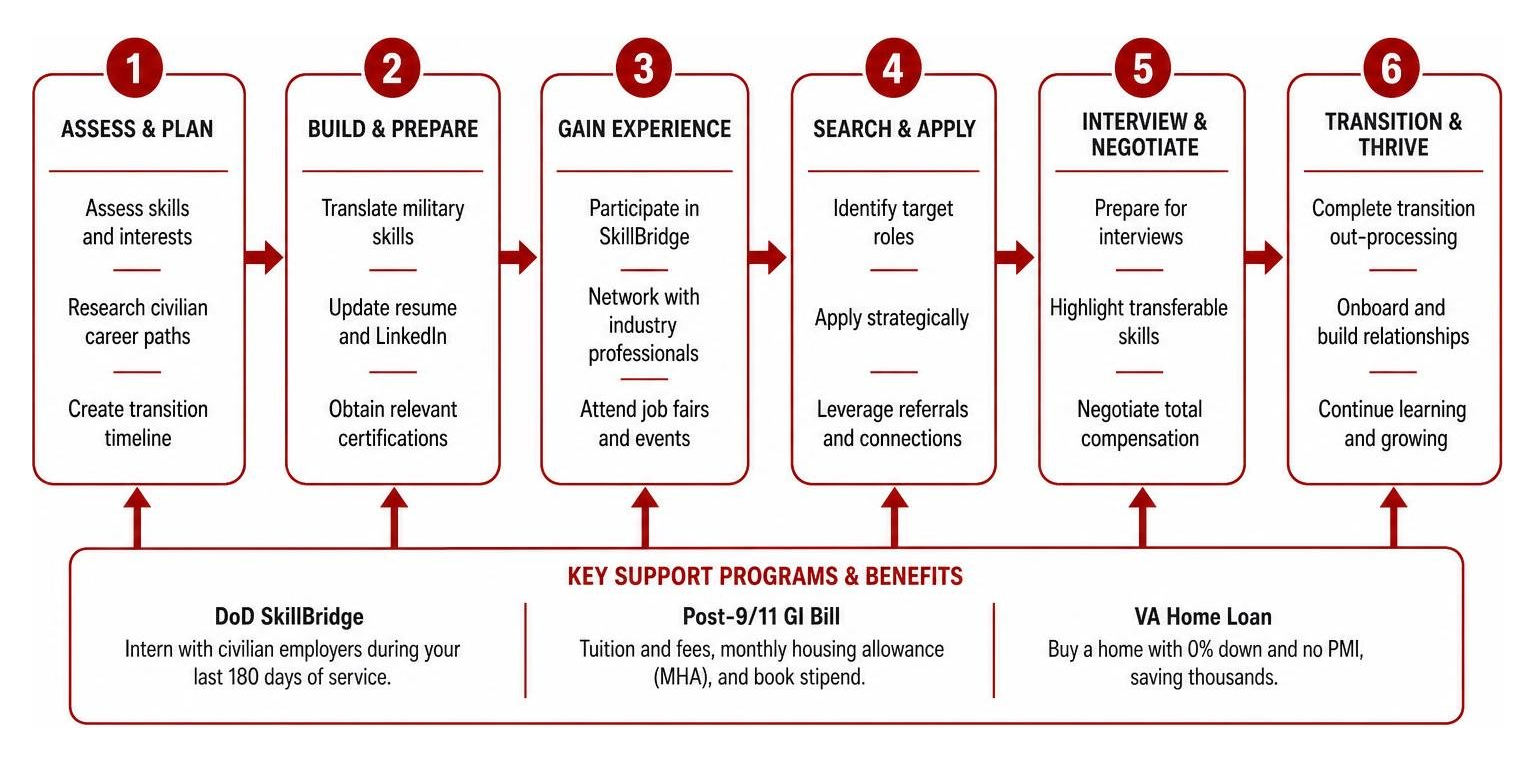
To help you successfully transition, we recommend utilizing several high-value programs:
- DoD SkillBridge: This program allows you to spend your last 180 days of active duty working in a civilian internship while still receiving full military pay and allowances. Air Force veterans see an average 83% placement rate through SkillBridge.
- The Post-9/11 GI Bill: Covers 100% of tuition and fees at public universities, provides a monthly housing allowance (MHA) equal to an E-5 BAH rate, and offers a book stipend. You can compare options in our guide on The 5 Best Military Branches for Education Compared.
- VA Home Loans: This benefit allows veterans to purchase homes with 0% down and no private mortgage insurance (PMI), saving home buyers an average of $90,000 to $150,000 over the life of a conventional loan.
- VA Disability Compensation: Tax-free monthly compensation for service-connected injuries. You can review the updated 2026 VA Disability Rates and compare them with the VA Disability Pay Chart for 2024 to see how these benefits support long-term financial stability.
For a broader look at how benefits compare across all services, check out Which Military Branch Has the Best Benefits and the external guide on Which Military Branch Has the Best Benefits? [2026 Updated Version].
Frequently Asked Questions About Military Pay
Which military branch has the fastest promotion timeline?
The U.S. Army generally has the fastest promotion timeline. Because of its large organizational size and higher personnel turnover, the Army has more open leadership slots (NCO positions) than smaller branches like the Air Force or Space Force. This allows motivated soldiers who pass their physical fitness tests and attend leadership schools to promote quickly.
Are military enlistment and reenlistment bonuses taxable?
Yes, military bonuses are subject to federal and state taxes. Typically, federal taxes are withheld at a flat 22% rate. However, there is a major loophole: if you sign your enlistment or reenlistment contract while deployed in an IRS-designated combat zone, your entire bonus is 100% tax-free under the Combat Zone Tax Exclusion (CZTE).
How does military total compensation compare to civilian salaries?
Military total compensation is highly competitive. While military base pay alone may look lower than some civilian salaries, when you add tax-free housing (BAH) and food (BAS) allowances, free medical care via TRICARE (which saves thousands annually compared to civilian premiums), and retirement matching, the total package for a mid-grade E-5 is equivalent to an $80,000 to $98,000 civilian salary.
Conclusion
When deciding which military branch offers the best jobs for long term financial pay, your military career is a launchpad. While the Army offers the fastest promotion speeds and the Navy provides unmatched technical bonuses in nuclear fields, the Air Force and Space Force lead the pack in post-service civilian transition earnings.
Maximizing your lifetime earnings is about choosing a highly technical specialty, staying healthy to promote regularly, and leveraging transition programs like SkillBridge and the GI Bill.
If you are ready to take the next step in planning your career, explore our guide on Which Branch of the Military Should I Join and connect with a recruiter.
Learn more about military branches, career paths, and benefits at USMilitary.com.
Free for Service Members & Veterans
Get the military benefits intel no one tells you about.
Weekly updates on VA benefits, pay changes, and money tips — free for service members and veterans.
No spam. Unsubscribe anytime. Your info is never shared.


