When It Comes to Elite Military Service, Which Path Is Actually Hardest?
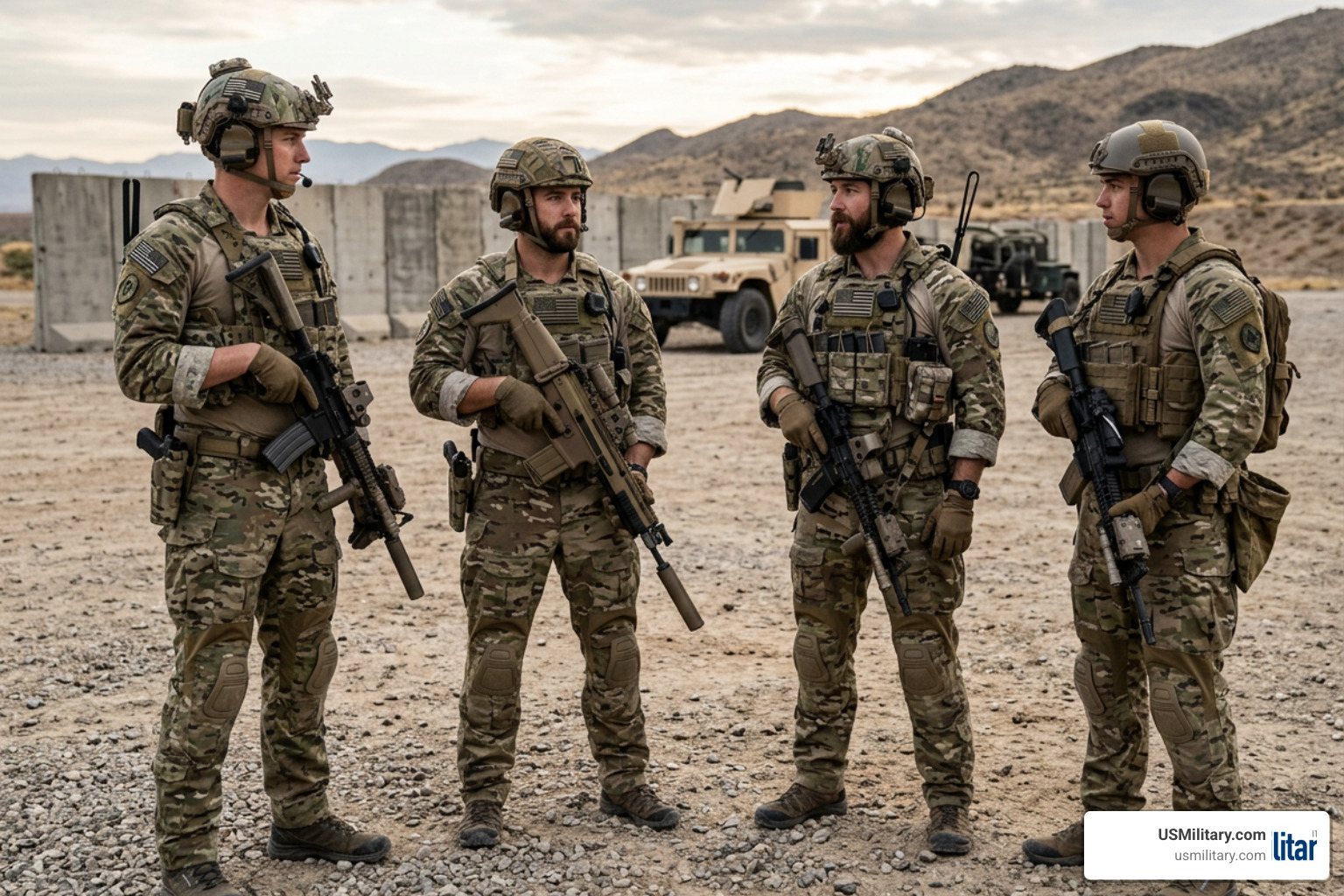
Is it easier to become a Marine MARSOC, Army Green Beret, Army Delta Force Operator, or Navy SEAL? The short answer: none of them are easy — but they are not equally hard to get into.
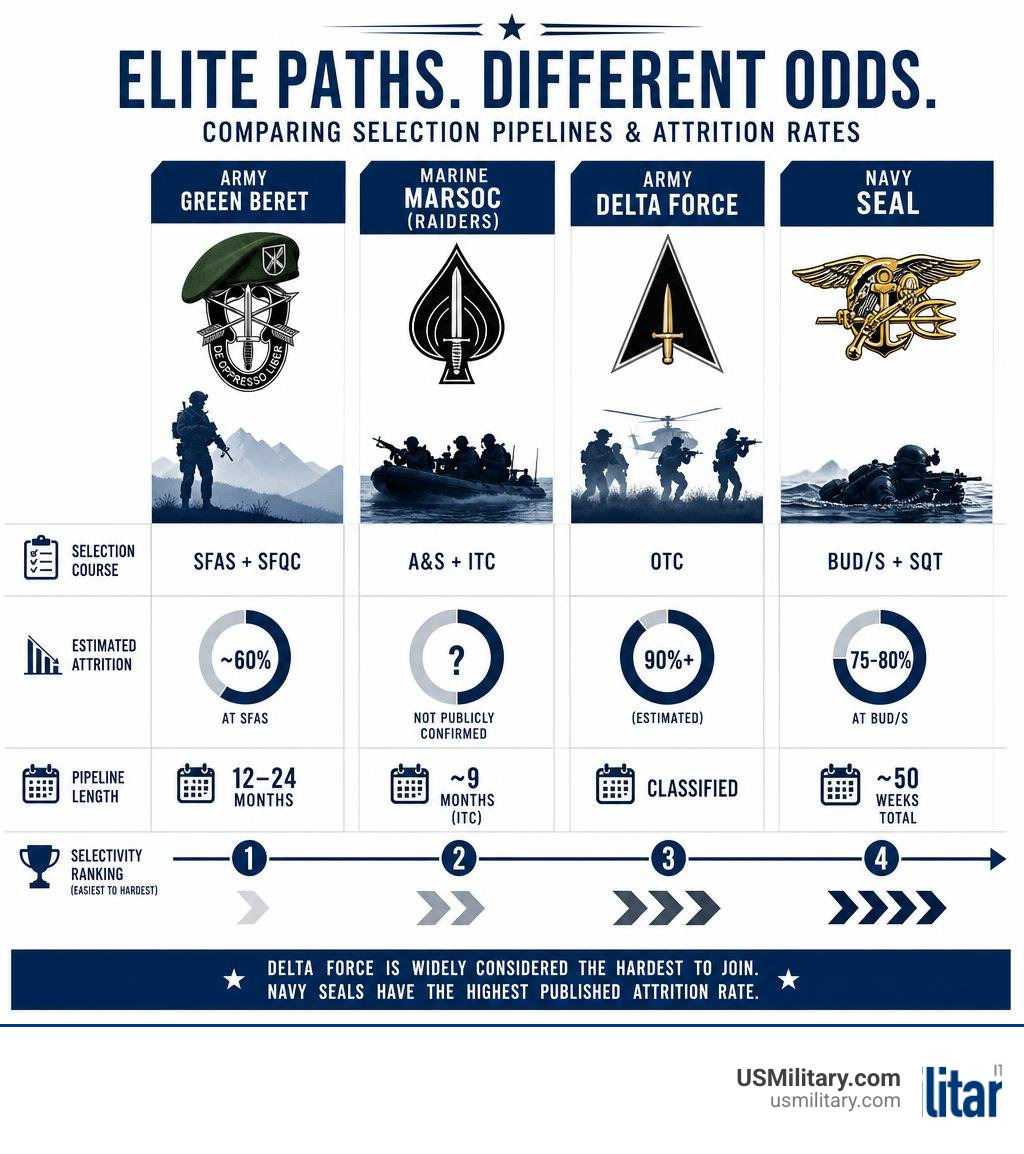
Here’s a quick breakdown ranked from most accessible to most selective:
| Unit | Selection Course | Estimated Attrition | Pipeline Length |
|---|---|---|---|
| Army Green Beret | SFAS + SFQC | ~60% at SFAS | 12-24 months |
| Marine MARSOC (Raiders) | A&S + ITC | Not publicly confirmed | ~9 months (ITC) |
| Navy SEAL | BUD/S + SQT | ~75-80% at BUD/S | ~50 weeks total |
| Army Delta Force | OTC | 90%+ (estimated) | Classified |
Bottom line: Delta Force is widely considered the hardest to join — candidates must already be elite soldiers before they can even attempt selection. Navy SEALs have the highest published attrition rate. Green Berets offer the most accessible entry path, including a direct civilian contract.
Every year, thousands of motivated candidates attempt to join one of America’s most elite fighting forces. Most won’t make it. These units — Marine Raiders, Army Green Berets, Delta Force, and Navy SEALs — are each built for different missions, draw on different strengths, and filter candidates in very different ways.
Whether you’re drawn to the maritime raids of the SEALs, the unconventional warfare of the Green Berets, the lethal precision of Delta Force, or the aggressive small-team ethos of the Marine Raiders, choosing the right path starts with understanding what each one actually demands.
My name is Larry Fowler, publisher of USMilitary.com, and since 2007 I’ve guided active duty service members, veterans, and military hopefuls through complex career and benefits decisions — including the question of is it easier to become a Marine MARSOC, Army Green Beret, Army Delta Force Operator, or Navy SEAL. In the sections ahead, I’ll break down each pipeline, attrition rate, and mission set so you can make an informed decision.
Key Is It Easier To Become a Marine MARSOC, Army Green Beret, Army Delta Force Operator, or Navy SEAL? vocabulary:
- Air Force Pararescuemen (PJs) vs Navy SEALs
- Pros and Cons Of Army Delta Force vs Navy SEALs
- Who Has The Hardest Training: Navy SEALs vs Army Rangers
Is It Easier To Become a Marine MARSOC, Army Green Beret, Army Delta Force Operator, or Navy SEAL?
When we look at the barrier to entry for these elite special operations forces (SOF), we have to start at the very beginning: the entry paths and baseline enlistment requirements. If you cannot even sign the contract to try out, the difficulty of the actual training is irrelevant.
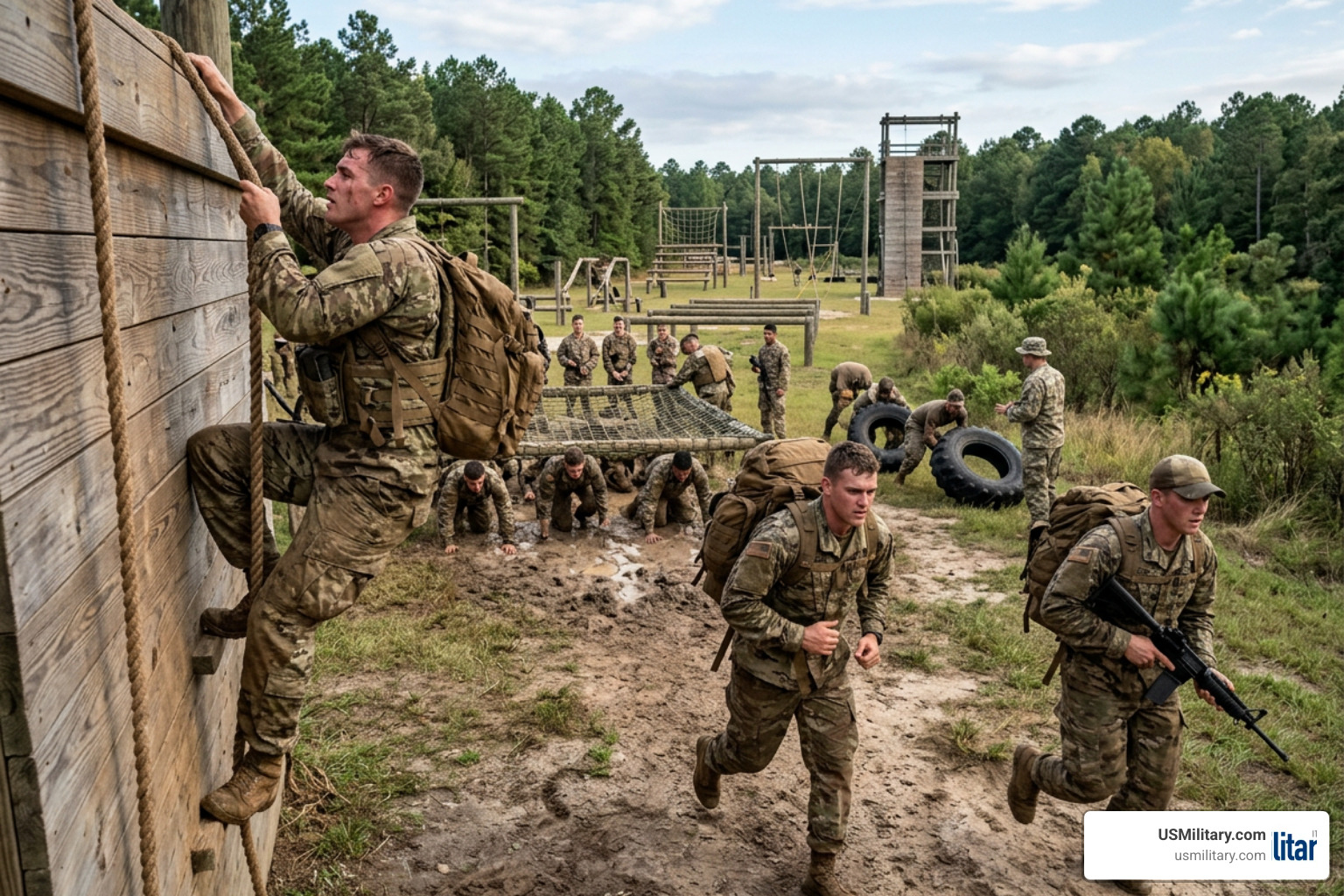
The direct-entry path is the biggest differentiator. If you are a civilian walking into a recruiting office in June 2026, you can enlist with a direct shot at becoming a Navy SEAL or an Army Green Beret.
The Army offers the famous 18X contract, which takes you from civilian life, through Infantry One Station Unit Training (OSUT), Airborne School, and directly into Special Forces Assessment and Selection (SFAS). Similarly, the Navy offers the Special Warfare Operator (SO) contract, allowing you to head straight to boot camp and then directly to Basic Underwater Demolition/SEAL (BUD/S) training.
To secure these contracts, you must meet strict baseline metrics, including high General Technical (GT) and Armed Services Vocational Aptitude Battery (ASVAB) scores. For example, the requirements to become a Navy SEAL require passing the physical screening test (PST) and securing a high ASVAB score.
Conversely, you cannot enlist directly as a Marine Raider (MARSOC) or an Army Delta Force operator from civilian life.
To join MARSOC, you must already be serving in the Marine Corps. Typically, candidates must be at least a Corporal (E-4) or Sergeant (E-5) with excellent performance reviews before they can apply for Assessment and Selection (A&S). While you might start by looking at the Find Your Ideal Career On The Marines Jobs List or testing your mettle to see if Do You Have What It Takes To Be In The Marine Corps Infantry, you must spend time in the fleet before MARSOC is even an option.
Delta Force (1st SFOD-D) raises the bar even higher. They do not recruit from the civilian world, nor do they take brand-new enlistees. To even receive an invitation to Delta’s selection, you must already be an experienced service member—usually from the Army’s elite ranks, such as the 75th Ranger Regiment or the Green Berets.
When comparing the overall difficulty of the parent branches, as discussed in our guide on Which Military Branch Is the Hardest? , we find that while the Marine Corps has the longest and most physically demanding standard boot camp, the Army provides a more streamlined, direct gateway into its special operations pipelines for highly motivated civilians.
Comparing Selection Pipelines, Attrition Rates, and Training Durations
To truly answer is it easier to become a Marine MARSOC, Army Green Beret, Army Delta Force Operator, or Navy SEAL, we must analyze the numbers, the phases, and the grueling attrition rates that define these pipelines.
| Metric | Navy SEAL | Army Green Beret | Marine Raider (MARSOC) | Army Delta Force |
|---|---|---|---|---|
| Pre-Selection Phase | Naval Special Warfare Prep (8 weeks) | SOPC (Special Ops Prep Course – 2 weeks) | Phase I A&S (Appx. 3 weeks) | Unit-level screening & physical prep |
| Primary Selection | BUD/S First Phase & Hell Week (7 weeks) | SFAS (Special Forces Assessment & Selection – 24 days) | Phase II A&S (Appx. 3 weeks) | Delta Selection (West Virginia mountains) |
| Attrition Rate | 75% – 80% | ~60% at SFAS | ~40% – 50% at A&S | 90%+ |
| Qualification Training | SQT (SEAL Qualification Training – 26 weeks) | SFQC (Q-Course – 12 to 24 months) | ITC (Individual Training Course – 9 months) | OTC (Operator Training Course – ~6 months) |
Is It Easier To Become a Marine MARSOC, Army Green Beret, Army Delta Force Operator, or Navy SEAL? Analyzing the Attrition Rates
Statistically, the raw attrition rates paint a clear picture. The Navy SEAL BUD/S pipeline is notorious for its high washout rate, with roughly 75% to 80% of candidates failing to earn the Navy Special Warfare designator. Much of this attrition occurs during the first phase, culminating in the sleep-deprived gauntlet of Hell Week.
The Army Special Forces Assessment and Selection (SFAS) has an attrition rate of approximately 60%. However, candidates who pass SFAS must still survive the grueling Special Forces Qualification Course (SFQC), which lasts between 12 and 24 months.
When comparing Marsoc Raiders Vs Army Green Berets Elite Forces Face Off, we find that MARSOC’s Assessment and Selection (A&S) is incredibly demanding, but because candidates are already screened Marines, the baseline physical readiness is higher, leading to slightly lower relative attrition rates than BUD/S.
Delta Force selection is in a league of its own. Because Delta candidates are already elite operators—often Ranger platoon leaders, experienced Green Berets, or seasoned infantrymen—the selection process is designed to break down the best of the best. The washout rate during Delta’s selection and the subsequent Operator Training Course (OTC) is estimated to be over 90%.
As we explore in our breakdown of Delta Force Vs Navy Seals and Army Delta Forces Vs Navy Seals, Delta’s selection does not rely on shouting instructors or public quitting rituals; instead, it uses quiet, psychological pressure and solo land navigation to find the ultimate self-motivated warrior.
Training Pipelines: From BUD/S and the Q-Course to ITC and OTC
The journey to earning your special operations insignia is a marathon, not a sprint.
For Navy SEAL candidates, the path goes through BUD/S in Coronado, California. It consists of three main phases: Basic Conditioning (including Hell Week), Combat Diving, and Land Warfare. Following BUD/S, candidates must complete SEAL Qualification Training (SQT) to learn advanced tactics, parachuting, and cold-weather operations. To learn more about these rigorous physical standards, check out our Navy Seals Buds Training Requirements Guide and our comprehensive All You Need To Know About Navy Seal Training Ultimate Guide.
For Green Berets, the Q-Course (SFQC) is a massive educational and tactical undertaking. Divided into multiple phases, it covers tactical combat skills, specialty training (such as weapons, engineering, medical, or communications), language and cultural training, and the famous Robin Sage unconventional warfare exercise.
Marine Raiders go through the Individual Training Course (ITC) at Camp Lejeune, North Carolina. This 9-month course is designed to build a well-rounded operator capable of direct action, special reconnaissance, and foreign internal defense. To prepare for this grueling schoolhouse, candidates should study our guide on Raider Ready Your Guide To Marsoc Assessment And Selection.
Finally, Delta Force operators undergo the highly classified Operator Training Course (OTC). OTC focuses on precision marksmanship, advanced breaching, defensive driving, executive protection, and hostage rescue in urban environments.
Mission Profiles, Cultural Philosophies, and Team Dynamics
Each unit was created to solve a specific national security problem, and their training reflects these unique mission profiles.

Is It Easier To Become a Marine MARSOC, Army Green Beret, Army Delta Force Operator, or Navy SEAL? Matching Skills to Mission Sets
The physical and mental hurdles of each selection process are tailored to the unit’s operational environment:
- Navy SEALs: Focus heavily on maritime special operations, direct action raids, hydrographic reconnaissance, and counterterrorism. If you struggle with water confidence, BUD/S will be an impossible barrier. For a deeper look at their daily operations, read about What Do Navy Seals Do.
- Army Green Berets: Their primary, legally mandated mission is Unconventional Warfare (UW) and Foreign Internal Defense (FID). They are designed to infiltrate a foreign country, build a relationship with a local guerrilla army, and train them to overthrow a hostile government.
- Marine Raiders: MARSOC blends the amphibious roots of the Marine Corps with SOCOM’s irregular warfare mandate. As detailed in the national report Marine Raiders Keep Low Profile Among U.S. Special Operations … , they maintain a remarkably small footprint (only about 3,000 Marines in the entire command) and specialize in direct action, special reconnaissance, and partner-nation training. Learn more about their unique history on our marsoc page or compare them directly in our analysis of MARSOC vs. Navy SEALs, Green Berets, & Marine Recon .
- Delta Force: Operates under the Joint Special Operations Command (JSOC) as a Tier 1 Special Mission Unit. Their focus is national-level counterterrorism, hostage rescue, and high-value target interdiction. If you want to know what separates these elite operators from other units, read our feature on The Shadow Warriors Everything You Need To Know About Delta Force.
Cultural Identities: “Quiet Professionals” vs. High-Profile Raiders
The operational philosophy of each unit shapes its internal culture and team dynamics:
- Army Special Forces (Green Berets): Known as the “Quiet Professionals” or “Snake Eaters.” They operate in 12-man Operational Detachment Alpha (ODA) teams. Because their job is to train foreign forces, they value emotional intelligence, language skills, and cultural adaptability as much as shooting accuracy.
- Navy SEALs: Culturally viewed as highly aggressive, fast-moving, and physically dominant. They operate in SEAL platoons and specialize in overwhelming kinetic force. We explore these cultural differences in depth in our comparisons of Green Beret vs Navy Seal and Navy Seal Vs Army Green Beret.
- Marine Raiders: Retain the tight-knit, highly disciplined “esprit de corps” of the Marine Corps. They operate in Marine Special Operations Teams (MSOTs) and focus on highly lethal, small-footprint missions.
- Delta Force: Culturally distinct in their autonomy. Operators often wear civilian clothes, sport longer hair, and blend into their environments to maintain operational security.
As noted in the community discussion Most people hear “Special Forces” and think it means SEALs, Delta … , the term “Special Forces” technically refers only to the Army Green Berets, while the others are “Special Operations Forces” (SOF). This distinction highlights the unique, relationship-centric mission of the Green Berets compared to the direct-action focus of the SEALs and Delta.
Physical, Mental, and Skill-Specific Demands
The physical demands of these units vary based on where they operate:
- Rucking and Land Navigation: If your knees and lower back cannot handle carrying an 80-pound rucksack over mountainous terrain for dozens of miles, you will not survive SFAS or Delta selection. The Army Special Forces and Delta selections are land-centric, testing your ability to navigate solo through thick forests and steep hills. We compare these land-based challenges in our analysis of the Army Ranger Vs Green Beret Ultimate guide.
- Water Confidence: If you panic when your air supply is cut off underwater, or if you cannot swim long distances in cold, rough ocean water, BUD/S will weed you out immediately. The Navy SEAL pipeline requires elite water competency. MARSOC also has a rigorous swim assessment, requiring candidates to swim 300 meters in utilities and tread water for 10 minutes.
- Cognitive and Language Skills: Green Berets must master a foreign language (such as Arabic, Russian, Spanish, or Mandarin) to graduate from the Q-Course. This mental hurdle can keep physically elite candidates from earning their long tab.
- Medical and Technical Skills: Special operations medics (especially Army 18D medics) undergo some of the most advanced trauma training in the world, adding years of intense study to their pipeline.
To understand how the physical demands of naval special warfare compare to standard Marine training, read our analysis of Navy Seal Vs Marine.
Frequently Asked Questions About Elite Special Operations Forces
Which special forces unit is statistically the hardest to join?
Statistically, Army Delta Force is the hardest to join because it requires prior service in an elite military unit, has a highly selective invite-only screening process, and features an estimated selection washout rate exceeding 90%.
For direct-entry pipelines from civilian life, the Navy SEAL pipeline (BUD/S) features the highest published attrition rate at 75% to 80%. If you want to see how these units rank globally, read our guides on the Worlds Toughest Special Forces, The Most Feared Special Forces Operators In The Us Military, and the Top 5 Most Fierce Military Special Forces. You can also learn about which units have the highest operational impact in Special Forces Have Most Kills.
Can civilians enlist directly into MARSOC or Delta Force?
No. Civilians cannot enlist directly into MARSOC or Delta Force.
To join MARSOC, you must first enlist in the Marine Corps, complete your initial training, and serve in the fleet before applying to Assessment and Selection. To join Delta Force, you must be an active duty service member (typically in the Army) with several years of outstanding service, usually within elite units like the 75th Ranger Regiment or Special Forces.
Do Marine Raiders and Green Berets perform the same missions?
While there is some operational overlap under SOCOM, they have different primary focuses.
Green Berets are specifically trained and designed for Unconventional Warfare and Foreign Internal Defense—meaning their primary job is to train, advise, and lead foreign partner forces. Marine Raiders focus heavily on direct action, special reconnaissance, and counterterrorism in irregular or amphibious environments, utilizing the aggressive, small-team ethos of the Marine Corps.
Conclusion
At USMilitary.com, we believe that choosing a career path in special operations is not about finding the “easiest” route—because there simply is no easy way to earn these titles. Instead, it is about matching your personal physiology, mental strengths, and career goals to the right mission set.
If you are an elite swimmer who thrives in maritime environments and loves direct-action raids, the Navy SEALs are your calling. If you are a strategic thinker, a natural teacher, and want to learn foreign languages while operating in small, autonomous teams, the Green Berets are your home. If you want to carry the proud legacy of the Marine Corps into high-stakes irregular warfare, look toward MARSOC. And if you are already an elite operator aiming for the absolute pinnacle of national security missions, Delta Force is the ultimate destination.
Before you make your decision, take the time to research, prepare your body, and build the mental resilience required to survive these selections. For a detailed, head-to-head breakdown of the military’s most elite tier-one and tier-two units, visit our guide to Compare Army Delta Force vs Navy SEALs.
Free for Service Members & Veterans
Get the military benefits intel no one tells you about.
Weekly updates on VA benefits, pay changes, and money tips — free for service members and veterans.
No spam. Unsubscribe anytime. Your info is never shared.


