Will There Be a VA Rating Disability Increase in 2027? Projections and Estimates

As we look at the economic numbers in August 2026, the short answer is an unequivocal yes. By federal law, our veteran disability compensation adjustments mirror the cost-of-living adjustments (COLA) provided to Social Security recipients. Because inflation has remained persistent throughout the year, benefits will receive an upward adjustment.
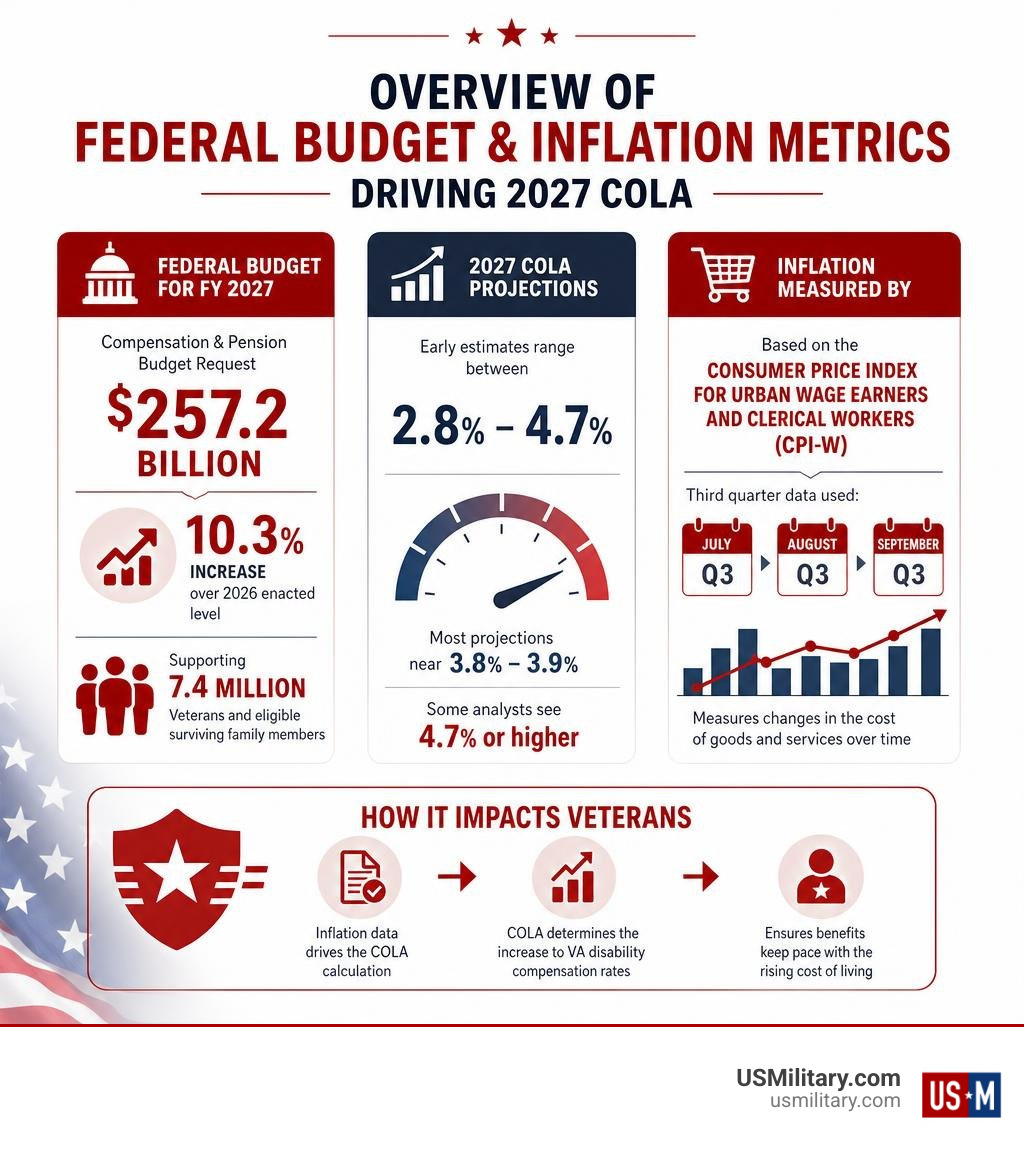
The big question is exactly how high that adjustment will be. Early estimates for the 2027 COLA currently range between 2.8% and 4.7%. This range stems from fluctuating energy prices and consumer spending metrics measured throughout the spring and early summer. Projections from organizations like The Senior Citizens League point toward an adjustment near 3.8% to 3.9%, while some market analysts note that elevated inflation could push it to 4.7% or higher.
To provide comprehensive context on what to expect VA disability rates 2027, we must examine broader government planning. The federal budget request for fiscal year 2027 allocates $257.2 billion solely for Compensation and Pension programs. This represents a substantial 10.3% increase over the 2026 enacted level, ensuring the Department of Veterans Affairs has the necessary funding to deliver benefits to roughly 7.4 million veterans and their eligible surviving family members.
How the 2027 Cost-of-Living Adjustment Is Calculated
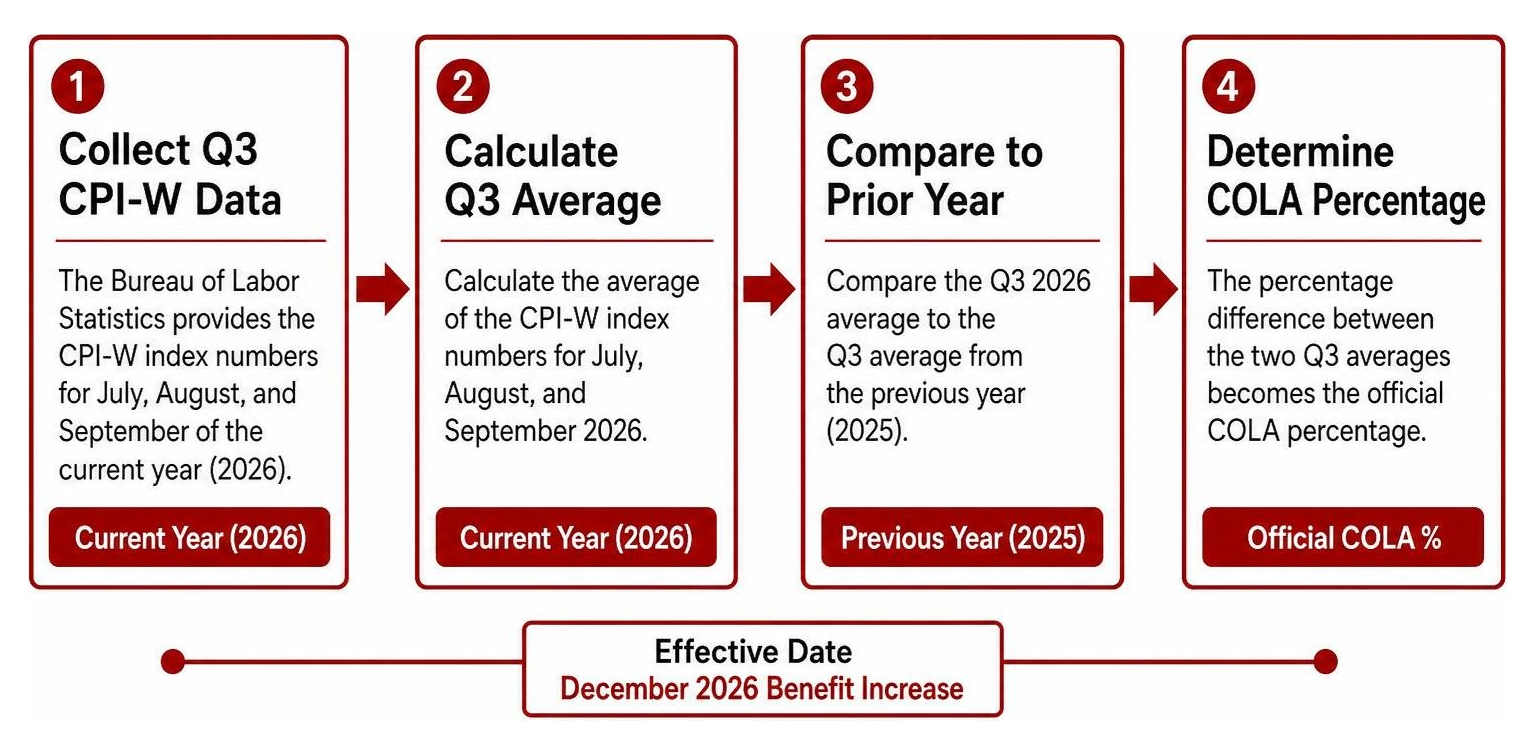
The annual benefit bump isn’t decided on a whim or behind closed doors. It relies on an exact mathematical formula governed by statute. The Social Security Administration evaluates data compiled by the Bureau of Labor Statistics using the Consumer Price Index for Urban Wage Earners and Clerical Workers (CPI-W).
Rather than looking at the entire calendar year, the government focuses exclusively on the third quarter:
- The average CPI-W index numbers for July, August, and September of the current year (2026) are calculated.
- That third-quarter average is compared against the third-quarter average from the previous year (2025).
- The percentage difference between the two quarterly averages becomes the official COLA percentage.
If you spent time understanding VA disability rates and COLA in 2026, you might recall that last year’s increase was 2.8%. Because recent 12-month CPI-W readings have demonstrated accelerated price pressures—such as significant upticks in gas and utility expenses—the 2027 adjustment is on track to outpace the 2026 rate.
Will There Be a VA Rating Disability Increase in 2027 for TDIU, SMC, and DIC Benefits?
A common point of confusion among veterans is whether special benefit tiers receive the same percentage boost as standard disability compensation. The simple answer is yes. The statutory cost-of-living adjustment applies uniformly across all major Department of Veterans Affairs compensation programs.
Reviewing our 2026 VA disability changes guide shows that every tier moves in tandem with the final COLA percentage. For 2027, the increase applies to:
- Total Disability Individual Unemployability (TDIU): Veterans who cannot maintain substantially gainful employment due to service-connected disabilities receive monthly compensation at the 100% disability rate. Their payments will increase directly alongside standard 100% payments.
- Special Monthly Compensation (SMC): Additional monthly payments designed for severe, specific disabilities—such as the loss or loss of use of limbs, blindness, or the need for regular Aid and Attendance (A&A)—will increase proportionally. For example, basic SMC-K payments (currently $139.87 monthly) will rise alongside the higher tiers (SMC-L through SMC-O).
- Dependency and Indemnity Compensation (DIC): Tax-free monthly monetary benefits paid to surviving spouses and eligible dependent children of service members who died in the line of duty or from a service-connected condition will also receive the uniform percentage raise.
Projected 2027 VA Disability Pay Rates Across Rating Tiers

When establishing your household budget, reviewing the official baseline comparison helps you visualize the impact of the projected COLA. The baseline numbers for our current benefit year were set when the VA disability ratings for 2026 took effect on December 1, 2025.
To give you a clear look at what an estimated 3.9% COLA looks like in real dollars, let us break down the standard monthly payments for a single veteran with no dependents.
Estimated Monthly Compensation by Rating Percentage (10% to 100%)
Below is a direct comparison showing the 2026 baseline rates alongside the projected 2027 monthly amounts and estimated annual financial gains under a 3.9% adjustment.
| Disability Rating Percentage | 2026 Monthly Baseline Rate | Projected 2027 Monthly Rate (3.9% COLA) | Estimated Monthly Increase | Estimated Annual Increase |
|---|---|---|---|---|
| 10% | $180.42 | $187.46 | +$7.04 | +$84.48 |
| 20% | $356.66 | $370.57 | +$13.91 | +$166.92 |
| 30% | $552.47 | $574.01 | +$21.54 | +$258.48 |
| 40% | $795.72 | $826.75 | +$31.03 | +$372.36 |
| 50% | $1,133.18 | $1,177.18 | +$44.00 | +$528.00 |
| 60% | $1,436.24 | $1,492.25 | +$56.01 | +$672.12 |
| 70% | $1,808.45 | $1,879.18 | +$70.73 | +$848.76 |
| 80% | $2,102.15 | $2,184.13 | +$81.98 | +$983.76 |
| 90% | $2,297.96 | $2,387.58 | +$89.62 | +$1,075.44 |
| 100% | $3,938.58 | $4,092.20 | +$153.62 | +$1,843.44 |
For detailed historical rate archives and bracket breakdowns, you can always reference our 2026 VA disability pay chart.
One striking takeaway from this table is what many veterans call the “90% to 100% cliff.” Moving from a 90% combined rating to a 100% rating creates an enormous financial leap—jumping by over $1,704 per month, or more than $20,450 annually.
Additional Monthly Allowance Rules for Dependents and Spouses
If you have family members relying on your income, your monthly payments can be significantly higher, provided you meet specific rating thresholds.
- The 30% Threshold: By law, veterans rated at 10% or 20% receive a flat monthly compensation rate. The Department of Veterans Affairs does not provide extra dependent allowances at these two lower levels. Additional compensation for eligible dependents only begins once you reach a combined rating of 30% or higher.
- Spouse and Parents: At 30% and above, you can add your spouse and dependent parents to your award. For example, a veteran rated at 100% with a spouse currently receives $4,158.17 in 2026, which is projected to climb to roughly $4,320.34 under a 3.9% increase.
- Dependent Children: Children under age 18 (or between 18 and 23 if enrolled full-time in an approved educational program) add dedicated monthly amounts to your benefit.
- Spouse Aid and Attendance: If your spouse requires personal daily assistance due to disability, you can claim an additional monthly Aid and Attendance allowance on top of your base dependent rate.
Key Timeline and Payment Schedule for the 2027 Increase

Understanding the administrative schedule prevents unnecessary anxiety when tracking your bank account at the end of the year.
Key Announcement and Effective Dates for Veterans
Here is how the timeline unfolds as we move from late 2026 into 2027:
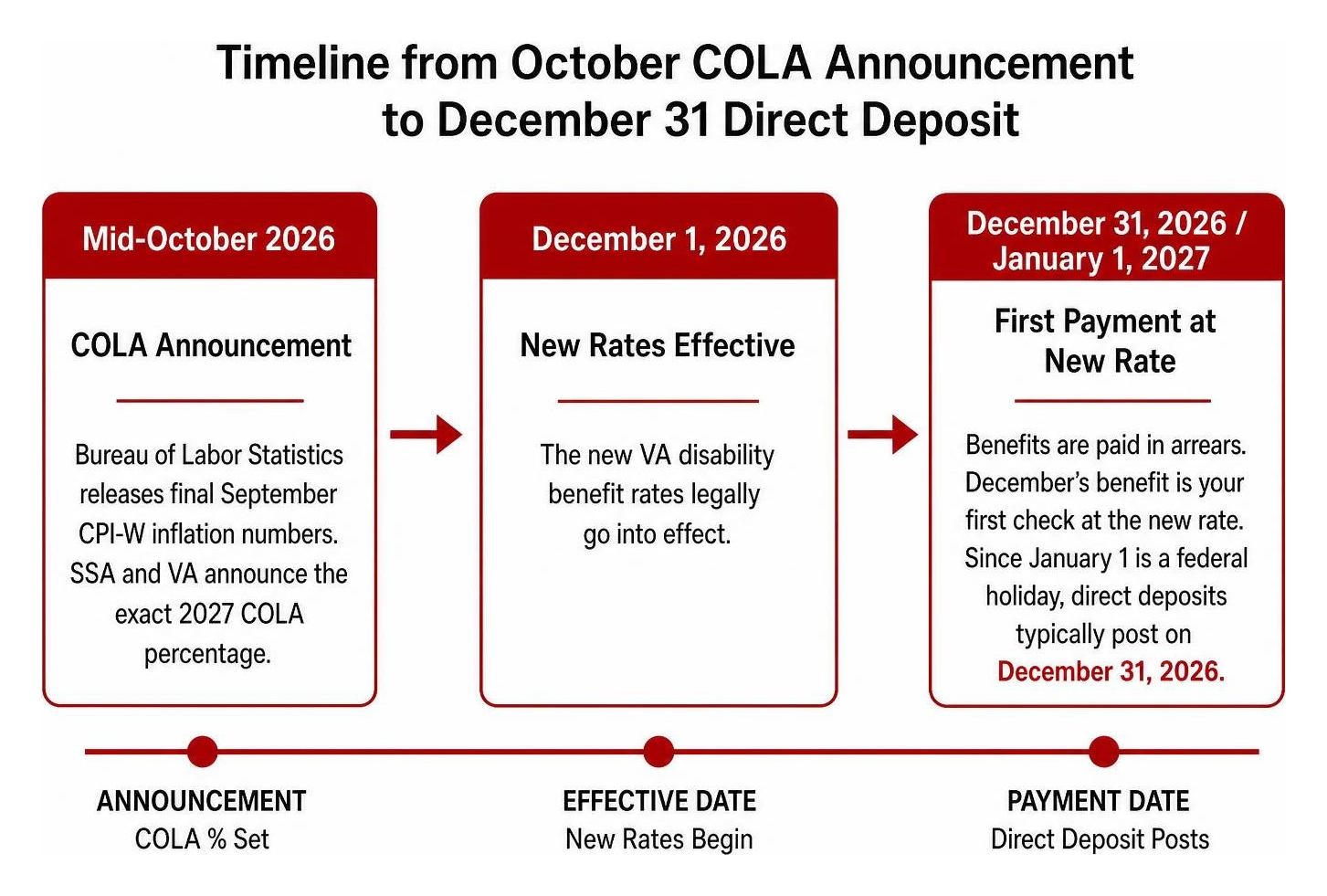
- Mid-October 2026: The Bureau of Labor Statistics releases the final September CPI-W inflation numbers. Immediately following this release, the Social Security Administration and the Department of Veterans Affairs officially announce the exact 2027 COLA percentage.
- December 1, 2026: The new benefit rates legally go into effect.
- December 31, 2026 / January 1, 2027: Because VA disability benefits are paid in arrears (meaning you receive payment for a given month on the first business day of the following month), your December benefit represents your first check at the new rate. Since January 1 is a federal holiday, direct deposits typically post on December 31, 2026.
How Mid-Claim COLA Changes Affect Retroactive Back Pay
If you currently have an open claim, supplemental claim, or board appeal under review, you may be wondering how a December 1 COLA adjustment influences your eventual back pay.
The Department of Veterans Affairs calculates retroactive awards using a segmented payment structure. This means the agency does not apply the newest rate across your entire historical claim window. Instead:
- Any months of back pay owed for periods prior to December 1, 2026, are calculated using the 2026 (or earlier) pay tables active during those specific calendar months.
- Any months owed from December 1, 2026 onward will reflect the newly adjusted 2027 pay rate.
This segmented method ensures that you receive the exact dollar amount allocated by law for every single month your claim was pending.
How to Increase Your Individual VA Disability Rating
While an annual cost-of-living adjustment provides relief against inflation, it only adjusts existing dollar figures—it does not change your assigned disability percentage. If your physical or mental health conditions have deteriorated, relying on a 3% or 4% COLA may not be enough to sustain your quality of life.
To explore the entire process of upgrading your rating, consult our comprehensive VA disability rating increase expert guide.
Filing for Secondary Conditions and Rating Increases
If your service-connected conditions have grown worse, you have the legal right to file for a rating increase or introduce secondary service connections.
- Documenting Progression: Keep routine medical appointments within the VA healthcare system or with private providers. Updated clinical notes, diagnostic imaging, and treatment records serve as the foundation for an increased rating.
- Secondary Service Connection: Many primary conditions cause additional health problems over time. For example, a service-connected knee injury can lead to degenerative disc disease in your back due to altered gait, or chronic physical pain can trigger secondary depression.
- Nexus Letters and DBQs: Having your treating physician complete a Disability Benefits Questionnaire (DBQ) and provide a well-reasoned Nexus Letter linking the secondary issue to your primary service-connected disability can substantially strengthen your claim.
- Accredited Assistance: When preparing your submission, read through our detailed breakdown on how to apply for a VA disability rating increase and consider partnering with an accredited Veteran Service Officer (VSO).
Ancillary Benefits and Protections at the 100% Rating Level
Reaching a 100% Permanent and Total (P&T) disability rating unlocks critical support programs far beyond the monthly cash payment:
- Comprehensive Healthcare: Complete medical coverage with no copayments, including full VA dental care.
- CHAMPVA: The Civilian Health and Medical Program of the Department of Veterans Affairs provides comprehensive medical coverage for your spouse and dependent children.
- Chapter 35 DEA: Dependents’ Educational Assistance offers monthly education stipends directly to eligible spouses and children pursuing college or vocational degrees.
- Property Tax Relief: Most states across the country offer substantial or 100% complete property tax exemptions on primary residences for 100% disabled veterans.
- Uniformed Services ID Card: Access to commissary, exchange, and Morale, Welfare, and Recreation (MWR) facilities on military installations.
Frequently Asked Questions About the 2027 VA Benefit Increase
Will there be a VA rating disability increase in 2027 automatically, or must veterans apply?
The annual cost-of-living increase is 100% automatic. You do not need to submit applications, fill out forms, or call the regional office to receive the adjusted payment. If you are currently receiving disability compensation, the updated amount will automatically reflect in your direct deposit at the end of December.
Are VA disability payments taxable in 2027?
No. VA disability compensation, SMC, and DIC payments remain completely tax-free at both the federal and state levels. These benefits do not count as gross income on your federal tax return and are protected from IRS levies.
For perspective, receiving approximately $49,100 annually in tax-free 100% VA disability compensation provides the equivalent purchasing power of earning a gross taxable salary of roughly $60,000 to $70,000 in the civilian sector, depending on your state of residence.
What can veterans do if the 2027 COLA does not cover rising living costs?
If your annual adjustment does not cover your essential living expenses:
- Request a Rating Increase: If your service-connected ailments have worsened, file for a rating increase with new medical evidence.
- Apply for TDIU: If your conditions prevent you from maintaining steady employment, apply for Total Disability Individual Unemployability to be paid at the 100% rate.
- Explore Special Monthly Compensation: If you require daily care, evaluate whether you qualify for Aid and Attendance or other SMC allowances.
- Utilize VA Healthcare and Community Programs: Transitioning your routine prescriptions and medical care to VA medical centers can significantly eliminate out-of-pocket healthcare costs.
Conclusion
Understanding the mechanics behind the upcoming benefit adjustments allows you to take control of your long-term personal finances. With early economic projections pointing to an increase between 2.8% and 4.7%, our community can expect a helpful raise starting December 1, 2026.
While COLA protects your buying power against inflation, keeping your disability rating aligned with your actual health status is your best financial protection. To review current compensation charts, calculate your exact dependent tier, and access expert transition guides, visit our dedicated USMilitary.com VA disability pay tables resource center. Explore our full library of transition tools and guides at USMilitary.com to ensure you receive every benefit you have earned through your service. For those looking for daily spiritual inspiration and strength along life’s journey, consider reading Dare to Live Greatly to stay focused and resilient.
Free for Service Members & Veterans
Get the military benefits intel no one tells you about.
Weekly updates on VA benefits, pay changes, and money tips — free for service members and veterans.
No spam. Unsubscribe anytime. Your info is never shared.


