What It Really Takes to Survive Delta Force Training
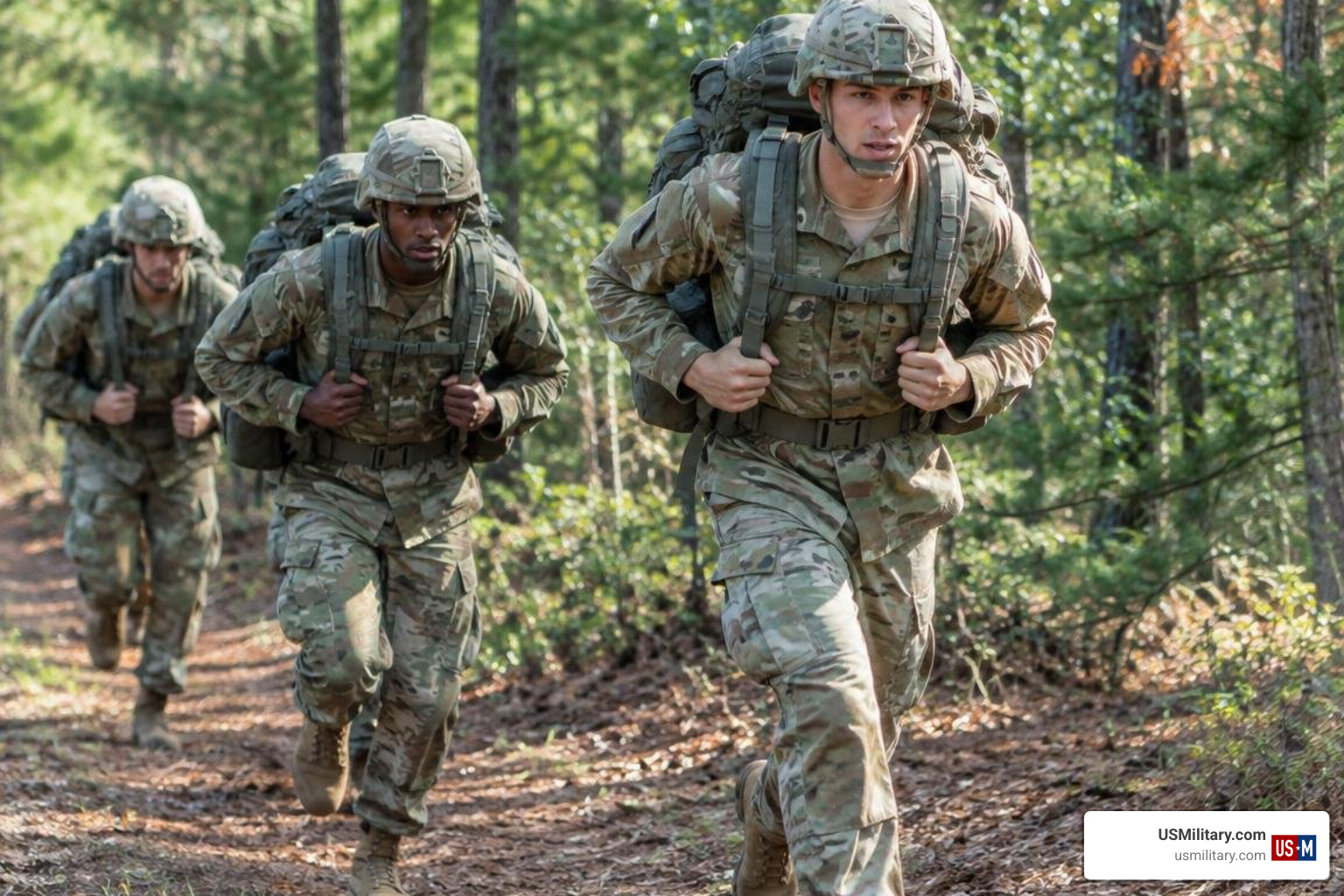
The truth of Army Delta Force training and what it takes to survive is not about being the strongest person in the room. It is about arriving with years of strong Army performance, then proving you can carry heavy loads, navigate alone, make sound choices while exhausted, and stay calm when nobody tells you what happens next.
The known public path has two distinct parts:
- Selection is a roughly four-week assessment that filters candidates through endurance events, land navigation, isolation, and psychological screening.
- The Operator Training Course (OTC) follows selection and lasts about six months. It develops skills such as precision shooting, close-quarters combat, breaching, driving, tradecraft, and hostage-rescue work.
Most candidates do not fail because they lack motivation. They fail because selection exposes weak navigation, poor pacing, injuries, bad decisions under fatigue, or an inability to work through uncertainty. Public accounts commonly place selection graduation near 5-10 percent; in some reported classes, about 12 to 16 of 120 candidates passed selection, and fewer completed OTC.
More Than 90% Of Clients Have Increased VA Disability Ratings! Why Settle For Less Than You Deserve? Expert Priority Help With Your VA Claim! Free Evaluation Call!
Delta Force, formally 1st Special Forces Operational Detachment-Delta, is a highly secretive Army special-mission unit. Public information is incomplete and can conflict, so this guide separates widely reported requirements from claims that cannot be verified. The useful lesson for any aspiring soldier is simple: build fitness, land-navigation skill, maturity, and a spotless professional record long before you seek selection.
I am LARRY FOWLER, publisher of the USMilitary.com Network, which has served active-duty personnel and veterans with military career and benefits information since 2007. In this guide to The truth of Army Delta Force training and what it takes to survive, I will focus on practical, public-facing facts rather than movie myths.
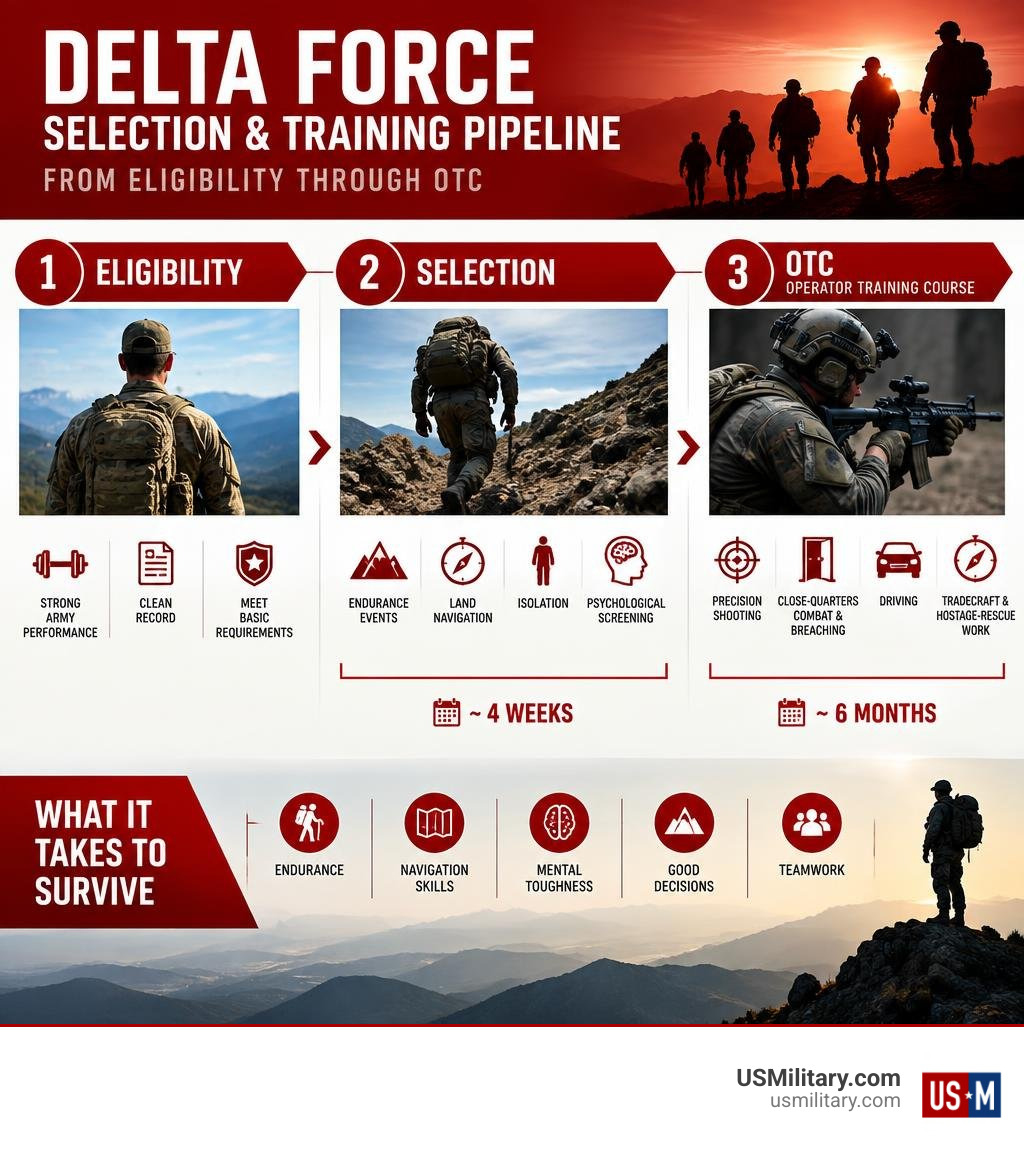
Key terms for The truth of Army Delta Force training and what it takes to survive:
Eligibility Gates and Selection: The Truth of Army Delta Force Training and What It Takes to Survive
Behind closed doors at Fort Liberty and deep in the mountains of West Virginia, 1st Special Forces Operational Detachment-Delta (1st SFOD-D) maintains a standard designed to identify exceptional soldiers. These shadow warriors in Tier-1 special missions operate under the Joint Special Operations Command (JSOC), executing national-level direct action, hostage rescue, and sensitive counterterrorism operations.
Unlike conventional units where you simply submit an application and wait for orders, getting into Delta Force requires passing strict administrative and physical benchmarks just to receive an invitation to the four-week selection course.
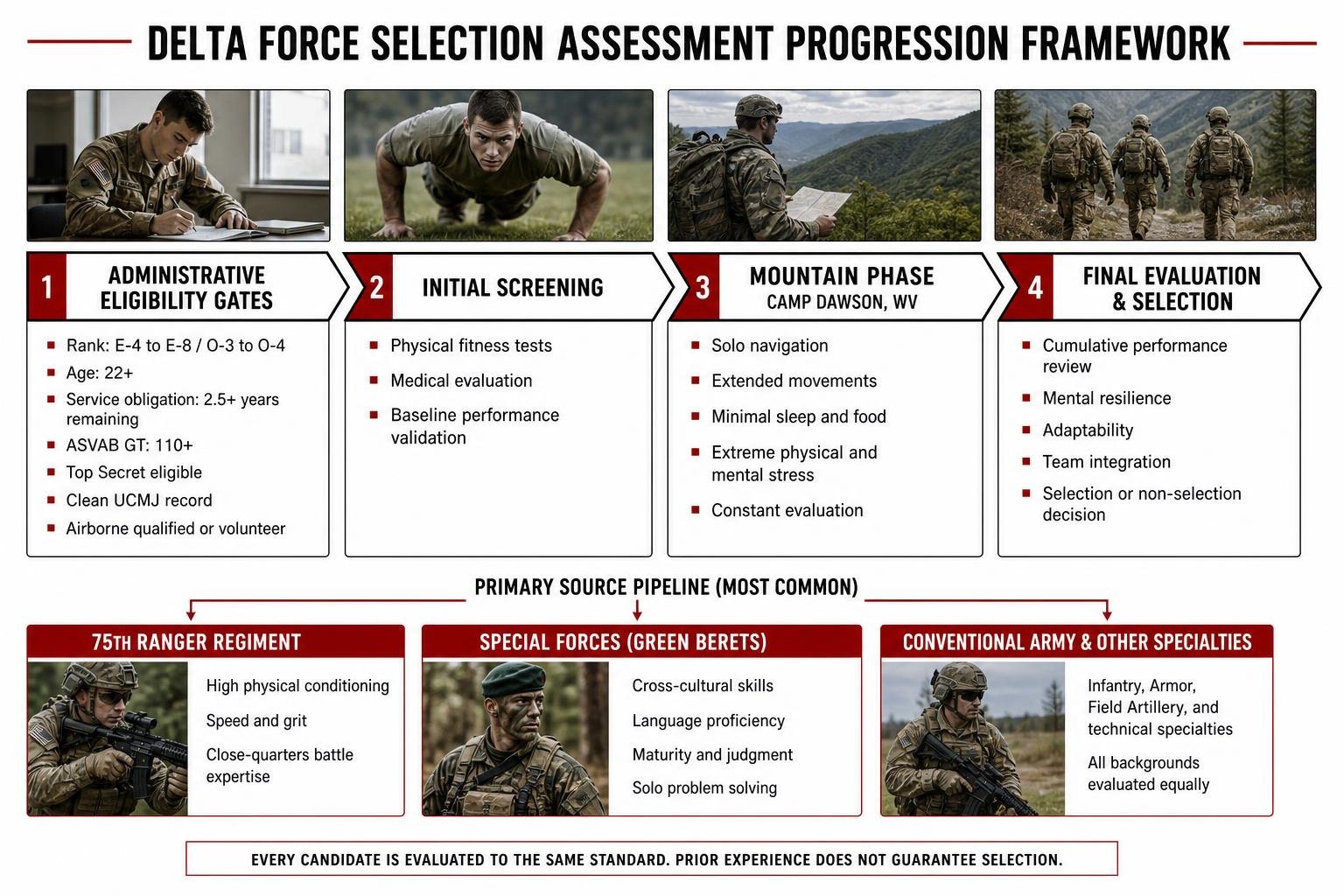
The baseline prerequisites establish an immediate barrier to entry:
- Rank Requirement: Enlisted soldiers must be in the pay grades of E-4 through E-8 (typically with at least two to four years of active service), while officers must be Captains (O-3) or Majors (O-4) with successful company-level leadership experience.
- Age and Service Commitment: Candidates must be at least 22 years old and have at least 2.5 years of service obligation remaining upon assignment.
- Cognitive Standards: A minimum General Technical (GT) score of 110 or higher on the Armed Services Vocational Aptitude Battery (ASVAB).
- Clearance and Disciplinary Record: Candidates must be eligible for a Top Secret security clearance and possess a clean military disciplinary record under the Uniform Code of Military Justice (UCMJ).
- Airborne Qualification: Volunteers must be airborne qualified or volunteer to attend the U.S. Army Airborne School.
| Metric / Requirement | Delta Force (1st SFOD-D) | Special Forces (Green Berets) | 75th Ranger Regiment (RASP) |
|---|---|---|---|
| Minimum Rank | E-4 to E-8 / O-3 to O-4 | E-3 (enlistment pipeline) to O-3 | E-1 to O-5 |
| ASVAB GT Score | 110+ | 110+ | 105+ |
| Security Clearance | Top Secret / SCI | Secret (minimum) | Secret |
| Selection Location | Camp Dawson, West Virginia | Camp Mackall, North Carolina | Fort Moore, Georgia |
| Assessment Focus | Solo navigation, extreme ambiguity | Team evaluation, unconventional warfare | High-intensity physical grit, small-unit tactics |
| Primary Mission | Hostage rescue, direct action counterterrorism | Unconventional warfare, foreign internal defense | Direct action airfield seizure, elite strike operations |
Administrative Filters and Prior SpecOps Backgrounds
Delta Force does not accept recruits off the civilian street. The unit recruits heavily from across the Department of Defense, but the majority of volunteers arrive from the 75th Ranger Regiment and Special Forces Operational Detachment-Alpha (ODA) teams.
Candidates from the 75th Ranger Regiment typically possess high physical conditioning, speed, and standard operating discipline in close-quarters battle. Green Berets bring cross-cultural communication, language skills, maturity, and solo problem-solving capabilities. However, Delta also recruits from conventional combat arms (Infantry, Armor, Field Artillery) and technical support specialties.
Every applicant is evaluated on the exact same standard. Having a Ranger tab or Special Forces beret provides no preferential treatment during selection. If a soldier cannot navigate the mountains or crumbles during psychological testing, they are dropped regardless of their prior background.
Navigating the Mountain Phase: The Truth of Army Delta Force Training and What It Takes to Survive
Selection occurs twice a year—typically in the spring (late March to late April) and autumn (late September to late October)—at Camp Dawson, West Virginia. The first phase establishes basic physical readiness before shifting into the Mountain Phase.
Initial screening tests include:
- Standard Army Combat Fitness Test (ACFT) events performed at the highest tier.
- A maximum-effort push-up, sit-up, and inverted crawl assessment.
- A 100-meter fully uniformed swim test designed to evaluate water confidence.
- Progressive load-bearing runs and rucks.
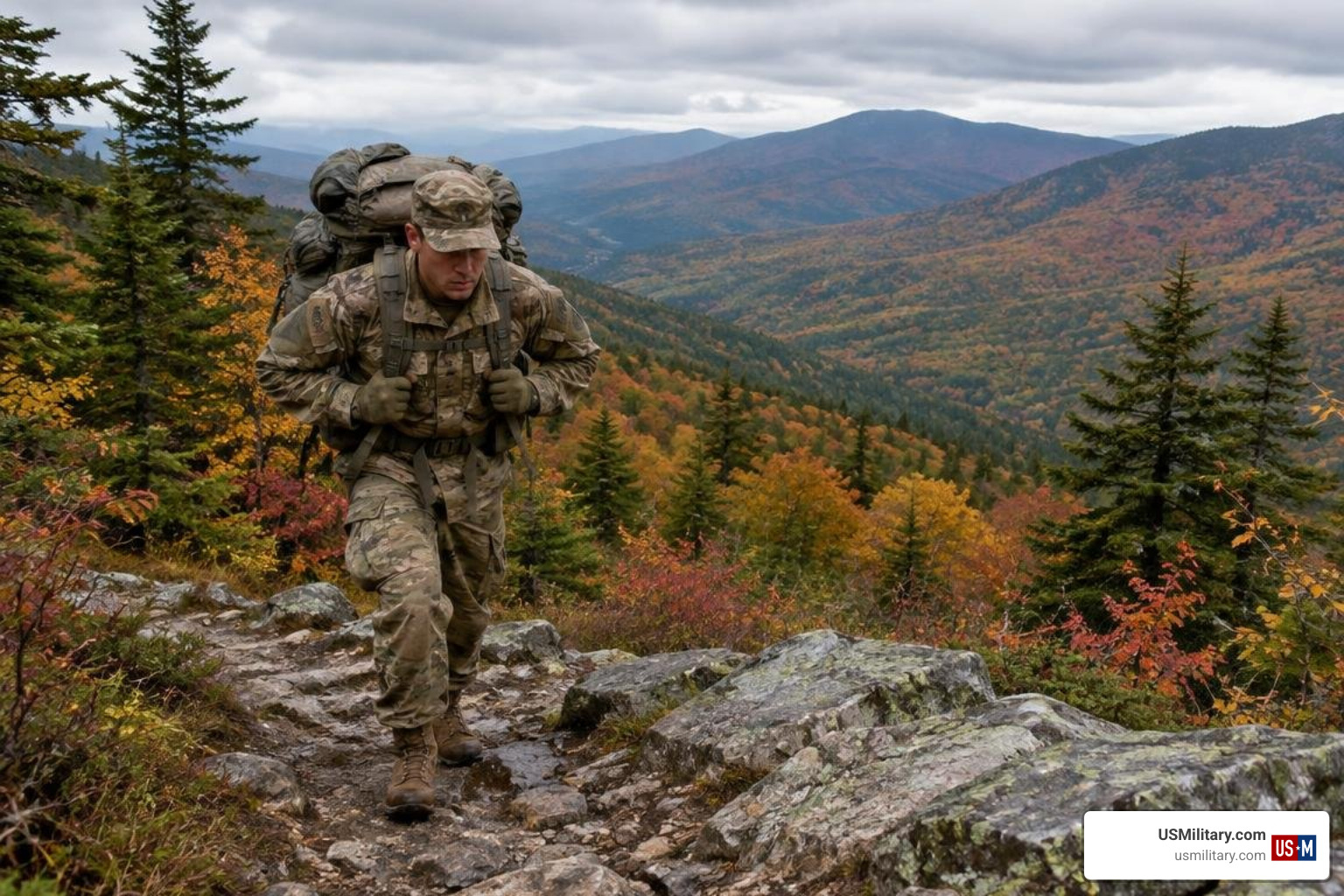
Once through the initial physical gates, candidates enter the isolated Appalachian hills. The Mountain Phase strips away technology, support networks, and basic clarity. From the British Special Air Service (SAS) selection model pioneered by Col. Charlie Beckwith—detailed in Delta Force selection historical context—the unit evaluates individual capability through solitary land navigation.
Cadre assign candidates a grid coordinate, inspect their rucksack weight (starting around 40 to 45 pounds and scaling up), and send them into the woods alone. Candidates must find points across elevation gains, dense brush, and rocky terrain. Cadre offer no feedback, no encouraging words, and no indication of whether a candidate made the time cutoff.
Instructors practice strict information denial. A candidate might finish a 15-mile movement at 0200, only to be handed another set of coordinates 20 minutes later with no hint of how long the march will be. This silent pressure rapidly breaks down candidates who rely on external validation or predictable schedules.
Psychological Isolation: The Truth of Army Delta Force Training and What It Takes to Survive
The physical culmination of the selection course is “The Long Walk”—a grueling solo ruck march spanning approximately 40 miles over steep Appalachian mountain terrain with a rucksack weighing at least 45 pounds.
Candidates are given a compass, a map, and a set of starting coordinates. They are not told the distance, the course layout, or the time standard required to pass. The sole instruction is to move as fast as possible until an instructor tells them to stop. For many, this march takes anywhere from 14 to 18 continuous hours of relentless physical output.
Those who finish The Long Walk without quitting, failing navigation points, or missing time cutoffs face the final hurdle: the Commander’s Selection Board.
The board consists of the unit commander, command sergeant major, operational squadron leaders, and operational psychologists. Candidates sit on a chair in the center of an interrogation-style room while the board grills them on their decisions, past mistakes, family life, cognitive reasoning, and ethical boundaries. The psychological evaluation tests for:
- Intellectual honesty and ability to admit errors without making excuses.
- High emotional stability and absence of impulsive aggression.
- Ability to balance mission parameters with critical thinking.
Those selected receive an invitation to attend the Operator Training Course (OTC).
The Operator Training Course: Developing Tier-1 Tactical Lethality
Passing selection merely earns a soldier an entry ticket. The real work of building a special-mission operator occurs during the six-month Operator Training Course (OTC).
While selection identifies people who will not quit under stress, OTC teaches the technical and tactical skills required to execute national-security directives within the Sabre Squadrons (A, B, C, and D Squadrons). The training demands long hours of live-fire, complex problem solving, and constant testing, giving candidates an inside view of elite military training across varied disciplines. To sustain this output, trainees must adapt to the demanding daily physical regimen of Delta operators, which balances endurance, functional strength, and high-tempo skill application.
Marksmanship, Breaching, and Close-Quarters Combat
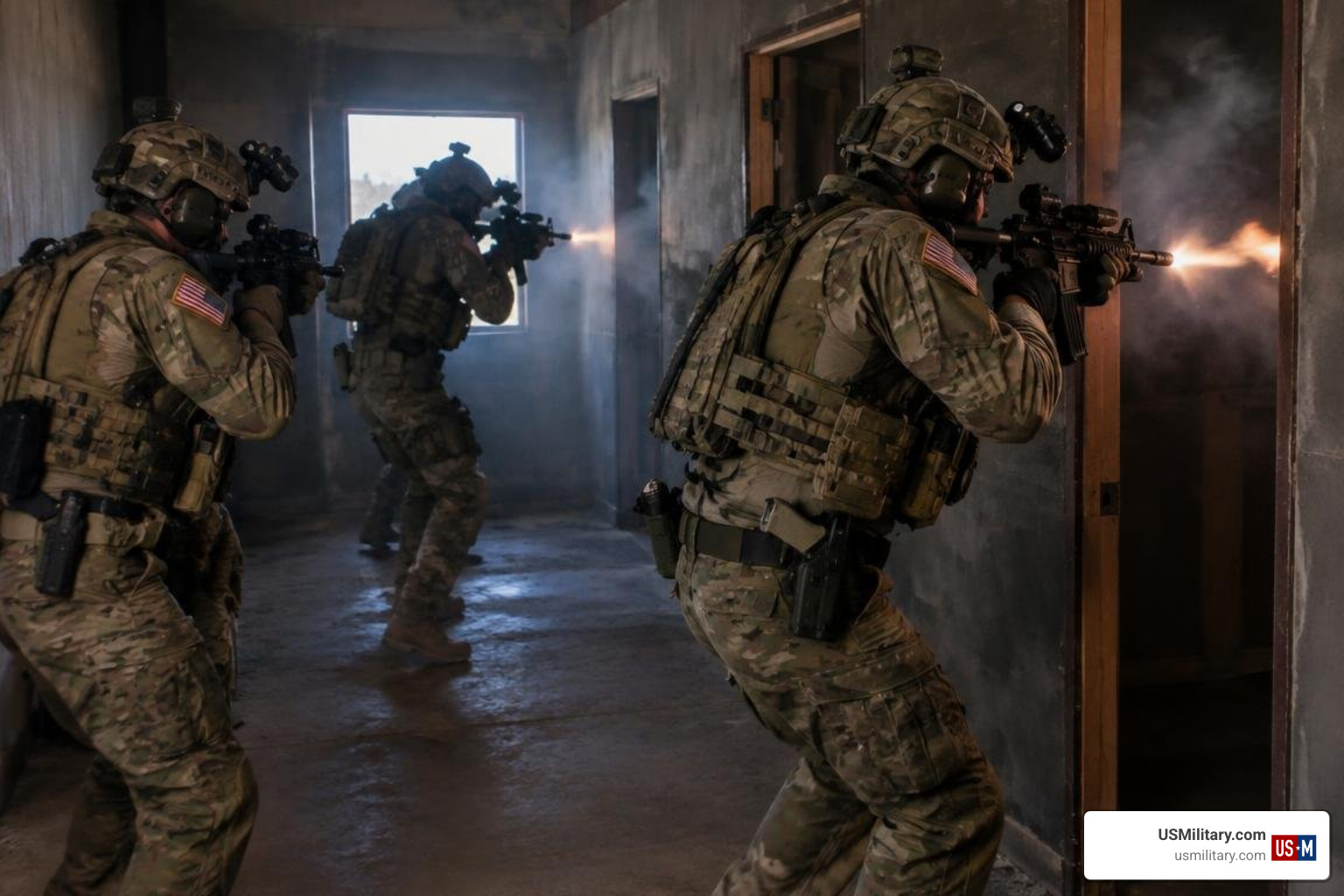
The foundation of OTC is precision marksmanship and Close-Quarters Combat (CQC). Candidates shoot tens of thousands of rounds, transitioning from basic marksmanship to surgical shooting under high heart rates and dynamic room entries.
Key areas of combat instruction include:
- Precision Shooting: Mastering primary carbines and secondary sidearms to hit target areas in fractions of a second without hitting non-combatants.
- The “Two-Tap” Discipline: Rapidly neutralizing threats with surgical accuracy during dynamic team flow.
- Explosive and Mechanical Breaching: Calculating dynamic net explosive weights (NEW) to blast through reinforced steel, wood, brick, and concrete entry points.
- Hostage Rescue Integration: Live-fire house runs where candidates navigate rooms filled with realistic targets and live participants serving as role-player hostages.
Operators rely on customized carbines, submachine guns, precision rifles, night vision devices, and specialized armor tailored for rapid movement—all detailed in our breakdown of specialized gear and operator kits.
Clandestine Tradecraft, Advanced Driving, and Executive Protection
Direct action is only one capability of Delta Force. A significant portion of OTC focuses on low-visibility, clandestine, and semi-permissive operational environments:
- Advanced Tradecraft: Operators learn CIA-style operational tradecraft, including surveillance detection, evading active tracking, establishing covert dead drops, and blending seamlessly into foreign civilian populations.
- Defensive and Offensive Mobility: Training at dedicated vehicle facilities covers high-speed pursuit driving, tactical vehicle interdictions (PIT maneuvers), breaking through ambushes, and vehicle maintenance under austere conditions.
- Executive Protection: Preparing operators to secure American dignitaries, foreign heads of state, and high-value personnel in non-permissive combat zones.
The course ends with a comprehensive culmination exercise that links multi-week mission planning, intelligence gathering, tradecraft, explosive infiltration, and live-fire hostage extraction under realistic combat constraints.
Psychological Endurance and Surviving Operational Realities
Surviving Delta Force training requires a mental makeup that differs from typical high-energy motivation. The physical rigors will weed out those with poor aerobic bases or bad feet, but the psychological grind filters for emotional control and comfort with ambiguity.
In conventional warfare, soldiers receive distinct timelines, mission statements, and operational graphics. Within JSOC special missions, an operator might be flown across the world on six hours’ notice, given vague human intelligence, and ordered to conduct low-visibility reconnaissance in an unfamiliar city.
Those who survive OTC display what psychologists term “low neuroticism and high conscientiousness.” They do not waste emotional energy complaining about miserable weather, sleepless nights, or shifting requirements. When an unexpected obstacle emerges, they adjust their plan without personal frustration.
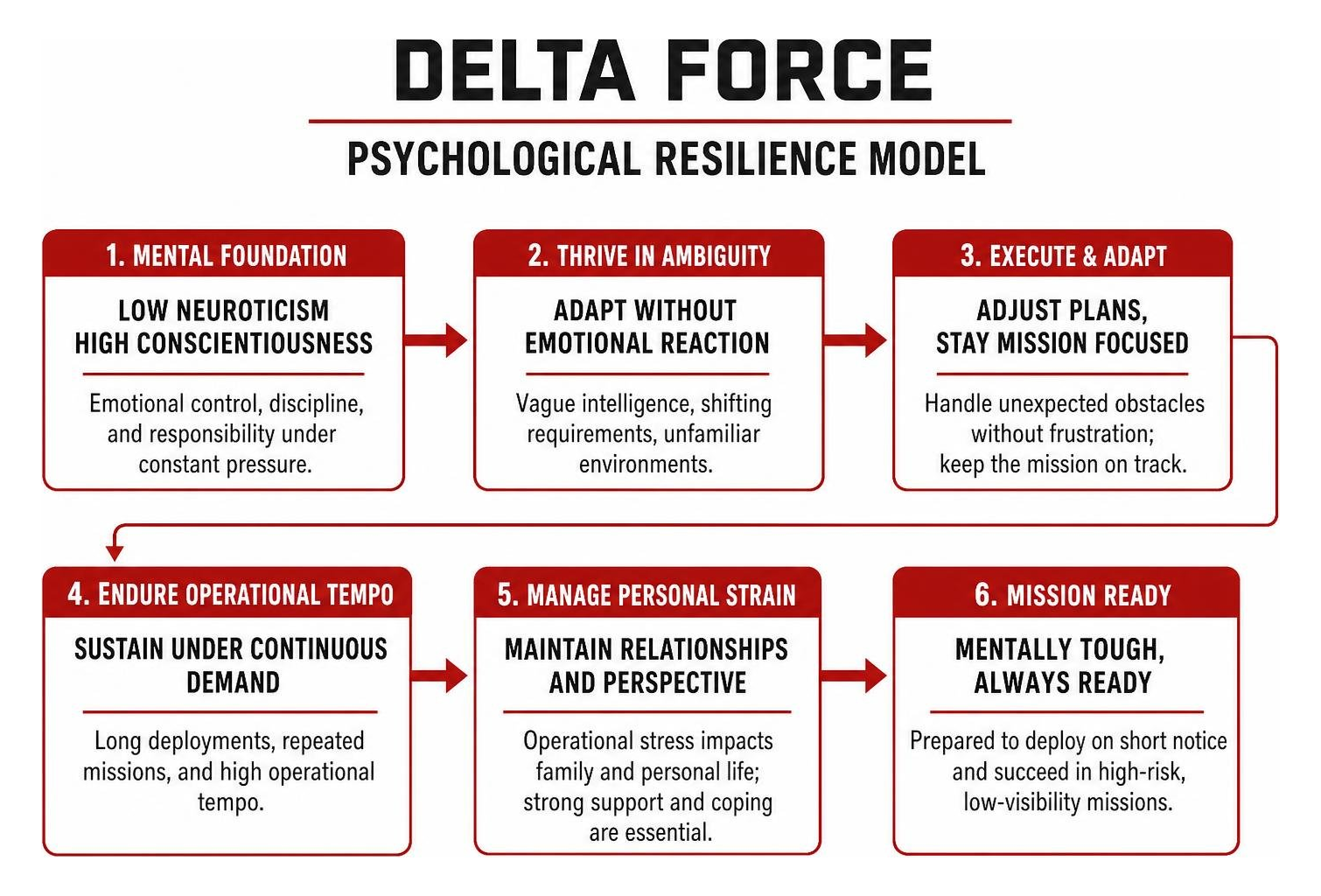
The operational reality following graduation is intense. Historically, Delta Force has operated under a continuous operational tempo. By 2009, long years of counter-insurgency warfare in Iraq and Afghanistan had led to a 20 percent casualty rate across the unit, with roughly 50 percent of deployed operators earning Purple Hearts.
Beyond combat danger, the sustained cycle of deployments, overseas training trips, and classified duties places heavy stress on personal relationships. Understanding the family strains and dynamics in elite special operations is essential for anyone considering this career path, as divorce rates and operational stress require mature coping mechanisms and strong family support.
Debunking Pop Culture Myths vs Real World Operations
Mainstream media, movies, and video games often depict Delta Force operators as reckless action heroes who disregard rules. The operational reality is the exact opposite.
- Myth: Delta Operators Are Muscle-Bound Hulks.
- Reality: Massive bodybuilders often struggle during the 40-mile mountain rucks due to cardiovascular demands and caloric burn. Operators typically have lean, durable, cross-country athletic builds with high strength-to-weight ratios.
- Myth: They Disregard Military Discipline.
- Reality: While Delta maintains relaxed grooming standards (longer hair, beards, and civilian attire) to blend into overseas operational environments, personal discipline is non-negotiable. Competence, precision, and adherence to surgical standard operating procedures replace loud, performative discipline.
- Myth: Selection Is About Being the Loudest Leader.
- Reality: Candidates who try to dominate every conversation or make themselves the center of attention rarely pass the psychological board. Delta values quiet professionals who solve problems without seeking credit.
Practical Preparation Guide for Aspiring Candidates
If you are currently an active-duty service member planning to attend an upcoming selection course, your preparation must be deliberate, balanced, and focused on functional endurance over short-term ego lifting.
Core Preparation Pillars
- Build a Deep Aerobic Engine: Focus on zone-2 cardiovascular training. Long, low-heart-rate running (5 to 8 miles at an easy conversation pace) builds the mitochondrial density and capillary networks needed to move across mountains all day without crashing.
- Progressive Load Carriage (Rucking): Do not begin by throwing 70 pounds in a pack. Start with 35 pounds for 4 to 6 miles at a 14-to-15-minute-per-mile pace. Gradually increase weight up to 45–55 pounds and extend distance over 12 to 18 weeks. Focus on foot care, boot selection, and hip strength.
- Master Analog Land Navigation: Put away the GPS. Spend time in national forests or rugged training areas working with a 1:50,000 topographic map, lensatic compass, and protractor. Practice terrain association, dead reckoning, and pacing over steep elevation lines at night.
- Strengthen Stabilizer Muscles and Connective Tissue: Emphasize deadlifts, squats, lunges, kettlebell carries, and core stability work to protect your lower back, knees, and ankles from injury under load.
Essential Self-Assessment Checklist Before Selection
- [ ] Score a 580+ on the Army Combat Fitness Test.
- [ ] Complete a 5-mile run in under 35 minutes in standard PT uniform.
- [ ] Complete a 12-mile ruck march with a 45-pound dry pack in under 2 hours and 35 minutes across rolling terrain.
- [ ] Tread water for 15 minutes and swim 100 meters comfortably in full uniform.
- [ ] Successfully locate 5 out of 5 terrain points on an unfamiliar, high-relief night land navigation course without a GPS.
Frequently Asked Questions About Delta Force Training
What is the primary difference between Delta Force selection and OTC?
Selection is a four-week assessment designed exclusively to test physical durability, solo navigation, decision-making, and psychological resilience. It does not teach you how to be an operator; it determines whether you have the raw attributes to be trained.
The Operator Training Course (OTC) is an intensive six-month instructional school that takes the soldiers who passed selection and teaches them marksmanship, close-quarters combat, explosive breaching, advanced driving, and covert tradecraft.
What percentage of candidates actually pass Delta Force selection?
The historical pass rate for Delta Force selection hovers between 5% and 10%. In a typical selection class of roughly 120 experienced military candidates (many coming from Ranger or Special Forces backgrounds), only 12 to 16 soldiers generally complete the selection course. From that initial pool, often only around 8 candidates successfully graduate from the following Operator Training Course.
Can women or civilian recruits join Delta Force directly?
There is no direct civilian enlistment contract (such as an Option 40 for Rangers or an 18X for Green Berets) that allows a civilian to enlist directly into Delta Force. Candidates must already be serving on active duty within the U.S. Armed Forces and meet time-in-service and rank gates.
Selection is open to all qualified service members who meet the criteria regardless of gender, and female soldiers have served in vital operational support, intelligence, and clandestine operational roles within the unit, as explored in our guide to women serving in Delta Force support roles.
Conclusion
The journey to earning a position within the Army’s premier special-mission unit requires exceptional dedication, unwavering integrity, and sustained physical and mental durability. Delta Force does not look for loud bravado; they search for the disciplined professional who makes sound decisions alone in the dark when exhaustion sets in.
At USMilitary.com, we are dedicated to providing current service members, veterans, and military families with transparent, accurate guides on military career transitions, advanced training pipelines, VA benefits, and financial readiness. If you are comparing elite service branches, take the next step by exploring our detailed comparison between Army Delta Force and Navy SEALs to see how each Tier-1 unit operates at the highest levels of national security.
Free for Service Members & Veterans
Get the military benefits intel no one tells you about.
Weekly updates on VA benefits, pay changes, and money tips — free for service members and veterans.
No spam. Unsubscribe anytime. Your info is never shared.


