Why the 75th Ranger Regiment is America’s Premier Raid Force
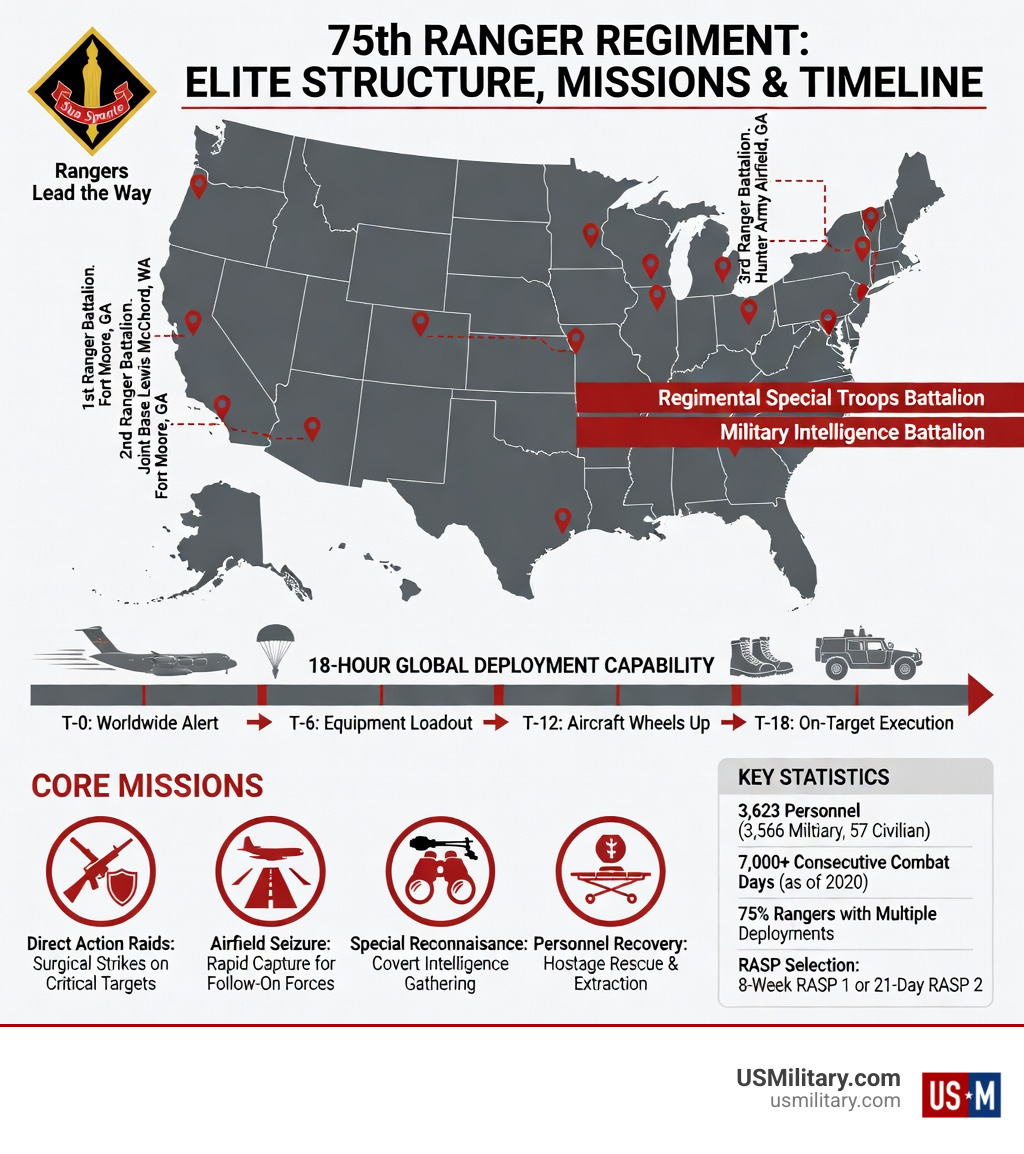
The 75th Ranger Regiment is the United States Army’s elite special operations direct-action raid force, comprising 3,623 specially selected personnel who execute the nation’s most critical missions. Here’s what you need to know:
Quick Facts:
- Mission: Conduct airborne assaults, direct action raids, airfield seizures, special reconnaissance, and personnel recovery
- Size: 3,566 military personnel and 57 civilians across three Ranger battalions
- Deployment Speed: Can deploy one battalion anywhere in the world within 18 hours
- Combat Record: Achieved 7,000 consecutive days of combat operations as of December 17, 2020
- Selection: All-volunteer force requiring completion of either RASP 1 (8 weeks) or RASP 2 (21 days)
- Motto: “Sua Sponte” (Of Their Own Accord) and “Rangers Lead the Way”
Rangers aren’t just soldiers—they’re a “triple-volunteer” force who choose the Army, choose Airborne School, and then volunteer specifically for the 75th Ranger Regiment. This elite unit bridges the gap between conventional forces and other special operations units, capable of conducting everything from large-scale joint forcible entry operations to surgical special operations raids.
What makes Rangers different? More than 70% of current Rangers have multiple combat deployments. They maintain readiness through constant training focused on the “Big 5”: marksmanship, physical training, medical training, small unit tactics, and mobility. A 2011 study found that the 75th Regiment had only a 3% death rate from potentially survivable causes compared to 24% in other U.S. military units—a testament to their superior combat medical training.
I’m Larry Fowler, publisher of the USMilitary.com Network, and since 2007 I’ve worked to provide active-duty personnel and veterans with accurate information about military career paths, including specialized units like the 75th Ranger Regiment. This guide will walk you through everything from the Regiment’s storied history to the rigorous selection process that separates Rangers from the rest.
Handy 75th ranger regiment terms:
The Mission and Structure of the 75th Ranger Regiment
When the United States needs to seize an airfield in the middle of the night or conduct a high-stakes raid against a high-value target, they call the 75th Ranger Regiment. As the Army’s premier raid force, the Regiment is a lethal, agile, and flexible unit capable of executing complex, joint special operations missions.
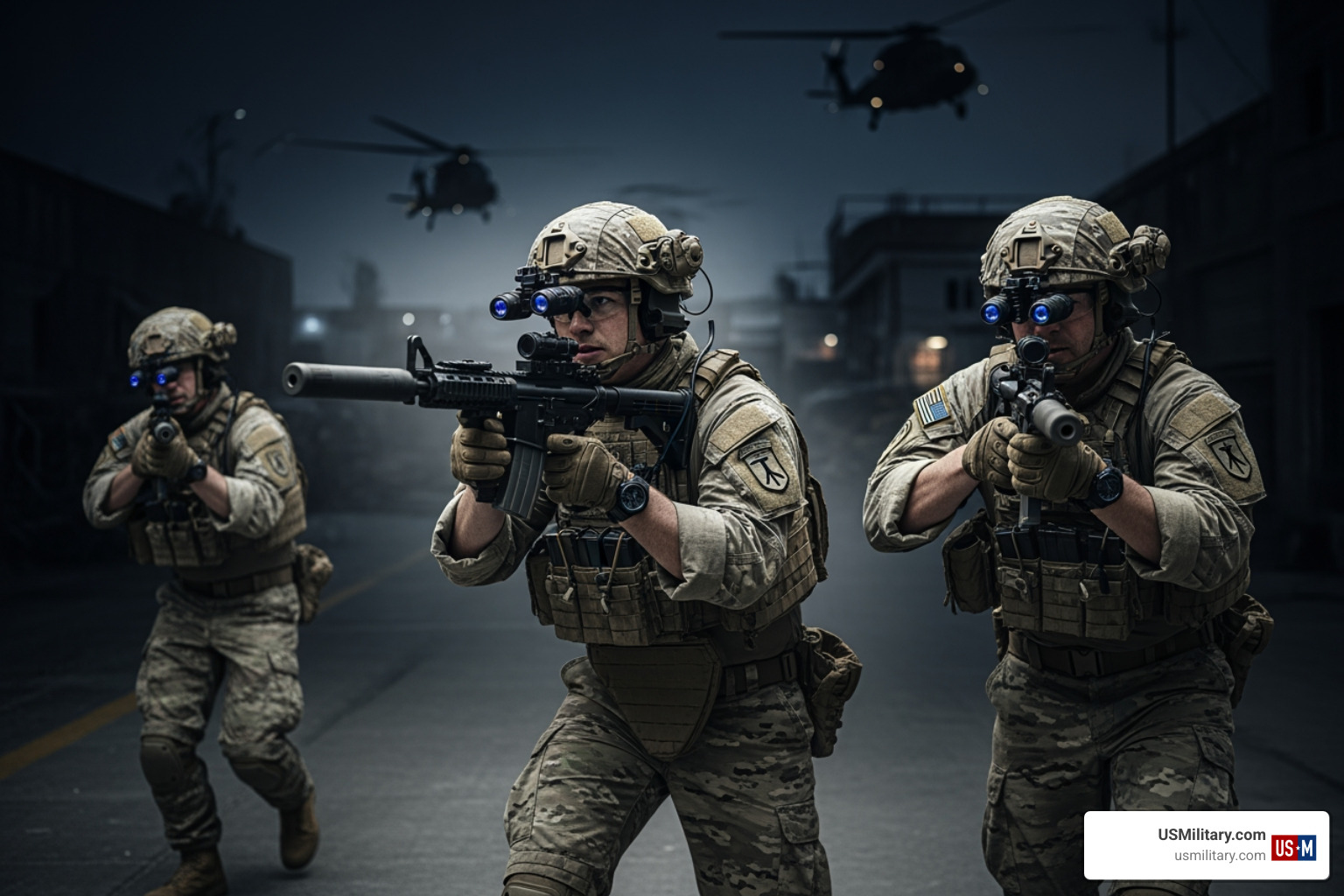
The primary mission of the 75th Ranger Regiment is to plan and conduct special missions in support of U.S. policy and objectives. This includes a wide array of capabilities:
- Direct Action Raids: Surgical strikes to capture or kill enemies.
- Airfield Seizure: Taking control of enemy landing strips to allow for further troop buildup.
- Special Reconnaissance: Gathering intelligence behind enemy lines.
- Personnel Recovery: Rescuing POWs or isolated personnel.
- Clandestine Insertion: Getting in and out of hostile territory via air, land, or sea.
The Regiment is authorized a total of 3,623 personnel (3,566 military and 57 civilians). This relatively small size allows for extreme precision and high standards. One of the most staggering statistics in modern military history is that the 75th Ranger Regiment marked 7,000 consecutive days of combat operations on December 17, 2020. They are, quite literally, always in the fight. For more on their specific role, you can visit the Official 75th Ranger Regiment Overview.
Organizational Breakdown of the 75th Ranger Regiment
The Regiment isn’t just one big group; it’s a “team of teams” geographically dispersed to ensure global coverage. It is organized into several key components:
- Regimental Headquarters and Headquarters Company (RHHC): Based at Fort Moore (formerly Fort Benning), Georgia.
- 1st Ranger Battalion: Located at Hunter Army Airfield, Georgia.
- 2d Ranger Battalion: Located at Joint Base Lewis-McChord, Washington.
- 3d Ranger Battalion: Located at Fort Moore, Georgia.
- Regimental Special Troops Battalion (RSTB): Activated in 2007 to provide specialized support like reconnaissance and communications.
- Regimental Military Intelligence Battalion (RMIB): The newest addition, focused on cyber-electromagnetic activities and multi-source intelligence.
Each battalion is designed to be self-sufficient but can also work together for regimental-sized operations. The ability to deploy one full battalion within 18 hours of an alert notification is a cornerstone of their operational concept.
Mottos, Creeds, and the Tan Beret
The culture of the 75th Ranger Regiment is built on a foundation of discipline and a refusal to fail. Their primary motto, Sua Sponte (Of their own accord), reflects the fact that every Ranger is a multi-time volunteer.
The Ranger Creed is the heartbeat of the unit. Every Ranger must memorize it, but more importantly, they must live it. It emphasizes being “a more elite soldier,” maintaining “mental alertness and physical strength,” and the promise that “never shall I fail my comrades.” You can read the full ranger-creed to understand the standard they set for themselves.
A major part of their identity is the Tan Beret. Historically, Rangers wore black berets. However, in 2001, when the wider Army adopted the black beret for all soldiers, the Rangers transitioned to the Tan Beret to maintain their distinct identity. This headgear is a symbol of the “triple-volunteer” status and the rigorous selection they survived.
From Darby’s Rangers to Modern Warfare: A Storied History
The lineage of the Rangers dates back to the 1700s with Benjamin Church and Robert Rogers, but the modern 75th Ranger Regiment draws its most direct heritage from World War II. In 1942, Major (later Colonel) William O. Darby organized and activated the 1st Ranger Battalion in Northern Ireland. These men became known as “Darby’s Rangers.”
During WWII, Rangers performed legendary feats:
- Sened Station: The 1st Battalion earned the nickname “Black Death” from Italian forces after a swift 20-minute raid.
- Pointe du Hoc: During the D-Day invasion, the 2nd Ranger Battalion scaled 100-foot cliffs under intense fire to disable German coastal guns.
- Omaha Beach: It was here that Brigadier General Norman Cota gave the unit their famous slogan. Seeing the Rangers, he yelled, “Well then Goddammit, Rangers, lead the way!”
- Cabanatuan: The 6th Ranger Battalion conducted a daring raid in the Philippines, rescuing 500 POWs from behind enemy lines.
The Regiment also traces its lineage to Merrill’s Marauders (the 5307th Composite Unit), who fought through the jungles of Burma. Following WWII, Ranger companies served with distinction in the Korean War and as Long-Range Reconnaissance Patrol (LRRP) units in Vietnam. For a deeper dive into these heroes, see the History and Heritage of the Rangers.
Notable Engagements of the 75th Ranger Regiment
In the post-Vietnam era, the Rangers were formalized into the battalions we see today. They have been at the tip of the spear for every major American conflict since.
- Operation Just Cause (Panama, 1989): Rangers conducted simultaneous parachute assaults on key airfields, capturing over 1,000 prisoners and 18,000 weapons.
- Battle of Mogadishu (Somalia, 1993): Rangers held improvised positions for nearly 18 hours against overwhelming odds. While 18 Americans were killed, they inflicted massive casualties on the enemy (estimated 500-1,000).
- Operation Enduring Freedom (Afghanistan): On October 19, 2001, Rangers conducted a low-level parachute jump to seize Objective Rhino. In one deployment alone, the 1st Battalion conducted over 900 missions and captured nearly 1,700 combatants.
- Operation Iraqi Freedom: Rangers were instrumental in the rescue of PFC Jessica Lynch and the seizure of the Haditha Dam.
- Counter-Terrorism: Rangers played a key role in the elimination of Abu Musab al-Zarqawi’s successors and the raid that led to the death of Abu Bakr al-Baghdadi.
By mid-2015, each Ranger battalion had completed its twentieth deployment to Afghanistan and Iraq, showcasing a level of combat experience that is virtually unmatched in the world.
The Path to the Tan Beret: Selection and Training
Joining the 75th Ranger Regiment is not for the faint of heart. It requires an intensive screening and selection process. Unlike other units where you might be assigned, you must earn your way into a Ranger Battalion.
The gateway to the Regiment is the Ranger Assessment and Selection Program (RASP).
- RASP 1: An 8-week selection course for junior non-commissioned officers and enlisted soldiers (E-1 through E-5). It is broken into two phases: the first focuses on physical and mental toughness, while the second teaches the specialized skills needed to serve in the Regiment.
- RASP 2: A 21-day selection course for senior NCOs (E-6 and above), officers, and warrant officers.
RASP 1 vs. RASP 2 Requirements
| Requirement | RASP 1 (Junior Enlisted) | RASP 2 (Senior NCOs/Officers) |
|---|---|---|
| Duration | 8 Weeks | 21 Days |
| Focus | Selection & Basic Skills | Selection & Leadership |
| Push-ups | 41 (Hand-release) | High Standard |
| Plank | 2:30 | 2:30 |
| 5-Mile Run | Under 40:00 | Under 40:00 |
| 12-Mile Ruck | 35lb load, Under 3 Hours | 35lb load, Under 3 Hours |
To even get a shot at RASP, you must be a U.S. citizen, on active duty, have a GT score of 105 or higher, and volunteer for airborne training. If you’re curious how they stack up against other elites, check out our comparison of army-rangers-vs-navy-seals.
Mastering the ‘Big 5’ Focus Areas
Once selected, a Ranger’s training never stops. The Regiment focuses on what they call the “Big 5.” These are the core competencies that every Ranger must master to a level of “exceptional proficiency”:
- Marksmanship: Being able to engage targets with extreme accuracy under stress.
- Physical Readiness: Maintaining the stamina to fight in any terrain, from mountains to swamps.
- Medical Training: Rangers are world leaders in Tactical Combat Casualty Care (TCCC).
- Small Unit Tactics: Mastering the squad and platoon-level maneuvers that win fights.
- Mobility: Proficiency in various insertion methods, including vehicles and parachutes.
The focus on medical training is particularly vital. A 2011 study highlighted that the Regiment’s emphasis on “self-help” battlefield medicine resulted in a 3% death rate from survivable causes, while other units faced a 24% rate. In the 75th Ranger Regiment, every man is a lifesaver.
Ranger School vs. the Regiment: Understanding the Difference
This is the most common point of confusion for civilians and even some soldiers. Ranger School and the 75th Ranger Regiment are two different things.
- Ranger School: A 61-day leadership course open to the entire Army (and other branches). Graduates earn the Ranger Tab, which is a permanent award showing they have mastered small-unit leadership.
- The 75th Ranger Regiment: A specific special operations unit. Members wear the Ranger Scroll on their sleeve.
While all officers and NCOs in the Regiment must be Ranger School qualified, being “Ranger Tabbed” does not mean you are in the Regiment. Conversely, a junior soldier in the Regiment may have his “Scroll” but not yet his “Tab.”
Ranger School is notoriously difficult, particularly the Darby Phase.
- Success Rate: Usually less than 50% of students complete the Darby Phase.
- RPA: The Ranger Physical Assessment requires 49 push-ups, 59 sit-ups, a 5-mile run in 40:00, and 6 chin-ups.
- RAP Week: Includes the “worm pit” at the Malvesti Confidence Course and a 12-mile foot march with a 47-pound load.
For those looking to prepare, our ranger-ready-the-ultimate-guide-to-joining-the-armys-toughest is an essential resource. You can also find more on the official Army Ranger career paths.
Frequently Asked Questions about the 75th Ranger Regiment
What is the difference between a Ranger Tab and a Ranger Scroll?
The Ranger Tab is a “school” patch. It proves you passed the 61-day leadership course. The Ranger Scroll is a “unit” patch. It signifies that you are a member of the 75th Ranger Regiment. To be a leader in the Regiment, you must have both.
Can women join the 75th Ranger Regiment?
Yes. In early 2017, the first woman successfully completed RASP and joined the 75th Ranger Regiment. Since then, the path has been open to all qualified soldiers regardless of gender, provided they meet the same rigorous physical and tactical standards. For more on this, read about dailey-go-to-ranger-school-regardless-of-gender.
How quickly can the Regiment deploy?
The 75th Ranger Regiment maintains a “Ranger Ready Force” (RRF) status. This means one battalion is always on high alert and can deploy anywhere in the world within 18 hours of notification.
Conclusion
The 75th Ranger Regiment represents the pinnacle of American light infantry. From the cliffs of Normandy to the mountains of Afghanistan, they have consistently proven themselves as the Army’s premier raid force. Their “triple-volunteer” status, relentless focus on the “Big 5,” and adherence to the Ranger Creed ensure they remain a lethal, agile, and flexible force.
Whether they are seizing an airfield or conducting a surgical strike, Rangers live by a simple standard: excellence. They don’t just meet the standard; they set it.
If you or someone you know is considering this path, it is a life of sacrifice, precision, and elite status. For more information on elite selections, you might also be interested in the army-delta-force-selection-process.
At USMilitary.com, we are proud to support our troops and veterans with the resources they need to navigate their careers. If you’re ready to take the next step, you can learn more about how to Join the 75th Ranger Regiment. Rangers Lead the Way!
Free for Service Members & Veterans
Get the military benefits intel no one tells you about.
Weekly updates on VA benefits, pay changes, and money tips — free for service members and veterans.
No spam. Unsubscribe anytime. Your info is never shared.