When Will VA Home Loan Interest Rates Go Down?

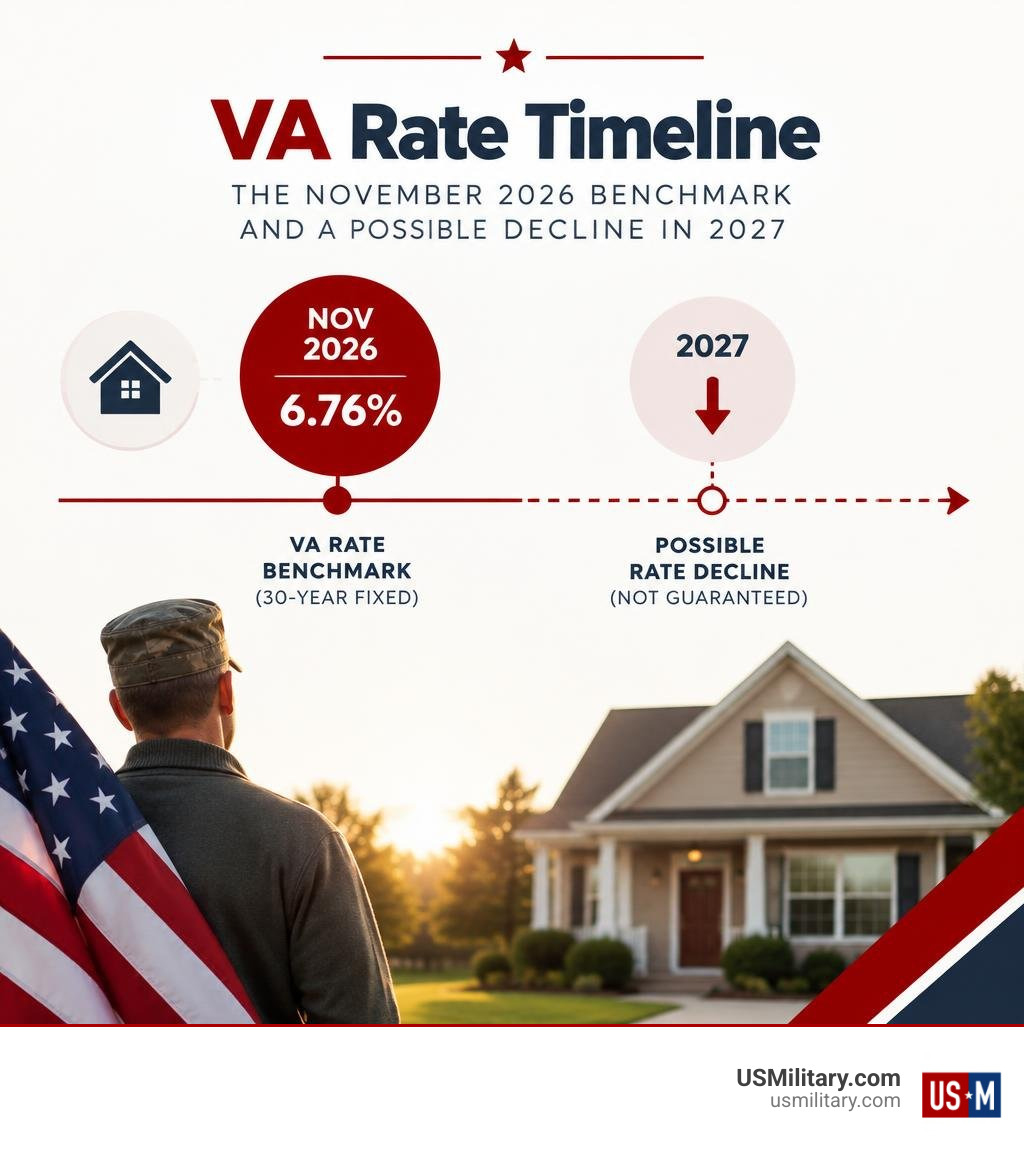
If you’re asking, “When Will VA Home Loan Interest Rates Go Down?” there is no certain date. Rates could ease into 2027 if inflation cools and bond yields fall, but a drop is not guaranteed. As of November 11, 2026, the average 30-year fixed VA rate was 6.76%. If you can afford a home at today’s rate, you may be able to refinance later if rates fall enough to outweigh the costs.
I’m Larry Fowler, a Navy veteran and publisher of USMilitary.com. I’ve covered VA benefits since 2007, and I’ll explain what matters most when asking, “When Will VA Home Loan Interest Rates Go Down?”
Current VA Mortgage Rates and Loan Type Comparisons

Understanding current VA interest rates is the foundation of any sound homebuying decision. As of November 2026, the 30-year fixed VA mortgage benchmark sits around 6.76% according to Optimal Blue data, though competitive lenders and credit unions offer rates in the lower 6% range depending on discount points and credit tiers. For instance, current credit union mortgage rates show 30-year VA options at 6.125% interest (6.584% APR) with 0.75 discount points.
When you compare current VA mortgage rates with other financing products, the VA loan consistently delivers substantial savings. Because the Department of Veterans Affairs guarantees a portion of every loan against default, private mortgage lenders take on significantly less risk. This backing allows lenders to price VA loans roughly 0.25% to 0.50% lower than conventional loans. Furthermore, VA loans require 0% down and eliminate monthly private mortgage insurance (PMI), saving military families hundreds of dollars every month compared to conventional or FHA alternatives.
| Feature / Metric | VA Home Loan | Conventional Loan | FHA Loan |
|---|---|---|---|
| Minimum Down Payment | 0% | 3% | 3.5% |
| Monthly Mortgage Insurance | None ($0/mo) | Required under 20% down (PMI) | Required for life of loan (MIP) |
| Average 30-Yr Fixed Rate (Late 2026) | ~6.29% – 6.76% | ~6.75% – 6.90% | ~6.50% – 6.80% |
| Typical Minimum Credit Score | 580–620 (Lender overlays) | 620 | 500–580 |
| Government Guarantee | Backed by the VA | None (Private / GSEs) | Insured by FHA |
15-Year vs. 30-Year VA Loans and ARM Options
Choosing the right loan structure depends on your monthly cash flow, financial goals, and military career trajectory. Here is what to know about VA loan interest across different terms:
- 30-Year Fixed-Rate VA Loan: Offers the lowest mandatory monthly payment, giving you budget flexibility. For example, a $300,000 balance at 6.125% results in a principal-and-interest payment of about $1,822 per month.
- 15-Year Fixed-Rate VA Loan: Carries a lower base interest rate (averaging 5.625% to 6.04%), allowing you to build equity rapidly and save tens of thousands in lifetime interest, though the monthly payment rises to around $2,471 on a $300,000 balance.
- 5/1 Adjustable-Rate Mortgage (ARM): Introductory rates for a 5/1 VA ARM start lower, often between 5.25% and 6.03%. This structure is ideal for service members facing a Permanent Change of Station (PCS) within three to five years, allowing them to lock in a lower payment during their tour before the rate adjusts.
When Will VA Home Loan Interest Rates Go Down? Expert Forecasts for 2026–2027
To understand rate trajectories, we look at the leading housing and economic forecasts. Major industry groups project a gradual cooling of mortgage rates through the end of 2026 and into 2027, provided economic conditions align.
According to expert predictions for mortgage rates, the National Association of Realtors (NAR) and Fannie Mae project 30-year rates to hover between 6.0% and 6.4% as inflation normalizes. The Mortgage Bankers Association (MBA) anticipates rates finishing near 6.7% by year-end, while the National Association of Home Builders (NAHB) projects rates could fall to roughly 6.16% if economic growth slows further.
To run scenarios on how prospective rate cuts alter your buying power, you can test different scenarios using trusted VA home loan calculators.
Economic Factors Determining When Will VA Home Loan Interest Rates Go Down
The primary drivers of VA mortgage rates are macroeconomic forces rather than direct government rate-setting:
- Inflation Benchmarks (CPI and PCE): Fixed mortgage rates move closely with inflation expectations. When inflation runs hotter than the Federal Reserve’s 2.0% target (such as CPI prints near 3.2%), bond yields rise to compensate for lost purchasing power, keeping mortgage rates elevated.
- 10-Year Treasury Yields: Mortgages track the 10-year Treasury bond yield. When economic data softens and investors move into government bonds, yields decline, pushing mortgage rates downward.
- Federal Reserve Monetary Policy: While the Fed does not set mortgage rates directly, its benchmark federal funds rate influences short-term liquidity and long-term market sentiment. Sustained rate cuts by the Fed signal an environment where mortgage rates can ease.
Buying Now vs. Waiting for When Will VA Home Loan Interest Rates Go Down
Trying to time the absolute bottom of the interest rate market is rarely successful. If you wait for rates to drop to 5.5% or 6.0%, lower borrowing costs often trigger intense homebuyer competition, driving up home prices and wiping out interest savings.
✉ Get updates like this in your inbox
Weekly VA benefit changes, pay updates, and money tips for service members, veterans, and military families. Free, no spam.
With median home prices appreciating between 3% and 4.1% annually, buying when you are financially prepared allows you to start building home equity immediately. You can review your comprehensive guide to VA home loans to prepare your budget, knowing that if rates drop substantially in the future, you can capture that savings through streamlined refinancing.
How to Capture Lower Rates Later: Refinancing and Rate Modification Options
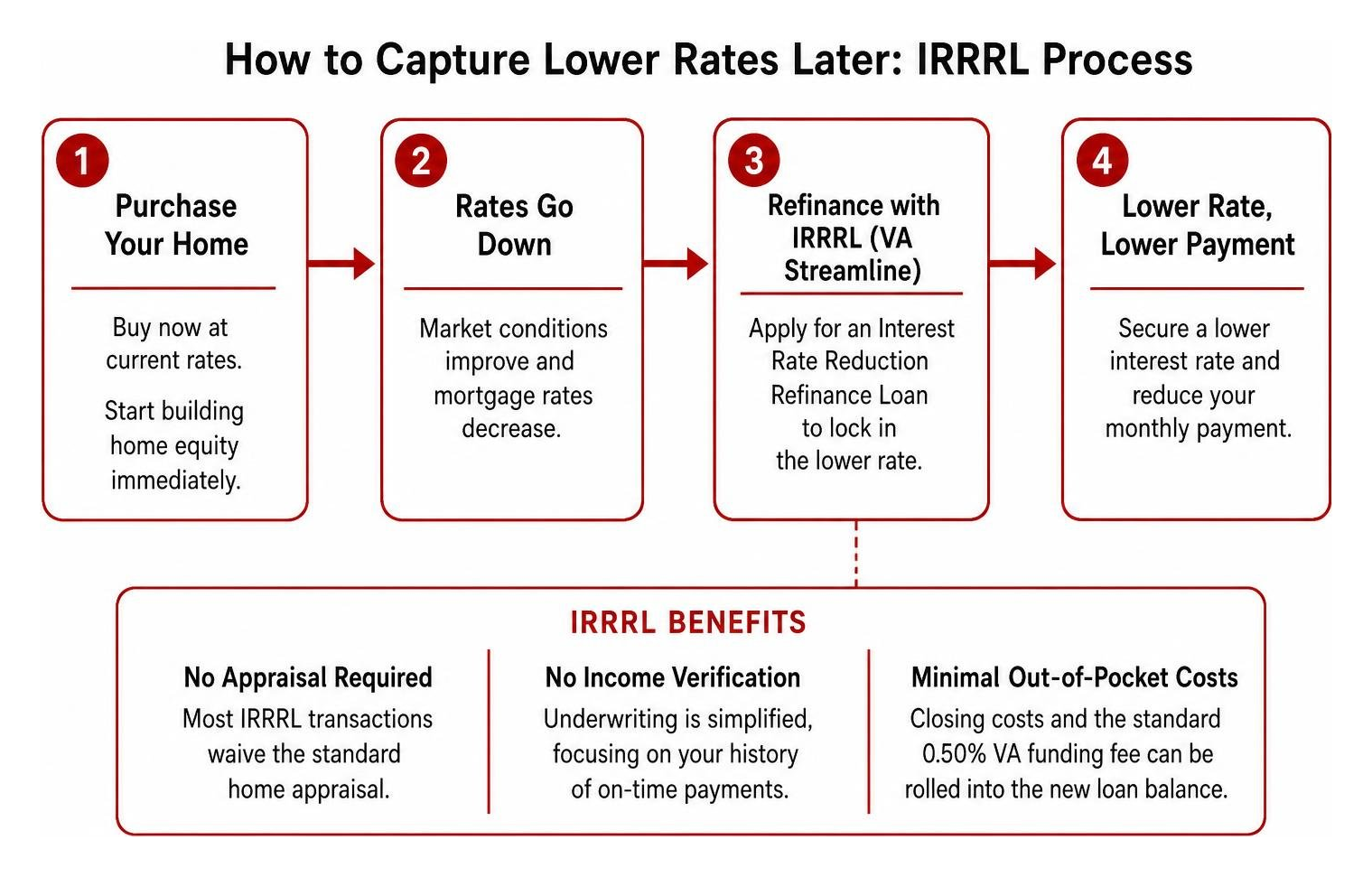
One of the greatest advantages of the VA loan program is the Interest Rate Reduction Refinance Loan (IRRRL), also known as the VA Streamline Refinance. If you purchase a home at current rates, you can refinance into a lower rate later with minimal hassle:
- No Appraisal Required: Most IRRRL transactions waive the standard home appraisal.
- No Income Verification: Underwriting is simplified, focusing on your history of on-time mortgage payments.
- Minimal Out-of-Pocket Costs: Closing costs and the standard 0.50% VA funding fee can be rolled directly into the new loan balance.
- Net Tangible Benefit: VA statutory guidelines require that the refinance provide a clear financial benefit, such as lowering your interest rate by at least 0.50% on a fixed-to-fixed refinance and meeting standard break-even recovery rules.
For full program regulations, review the official VA home loan benefits documentation and evaluate effective VA loan refinance strategies before locking in terms.
The No-Refi Rate Drop Alternative
Some leading mortgage lenders and credit unions now offer specialized rate modification programs, often called a “No-Refi Rate Drop.”
Under this program, if market rates decline after your purchase, you can lower your fixed interest rate without undergoing a complete refinance. Typically, after six consecutive on-time monthly payments, eligible borrowers can secure a rate drop of at least 0.25% for a nominal administrative fee (around $250). This bypasses traditional closing costs and origination fees entirely, making it an excellent bridge for buyers purchasing in a shifting rate climate. Working with top VA home loan lenders will help you discover which institutions provide this option.
Practical Steps to Secure the Best VA Loan Rate Today

You do not have to wait for the Federal Reserve to secure a lower rate. Active steps can reduce your rate immediately:
- Optimize Your Credit Profile: While the VA does not set a hard credit score floor, lenders enforce overlays. Elevating your score above 680 to 720 positions you for top-tier pricing.
- Shop Multiple Lenders: Rates vary significantly across lenders on any given day. Request written Loan Estimates from 3 to 5 mortgage providers on the same day to compare origination charges and APRs. Check our insights on finding the best VA mortgage lenders to narrow your search.
- Consider Discount Points: Paying 1 point (1% of the loan amount) upfront typically drops your rate by roughly 0.25%. If you plan to remain in the home long enough to pass the break-even point, buying points provides guaranteed savings.
- Follow Standard Application Steps: Gather your DD-214 or Statement of Service, pull your Certificate of Eligibility (COE), and learn how to apply for a VA home loan efficiently to avoid delays during your lock period.
Frequently Asked Questions About VA Loan Rates
How much lower are VA loan rates compared to conventional mortgages?
On average, VA loan rates are roughly 0.25% to 0.50% lower than conventional 30-year fixed mortgages. Additionally, because VA loans require no monthly private mortgage insurance (PMI), the total monthly payment is often $150 to $200 lower than a conventional loan on an identical purchase price.
What credit score do I need to get the lowest VA interest rate?
The VA does not establish a statutory minimum credit score, but most lenders require at least 580 to 620. To unlock prime rate tiers and minimal fee structures, aim for a credit score of 680 or higher before locking your rate.
Can I use the VA IRRRL if market rates drop after I buy?
Yes. As long as you have an existing VA-backed mortgage, have made at least six consecutive monthly payments, and meet the seasoning requirements (at least 210 days from your first payment due date), you can use the VA IRRRL to lower your rate with no appraisal and no income verification.
Conclusion
While economic forecasts indicate that VA loan interest rates may gradually ease into 2027, waiting on the sidelines carries risks of rising home prices and heightened buyer competition. By pairing current VA loan benefits—such as zero down payment and no monthly PMI—with long-term refinancing strategies like the VA IRRRL, military buyers can enter the housing market with confidence today.
At USMilitary.com, we are committed to providing the military community with clear, actionable resources on military pay, VA disability ratings, and housing benefits. To see how your monthly housing allowance aligns with local home prices, explore our Basic Allowance for Housing (BAH) guide to start planning your path to homeownership.
Free for Service Members & Veterans
Get the military benefits intel no one tells you about.
Weekly updates on VA benefits, pay changes, and money tips — free for service members and veterans.
No spam. Unsubscribe anytime. Your info is never shared.


Leave a Reply