Who Is Exempt from Selective Service Registration?

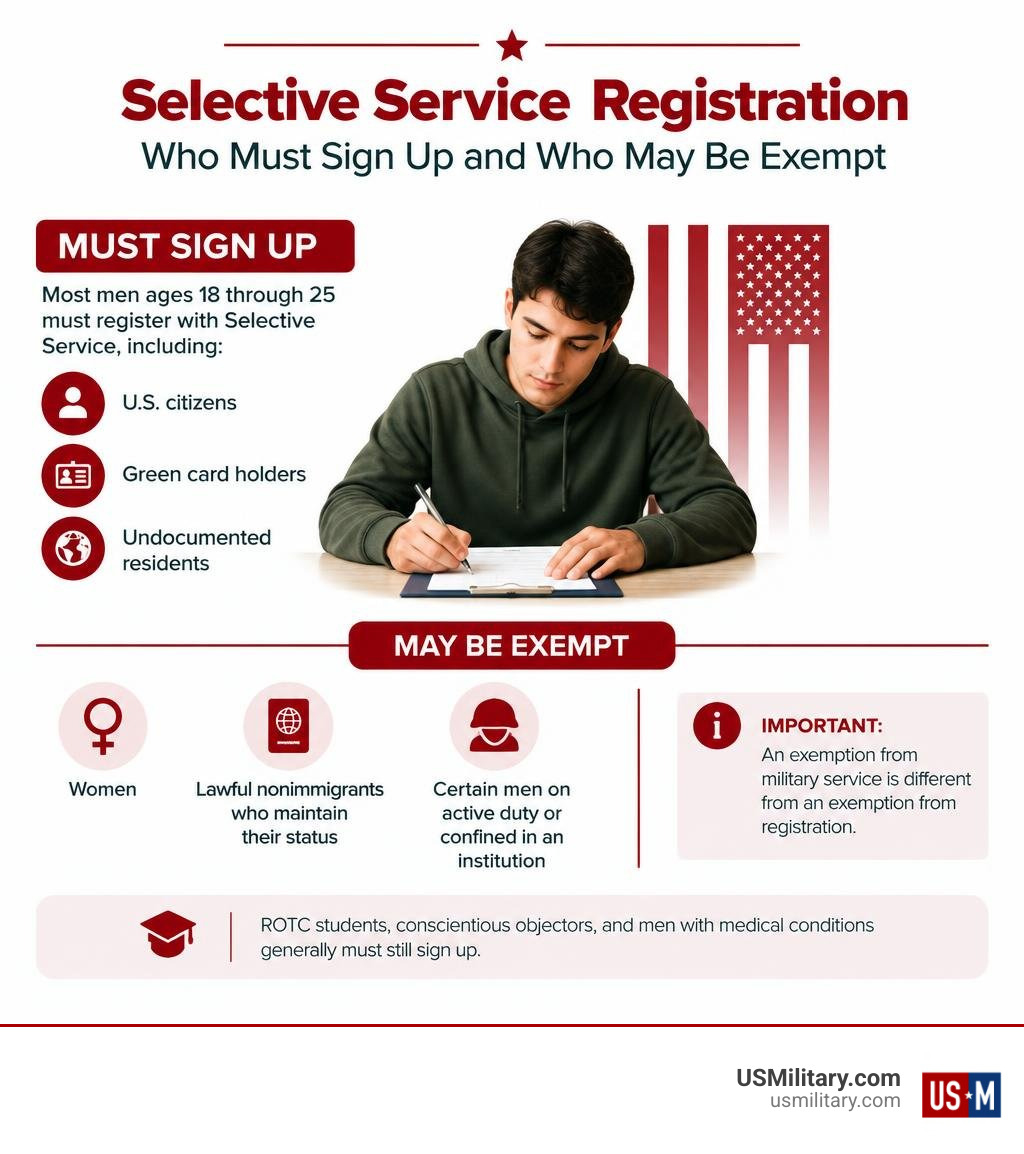
Most men ages 18 through 25 must register with Selective Service, including U.S. citizens, green card holders, and undocumented residents. Those who do not have to register include women, lawful nonimmigrants who maintain their status, and certain men on active duty or confined in an institution. An exemption from military service is different from an exemption from registration: ROTC students, conscientious objectors, and men with medical conditions generally must still sign up.
I’m Larry Fowler, publisher of the USMilitary.com Network, which has covered military service and veterans’ issues since 2007. I’ll explain who is exempt from selective service and which situations still call for registration, so you can check your next step with confidence.
Key who is exempt from selective service vocabulary:
- What disqualifies you from the military draft
- exemptions military draft
- military draft exemptions medical
Legal Breakdown: Who Is Exempt from Selective Service Registration
Under Section 3 of the Military Selective Service Act provisions, Congress established a clear mandate: every male citizen and male resident living in the United States must register upon turning 18. This federal registry ensures the nation maintains an organized pool of potential personnel for emergency mobilization.
The law applies strictly by age and biological sex at birth. The statutory window spans from a young man’s 18th birthday through his 25th year, officially closing on his 26th birthday. Women are not legally required to register. While Congress has debated expanding the mandate, the statutory language still applies exclusively to male persons.
| Category | Must Register? | Exemption Criteria / Conditions |
|---|---|---|
| U.S. Male Citizens (Ages 18–25) | Yes | Mandatory across all states, territories, and overseas locations. |
| Women | No | Completely exempt under current statutory authority. |
| Active-Duty Military | Conditional | Exempt while serving continuously from age 18 through 25. |
| Service Academy Cadets / Midshipmen | No | Exempt while actively enrolled in a qualifying commissioning academy. |
| Lawful Nonimmigrants (Visas) | No | Exempt as long as valid nonimmigrant status (e.g., F-1, H-1B, A-1) is maintained. |
| Permanent Residents (Green Card) | Yes | Mandatory for all resident aliens within the statutory age window. |
| Undocumented Immigrants | Yes | Mandatory for all non-visa male residents ages 18 through 25. |
| Incarcerated / Hospitalized Men | Conditional | Exempt while confined; must register within 30 days of release before age 26. |
Active-Duty Military, Service Academies, and Officer Trainees
Men serving in the armed forces have unique rules regarding draft registration. Commissioned officers, warrant officers, and enlisted personnel serving on full-time active duty in the Regular Army, Navy, Air Force, Marine Corps, Space Force, and Coast Guard are exempt from registration while in uniform.
Cadets and Midshipmen attending the United States Military Academy, Naval Academy, Air Force Academy, and Coast Guard Academy are likewise exempt, as are students enrolled in full-time Officer Procurement Programs.

However, members of the Reserve components and the National Guard who are not on continuous active duty must register. Furthermore, college students participating in general ROTC programs are not automatically exempt and must complete their registration unless they hold an active-duty military status.
Non-Citizens and Lawful Nonimmigrant Visa Categories
According to official Selective Service registration guidelines, an individual’s immigration status dictates their obligation under the law:
- Lawful Nonimmigrants: Foreign nationals residing temporarily in the United States on valid nonimmigrant visas are completely exempt. This includes diplomatic representatives on A-visas, international students on F-1 visas, specialty workers on H-1B visas, and seasonal agricultural workers on H-2A visas. To remain exempt, these individuals must maintain lawful, unexpired status continuously until age 26.
- Lawful Permanent Residents: Green card holders (immigrants admitted for permanent residence) are not exempt and must register just like U.S. citizens.
- Undocumented Immigrants and Asylees: Refugees, parolees, asylees, and undocumented male residents living in the United States must register.
- Dual Nationals: Male dual citizens must register regardless of whether they reside in the United States or abroad.
Incarcerated, Institutionalized, and Medical Confinement Rules
Men who are continuously confined to hospitals, mental health facilities, or correctional institutions throughout their entire 18th through 25th years are not required to register while institutionalized.
If an individual is released from prison, a medical hospital, or an institutional care facility before turning 26, the temporary exemption ends. He must register with the Selective Service System within 30 days of his release.
For men with severe, permanent cognitive or developmental disabilities who are continually confined or unable to function independently in society, a representative can establish exemption by obtaining a certificate of incompetency or submitting certified medical documentation confirming full-time institutional care.
Exemptions vs. Post-Draft Deferments: Understanding the Distinction
One of the most widespread misconceptions about the Selective Service System is confusing registration exemptions with induction deferments.
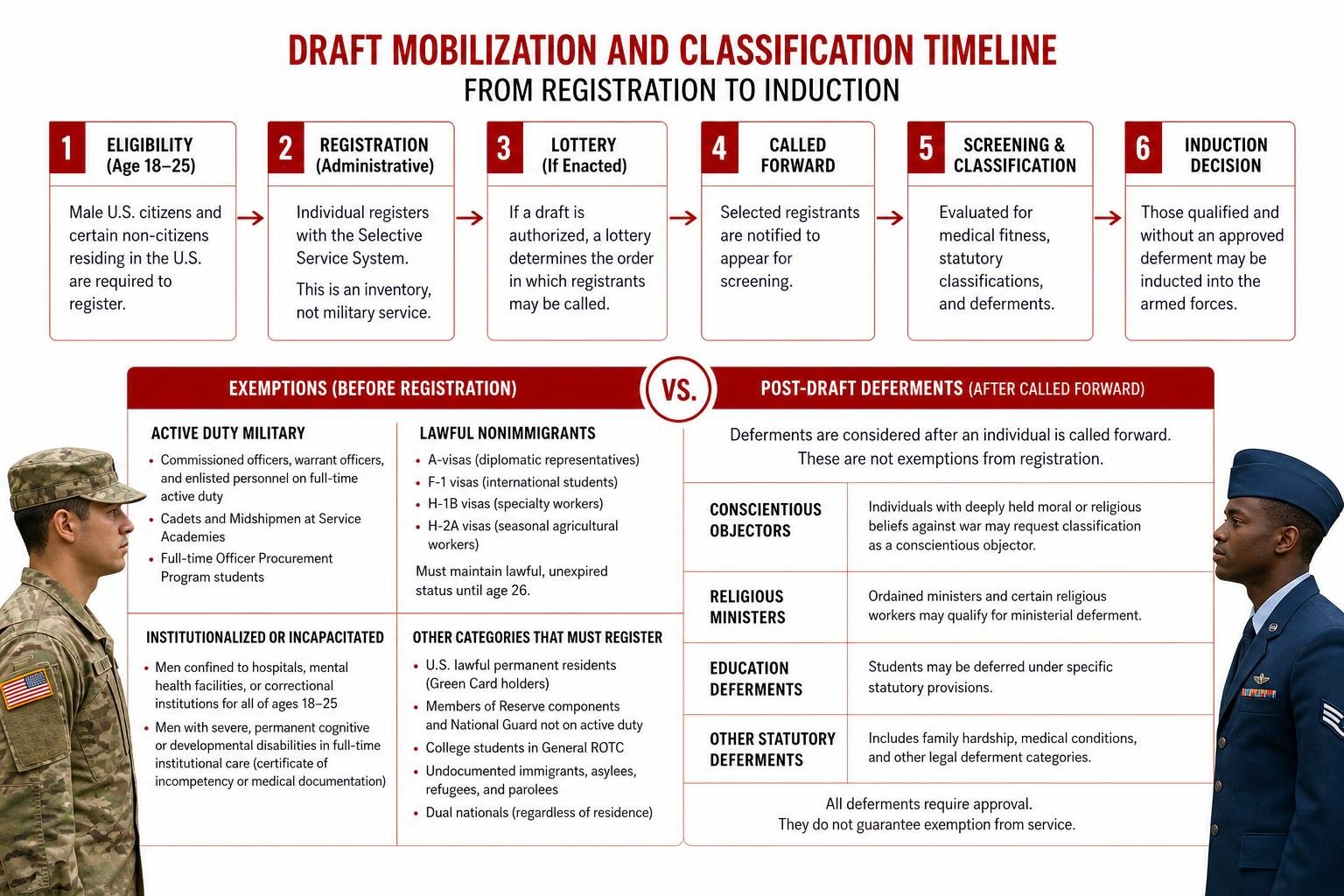
Registration is simply an administrative inventory of eligible individuals. It does not mean you have joined the military, nor does it guarantee you will be inducted if Congress reinstates a draft. During peacetime, the law provides virtually no pre-registration exemptions for personal beliefs, medical ailments, or family dynamics.
If a draft lottery were enacted, every registered individual called forward would undergo formal screening to determine their military draft qualification standards. At that point, candidates could pursue legal methods to avoid draft induction through statutory classifications, postponement, or medical discharge.
Conscientious Objectors and Religious Ministers
Regular or duly ordained ministers of religion, as well as divinity students pursuing full-time studies at recognized theological schools, are exempt or deferred from military training and service—but they must still register with the Selective Service at age 18.
Men with deep moral or religious convictions against taking part in war must also register. You cannot claim conscientious objector (CO) status during the initial registration process.
Should a draft be authorized, registered men who receive an induction notice can demonstrate they meet statutory conscientious objector criteria during local draft board hearings. Claimants follow a formal process by applying for conscientious objector classification to secure noncombatant military roles (Class 1-A-O) or community-based civilian alternative service (Class 1-O) rather than refusing military induction during a draft.
Hardship, Sole Surviving Son, and Medical Disqualifications
Many young men assume that pre-existing medical conditions or unique family responsibilities spare them from registration. In practice, these circumstances serve only as post-mobilization claims:
- Sole Surviving Sons: Being the only surviving son or the last male heir to carry a family name does not grant an exemption from initial registration. Peacetime draft exemptions for sole surviving sons apply only when a parent or sibling died as a result of military service.
- Family Hardship: Providing sole financial or physical support for dependents does not exempt you from registering. Hardship deferments are evaluated by local boards only after mobilization orders are issued.
- Medical and Physical Conditions: Men with physical, psychological, or sensory disabilities must still register unless they are institutionalized or homebound. Specific medical disqualifications for draft induction and permanent physical disabilities are evaluated at a Military Entrance Processing Station (MEPS) only if an individual is drafted.
How to Establish Eligibility: Who Is Exempt from Selective Service Status Letters
To verify your compliance or confirm an official exemption, you must know what documentation the federal government accepts. As of June 30, 2026, the Selective Service System discontinued issuing traditional Status Information Letters (SIL) for men who failed to register. Individuals must now rely directly on official system verification, naturalization records, and original immigration filings as outlined in the Selective Service System official FAQ.
When requesting waivers or proving lawful exemption to federal employers or security clearance adjudicators, the legal burden of proof rests entirely on the individual asserting the exemption.
Documenting Lawful Status and the OPM Exemption Review
If you are over age 26 and did not register because you qualified for a statutory exemption, you must provide clear documentation to the U.S. Office of Personnel Management (OPM) or your hiring agency:
- Lawful Nonimmigrants: Submit Form I-94 arrival/departure records, unexpired foreign passports, and copies of all I-20 (student) or I-797 (work visa) approval notices demonstrating continuous legal status from age 18 through 25.
- Military Personnel: Provide your DD Form 214 or official military service records showing continuous active-duty service throughout the entire statutory window.
- Medical Incompetence: Provide certified medical records from licensed physicians establishing that you were homebound, hospitalized, or legally incapacitated during those years.
If an unregistered applicant was not exempt, OPM requires clear and convincing evidence that the failure to register was neither knowing nor willful before clearing them for federal employment.
Automatic Registration Updates Under the 2026 NDAA
The National Defense Authorization Act for Fiscal Year 2026 (Public Law 119-60) introduced statutory language authorizing the Director of the Selective Service System to automatically register eligible male residents using existing federal and state databases.
By pulling verified data from the Social Security Administration, state driver’s license bureaus (DMVs), and federal education records, automatic registration aims to reduce non-compliance rates. However, until full nationwide automation is finalized, young men turning 18 are still legally obligated to ensure their registration is active and accurate.
Penalties for Non-Compliance: Why Men Must Still Sign Up
Willful failure to register with the Selective Service is a federal felony under 50 U.S.C. § 3811. The statutory penalties include:
- A fine of up to $250,000
- Imprisonment for up to five years
- A permanent felony record
Beyond criminal prosecution, failing to register triggers severe administrative consequences that can disrupt an individual’s career and education. Understanding the legal penalties for failing to register underscores why young men must stay compliant.
Evaluating Non-Citizens and Expats: Who Is Exempt from Selective Service Overseas
U.S. citizens living or traveling abroad when they turn 18 are not exempt from registration. They must register online or submit their paperwork at the nearest U.S. Embassy or Consulate within 30 days of their 18th birthday.
In U.S. territories such as Puerto Rico, Guam, the U.S. Virgin Islands, and the Northern Mariana Islands, all resident male citizens must register. Nationals of American Samoa become obligated to register if they establish habitual residence in the United States or reside on the mainland for one continuous year.
Long-Term Consequences for Employment, Loans, and Naturalization
For most men who fail to register, the administrative fallout occurs silently until they apply for key federal opportunities:
- Federal and Postal Employment: Registration is a strict statutory prerequisite for civil service appointments across all Executive Branch agencies and the U.S. Postal Service.
- Federal Security Clearances: Unregistered status can disqualify candidates from obtaining the security clearances required for defense contracting and intelligence roles.
- U.S. Citizenship (Naturalization): Immigrant men who fail to register between ages 18 and 25 may be denied citizenship by U.S. Citizenship and Immigration Services (USCIS) for failing to demonstrate “good moral character” and attachment to the U.S. Constitution.
- State Benefits and Licensure: Several state governments tie Selective Service registration to eligibility for state-funded student aid, state employment, and professional licensing.
Once a man reaches his 26th birthday, he passes the statutory age limit and can no longer register retroactively.
Frequently Asked Questions About Draft Registration
Are women required to register for the Selective Service in 2026?
No. Under current federal law, women are not required to register. The Military Selective Service Act specifically authorizes the registration of “male persons.” In the landmark ruling Rostker v. Goldberg, the U.S. Supreme Court upheld this male-only requirement. While legislative proposals to include women have surfaced during annual defense authorization debates, Congress has not enacted a statutory change.
Can you register for the draft after turning 26?
No. The legal authority to register closes permanently on midnight of your 26th birthday. If you are 26 or older and did not register, you cannot submit a late registration. If you need to prove eligibility for federal employment or citizenship, you must demonstrate to the relevant agency (such as OPM) that your failure to register was either legally exempt or not a knowing and willful violation of the law.
Are undocumented immigrants exempt from draft registration?
No. Undocumented male immigrants living in the United States who are between the ages of 18 and 25 are legally required to register. The law requires registration for all resident non-citizens except those maintaining valid, lawful nonimmigrant visa status. Registering with the Selective Service does not share immigration status with enforcement agencies, but failing to register can create severe roadblocks if the individual later applies for lawful status or naturalization.
Conclusion
Understanding draft obligations comes down to a simple principle: while the military draft has been inactive since 1973, registration remains mandatory for nearly all young men living in the United States. True statutory exemptions are narrowly restricted to women, lawful nonimmigrant visa holders who maintain their status, full-time active-duty military personnel, and continuously institutionalized individuals. Common situations like college enrollment, moral objections, pre-existing health conditions, or family hardships do not excuse you from registering at age 18.
Taking two minutes to verify your status ensures you protect your future access to federal employment, civil service careers, and citizenship benefits. To stay informed about defense policies, military careers, and veteran benefits, explore our comprehensive overview of how the US military draft operates right here at USMilitary.com.
Free for Service Members & Veterans
Get the military benefits intel no one tells you about.
Weekly updates on VA benefits, pay changes, and money tips — free for service members and veterans.
No spam. Unsubscribe anytime. Your info is never shared.



Leave a Reply