Should You Enlist or Apply to OCS With a College Degree?
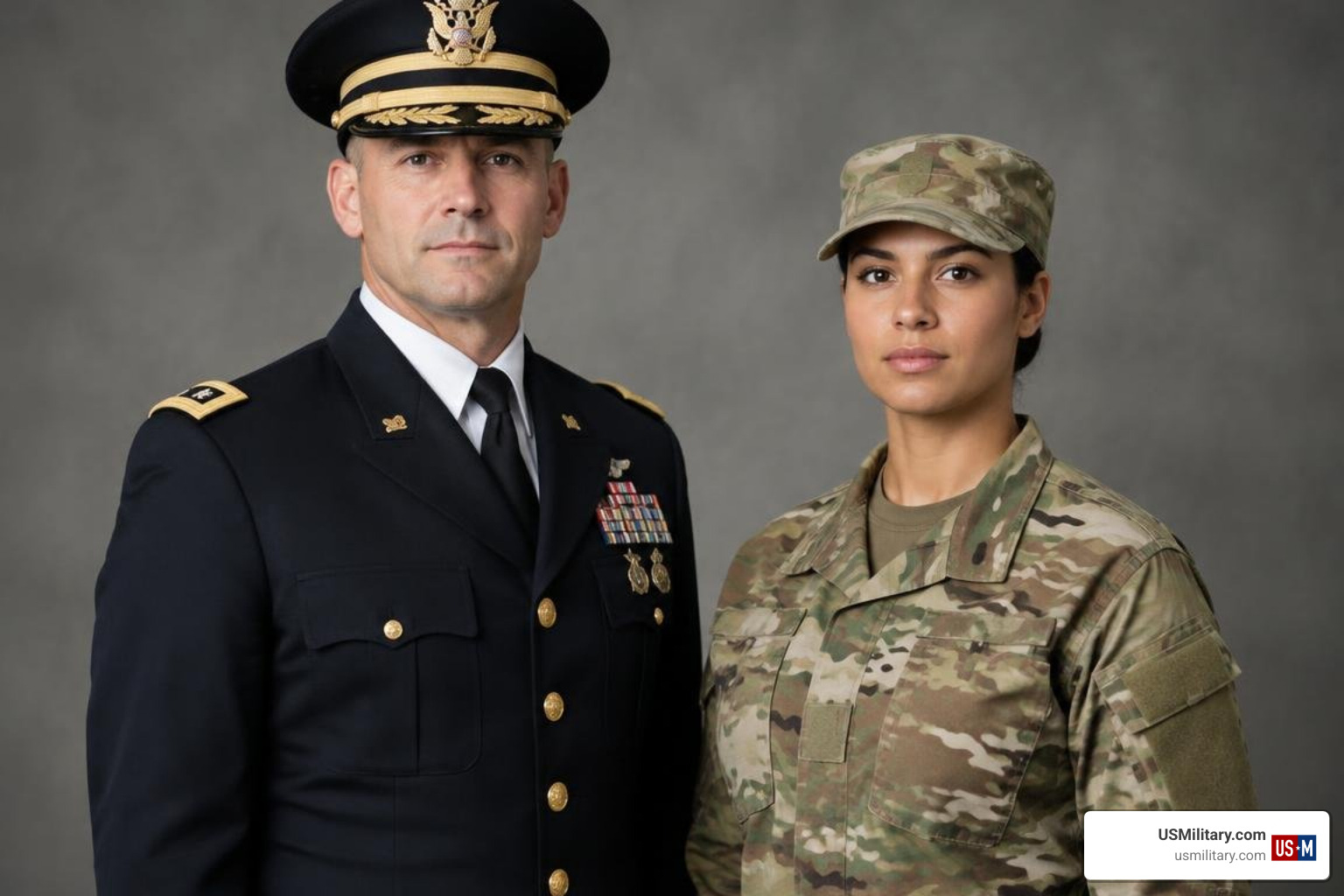
Apply for Officer Candidate School (OCS) if you want to lead, earn officer pay, and start your officer career sooner. Enlist first if you want a hands-on military job or time to learn the service before seeking a commission. A degree makes you eligible to pursue OCS, but it does not guarantee selection or a particular job.
Before you sign, ask an officer recruiter about your branch’s application timeline, job assignment rules, and what happens if you do not finish OCS. Those details can change the choice that makes sense for you.
I’m Larry Fowler, publisher of the privately owned USMilitary.com Network, which has shared military career and benefits information since 2007. When readers ask, “If I Have a College Degree Should I Enlist or Go To Officer Candidate School (OCS)?”, I encourage them to compare the work they want with the commitment they would make.
Similar topics to If I Have a College Degree Should I Enlist or Go To Officer Candidate School (OCS)?:
- Requirements To Join The US Military
- High Paying Civilian Jobs That The Military Offers Best Training
- military career paths
If I Have a College Degree Should I Enlist or Go To Officer Candidate School (OCS)? Core Differences in Pay, Responsibility, and Career Trajectory
Holding a four-year bachelor’s degree places you in a distinct demographic when entering the Armed Forces. Every year, the Department of Defense commissions nearly 20,000 officers. While roughly 44% graduate from ROTC and about 11% receive direct commissions in specialized fields like healthcare or law, 21% earn their rank through Officer Candidate School (OCS) or Officer Training School (OTS).
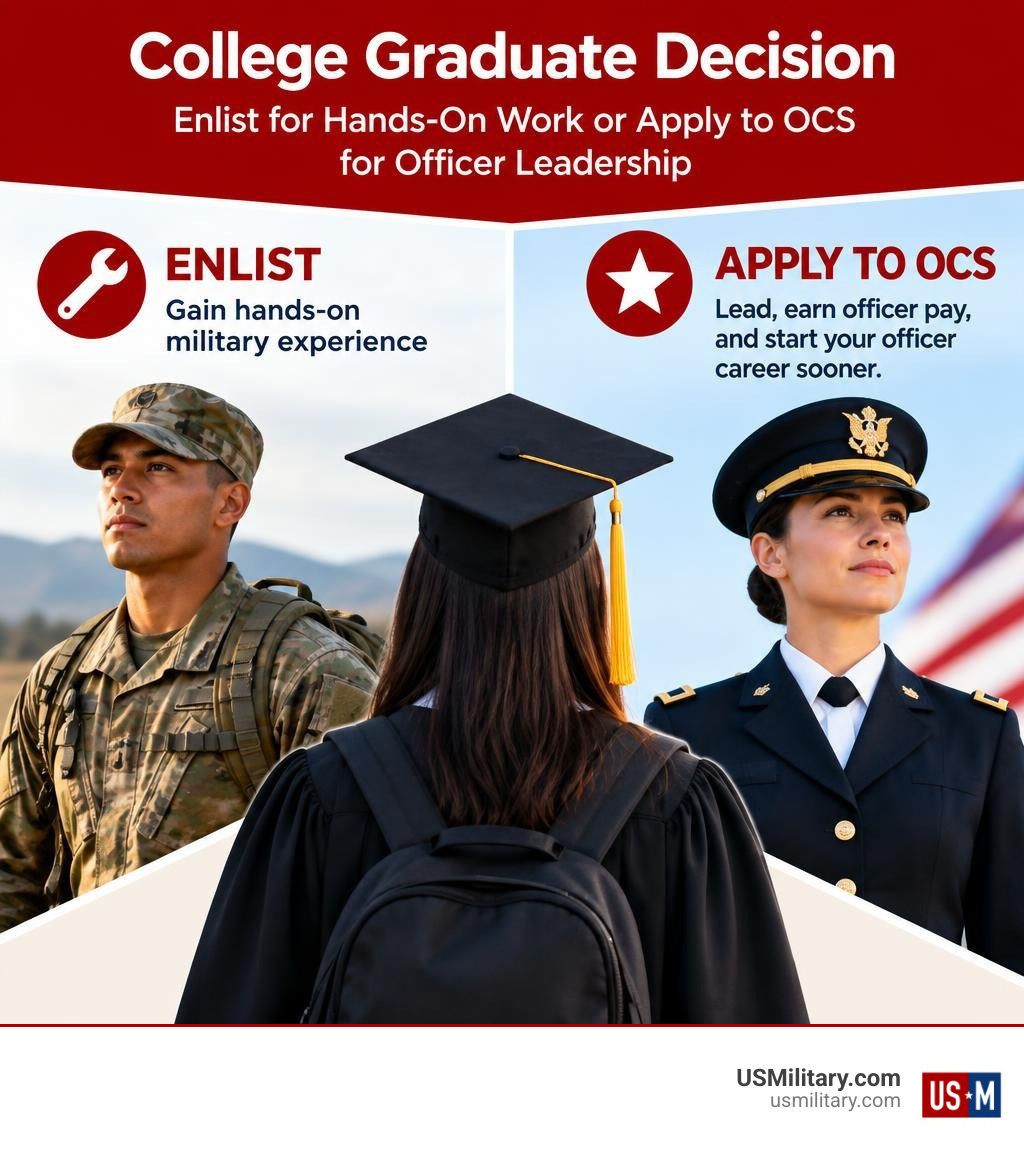
The decision to enlist or pursue a commission hinges on how you want to spend your working hours, your financial expectations, and how you define career success. Commissioned officers function as executive leaders, planners, and operational managers. Enlisted personnel perform technical execution, hands-on operations, and direct troop leadership as they advance through the non-commissioned officer (NCO) ranks.
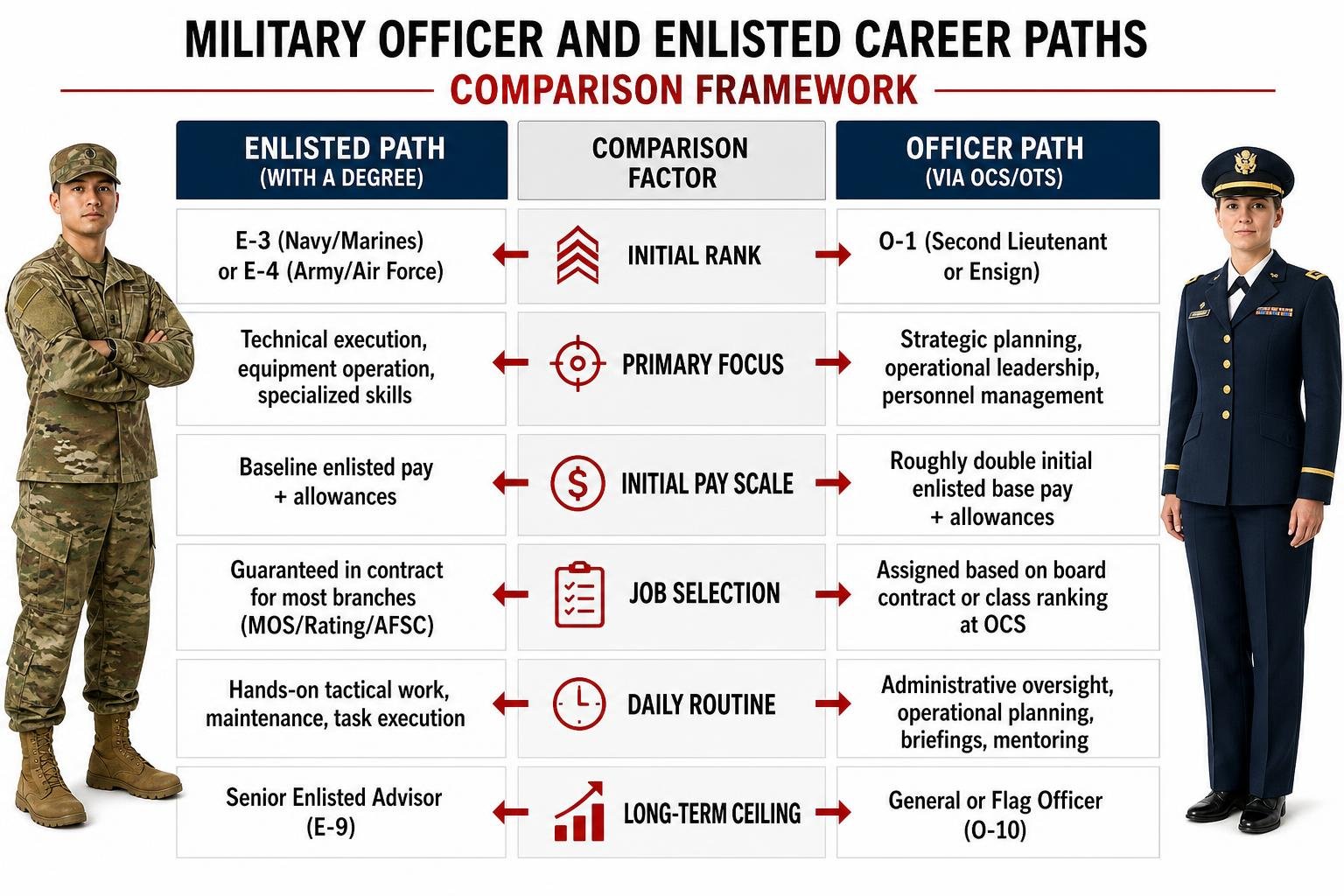
| Decision Factor | Enlisted Pathway (With a Degree) | Commissioned Officer Pathway (via OCS/OTS) |
|---|---|---|
| Initial Rank | E-3 (Navy/Marines) or E-4 (Army/Air Force) | O-1 (Second Lieutenant or Ensign) |
| Primary Focus | Technical execution, equipment operation, specialized skills | Strategic planning, operational leadership, personnel management |
| Initial Pay Scale | Baseline enlisted pay + allowances | Roughly double initial enlisted base pay + allowances |
| Job Selection | Guaranteed in contract for most branches (MOS/Rating/AFSC) | Assigned based on board contract or class ranking at OCS |
| Daily Routine | Hands-on tactical work, maintenance, task execution | Administrative oversight, operational planning, briefings, mentoring |
| Long-Term Ceiling | Senior Enlisted Advisor (E-9) | General or Flag Officer (O-10) |
To understand where you fit in the military rank structure and compensation, we must look at how starting rank shapes your daily life and financial health.
If I Have a College Degree Should I Enlist or Go To Officer Candidate School (OCS) for Pay and Rank Advantages?
If your primary objective is maximizing compensation, the officer route holds a distinct advantage. An OCS graduate commissions as an O-1 (Second Lieutenant in the Army, Marine Corps, and Air Force, or Ensign in the Navy and Coast Guard). An O-1 earns significantly higher base pay than an entry-level enlisted service member.
While college graduates who enlist usually bypass E-1 and enter at E-3 or E-4 (such as a Specialist in the Army), the pay gap remains substantial. In addition to basic pay, both ranks receive tax-free allowances for housing (BAH) and meals (BAS), but officer BAH rates are higher in every geographic market.
Understanding how education impacts military advancement helps clarify why this gap exists: the military pays a premium for the organizational liability and decision-making authority placed on officers from day one.
Scope of Responsibility: Hands-On Technical Specialist vs. Strategic Executive Leader
The difference in daily responsibility is stark:
- Enlisted Service Members: You are the subject-matter specialist. If you enlist as an intelligence analyst, cyber operator, or mechanic, you spend your duty days working on equipment, analyzing raw data, or firing weapon systems. You master the craft before leading small teams.
- Commissioned Officers: You manage the personnel, equipment, and broader mission. A second lieutenant often leads a platoon of 30 to 40 service members immediately after completing initial branch training. You write operational orders, manage logistics budgets, coordinate evaluations, and balance administrative requirements.
Reviewing how officer career progression unfolds shows that as an officer advances toward O-3 (Captain/Lieutenant) and O-4 (Major/Lieutenant Commander), their role transitions further into executive management, high-level strategy, and organizational leadership.
Key Advantages and Trade-Offs of Enlisting First vs. Going Directly to OCS

Choosing between enlisting first and applying directly to OCS involves weighing trade-offs between job guarantees, culture shock, leadership style, and time horizons.
Why Some Graduates Choose Enlistment: Guaranteed Jobs and Hands-On Credibility
A noticeable number of college graduates choose to enlist first. Their reasons center on practical benefits:
- Guaranteed Job Specialty: In branches like the Army, Navy, and Air Force, enlisted contracts often let you lock in your specific Military Occupational Specialty (MOS) or Air Force Specialty Code (AFSC) before shipping to boot camp, provided you qualify on the ASVAB. If you want to do specialized intelligence, cyber defense, or aviation maintenance, enlisting guarantees you work in that field.
- Immediate Entry: Enlisted accession happens quickly. While an OCS applicant might wait 6 to 12 months for a selection board, an enlisted recruit can ship to Basic Combat Training within weeks or a few months.
- Grassroots Respect and Practical Credibility: Serving in the ranks provides an unfiltered understanding of military culture, equipment maintenance, and junior troop welfare. Prior-enlisted officers (often called “Mustangs”) carry practical credibility because they understand the direct impact of operational orders on junior troops.
- Commissioning Programs from Within: Enlisted members can leverage internal commissioning pathways later, such as the Army Green to Gold program, Navy STA-21, or Marine Corps Enlisted Commissioning Program (ECP).
If you want a detailed overview of the enlistment process, review our enlistment guide to joining the military and see our step-by-step breakdown of military enlistment.
✉ Get updates like this in your inbox
Weekly VA benefit changes, pay updates, and money tips for service members, veterans, and military families. Free, no spam.
Why Most Graduates Choose Direct OCS: Direct Commissioning and Fast-Track Upward Mobility
Despite the appeal of enlisting, most college graduates target OCS directly:
- Accelerated Financial Growth: Commissioning directly avoids years of lower enlisted wages, allowing you to build investments and retirement savings earlier under the Blended Retirement System (BRS).
- Immediate Executive Experience: Leading a platoon or division in your early twenties builds management experience that aligns with high-level corporate and civilian executive roles.
- Avoiding Internal Board Hurdles: Applying as an active-duty enlisted member requires endorsements from your chain of command, commander recommendations, and competing against seasoned NCOs. Entering through civilian OCS means competing strictly against other civilian graduates.
Prospective candidates weighing their post-college options can evaluate their readiness before contacting a recruiter by reviewing the military career paths available to degree holders.
The OCS Application Process, Timeline, and Branch Competitiveness in 2026
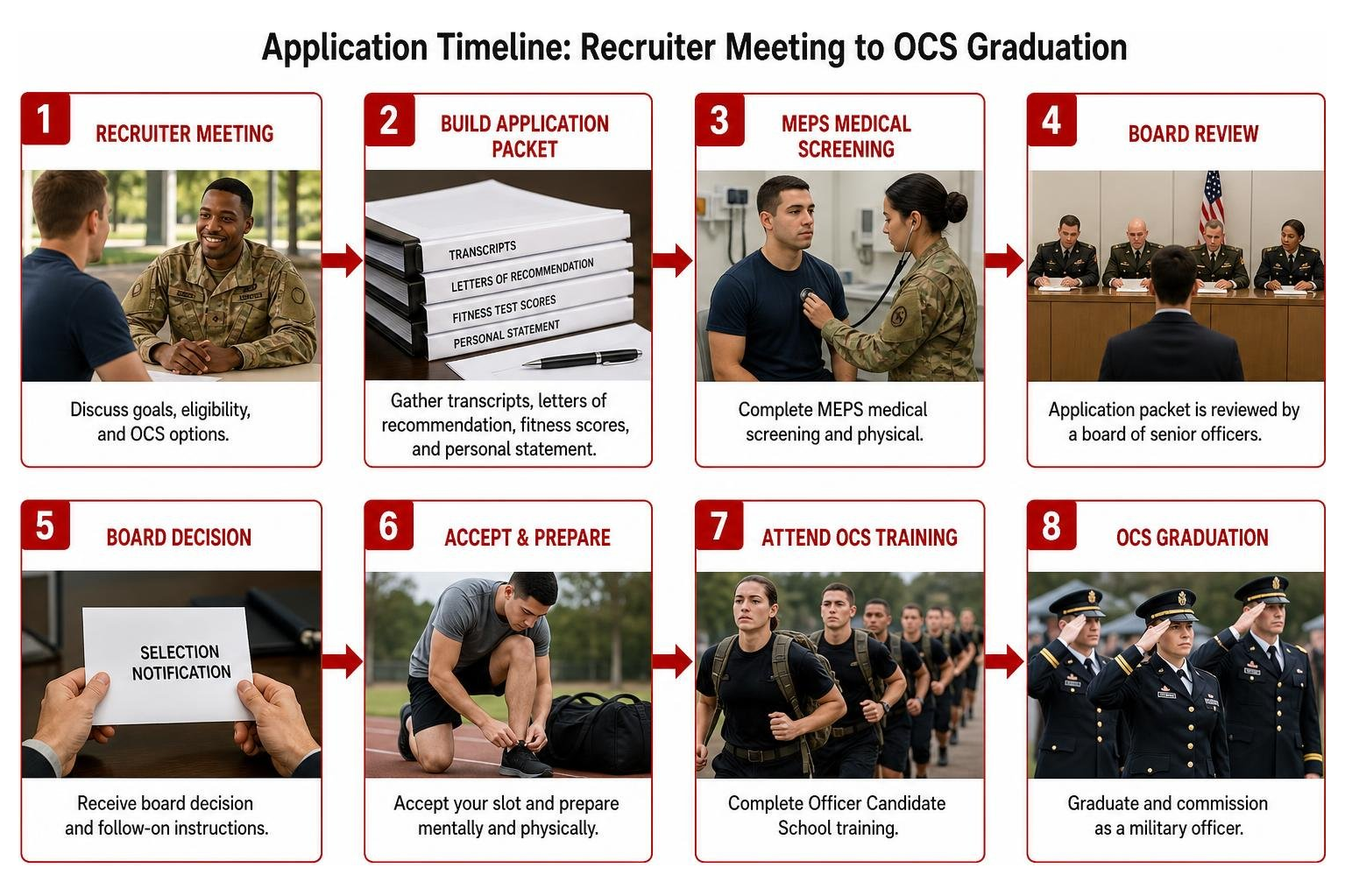
Applying to OCS as a civilian is a multi-step process that takes 6 to 12 months. It requires compiling a comprehensive application packet: university transcripts, letters of recommendation, physical fitness test scores, an essay on why you want to lead, and clearing MEPS (Military Entrance Processing Station) medical screening. Once completed, your packet goes before a formal board of senior officers.
If you are planning your enlistment or commissioning timeline, check the 2026 military entry guide for updated medical and administrative standards.
Branch Selection Rates, Program Durations, and Branch-Specific Paths
Each branch approaches OCS differently. Training lengths, environments, and board selection rates vary across the Armed Forces.
| Branch Program | Course Duration | Est. Board Selection Rate | Key Training Focus & Location |
|---|---|---|---|
| Army OCS | 12 Weeks | ~60% – 65% | Tactical leadership, land navigation, field exercises (Fort Moore, GA) |
| Marine Corps OCC | 10 Weeks | ~35% – 45% | Physical endurance, combat leadership under stress, screening (Quantico, VA) |
| Navy OCS | 13 Weeks | ~30% – 40% (Varies by designator) | Naval customs, navigation, engineering, physical discipline (Newport, RI) |
| Air Force OTS | 8.5 Weeks | ~30% – 50% (Varies by AFSC needs) | Strategic leadership, aerospace culture, management (Maxwell AFB, AL) |
| Coast Guard OCS | 17 Weeks | ~15% – 25% | Maritime safety, leadership, law enforcement, nautical science (New London, CT) |
If I Have a College Degree Should I Enlist or Go To Officer Candidate School (OCS) to Guarantee My Career Field?
Job selection timing is a crucial difference between enlisting and commissioning:
- Navy & Air Force: You generally know your career field before shipping. When selected by a Navy or Air Force board, you are selected for a specific designator (e.g., Surface Warfare Officer, Pilot, Naval Flight Officer, Intelligence) or AFSC. If you are not selected for your chosen designator, you can decline the contract.
- Army OCS: Active duty candidates compete on an Order of Merit List (OML) during the 12-week course at Fort Moore. Your branch (Infantry, Armor, Cyber, Logistics, etc.) is awarded based on class ranking, academic scores, physical fitness, and Army requirements. Higher scores mean a better chance at your preferred branch, but it is not guaranteed upfront.
- Marine Corps: Ground candidates select their MOS during the 6-month Basic School (TBS) following OCS, based on class standing and command evaluation. Only Air (Aviation) and Law contracts are guaranteed prior to attending OCC.
You can compare career specialties across the Armed Forces using our military career path guide.
What Happens If You Wash Out of OCS or Decide to Leave?
Understanding the contractual risk of OCS is essential before signing paperwork:
- Army Federal OCS: To attend Army OCS as a civilian, you enlist under an “Officer Candidate” contract and complete standard Basic Combat Training (10 weeks) first. If you fail OCS academically, fail physical evaluations, or voluntarily withdraw, the Army may reclassify you based on its operational needs. You will likely serve the remainder of your enlistment contract in an enlisted MOS.
- Marine Corps OCC: The Marine Corps operates on a unique model. Marine OCS is purely an evaluation course. Candidates who fail or choose to drop on their own request (DOR) are discharged with zero remaining military service obligation.
- Navy and Coast Guard OCS: Candidates who fail out are evaluated by an academic review board. Depending on your contract terms, you may be offered the chance to reclassify into an enlisted rating to complete your service, or be administratively discharged.
Age requirements and service limitations also play a role in your eligibility. Learn more in our guide to military enlistment age limits.
How a Bachelor’s Degree Influences Enlisted Advancement and Long-Term Officer Prospects
If you decide to enlist with a four-year degree, your education remains valuable. Across all branches, college credits award civilian education promotion points. In the Army, holding a bachelor’s degree provides the maximum allowance of civilian education points, accelerating your advancement from Specialist (E-4) to Sergeant (E-5) and Staff Sergeant (E-6).
At the senior enlisted level (E-7 through E-9), promotion boards consider college degrees favorably during evaluation boards.
For officers, a bachelor’s degree is simply the baseline requirement for entry. To remain competitive for promotion to field grade ranks (Major/Lieutenant Commander, O-4, and Lieutenant Colonel/Commander, O-5), officers are expected to complete advanced professional military education (PME) and often earn a master’s degree.
If you plan to serve in a part-time component, review age limits for prior service in the Army Reserve.
Frequently Asked Questions About Enlisting vs. Going to OCS With a College Degree
Can I apply for OCS while still in my senior year of college?
Yes. Most branches allow college seniors to begin their OCS application packet during their final year. You can complete your physical exam at MEPS, gather recommendations, and interview with the selection board. Final acceptance and your ship date to training remain conditional until your university officially confers your degree and generates an official transcript.
Does having prior enlisted experience make you a better commissioned officer?
Prior enlisted experience gives you practical familiarity with daily military life, equipment maintenance, and small-unit dynamics. It helps you relate to the challenges faced by junior troops. However, prior-enlisted officers must transition out of the technical execution mindset and step into executive planning. Being an effective officer depends on leadership judgment, humility, and organizational management, regardless of your commissioning source.
How long does the entire OCS civilian-to-officer process take?
For most civilian applicants, the process takes between 6 and 12 months from your first recruiter meeting to your first day of training. The timeline includes assembling letters of recommendation, medical clearance through MEPS, waiting for quarterly selection boards to convene, and awaiting an assigned class date.
Conclusion: Making the Right Military Career Decision for Your Goals
Deciding whether to enlist or apply to OCS comes down to your career objectives:
- Choose OCS if you want to lead organizations, handle operational planning, start on a faster promotion timeline, and earn officer pay.
- Choose Enlistment if you want a guaranteed technical specialty, want to master a hands-on craft, desire direct tactical experience before leading, or need to ship quickly.
Both paths offer meaningful service, full military benefits, and valuable leadership experience. To narrow down which service aligns with your strengths and lifestyle preferences, read our comprehensive guide on choosing the right military branch. At USMilitary.com, we are dedicated to helping you make informed career, educational, and financial decisions throughout your military journey.
Free for Service Members & Veterans
Get the military benefits intel no one tells you about.
Weekly updates on VA benefits, pay changes, and money tips — free for service members and veterans.
No spam. Unsubscribe anytime. Your info is never shared.