What You Need to Know About the VA Loan Funding Fee.

The VA loan funding fee 2026: rates, exemptions & how to pay is one of the most important costs to understand before using your VA home loan benefit. Here is a quick snapshot so you can get the essential facts right away:
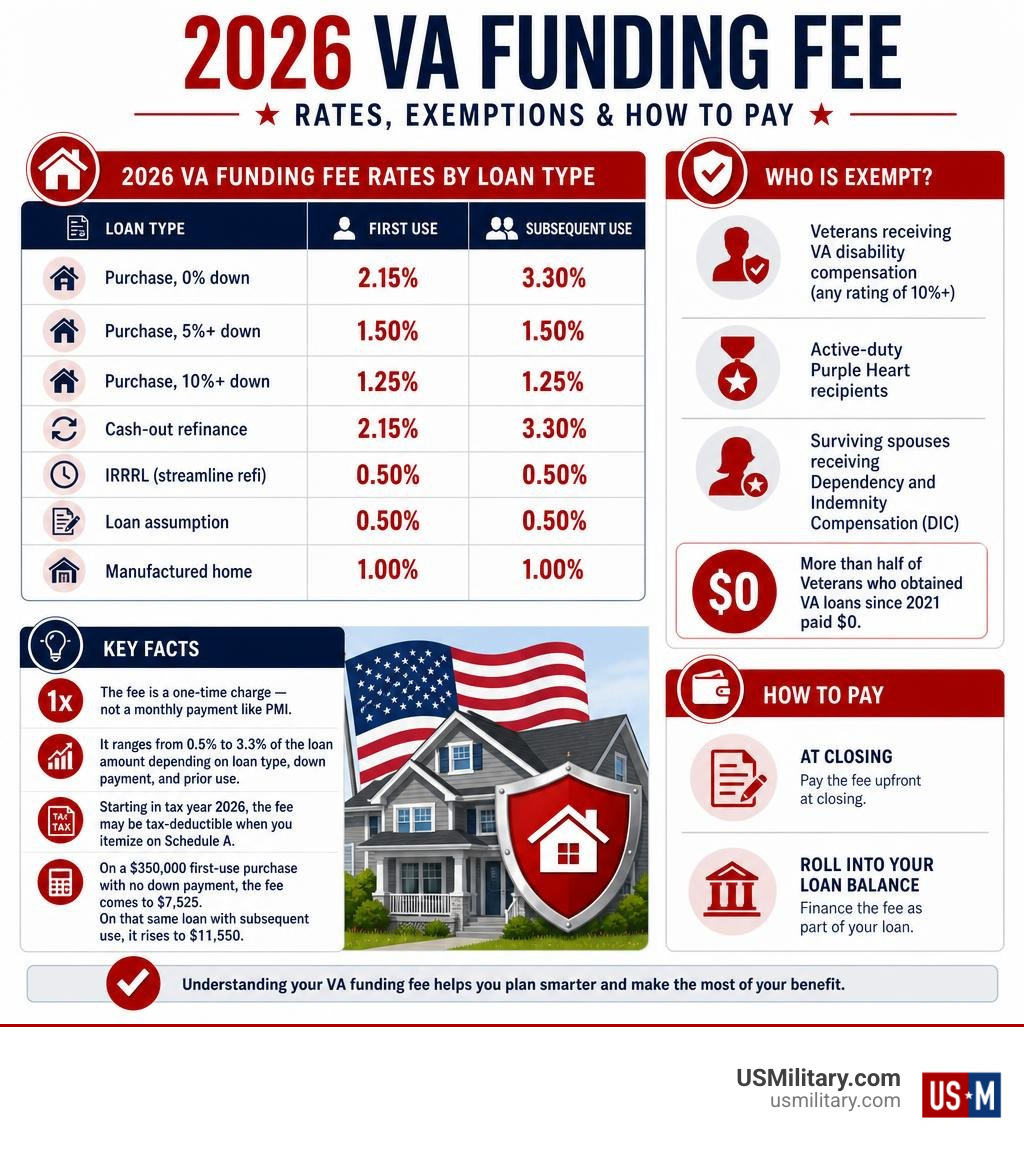
2026 VA Funding Fee at a Glance:
| Loan Type | First Use | Subsequent Use |
|---|---|---|
| Purchase, 0% down | 2.15% | 3.30% |
| Purchase, 5%+ down | 1.50% | 1.50% |
| Purchase, 10%+ down | 1.25% | 1.25% |
| Cash-out refinance | 2.15% | 3.30% |
| IRRRL (streamline refi) | 0.50% | 0.50% |
| Loan assumption | 0.50% | 0.50% |
| Manufactured home | 1.00% | 1.00% |
Key facts:
- The fee is a one-time charge — not a monthly payment like PMI
- It ranges from 0.5% to 3.3% of the loan amount depending on loan type, down payment, and prior use
- More than half of Veterans who obtained VA loans since 2021 paid $0 — because they were exempt
- Starting in tax year 2026, the fee may be tax-deductible when you itemize on Schedule A
- You can pay it at closing or roll it into your loan balance
- Exempt groups include Veterans receiving VA disability compensation (any rating of 10%+), active-duty Purple Heart recipients, and surviving spouses receiving Dependency and Indemnity Compensation (DIC)
On a practical level, the numbers add up fast. On a $350,000 first-use purchase with no down payment, the fee comes to $7,525. On that same loan with subsequent use, it rises to $11,550. If you are exempt, you save every dollar of that at closing.
I’m Larry Fowler, publisher of USMilitary.com and a long-time advocate for Veterans navigating VA benefits — including the VA loan funding fee 2026: rates, exemptions & how to pay. Since 2007, I’ve helped hundreds of thousands of active-duty service members and Veterans cut through the noise on exactly these kinds of financial decisions. Let’s break it all down clearly.
VA loan funding fee 2026: rates, exemptions & how to pay terms simplified:
VA Home Loan
See If You Qualify for a $0-Down VA Loan
Check your VA loan eligibility in a few minutes. It's free, with no obligation.
What is the VA Funding Fee and Why Does the VA Charge It?
To understand the VA loan funding fee 2026: rates, exemptions & how to pay, we must first look at why this fee exists. The VA home loan program is one of the most powerful wealth-building tools available to those who have served. However, unlike conventional mortgages, VA loans do not require a down payment or monthly private mortgage insurance (PMI).
To offset the cost of administering this program and protect American taxpayers from losses, Congress established the VA funding fee. It is a statutory fee paid directly to the Department of Veterans Affairs. This self-funding mechanism is the reason the VA can guarantee up to 25% of your loan to the lender, allowing you to secure highly competitive interest rates with zero money down.
When we look at a VA loan vs FHA vs conventional comparison, the funding fee stands out because it is a one-time cost. While FHA loans require both an upfront mortgage insurance premium (MIP) and monthly MIP for the life of the loan, the VA loan keeps your monthly payments lower by eliminating ongoing insurance charges.
As explained in the official VA funding fee overview, the fee is calculated as a pure percentage of your total loan amount. By charging this fee to non-exempt borrowers, the VA recently reached an incredible milestone: granting its 29 millionth VA-guaranteed home loan to Veterans, service members, and surviving spouses.
VA Loan Funding Fee 2026: Rates, Exemptions & How to Pay by Loan Type
The exact amount you will pay is determined by several distinct factors: the purpose of your loan (purchasing, building, or refinancing), your down payment amount, and whether you have used your VA loan benefits before.
In 2026, approximately 43% of Veterans may opt for VA loans to navigate the housing market, making it essential to understand how these rates are structured across different transactions.
Purchase and Construction Rates for the VA Loan Funding Fee 2026: Rates, Exemptions & How to Pay
When you buy or build a home, your funding fee is heavily influenced by how much money you put down. While zero-down is the most popular option, contributing a down payment of 5% or 10% unlocks lower fee tiers.
Additionally, the VA distinguishes between “first use” and “subsequent use.” If you have successfully closed a VA loan in the past and did not have it restored or are using your entitlement again, you will pay the subsequent use rate unless you put down at least 5%.
Here is how these tiers break down mathematically in 2026:
- First-Time Use (Less than 5% Down): The rate is 2.15%. On a $350,000 loan, a first-time funding fee of 2.15% amounts to $7,525.
- First-Time Use (5% to 9.99% Down): The rate drops to 1.50%. On a $350,000 loan, this reduces your fee to $5,250, saving you $2,275.
- First-Time Use (10% or More Down): The rate drops to its lowest purchase tier of 1.25%. On a $350,000 loan, this fee is $4,375.
- Subsequent Use (Less than 5% Down): The rate rises to 3.30%. On a $350,000 loan, a subsequent-use funding fee of 3.3% amounts to $11,550.
- Subsequent Use (5% or More Down): If you make a down payment of 5% or more, the subsequent use penalty is completely wiped out. The fee resets to 1.50% (for 5% down) or 1.25% (for 10% down), matching the first-time use rates.
Calculating your down payment percentage must be done precisely without rounding. For example, if you are purchasing a home for $300,000, a down payment of exactly $15,000 is required to hit the 5% threshold. If you pay even a dollar less, the system will charge you the higher fee tier.
If you want to map out your home buying budget, you can learn more about the process in our guide on how to qualify for a VA home loan and review detailed VA funding fee rate charts.
Refinance and Specialized Rates for the VA Loan Funding Fee 2026: Rates, Exemptions & How to Pay
Refinancing your current mortgage or using specialized VA loan programs carries different funding fee structures.
- Interest Rate Reduction Refinance Loan (IRRRL): Often called a VA streamline refinance, this loan is designed to lower your interest rate on an existing VA loan with minimal paperwork. The funding fee is a flat 0.50%, regardless of whether it is your first or subsequent use. On a $350,000 loan, the IRRRL funding fee of 0.5% amounts to $1,750.
- Cash-Out Refinance: If you are pulling equity out of your home or refinancing a non-VA loan into a VA loan, the rates match the standard zero-down purchase rates. First-time cash-out refinances carry a 2.15% fee, while subsequent cash-out refinances cost 3.30%.
- Native American Direct Loan (NADL): This direct loan program helps Native American Veterans buy, build, or improve homes on trust land. The purchase funding fee is 1.25%, and the refinance funding fee is 0.50%.
- Loan Assumptions: If a buyer assumes your existing VA loan, the transaction carries a flat 0.50% funding fee.
- Manufactured Home Loans (not permanently affixed): These carry a flat 1.00% funding fee.
To read the exact administrative directives and historical background behind these numbers, you can check our comprehensive VA home loans guide and the official VA circular on funding fee updates.
Who is Exempt from the VA Funding Fee?
One of the greatest aspects of the VA loan program is that many who serve do not have to pay this fee at all. Since 2021, more than half of Veterans who obtained a VA-guaranteed home loan were exempt from paying the funding fee. This exemption represents massive savings at the closing table.
✉ Get updates like this in your inbox
Weekly VA benefit changes, pay updates, and money tips for service members, veterans, and military families. Free, no spam.

To qualify for a $0 funding fee, a borrower must meet at least one of the following statutory requirements:
- Service-Connected Disability: You receive VA compensation for a service-connected disability, or you are entitled to receive compensation but receive active-duty or retirement pay instead. Notably, any compensable rating of 10% or higher grants a complete 100% waiver. A Veteran rated at 10% receives the exact same complete waiver as a Veteran rated at 100%.
- Purple Heart Recipients: Active-duty service members who provide official evidence of having been awarded a Purple Heart before the loan closing date are fully exempt.
- Surviving Spouses: Surviving spouses who are eligible for a VA loan and receive Dependency and Indemnity Compensation (DIC) pay a $0 funding fee.
- Pre-Discharge Disability Ratings: Active-duty service members who have a memorandum or proposed rating from a pre-discharge exam showing they are eligible for disability compensation are exempt.
The financial impact of these exemptions is life-changing. On a $350,000 loan with a first-use purchase, the exemption saves $4,725 compared to a 1.35% rate, or a full $7,525 if compared to the standard 2.15% zero-down fee. On a $300,000 loan, skipping a 2.15% fee saves $6,450 immediately. For larger purchases, such as a $400,000 first-use purchase, the exemption saves $8,600 at closing.
For more details on how disability ratings impact your home buying journey, read about 100 percent disabled veteran home loan benefits and look over the official VA funding fee exemptions guide.
Verifying Exemption Status and Resolving COE Mismatches
Your lender will verify your exemption status by pulling your Certificate of Eligibility (COE) through the VA’s online portal. The COE will clearly state whether you are exempt or non-exempt.
However, system errors and administrative delays happen. It is not uncommon for a Veteran’s COE to incorrectly show them as non-exempt, especially if a disability rating was awarded recently. If this happens, do not panic.
You should immediately provide your lender with your official VA disability award letter or a completed VA Form 26-8937 (Verification of VA Benefits). This allows your lender to manually update the loan file and contact the VA Regional Loan Center to correct the COE before you close. For a smooth closing, make sure you understand the steps for getting your COE early in the process.
How to Pay, Refund, and Deduct the VA Funding Fee in 2026
If you are not exempt, you have three primary ways to handle this cost:
- Finance It Into the Loan: This is the most popular option. The VA allows you to roll the entire funding fee into your total loan balance. For example, if you buy a home for $300,000 and have a 2.15% fee ($6,450), your total starting loan balance will be $306,450. This keeps your upfront out-of-pocket costs at zero, though it will slightly increase your monthly payment and the total interest you pay over the life of the loan.
- Pay It Upfront at Closing: You can pay the entire fee in cash at closing. This keeps your loan balance lower and saves you money on interest over time.
- Seller Concessions: You can negotiate with the seller to pay your funding fee. The VA allows sellers to contribute up to 4% of the home’s value in concessions, which can be used to cover your funding fee and other closing costs.
Retroactive Disability Ratings and the Refund Process
What happens if you close your loan, pay the funding fee, and then the VA awards you a service-connected disability rating that is backdated to a time before your closing date?
You are entitled to a full refund of the funding fee! The key factor is the effective date of your disability rating. If the effective date of your rating is on or before your loan closing date, you qualify for a refund.
The VA Office of Inspector General identified more than 250 Veterans entitled to refunds between October 2021 and September 2024 who had not yet received them. If you believe you are owed a refund, you can request it through your lender or by contacting the VA Regional Loan Center directly at 1-877-827-3702.
Once approved, the refund is typically paid directly to you (if you paid cash upfront) or applied as a direct reduction to your principal loan balance (if you financed the fee).
To ensure you satisfy all necessary criteria, review the 2026 VA home loan requirements and read up on the VA funding fee 2026 refund procedures.
VA Home Loan
See If You Qualify for a $0-Down VA Loan
Check your VA loan eligibility in a few minutes. It's free, with no obligation.
Frequently Asked Questions About the VA Funding Fee
Is the VA funding fee tax-deductible in 2026?
Yes, starting in tax year 2026, Veterans, service members, and surviving spouses can deduct VA funding fees on their federal taxes. To claim this deduction, you must itemize your deductions on Schedule A (Form 1040) as an upfront mortgage insurance premium. Because tax laws can vary based on your income level and filing status, we highly recommend consulting with a certified tax professional before filing.
How does the VA funding fee compare to private mortgage insurance (PMI)?
Conventional loans typically require you to pay monthly private mortgage insurance (PMI) if you put down less than 20%. This monthly fee does not go toward your principal balance; it is simply an added cost. FHA loans require both an upfront fee of 1.75% and monthly premiums for the life of the loan.
By comparison, the VA funding fee is a one-time charge. Even if you finance a 2.15% fee into your loan, the lack of a monthly mortgage insurance bill makes the VA loan significantly cheaper over time. On a $300,000 home, a VA loan can save you tens of thousands of dollars compared to FHA or conventional alternatives over a 10-year period. You can read a complete breakdown of these differences in our guide to the pros and cons of VA loan vs conventional loan.
Can the VA funding fee be refunded if my disability rating is awarded after closing?
Yes, but only if the effective date of your disability rating is retroactively dated to on or before your loan closing date. If you apply for disability after closing and receive a rating with a post-closing effective date, you will not be eligible for a refund on that specific loan. However, you will be completely exempt from paying the funding fee on any future VA loans you take out.
Conclusion
Navigating the VA loan funding fee 2026: rates, exemptions & how to pay does not have to be overwhelming. By understanding your rate tier, checking your exemption eligibility early, and strategically choosing how to pay, you can maximize the value of your hard-earned military benefits.
At USMilitary.com, we are honored to serve as your central hub for military-related guidance, from career paths to financial planning. If you are ready to take the next step toward homeownership, we encourage you to explore VA loan options and connect with a trusted lender today.
Free for Service Members & Veterans
Get the military benefits intel no one tells you about.
Weekly updates on VA benefits, pay changes, and money tips — free for service members and veterans.
No spam. Unsubscribe anytime. Your info is never shared.