Should You Join the Army or the Marines?

Choose the Army if you want a wider range of jobs, more part-time service options, or a better chance to secure a specific job in your enlistment contract. Choose the Marines if you are drawn to expeditionary missions, a strong shared identity, and a longer, demanding boot camp. Neither branch is better for everyone. When considering why you should join the Army vs Marines, your best choice depends on the work you want to do and the life you want while serving.
Both branches offer federal benefits such as military health care and access to the GI Bill. Before signing, compare the actual contracts offered to you, including the job, service commitment, bonus terms, and training path.
I’m Larry Fowler, publisher of USMilitary.com, where I’ve covered military careers and veterans’ benefits since 2007. My experience helping prospective recruits explore service options informs this guide to Why You Should Join The Army vs Marines.
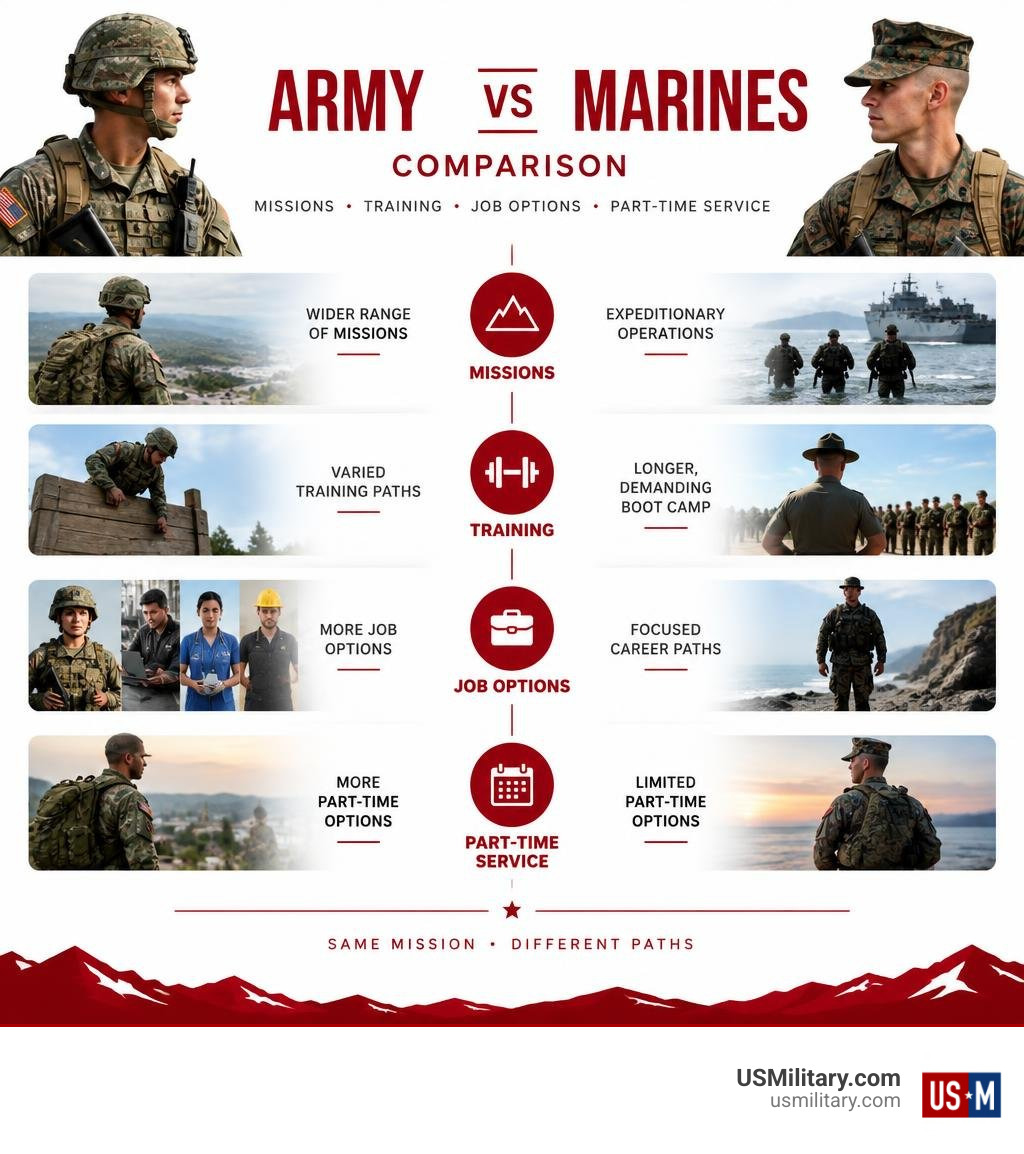
Why You Should Join The Army vs Marines terms explained:
Why You Should Join The Army vs Marines: Core Differences in Mission and Scale
When weighing a military career as of October 2026, understanding the fundamental divide between the United States Army and the United States Marine Corps comes down to scale, operational scope, and doctrine. Both services build elite ground combat forces, but they are built for distinct battlefield objectives.
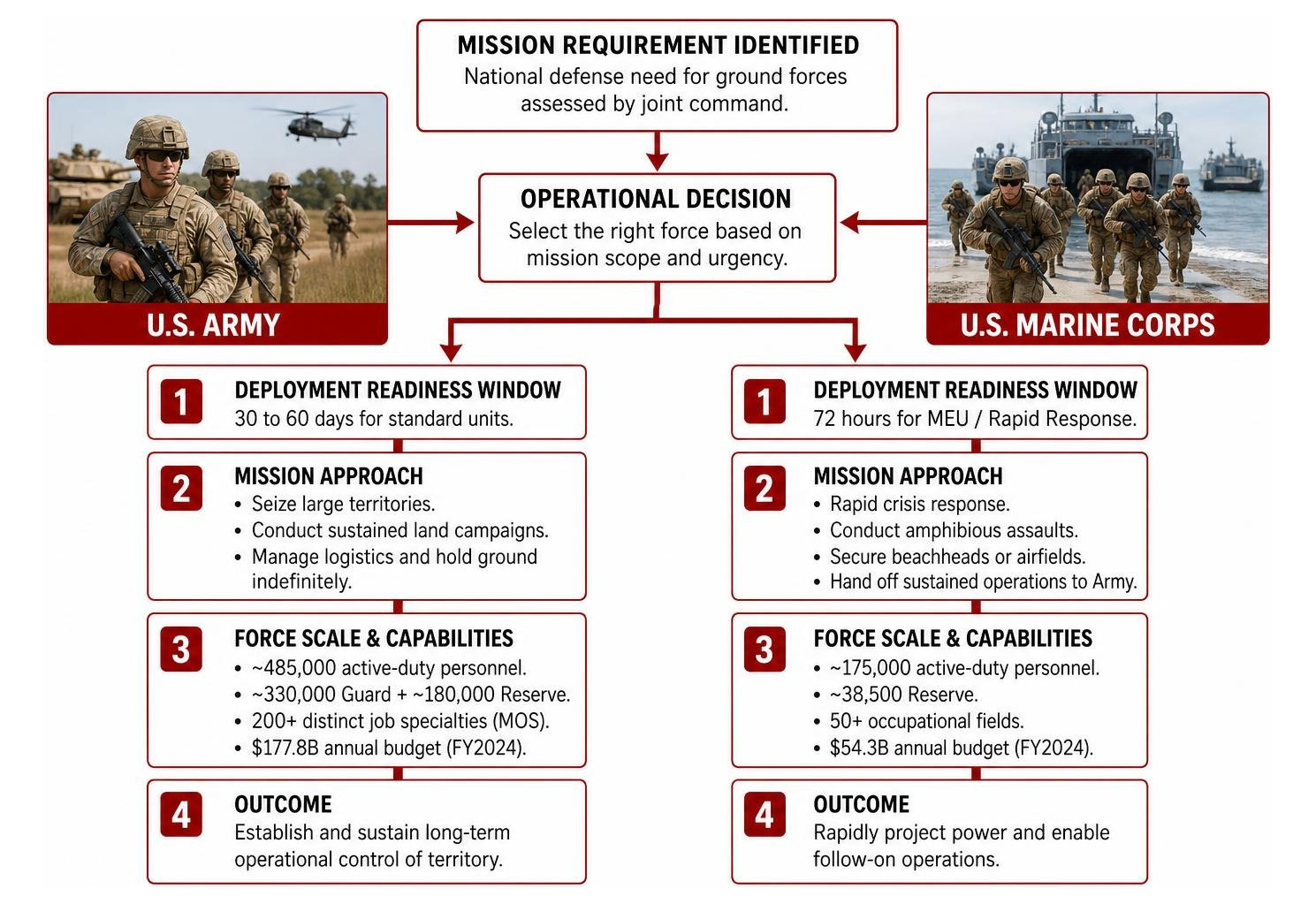
The Army is America’s primary land-warfare branch, engineered to seize large territories, conduct sustained land campaigns, manage expansive logistics lines, and hold strategic ground indefinitely. By contrast, the Marine Corps operates under the Department of the Navy as a lean, agile expeditionary force specializing in amphibious assaults, rapid crisis response, and serving as the tip of the spear in contested littoral environments.
To see how these forces fit alongside aviation and sea components, our complete guide to branches of the military breaks down the broader national defense structure.
| Key Factor | U.S. Army | U.S. Marine Corps |
|---|---|---|
| Active-Duty Force Size | ~485,000 personnel | ~175,000 personnel |
| Reserve / Guard Strength | ~330,000 (Guard) + ~180,000 (Reserve) | ~38,500 (Reserve) |
| Annual Budget (FY2024) | ~$177.8 Billion | ~$54.3 Billion |
| Deployment Readiness Window | 30 to 60 days (standard units) | 72 hours (MEU / Rapid Response) |
| Available Job Specialties (MOS) | 200+ distinct specialties | 50+ occupational fields |
| Initial Active Duty Commitment | 2 to 6 years | 4 to 5 years |
Primary Missions and Global Deployments
The Army manages massive global responsibilities across multiple theaters, maintaining heavy armor divisions, airborne formations, cyber warfare commands, and extensive logistics units designed for prolonged conflict. When national defense requires a massive, fortified troop footprint that can stay deployed for years, the Army handles that mission.
The Marine Corps revolves around expeditionary task forces. Marine Expeditionary Units (MEUs) deploy aboard U.S. Navy amphibious assault ships, constantly patrolling international waters and ready to mobilize boots on the ground within 72 hours. This difference in operational pacing means Marines operate as a rapid-entry force that strikes quickly, secures beachheads or airfields, and hands off sustained, large-scale theater operations to the Army. For detailed analysis on other joint service comparisons, read about what’s the difference between the 7 military branches.
Budget, Infrastructure, and Base Locations
The Army’s sizable annual budget ($177.8 billion compared to the Marine Corps’ $54.3 billion) supports large-scale bases across the continental United States and major overseas garrisons in Germany, South Korea, and Italy. Army posts like Fort Liberty, Fort Cavazos, and Fort Moore are sprawling mini-cities with comprehensive family infrastructure.
The Marine Corps maintains over 130 global installations, concentrated along coastal regions such as Camp Pendleton in California, Camp Lejeune in North Carolina, and extensive forward bases in Okinawa, Japan. Because the Marines operate under the Department of the Navy, they share naval resources, ships, and medical personnel (Navy Corpsmen serve alongside Marine platoons). Prospective recruits interested in specialized combat roles can also check what to know about Marines vs Army Special Forces to compare how each service funds its highest-tier operators.
Training Standards and Boot Camp Demands
Military service starts with transformative entry-level training. The culture shock between civilian life and military discipline is intentionally severe, but Drill Sergeants in the Army and Drill Instructors in the Marine Corps approach instruction with different timetables and traditions.

If you are researching the physical and mental intensity required across entry pipelines, our analysis of basic training toughness between branches highlights what separates these initial crucibles.
Army Basic Combat Training vs Marine Boot Camp
Army Basic Combat Training (BCT) runs for 10 weeks across four main installations: Fort Moore, Fort Jackson, Fort Leonard Wood, and Fort Sill. The Army focuses heavily on tactical combat fundamentals, team-building exercises, physical conditioning, and marksmanship before recruits proceed to their specific Advanced Individual Training (AIT).
Marine Corps recruit training lasts 13 rigorous weeks at either Marine Corps Recruit Depot (MCRD) Parris Island or MCRD San Diego. Marine boot camp places immense emphasis on historical lineage, aggressive hand-to-hand combat (MCMAP), advanced rifle marksmanship at distances up to 500 yards, and mandatory Combat Water Survival qualification. Every Marine recruit must endure “The Crucible”—a brutal 54-hour final field exercise involving 48 miles of marching under full gear, sleep deprivation, and food rationing before earning the Eagle, Globe, and Anchor.
Age Limits, ASVAB Scores, and Eligibility
Both branches require high school diplomas (or GEDs with qualifying college credits) and passing scores on the Armed Services Vocational Aptitude Battery (ASVAB). However, age cutoffs and waiver availability differ significantly:
- Army Age Criteria: Enlistment is open to applicants aged 17 to 35. This higher age ceiling allows older candidates with college degrees or prior work experience to pursue careers. Learn more about the Army enlistment age criteria and review general standards in our guide to the age game and what to know before enlisting.
- Marine Corps Age Limits: Recruits must enlist between ages 17 and 28. Review current details regarding Marine Corps age limits for 2026 recruits alongside our breakdown on the Marine Corps enlistment age cutoff.
Career Pathways, Promotion Timelines, and MOS Options
Beyond basic training, your military experience is largely defined by your daily job and how quickly you can climb the ranks. The two branches structure their contracts, Military Occupational Specialties (MOS), and promotion systems very differently.
Career Opportunities: Why You Should Join The Army vs Marines for MOS Variety
The Army offers over 200 distinct MOS options spanning aviation, intelligence, engineering, cyber defense, logistics, healthcare, and combat arms. The Army allows qualified recruits to sign “closed contracts” guaranteeing their exact MOS before shipping out, provided they meet ASVAB sub-score requirements.
The Marine Corps offers roughly 50 broader occupational fields. Enlisted Marines often sign “program placement options,” which guarantee a broad job field (such as Communications, Aviation Mechanics, or Infantry) rather than a specific numeric MOS. Specific duty assignments are finalized based on the needs of the Corps during training. Those mapping out their enlistment paperwork should review our step-by-step military recruitment process for detailed guidance.
Promotion Rates and Leadership Advancement
The Army’s massive structure requires a continuous flow of non-commissioned officers (NCOs). Soldiers who maintain clean records and pass basic requirements typically achieve automatic promotion to Specialist (E-4) within 18 to 24 months of service.
In the Marine Corps, promotions past Lance Corporal (E-3) are decided by a highly competitive “cutting score” system. This composite score weights physical fitness test scores, rifle range performance, time-in-service, Marine Corps Institute education courses, and commander evaluations. Consequently, achieving Corporal (E-4) and Sergeant (E-5) in the Marines can take longer, demanding peak performance across every physical and administrative metric.
Lifestyle, Benefits, and Post-Service Opportunities

Both branches provide the standard Department of Defense benefits package: comprehensive medical and dental coverage under TRICARE, 30 days of paid annual leave, basic allowance for housing (BAH), and access to the VA Home Loan. You can read our ultimate guide to military benefits to understand the long-term financial advantages of active-duty and veteran status.
Physical Fitness and Deployment: Why You Should Join The Army vs Marines for Lifestyle Fit
Daily life reflects each service’s physical philosophy:
- Army Physical Fitness: The Army uses the Army Combat Fitness Test (ACFT), a six-event, gender-and-age-normed assessment consisting of the deadlift, standing power throw, hand-release push-ups, sprint-drag-carry, plank, and a two-mile run.
- Marine Physical Fitness: Marines must pass two physical tests annually: the Physical Fitness Test (PFT)—featuring pull-ups, plank holds, and a three-mile run—and the Combat Fitness Test (CFT), which includes an 880-yard sprint in boots, ammo can lifts, and a simulated maneuver-under-fire obstacle run.
Deployment lifestyles also vary. Marines can expect rotating shipboard life aboard Navy vessels, cramped quarters, and amphibious exercises. Soldiers typically deploy to established forward operating bases or allied installations across Europe and the Middle East, with larger infrastructure and base support networks.
Education Benefits and Reserve Component Flexibility
Both branches provide 100% Tuition Assistance during active duty and full access to the Post-9/11 GI Bill upon completing your service commitment. However, if you plan to balance higher education with military service right away, the Army’s part-time options offer distinct advantages.
The Army operates both the federal Army Reserve and the state-level Army National Guard (with over 330,000 personnel), which frequently provides state-specific college tuition waivers on top of federal benefits. The Marine Corps Reserve operates on a smaller scale (~38,500 personnel) with fewer localized drill stations. For a deeper breakdown of academic funding across branches, see our guide on the top military branches for education benefits.
Frequently Asked Questions About Enlisting in the Army vs Marines
Which branch has a harder basic training program?
Marine Corps recruit training is widely considered more physically and psychologically demanding. It lasts 13 weeks compared to the Army’s 10-week Basic Combat Training, includes intense swim qualification protocols, and culminates in the 54-hour Crucible field exercise.
Does the Army or Marine Corps promote faster?
The Army generally promotes faster through the junior enlisted ranks, with many soldiers reaching E-4 (Specialist/Corporal) within 18 to 24 months. The Marine Corps relies on a merit-based cutting score system for promotion to Corporal and Sergeant, making advancement more competitive.
Can recruits guarantee their exact military job before enlisting?
Yes, in the Army you can secure a contract that guarantees your specific Military Occupational Specialty (e.g., 68W Combat Medic or 11B Infantry) prior to leaving for basic training. The Marine Corps typically guarantees an occupational field rather than a specific numeric MOS.
Conclusion
At USMilitary.com, our goal is to empower prospective service members and their families with clear, practical guidance as you make this major life decision. If your priority is career specialization, choosing your exact job, faster promotion pathways, and part-time service flexibility, the Army offers unmatched versatility. If you are seeking a rapid-response combat ethos, expeditionary sea-based deployments, and the unique pride of earning the title of United States Marine, the Corps delivers that challenge.
Before you make a final commitment, sit down with recruiters from both services to compare current signing bonuses, enlistment incentives, and contract terms. Review the official requirements to join the Army to get started on your path to serving our nation. For additional perspective on how the two services compare, the United States Marine Corps overview provides broader historical and organizational context.
Free for Service Members & Veterans
Get the military benefits intel no one tells you about.
Weekly updates on VA benefits, pay changes, and money tips — free for service members and veterans.
No spam. Unsubscribe anytime. Your info is never shared.



More Than 90% Of Clients Have Increased Ratings! Why Settle For Less Than You Deserve? Expert Priority Help With Your VA Claim Today! Free Evaluation Call!
The mission of Veteran Services United is to support veterans in filing and winning disability claims by offering expert guidance, advocacy, and personalized assistance. Through dedicated service, Veteran Services United empowers veterans to secure the benefits they have earned, ensuring they receive the care and support they deserve.
Leave a Reply