Why Joining the Military in 2027 Can Be a Smart Long-Term Move

The 15 Huge Benefits Of Joining The Military in 2027 go far beyond a steady paycheck. Qualified service members can earn base pay, tax-advantaged housing and food allowances, healthcare through TRICARE, paid leave, job training, tuition help, GI Bill education benefits, and retirement savings through the Blended Retirement System.
The biggest value comes from using these benefits as a plan:
- Choose a career field with training that fits your future goals.
- Confirm any bonus, loan-repayment offer, or advanced-rank option in writing before you enlist.
- Use Tuition Assistance and the Post-9/11 GI Bill to limit college debt.
- Build savings early through the Thrift Savings Plan.
- Learn how VA home loan eligibility and veteran career benefits may support life after service.
Military service can also offer modern hands-on training in fields such as cyber, aviation, logistics, healthcare, and advanced equipment operations. Members who perform heroically may earn formal recognition and awards, while units create a close support network built around teamwork, mission, and public service.
I’m LARRY FOWLER, publisher of the USMilitary.com Network since 2007, where I have helped active-duty members, veterans, and future recruits understand service opportunities and benefits. In this guide to 15 Huge Benefits Of Joining The Military in 2027, I’ll help you separate dependable benefits from claims you should verify with a recruiter before signing a contract.

Common 15 Huge Benefits Of Joining The Military in 2027 vocab:
Comprehensive Overview: 15 Huge Benefits Of Joining The Military in 2027
Deciding to join the armed forces is one of the most consequential choices an individual can make. In September 2026, as prospective recruits map out career decisions heading into 2027, the military compensation model remains unlike anything in the civilian corporate world. While private-sector wages can fluctuate based on corporate downsizings and market downturns, uniformed service provides a legally protected, multi-layered safety net.
When evaluating an enlistment contract across the Army, Navy, Air Force, Marine Corps, Space Force, or Coast Guard, you are not merely evaluating a standard hourly wage. You are assessing an integrated package of direct cash, non-taxable allowances, full-spectrum medical coverage, technical education, and lifelong post-service privileges. To see how these pieces fit together across your entire career trajectory, explore our overall military compensation guide.
Core Financial Upsides of 15 Huge Benefits Of Joining The Military in 2027
A common misconception among first-time recruits is that entry-level military pay looks low when compared to private-sector hourly rates. However, a detailed financial analysis of military service demonstrates that base pay represents only a fraction of total take-home value.
Because substantial portions of military compensation—such as housing and subsistence—are entirely exempt from federal, state, and local income taxes, an enlisted member’s gross taxable income appears artificially low on paper. In reality, when accounting for zero-deductible healthcare, housing support, food stipends, and retirement matching, an E-4 or E-5 frequently enjoys purchasing power equivalent to a civilian earning $80,000 to $98,000 annually.
Career and Personal Growth in 15 Huge Benefits Of Joining The Military in 2027
Beyond baseline financial security, joining the armed forces provides an immediate runway for personal development and vocational direction. When evaluating enlisting versus college options, young adults frequently find that military service eliminates the burden of heavy student loan debt while providing real-world supervisory responsibility years ahead of corporate entry-level roles.
Service members manage multi-million-dollar inventory systems, lead diverse squads under pressure, and master state-of-the-art technological hardware. This accelerated maturation produces dynamic leaders equipped with poise, adaptability, and high-demand operational skill sets.
Financial Pay, Housing, and Retirement Benefits
Financial stability in the military rests on three pillars: guaranteed base compensation, tax-free living subsidies, and early retirement compounding. Reviewing the 2026 enlisted military pay chart illustrates how steady time-in-service step increases and competitive rank promotions ensure reliable upward income mobility.
The table below highlights how an active-duty compensation package stacks up against a standard entry-level civilian job:
| Compensation Component | Active Duty Military (E-4 over 3 Yrs) | Entry-Level Civilian Worker |
|---|---|---|
| Base / Taxable Salary | ~$35,000 – $38,000 / year | $45,000 – $50,000 / year |
| Housing Subsidy | Non-taxable BAH ($18,000 – $36,000/yr) | $0 (Paid out of gross salary) |
| Food / Subsistence | Non-taxable BAS (~$5,500/yr) | $0 (Paid out of net income) |
| Healthcare Premiums | $0 Out-of-pocket (TRICARE) | $1,800 – $6,000 / year + deductibles |
| Retirement Match | Up to 5% TSP Government Match | Varies (often 3% or zero) |
| Approximate Civilian Equivalent | $78,000 – $95,000+ | $45,000 – $50,000 |
1. Predictable Base Pay and Annual Congressional Cost-of-Living Raises
Every member of the armed forces receives a structured base salary established by law and funded directly through the annual National Defense Authorization Act (NDAA). Base pay increases predictably as you gain time in service and earn higher rank, ensuring transparent career milestones without awkward corporate salary negotiations.
To track your earning trajectory from basic training through junior officer leadership, explore our detailed breakdown of pay grades from E-1 to O-4. Unlike private industry where annual wage reviews are discretionary, Congress consistently enacts statutory pay raises to keep pace with economic changes, guaranteeing your baseline purchasing power remains resilient year after year.
2. Tax-Free Basic Allowance for Housing (BAH) and Subsistence (BAS)
One of the greatest financial engines in the Department of Defense compensation structure is the allowance system. If you do not live in government-provided barracks or ship quarters, you receive the Basic Allowance for Housing (BAH), a monthly tax-free stipend calibrated directly to local rental market rates and your dependency status.
In high-cost-of-living metropolitan duty stations, BAH payments often reach $2,500 to $3,800 per month without generating a single dollar of taxable income. Coupled with the Basic Allowance for Subsistence (BAS)—a monthly food allowance exceeding $460 for enlisted members—these allowances shield service members from rising living costs and drastically reduce overall effective tax rates.
3. Generous Enlistment and Critical Skill Bonuses
To recruit and retain top-tier talent in specialized operational and technical fields, all service branches offer aggressive cash bonuses. Depending on current branch needs and ASVAB entrance test scores, prospective recruits in high-demand fields like cyber warfare, nuclear propulsion, aviation mechanics, and special operations can secure signing bonuses up to $50,000.
Recruits who demonstrate rapid enlistment readiness can also secure quick-ship bonuses simply by agreeing to ship to basic training on expedited timelines. Furthermore, entering service with completed college credits, JROTC experience, or an Eagle Scout ranking can qualify you for accelerated rank advancement upon enlistment, boosting your pay from your very first day in uniform.
4. Zero-Down VA Home Loan Benefits
The VA Home Loan guaranty program represents one of the most powerful wealth-building tools available anywhere in the United States. Active-duty service members who meet minimum service thresholds gain access to competitive mortgage financing backed by the Department of Veterans Affairs.
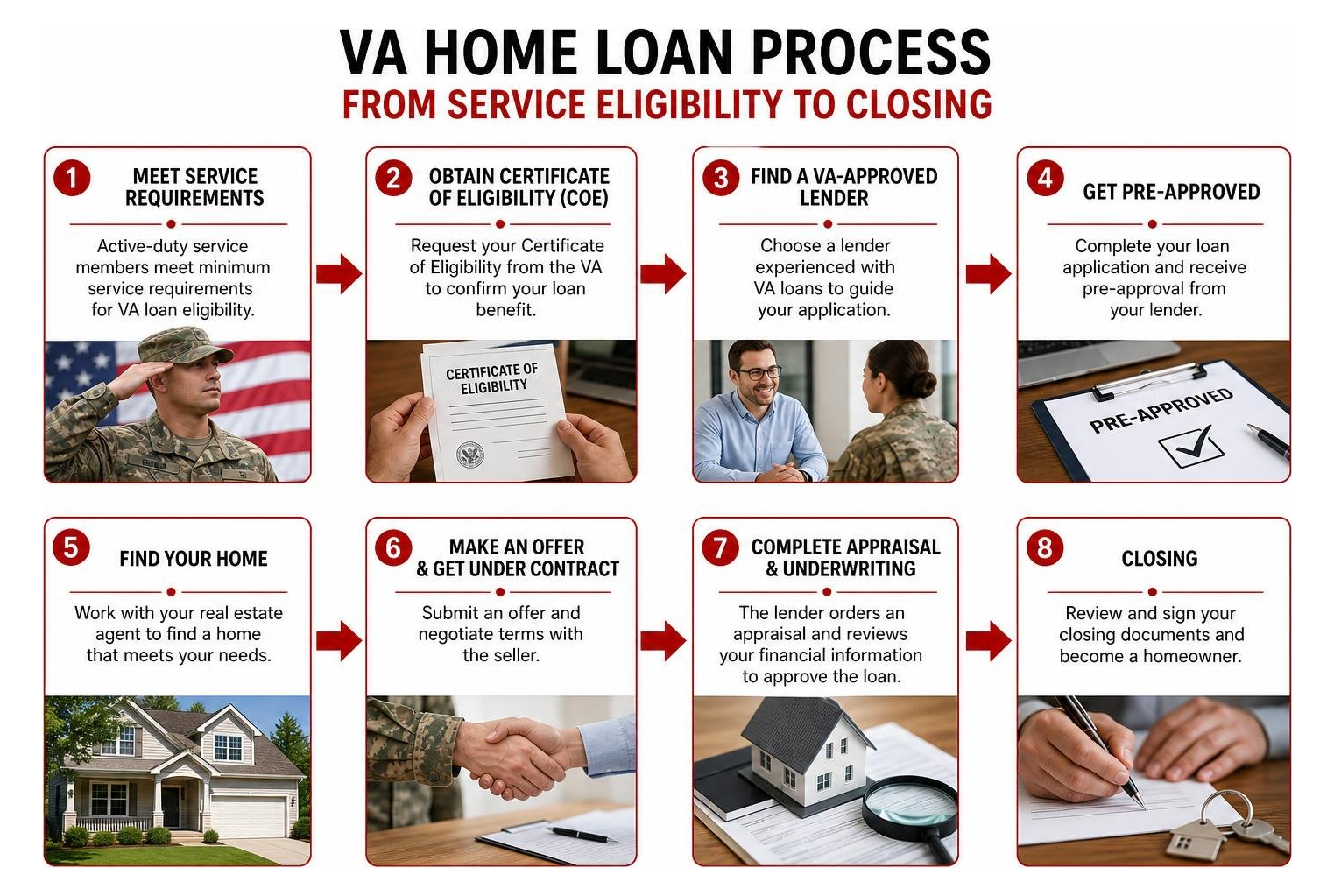
Qualified military borrowers can purchase single-family homes, townhouses, or multi-unit properties (up to 4 units) with 0% down payment and no monthly Private Mortgage Insurance (PMI). When you are ready to explore homeownership, understand the process by applying for a VA home loan and navigating our complete step-by-step VA home loan guide. Over a standard 30-year mortgage, avoiding PMI and securing favorable interest rates saves service members tens of thousands of dollars.
5. Blended Retirement System (BRS) with 5% TSP Government Matching
The military’s modernized Blended Retirement System (BRS) ensures that every service member leaves the military with dedicated retirement assets, even if they only complete a single four-year enlistment contract. Under the BRS, the Department of Defense automatically contributes 1% of your basic pay into your Thrift Savings Plan (TSP) account after 60 days of service.
The government then matches your voluntary personal contributions dollar-for-dollar up to 3%, and 50 cents on the dollar for the next 2%, allowing you to secure a full 5% matching contribution. The TSP operates identically to an institutional corporate 401(k), offering index funds with ultra-low management expense ratios that maximize long-term compound growth.
6. 20-Year Defined Military Pension and Early Retirement Options
For career service members who complete 20 years of qualifying active-duty service, the military provides a defined-benefit pension that pays an immediate monthly lifetime annuity starting the day of retirement—regardless of whether you retire at age 38, 42, or 45.
Under the Blended Retirement System, your lifetime monthly pension calculation equals:
Retiring at 20 years locks in 40% of your highest baseline pay, with cost-of-living adjustments (COLA) indexed for life. Review military pension eligibility rules and our comprehensive Army pension and retirement pay overview to see how pairing an immediate pension with a second civilian career creates lasting generational wealth.
World-Class Healthcare, Insurance, and Quality of Life Perks

Medical and family security are central components of military retention. While civilian workers face high monthly payroll deductions, co-pays, and out-of-pocket deductibles, the Department of Defense maintains a comprehensive healthcare apparatus designed to keep service personnel fit and families fully protected.
7. Premium-Free Healthcare and Dental Coverage via TRICARE
Active-duty service members receive comprehensive medical and dental care at military treatment facilities and civilian network providers with zero monthly premiums, zero deductibles, and zero copayments for covered services. Family members are covered under robust dependent health plans that carry negligible out-of-pocket expenses compared to civilian corporate health insurance.
From emergency surgeries and specialized clinical care to prescription drug maintenance and mental wellness programs, TRICARE ensures your household never faces medical debt. Learn how specific plan tiers operate by reviewing TRICARE health plan options.
8. Subsidized Life Insurance Coverage (SGLI)
Active-duty military members are automatically eligible for Servicemembers’ Group Life Insurance (SGLI), providing up to $500,000 in low-cost term life insurance coverage regardless of occupational hazards, flight duties, or deployment assignments. Coverage costs pennies on the dollar and is deducted automatically from monthly pay.
Upon separation or retirement, service members can seamlessly transition their coverage into Veterans’ Group Life Insurance (VGLI) without undergoing a medical underwriting exam. Discover how service-connected policies protect your family’s future with our guide to VA life insurance policies.
9. Comprehensive Military Spouse Career and Relocation Support
The military recognizes that family readiness is essential to operational success. The Department of Defense funds extensive resources dedicated to military spouse employment, including career advancement accounts (MyCAA) that provide tuition grants for portable certifications, license transfer fee reimbursements across state lines, and priority hiring preferences for federal civil service positions.
Additionally, military installations offer subsidized, on-base Child Development Centers (CDCs) staffed by certified early-childhood professionals, significantly lowering household childcare expenses. Read our complete guide to military spouse benefits and resources to see how your entire family is supported throughout every duty assignment.
10. 30 Days of Paid Annual Leave and Space-A Travel Privileges
Every active-duty service member accrues 2.5 days of paid annual leave per month, totaling 30 days of paid vacation per year from their first year of service. This generous baseline stands well above standard private-sector vacation accruals.
Service members and their families can also access Space-Available (Space-A) military travel, allowing them to fly on military transport aircraft to destinations across the globe for nominal administrative fees. When combined with world-class military resort destinations—such as the Hale Koa in Honolulu or Shades of Green in Orlando—traveling the world becomes accessible and affordable.
Advanced Education, Cutting-Edge Tech Training, and Veteran Success
Whether you plan to serve four years or thirty, the military acts as an unmatched career accelerator by financing your higher education and providing technical experience on cutting-edge platforms.
11. 100% Active Duty Tuition Assistance (TA) and Student Loan Repayment
While on active duty, service members can pursue college coursework, associate degrees, bachelor’s degrees, or master’s degrees using Military Tuition Assistance (TA). This program pays up to $250 per semester credit hour directly to accredited academic institutions, allowing you to advance your education without touching your GI Bill benefits.
For recruits entering service with existing qualifying debt, various service branches offer the College Loan Repayment Program (CLRP), which can pay down tens of thousands of dollars in federally insured student loans in exchange for an enlistment commitment. Compare how various service branches structure these educational funds by reviewing the top branches for educational benefits.
12. Post-9/11 GI Bill with Housing Allowance and Dependent Transferability
The Post-9/11 GI Bill remains one of the most generous education programs in American history. Qualified service members receive up to 36 months of fully funded tuition at public colleges and universities (or substantial coverage at private institutions via the Yellow Ribbon Program), alongside an annual book and supply stipend up to $1,000.
Crucially, the Post-9/11 GI Bill pays a monthly housing allowance (MHA) equal to the local E-5 with-dependents BAH rate for the campus ZIP code where classes are attended. Service members who serve at least six years and commit to four additional years can also transfer these education benefits to their spouse or children. Learn how monthly stipends are calculated through our guide to Post-9/11 monthly education payments.
13. World-Class High-Tech Job Training in AI, Cyber, and Aviation
Today’s military operates some of the most technologically advanced systems on earth, including autonomous drone swarms, satellite constellations, enterprise cybersecurity fabrics, and complex avionics. Enlisting into a technical Military Occupational Specialty (MOS), Air Force Specialty Code (AFSC), or Navy Rating gives you formal technical school instruction that directly mirrors Fortune 500 infrastructure.
Veterans who hold active Top Secret / Sensitive Compartmented Information (TS/SCI) security clearances and military technical experience routinely transition into six-figure civilian roles in defense contracting, cloud architecture, and systems engineering. Explore our comprehensive breakdown of high-paying military career paths to align your enlistment contract with high-growth industries.
14. Fast-Track Advanced Enlistment Rank and Leadership Experience
Unlike civilian corporate environments where promotions can be delayed by office politics, the military rewards verified merit, education, and institutional knowledge. Recruits with college credits, vocational certifications, or leadership experience through scouting or JROTC can enter active duty with an accelerated pay grade up to E-3.
From your early twenties, you will be entrusted with direct supervisory authority over personnel, maintenance operations, and critical equipment. This early leadership exposure builds crisis management abilities and accountability that stand out on any civilian executive resume.
15. Lifelong Veteran Preference, Disability Protections, and Alumni Network
Completing an honorable term of active service opens doors across the civilian economy. Qualified veterans enjoy statutory Veterans’ Preference when applying for federal civil service careers across agencies like the Department of Defense, Homeland Security, and the FAA.
Furthermore, if you incur a service-connected illness or injury, the VA provides tax-free monthly disability compensation, vocational rehabilitation, and comprehensive clinical healthcare protections. The shared bond of military service also connects you to a nationwide network of veteran mentors and employers who actively recruit former military personnel. Review all the lifelong advantages of your service through our guide on essential active duty service benefits.
Frequently Asked Questions About Military Enlistment
How much money do new recruits make in basic pay and allowances?
Entry-level enlisted members starting at grade E-1 earn a predictable baseline salary that increases automatically upon completion of initial training and scheduled promotions to E-2 and E-3. In addition to taxable base pay, recruits living outside military quarters receive non-taxable BAH and BAS, effectively increasing their real-world compensation. Review our 2026 military base pay guide for updated rank tables.
Can I join the military to pay off existing student loans?
Yes. Specific branches offer the College Loan Repayment Program (CLRP) for enlistees entering designated high-priority military specialties. Qualified applicants can have existing federal student loans paid down by the military up to established branch maximums in exchange for their term of service. Always ensure your student loan repayment guarantees are explicitly written into your DD Form 4 enlistment contract.
How does the Post-9/11 GI Bill work if I want to earn a degree while serving?
While on active duty, service members typically use Military Tuition Assistance (TA) first so they do not exhaust their Post-9/11 GI Bill entitlements. Once separated or retired, veterans can deploy their 36 months of GI Bill benefits to attend undergraduate or graduate programs full-time, receiving 100% in-state tuition coverage, book stipends, and a monthly housing allowance based on their school’s physical location.
Conclusion
The military remains one of the most effective launchpads for personal discipline, high-tech career training, and lifelong financial stability. When you harness predictable pay increases, tax-free housing allowances, full healthcare, zero-down VA home loans, and fully funded college education, you establish a resilient foundation for long-term independence.
At USMilitary.com, we help service members, veterans, and future recruits make informed choices at every phase of their military journey. Before signing your enlistment contract, consult with recruiters across branches, explore our comprehensive guide to US veteran benefits, and build a service plan that supports your personal, professional, and financial goals for 2027 and beyond.
Free for Service Members & Veterans
Get the military benefits intel no one tells you about.
Weekly updates on VA benefits, pay changes, and money tips — free for service members and veterans.
No spam. Unsubscribe anytime. Your info is never shared.


