The Toughest Military Schools in the U.S. — Quick Answer

The toughest military schools in the U.S. are ranked below by overall difficulty, attrition rate, and training demands:
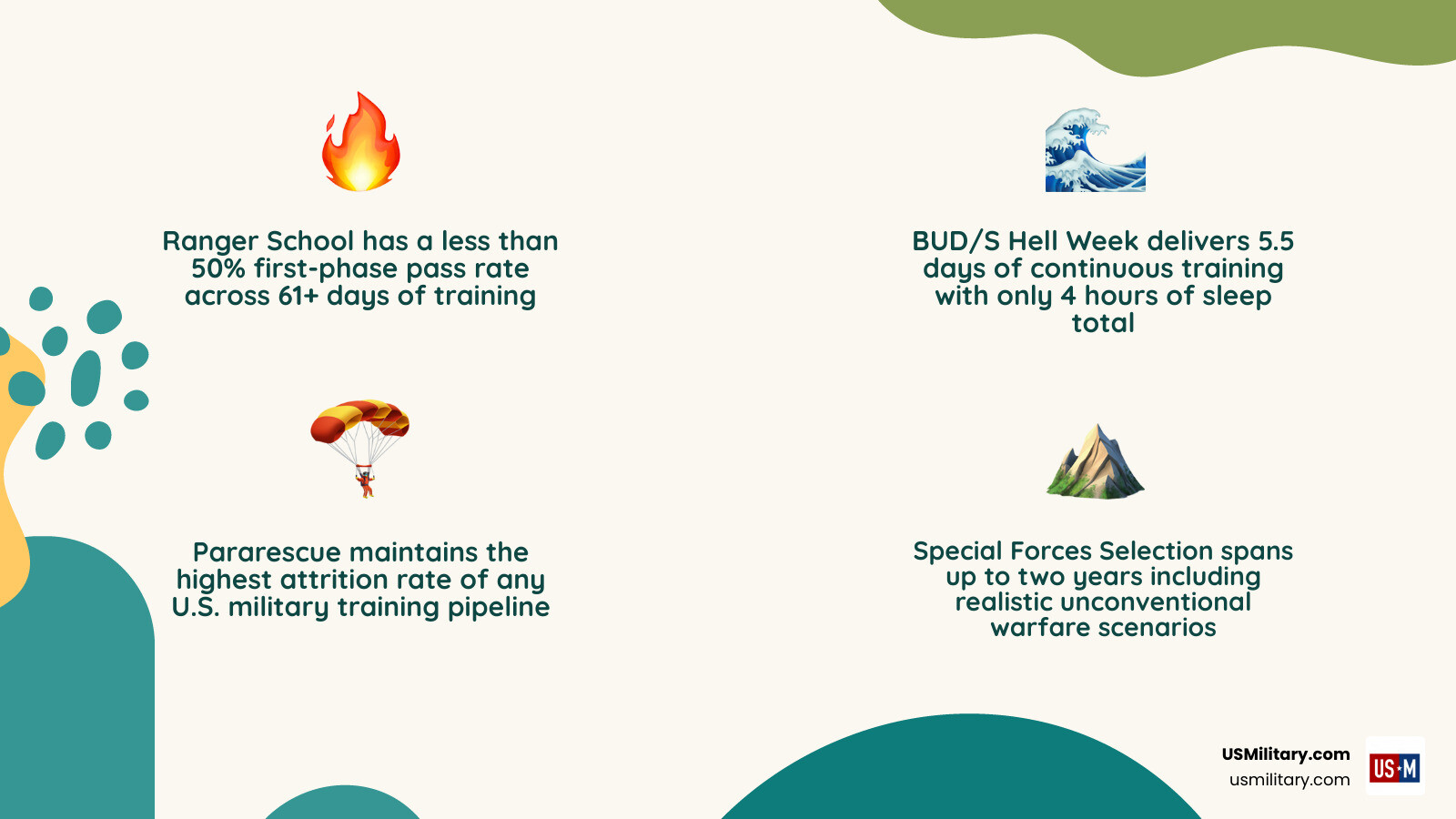
- Pararescue School (U.S. Air Force) — highest attrition rate of any U.S. military school
- U.S. Army Special Forces Selection and Training — up to two years of training, including ROBIN SAGE
- BUD/S — Navy SEAL Training — Hell Week: 5.5 days continuous training, max 4 hours of sleep
- Basic Recon Course (USMC) — nine weeks of grueling amphibious and team tactics training
- Ranger School (U.S. Army) — 61+ days; less than 50% of students pass the first phase
Not every military school is created equal. Some push candidates to their absolute physical and mental limits — and most people who try simply don’t make it through.
Whether you’re considering enlisting, exploring special operations, or just want to understand what separates elite military training from the rest, knowing which programs are the hardest — and why — matters.
The schools on this list are not just physically brutal. They test judgment, leadership, and the ability to keep going when everything in your body says stop.
I’m Larry Fowler, publisher of USMilitary.com since 2007 and a longtime resource for active military, veterans, and those navigating enlistment decisions — including researching the toughest military schools in every branch. Keep reading for a full breakdown of what each program demands and what graduates gain from completing it.
Defining the Toughest Military Schools: Selection Criteria and Rigor
What makes a military school truly “tough”? If you ask five different veterans, you will likely get five different answers. Marines might tell you that their training is inherently harder simply because they are Marines. Meanwhile, an Army Ranger will point to sleep deprivation, and a Navy SEAL will argue that nothing compares to the bone-chilling cold of Pacific Ocean surf torture.
When we analyze the Toughest Military Schools, we must look past branch rivalries and focus on objective selection criteria: attrition rates, physical demands, mental challenges, and the complexity of the specialized skills taught.
- Attrition Rates: The ultimate indicator of difficulty. If nine out of ten candidates pack their bags and head home, the program is doing something to systematically weed out those who cannot perform under maximum stress.
- Physical Demands: This includes carrying heavy loads over extreme distances, running under tight time constraints, swimming miles in open water, and navigating obstacle courses designed to test raw strength and agility.
- Mental Challenges: Sleep deprivation, starvation-level calorie restriction, and continuous psychological pressure from instructors are deliberately applied to see if a candidate’s decision-making breaks down.
- Specialized Skills: It is one thing to run a marathon; it is another to perform a complex medical procedure on a simulated casualty while taking simulated mortar fire, or calculating a parachute jump trajectory in high-stress environments.
To see how these demands stack up across different paths, let’s look at a direct comparison:
| Branch / School | Primary Focus | Training Duration | Attrition Rate | Key Physical & Mental Stressors |
|---|---|---|---|---|
| Air Force Pararescue | Combat rescue & medicine | Up to 2 years (pipeline) | 80% – 90% | Water confidence, extreme endurance, high-stakes medical testing |
| Army Special Forces | Unconventional warfare | Up to 2 years | 60% – 80% | Long-range land navigation, heavy rucking, cognitive endurance |
| Navy BUD/S | Maritime special operations | 6 months (BUD/S phase) | 70% – 85% | Cold-water exposure, Hell Week, surf zone operations |
| Marine Recon (BRC) | Amphibious reconnaissance | 9 weeks | 50% – 60% | Ocean swims, high-intensity water survival, team tactics |
| Army Ranger School | Small-unit leadership | 61+ days | 50% – 60% (overall) | Severe sleep and food deprivation, continuous graded patrolling |
While special operations schools represent the absolute peak of tactical and physical rigor, we must also recognize that the military education pipeline starts much earlier for many. For young men and women looking to build the foundation of discipline required for these elite programs, preparatory environments like those listed in the Best Military Boarding Schools (2026) offer a structured, academic-first introduction to the military lifestyle. These boarding schools teach the initial time-management and self-discipline skills that candidates will desperately need later if they attempt any of the top five schools listed below.
The Top 5 Toughest Military Schools Ranked

To rank these programs, we evaluated not just how hard it is to get in, but how difficult it is to stay in. Candidates who enter these pipelines typically come from highly athletic backgrounds—many are former high school or college athletes, marathon runners, or exceptionally fit service members who have spent years preparing. Yet, the physical and mental toll of these programs is so high that even the most prepared candidates frequently drop out. Let’s look at the top five toughest programs in detail.
Why Ranger School is Among the Toughest Military Schools
When discussing the premier leadership training in the world, the conversation always leads back to the U.S. Army Ranger School. Ranger School is not a selection program for a specific unit in the traditional sense; rather, it is a premier combat leadership school open to soldiers, officers, and members of other military branches who want to master small-unit tactics.
The course is theoretically 61 days long, but many candidates spend much longer there because they get “recycled”—forced to repeat a phase due to a failed patrol or poor peer evaluations.
Ranger School is broken into three distinct, punishing phases:
- The Benning Phase: Conducted at Fort Moore (formerly Fort Benning), Georgia, this phase begins with Ranger Assessment Phase (RAP) week. The physical standards are unforgiving: candidates must complete 49 push-ups, 59 sit-ups, a 5-mile run in under 40 minutes, and 6 dead-hang chin-ups. They must also survive the Malvesti Confidence Course, water survival tests, and difficult land navigation. Historically, less than 50% of Ranger students complete the Benning Phase on their first try.
- The Mountain Phase: Located at Camp Frank D. Merrill near Dahlonega, Georgia, this phase shifts focus to military mountaineering, knots, rappelling, and platoon-level combat patrols in rugged, high-altitude terrain. Candidates carry rucksacks weighing up to 80 pounds up steep inclines on very little sleep.
- The Swamp Phase: Held in the coastal swamps of Florida, this final phase tests the candidates’ ability to lead waterborne operations, build rope bridges, and execute patrols in waist-deep water filled with local wildlife, all while dealing with extreme fatigue.
According to our guide on Ranger Ready The Ultimate Guide to Joining the Army’s Toughest, the true enemy in Ranger School is not the terrain, but the combination of calorie restriction and sleep deprivation. Students are deliberately kept on a deficit, receiving only one or two Meals, Ready-to-Eat (MREs) a day while operating on 1 to 3 hours of sleep. Under these conditions, they must step into leadership roles and successfully plan and execute complex combat patrols. If their peers evaluate them poorly, or if they receive too many negative spot reports, they are sent home.
4. Basic Recon Course – USMC
The Marine Corps is famous for its demanding entry-level training, but for those who want to join the ranks of Marine Reconnaissance, the real test begins at the Basic Recon Course (BRC). This nine-week session is designed to train Marines in the art of amphibious reconnaissance, ground surveillance, and team tactics.
What makes BRC exceptionally difficult is the heavy emphasis on water competency. Marines must undergo extreme physical conditioning in the pool and the open ocean. They are required to perform underwater knot-tying, swim long distances in full utility uniforms and boots, and survive “drown-proofing” exercises that challenge their mental control under water.
In addition to water operations, candidates are subjected to long-distance land navigation, high-speed rucking, and complex team-based patrolling exercises. The Marine Corps philosophy is that Recon Marines must be self-reliant, capable of operating deep behind enemy lines without immediate support. The physical conditioning is designed to push candidates to the point of exhaustion so that instructors can evaluate how they make decisions when their bodies are failing. If a candidate panics in the water or loses focus during a land navigation exercise, they are quickly dropped from the course.
3. BUD/S – US Navy SEAL Selection and Training
For decades, Basic Underwater Demolition/SEAL has held a legendary status in the public eye as one of the most physically punishing selection programs on earth. Located at the Naval Special Warfare Center in Coronado, California, BUD/S is a six-month challenge designed to find those with the unique mental resilience required for Navy SEALs BUD/S Training.
The first phase of BUD/S is nine weeks of basic conditioning, where candidates run miles on soft sand, complete timed four-mile runs in boots, and swim up to two miles in the open ocean wearing fins. The obstacle course is a weekly hurdle that candidates must complete under strict time limits.
The true climax of First Phase is Hell Week Navy SEALs. This is a 5.5-day stretch of continuous training where candidates are allowed a total of only about four hours of sleep. During this week, candidates are constantly wet, sandy, and cold. They carry heavy rubber boats on their heads, paddle for miles in the surf, and perform endless physical training drills in the freezing mud of the Tijuana Estuary.
The philosophy behind Hell Week is simple: it is designed to strip away all physical advantages and test the candidate’s pure mental drive. In this environment, instructors often remind candidates that the human body is capable of doing ten times the amount of work the average man thinks it can. Those who focus on the cold or their aching muscles usually quit by ringing the brass bell in the courtyard. Those who survive go on to learn combat diving, land warfare, and demolition, eventually earning their Navy SEAL insignia.
2. US Army Special Forces Selection and Training
While programs like BUD/S focus heavily on raw physical survival, the U.S. Army Special Forces (Green Berets) selection and training pipeline places an immense premium on cognitive ability, cultural adaptability, and unconventional warfare. Managed by the U.S. Army John F. Kennedy Special Warfare Center and School, which trains approximately 3,100 students on any given day, the Special Forces Qualification Course (SFQC) can take up to two years to complete.
The journey begins with Special Forces Assessment and Selection (SFAS), a grueling multi-week phase where candidates are evaluated on physical fitness, land navigation, and their ability to work under extreme stress during “team week”—where they must carry heavy, awkward loads (like wooden logs and heavy metal pipes) over miles of sandy roads without speaking to one another.
Once selected, candidates enter the “Q-Course,” which is divided into phases covering:
- Tactical Combat Skills: Advanced shooting, patrolling, and survival techniques.
- Specialty Training: Becoming an expert in weapons, engineering, medical procedures, or communications.
- Language and Culture: Learning a foreign language to a high level of fluency, as Green Berets must work directly with foreign military forces.
- ROBIN SAGE: The legendary culminating exercise held across several counties in North Carolina. Candidates are inserted into a realistic, simulated country called “Pineland,” where they must contact, train, and advise a local guerrilla force to overthrow an oppressive government.
The mental stamina required to maintain peak performance over a two-year pipeline is incredibly rare. Green Berets must be “quiet professionals” who can solve complex geopolitical problems just as easily as they can direct a close-air-support strike.
Pararescue: The Toughest Military Schools Champion
When comparing overall attrition rates and the sheer variety of extreme environments candidates must master, the U.S. Air Force Pararescue (PJ) School is widely considered the toughest military school of all. Pararescue Specialists are tasked with recovering downed aircrew and wounded personnel from some of the most hostile and inaccessible places on earth.
The PJ pipeline, often referred to as “The Pipeline” or “Superman School,” has an attrition rate that regularly hovers between 80% and 90%. According to The Top 5 Toughest Schools in the Military – American Grit, the initial assessment phase—known as “Development”—is a masterclass in water-confidence training. Candidates must perform under-water swim challenges, buddy-breathing exercises where instructors simulate combat stress underwater, and heavy physical training on land.
What sets Pararescue apart is that candidates cannot just be physically elite; they must also become certified paramedics. The academic and medical training is conducted under high-stress conditions where a single mistake on a test means instant dismissal from the program. PJs must master:
- Combat Diving: Navigating underwater to reach survivors.
- Freefall Parachuting: Jumping from high altitudes into the ocean or dense jungle.
- Mountain Rescue: Operating ropes and rigging systems on vertical cliff faces.
- Paramedic Medicine: Performing advanced lifesaving procedures under direct enemy fire.
The combination of extreme water-confidence training, high-altitude parachuting, and the academic pressure of paramedic school makes the Pararescue pipeline the most difficult training program in the entire U.S. military.
Academic and Preparatory Institutions: The Toughest Military Academies
While special operations schools test tactical and physical limits, the nation’s service academies test academic, physical, and character limits over a multi-year experience.
The premier leader development institution in the world is the United States Military Academy West Point. Gaining entry is a challenge in itself; according to USMA Admissions | U.S. Military Academy West Point, the academy has an acceptance rate of just 12%. Once admitted, cadets embark on a 47-month leadership experience that integrates:
- Academic Excellence: Cadets choose from 36 majors, supported by a 7:1 student-to-faculty ratio and 28 research centers.
- Military Rigor: Summer field training, weapons qualification, and leadership roles within the Cadet Corps.
- Physical Fitness: Every cadet must participate in NCAA, club, or intramural athletics to build a warrior spirit.
Graduates of West Point receive a fully funded education, zero student debt, and a guaranteed starting salary of approximately $70,000 as a commissioned officer with 100% job placement.
Similarly, the U.S. Air Force Academy (USAFA) provides a comprehensive, year-round program that balances military training, athletics, and intense academic study. As detailed in the USAFA Firmly on course as America’s Premier Military Service Academy: 2025 in Review • United States Air Force Academy, USAFA has transitioned toward highly realistic, adversary-focused combat training. During Basic Cadet Training, cadets now complete full weapons qualifications on the M4 rifle and M18 pistol, alongside scenario-based training in tactical command, casualty care, and movement under fire.
For younger students, preparatory military boarding schools like Fishburne Military School | Boys Boarding School Since 1879 provide the structured environment necessary to prepare for these service academies. With a small student-to-teacher ratio of 12:1 and a focus on individualized attention, Fishburne helps young men discover their potential and build the discipline required to face the challenges of higher-level military education.
Frequently Asked Questions about Elite Military Training
How does Ranger School compare to Navy SEAL BUD/S?
The debate between Ranger School vs Navy SEAL Training is one of the most common in military circles. The primary difference lies in their focus and design:
- Ranger School is a leadership school. It evaluates how well you can lead a team of exhausted, starving soldiers through complex land combat operations. The primary stressors are continuous sleep deprivation (1-3 hours a night) and food restriction over a 61-day period.
- BUD/S is a selection program. Its primary goal is to weed out those who do not have the mental grit to be a Navy SEAL. The training is heavily focused on maritime operations, open-ocean swimming, and cold-water tolerance. While BUD/S has a famous 5.5-day sleep-deprivation event (Hell Week), candidates generally get more regular sleep and food during the rest of the course compared to Ranger students, but the physical intensity of the daily ocean swims and runs is significantly higher.
What is the attrition rate for SAS selection?
The British Special Air Service (SAS) selection program is widely regarded as one of the most difficult in the world, featuring an astonishing 90% fail rate.
The selection process lasts approximately five months and is broken into distinct, brutal phases:
- The Hills Phase: Conducted in the Brecon Beacons of Wales, candidates must perform weighted rucksack marches over mountainous terrain. This culminations in “the Fan Dance,” a solo navigation of the 2,907-foot Pen y Fan peak that must be completed within tight time limits.
- The Jungle Phase: Held in dense rainforests (such as Brunei or Belize), where candidates learn survival, navigation, and patrolling in a high-humidity environment that degrades the body.
- Escape and Evasion: The final phase tests candidates’ ability to evade capture across difficult terrain, followed by a brutal week-long tactical interrogation resistance test designed to break them down mentally.
Who attends military SERE training?
Survival, Evasion, Resistance, and Escape (SERE) training is a specialized program designed to prepare military personnel to survive and return with honor if they are captured or isolated behind enemy lines.
According to our resources on What is Military SERE Training and Who Attends Military SERE Training, the course is primarily attended by high-risk personnel, including:
- Military Aviators: Pilots, navigators, and aircrew members who face a high risk of being shot down over hostile territory.
- Special Operations Forces: Navy SEALs, Army Green Berets, Rangers, and Air Force Pararescue specialists.
- Intelligence Officers: Personnel operating in high-threat environments where capture is a distinct possibility.
During SERE school, students are taught how to find food and water in extreme environments, navigate without GPS, evade tracking dogs, and resist interrogation techniques if captured.
Conclusion
Surviving the toughest military schools requires more than just physical fitness; it demands a deep mental resilience and a commitment to a larger mission. Whether it is the water-confidence drills of Pararescue, the leadership challenges of Ranger School, or the team-focused hardships of BUD/S, these schools shape the very best leaders our country has to offer.
For those who make it through, the career benefits are profound—including specialized skills, leadership capabilities, and a lifelong bond with an elite community.
If you are ready to explore your own path in the armed forces, or if you need assistance navigating your post-military benefits, VA loans, or disability ratings, we are here to support you. Visit US Military Recruiting today to find the resources, guides, and career comparisons you need to take your next step.
Free for Service Members & Veterans
Get the military benefits intel no one tells you about.
Weekly updates on VA benefits, pay changes, and money tips — free for service members and veterans.
No spam. Unsubscribe anytime. Your info is never shared.


