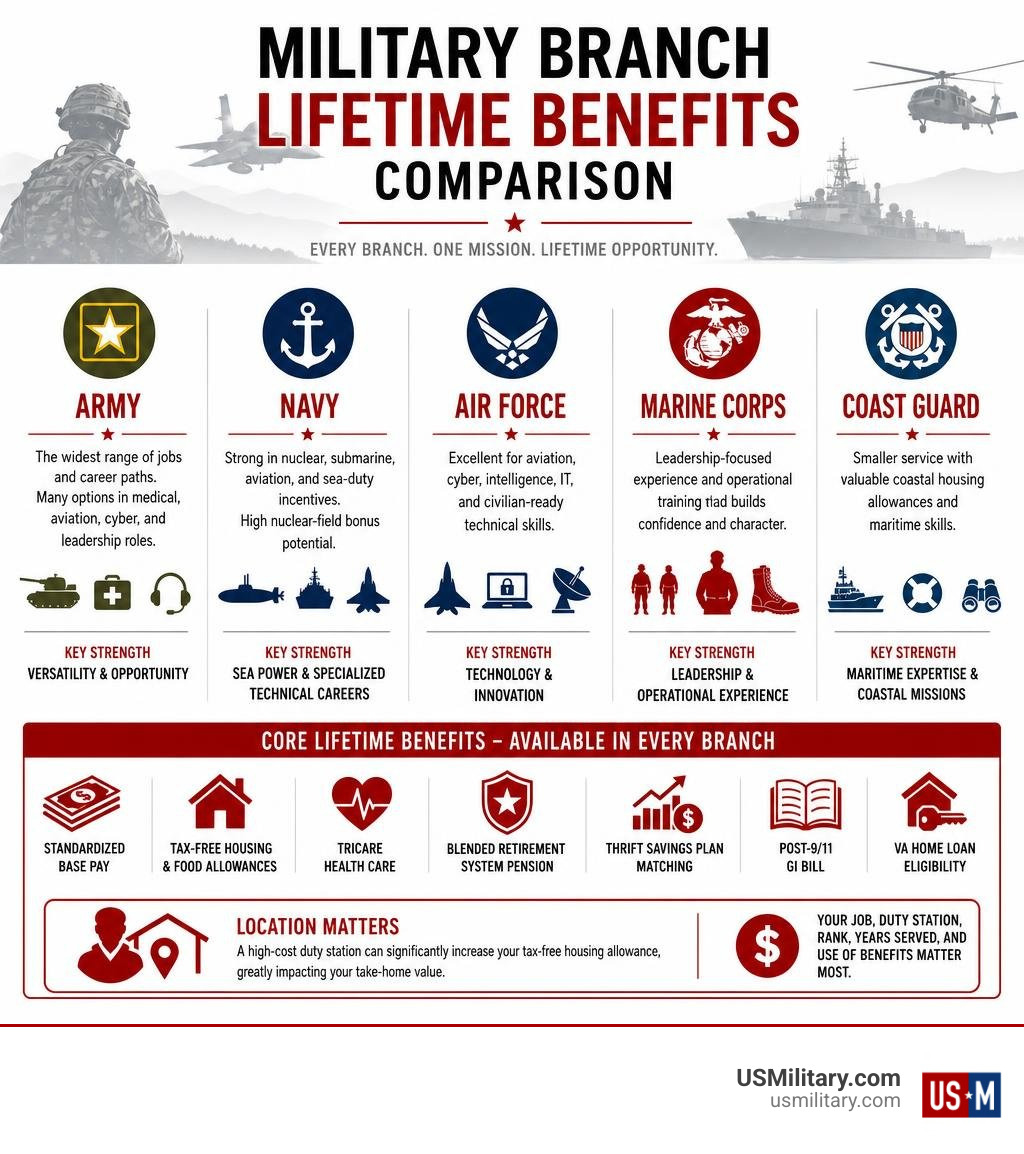
The Air Force and Navy often offer the strongest lifetime financial upside for technical careers, while the Army offers the widest job selection and the Marine Corps offers leadership-focused experience. But no branch automatically pays more in base salary. Your job, duty station, rank, years served, and use of benefits matter far more than the uniform you wear.
For a 20-year career, every branch can provide the same core package: standardized base pay, tax-free housing and food allowances, TRICARE, a Blended Retirement System pension, Thrift Savings Plan matching, the Post-9/11 GI Bill, and VA home loan eligibility. A military pension alone may be worth roughly $720,000 to $1.35 million over a lifetime, depending on rank and retirement age.
The biggest branch differences are usually found in specialized work:
- Navy: Strong nuclear, submarine, aviation, and sea-duty incentives. It can offer especially large nuclear-field enlistment bonuses.
- Air Force and Space Force: Strong choices for aviation, cyber, intelligence, IT, and civilian-ready technical skills.
- Army: The broadest range of jobs, large specialty bonuses, and many paths into medical, aviation, cyber, and leadership roles.
- Coast Guard: Smaller service, but potentially valuable coastal housing allowances and maritime skills.
- Marine Corps: Lower bonus ceilings in many fields, but meaningful leadership, security, and operational experience for the right person.
 Which Military Branch Offers The Best Life-Time Career Benefits terms explained:
- active duty retirement
- military benefits
- active duty military benefits
Core Military Compensation: Universal Lifetime Benefits Across All Branches
When evaluating military compensation, many prospective recruits look strictly at the standard pay table and assume military pay falls short of civilian careers. That assumption misses the broader financial structure. Active-duty military compensation is a multi-layered ecosystem composed of taxable base pay, non-taxable allowances, comprehensive healthcare, institutional training, and retirement vesting. To understand the baseline, we must look at Regular Military Compensation (RMC). An E-5 with 6 years of service earns a base salary of roughly $37,716, yet their total effective civilian compensation sits between $80,000 and $98,000 annually when factoring in tax advantages, housing, food, and zero-premium medical coverage. For detailed program rules and program breakdowns, The Ultimate Guide to Military Benefits provides an in-depth look at these baseline guarantees.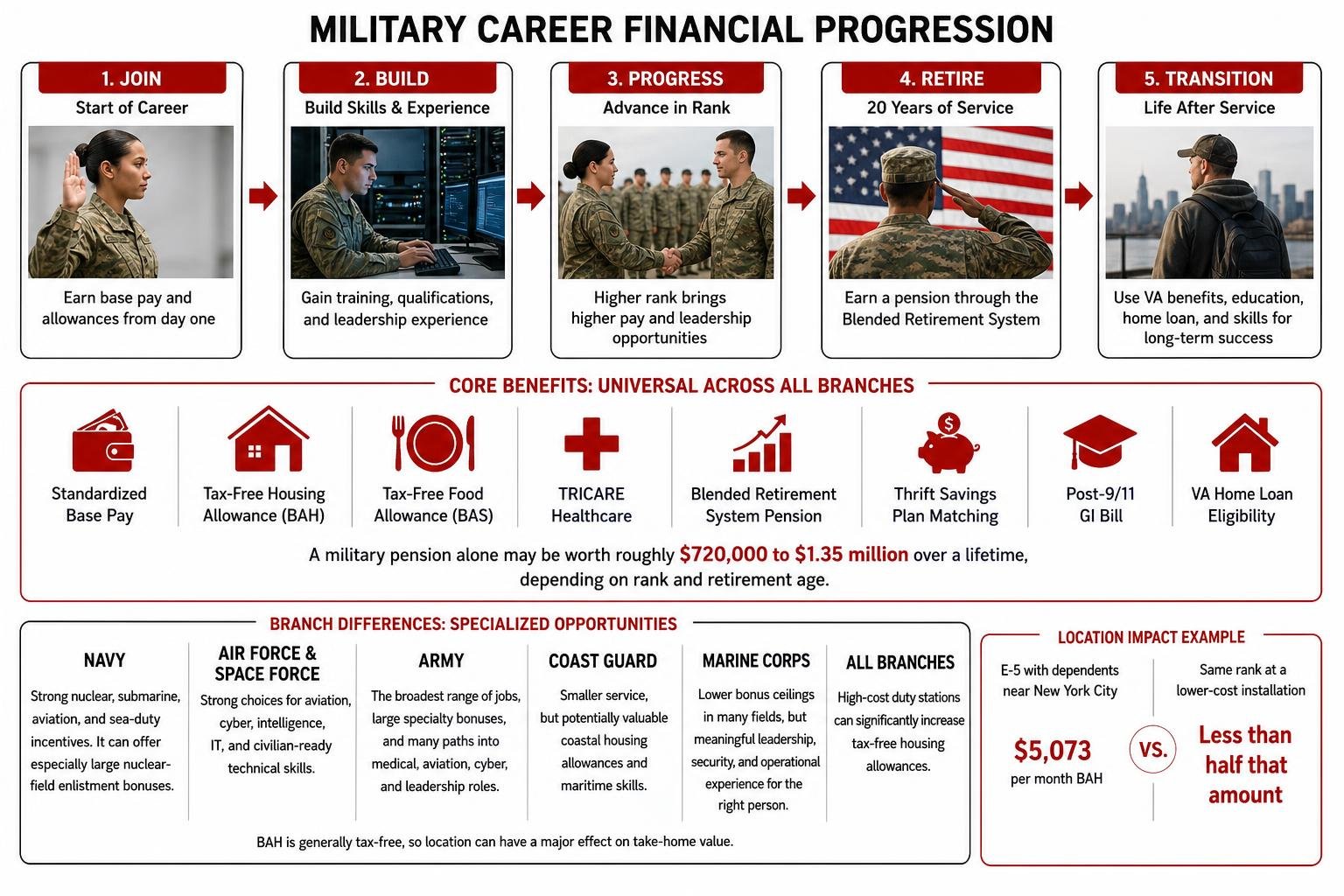 Whether you serve in the Army, Navy, Air Force, Marine Corps, Space Force, or Coast Guard, the statutory baseline is identical. Every branch receives the exact same fundamental entitlements under Title 37 of the United States Code. The core differentiators only begin to show up when we look at special duty pays, geographic cost-of-living adjustments, and occupational career fields.
Standardized Pay, Allowances, and Healthcare Coverage
The Department of Defense sets basic pay rates uniformly across all service branches. A Sergeant in the Army (E-5) with six years of service receives the exact same base pay as a Staff Sergeant in the Air Force or a Petty Officer Second Class in the Navy. You can verify every grade and longevity step by reviewing The Ultimate Guide to 2026 Military Pay Chart alongside our military pay scale in 2026 for enlisted and officers. Where the immediate cash value expands is through non-taxable allowances:- Basic Allowance for Housing (BAH): An equitable monthly stipend designed to cover market-rate housing costs when government quarters are not provided. BAH is completely exempt from federal, state, and payroll taxes.
- Basic Allowance for Subsistence (BAS): A non-taxable food allowance set at $476.95 per month for enlisted personnel and $328.48 per month for commissioned officers.
- TRICARE Healthcare: Active duty members and their enrolled dependents receive zero-cost comprehensive health coverage through TRICARE Prime. There are no monthly premiums, no deductibles for in-network active-duty care, and zero copays. To compare family coverage tiers, check our guide to Tricare Health Plans A Complete Overview as well as your wallets guide to Tricare Prime expenses and navigating Tricare Select understanding your benefits.
Military Pension and Thrift Savings Plan Growth Under BRS
Retirement planning changed fundamentally with the implementation of the Blended Retirement System (BRS). For service members entering today, the retirement structure blends a defined-benefit pension with government matching in the Thrift Savings Plan (TSP).- Defined-Benefit Pension: Serving 20 years or more entitles you to an immediate lifetime monthly annuity starting the day you retire, regardless of whether you are 38 or 42 years old. The formula provides 2.0% of your highest 36-month average basic pay per year served (e.g., 40% of base pay at 20 years, 50% at 25 years, and 60% at 30 years).
- Thrift Savings Plan (TSP) Matching: The DoD automatically contributes 1% of basic pay into your TSP after 60 days and matches up to an additional 4% after two years of service, totaling a 5% employer contribution. With the 2026 TSP elective deferral limit at $24,500, service members can build substantial wealth through early compounding.
- Continuation Pay: A mid-career cash retention multiplier distributed between 8 and 12 years of service in exchange for an additional service commitment.
Long-Term Value of the Post-9/11 GI Bill and VA Home Loan
Two cornerstone benefits offer massive post-service wealth building regardless of branch: the Post-9/11 GI Bill and the VA Home Loan guarantee. The Post-9/11 GI Bill covers 100% of in-state tuition and fees at public universities (capped at $28,937 per year at private institutions), supplies an annual $1,000 book stipend, and pays a monthly housing allowance (MHA) equal to an E-5 with dependents in the campus ZIP code. Over a 36-month academic lifecycle (four standard 9-month college years), this benefit delivers between $100,000 and $180,000+ in total financial value. Service members with at least six years of service who commit to four additional years can transfer these educational benefits directly to their spouse or children. Learn more about maximizing these funds in The 5 Best Military Branches for Education Compared and post-911 payments a guide to your education payday. To take full advantage of this loan program, explore Your Guide to VA Home Loans From Service to Homeownership, check from service to savings understanding your VA home loan eligibility, and research the best VA home mortgage lenders that honestly save you money, best lenders for VA home loans, or top 10 mortgage VA lenders for Army veterans active.Branch-by-Branch Comparison: Special Pays, Bonuses, and Geographic BAH
While base statutory entitlements are equal, actual net career earnings differ dramatically depending on how branches assign special and incentive (S&I) pays, deployment tax exclusions, and geographic base locations. A service member operating in high-demand technical environments earns tens of thousands of dollars more per year than an individual in a non-specialized role. For an overview of branch structures, reference our complete guide to branches of the military and military career paths complete guide.| Military Branch | Max Initial Enlistment Bonus | Elite Special & Incentive Pays | Average Geographic BAH Weighting | Top Post-Service Civilian Transitions |
|---|---|---|---|---|
| U.S. Navy | Up to $75,000 (Nuclear Field) | Submarine Pay ($85–$840/mo), Sea Pay ($100–$750/mo), Nuclear Retention ($30k–$50k/yr) | High (Concentrated in coastal hubs: San Diego, Norfolk, Hawaii, Puget Sound) | Commercial Nuclear Operator, Maritime Logistics, Defense Systems |
| U.S. Air Force | Up to $40,000 (Special Warfare/Cyber) | Aviation Continuation Pay (up to $50k/yr, max $600k contract), Flight Pay ($150–$1,000/mo) | Moderate-to-High (Major technical centers, space hubs, suburban flight bases) | Commercial Airline Pilot, Defense Aviation Engineering, Cyber Architect |
| U.S. Army | Up to $50,000 (Critical MOS/Quick Ship) | Airborne/Ranger Hazard Pay ($150–$250/mo), Special Forces Incentive, Medical Officer Incentives | Moderate-to-Low (Large rural installations: Fort Liberty, Fort Cavazos) | Federal Law Enforcement, Systems Project Management, Government Intelligence |
| U.S. Space Force | Highly Selective / Variable | Cyber Special Duty Pay ($150–$500/mo), Critical Space Operations Bonuses | High (Colorado Springs, Los Angeles AFB, Buckley, Cape Canaveral) | Aerospace Systems Architect, Orbital Defense Analyst, Satellite Operations |
| U.S. Marine Corps | Up to $15,000 (Select Skills) | Recon Hazard Pay, Flight Deck Pay ($150/mo), Combat Arms Retention | Moderate-to-High (Camp Pendleton, Camp Lejeune, Hawaii, Okinawa) | Private Security Leadership, Logistics Operations, Federal Agency Operations |
| U.S. Coast Guard | Up to $40,000 (Critical Rates) | Maritime Hazard Pay, Coxswain Pay, Deep Sea Diver Pay | High (Coastal port installations with high median regional BAH) | Port Operations Director, Commercial Maritime Captain, Emergency Manager |
Navy and Air Force: Elite Technical Incentives and Aviation Continuation Pay
The Navy and the Air Force distribute the highest recurring special incentive pays across the Department of Defense. The Navy faces unique retention demands for personnel managing naval nuclear propulsion plants aboard aircraft carriers and ballistic missile submarines. As highlighted in our review of 20 reasons you should care about Navy jobs, enlisted nuclear machinists, electricians, and reactor operators can earn enlistment bonuses up to $75,000, combined with up to $65,000 in student loan repayment. For officers, nuclear retention bonuses can exceed $35,000 to $50,000 per year, which significantly out-earns standard officer base compensation. In the Air Force, retention incentives are concentrated heavily in the cockpit. To retain experienced aviators who are courted by commercial airlines, the Air Force offers Aviation Continuation Pay (ACP) reaching up to $50,000 annually. Over a multi-year retention contract, an Air Force pilot can earn up to $600,000 in bonus compensation alone on top of regular military pay. Explore specific Air Force occupations in our guide to the 15 best Air Force jobs for long-term financial success.Army and Marine Corps: Enlistment Bonuses and Fast-Track Progression
The Army operates at the largest personnel scale in the DoD. To fill critical roles across infantry, air defense, mechanics, intelligence, and special operations, the Army regularly offers initial enlistment bonuses up to $50,000, particularly for recruits who select quick-ship departure dates or high-priority combat support specialties. Promotion velocity is another critical financial factor. Because the Army has substantial organizational requirements for mid-grade and senior Non-Commissioned Officers (NCOs), motivated soldiers often advance through junior enlisted ranks (E-1 through E-5) faster than peers in technical branches like the Air Force. Each accelerated promotion step yields a compound increase in taxable base pay and housing allowance entitlement over a 20-year career. Track officer progression benchmarks in a comprehensive guide to military officer career progression and see the soldiers GPS to career success. The Marine Corps intentionally limits large upfront bonuses, focusing its retention on core culture, elite tactical development, and leadership responsibility. While initial financial signing incentives are smaller (capping near $15,000 for select specialties), Marines often exit the service with recognized command experience and organizational leadership credentials that pay dividends in law enforcement, defense contracting, and corporate operations.Space Force and Coast Guard: Specialized Roles and High Quality of Life
The Space Force and Coast Guard provide unique financial advantages tied to location and job specialization:- Space Force: With primary installations concentrated in high-cost tech and aerospace corridors like Los Angeles Air Force Base, Peterson Space Force Base, and Buckley, Guardians receive elevated BAH rates. Because the Space Force focuses entirely on high-tech career fields—such as cyber operations, space domain awareness, intelligence, and satellite communications—the long-term market value of its personnel upon civilian exit is exceptionally high. Learn more about these specialties in our guide to the top 20 best Space Force career jobs compared.
- Coast Guard: Because Coast Guard personnel are positioned at maritime ports, waterways, and coastal stations across California, Florida, the Pacific Northwest, and New England, their housing allowances reflect high coastal median costs. The service also features high retention rates and manageable operational cycles without standard multi-year overseas deployments.
Which Military Branch Offers The Best Life-Time Career Benefits: Total Career Valuation
When calculating the ultimate financial return of a military career, you have to look beyond signing day bonuses and evaluate total lifetime value: active duty earnings, advanced credentials, pension payouts, and post-service marketability.
Evaluating Which Military Branch Offers The Best Life-Time Career Benefits for Technical Fields
If your goal is to leverage high-end technical training for long-term private sector wealth, the Air Force, Space Force, and Navy provide the clearest lifetime financial path. These branches invest heavily in programs where civilian industry demand is high:- Cyber Warfare & Information Warfare: Air Force, Space Force, and Navy cyber specialists regularly earn Top Secret / Sensitive Compartmented Information (TS/SCI) security clearances along with DoD-funded credentials like CISSP, CEH, and CompTIA Security+. In the private tech and defense contracting markets, these credentials regularly translate into civilian salaries ranging from $115,000 to $165,000+.
- Nuclear Engineering: A Navy-trained nuclear propulsion operator completes one of the most rigorous technical pipelines in the federal government. Exiting service members are recruited directly into commercial power grid management, nuclear medical technology, and semiconductor fabrication plants, often securing six-figure civilian salaries without needing a 4-year degree.
- Medical Specialties: Across all branches, military healthcare providers—especially flight surgeons, cardiologists, and anesthesiologists—receive incentive pays up to $69,000 annually while building clinical experience without medical school debt. Discover these lucrative paths in our review of top 10 military jobs six figures guide and 10 high paying civilian jobs with military training.
Which Military Branch Offers The Best Life-Time Career Benefits for a 4-to-6 Year Enlistment?
For an enlistee who wants to complete one 4-year or 6-year enlistment contract and return to the civilian sector, the total compensation package is remarkably high: For short contracts, the Navy (due to maximum nuclear bonuses up to $75,000) and the Army (with enlistment bonuses up to $50,000 and broad MOS choices) deliver the largest upfront cash return. However, if your focus is avoiding physical wear and acquiring corporate IT or aerospace skills, a 4-year enlistment in the Air Force or Space Force often generates the highest long-term civilian salary. You can learn how to convert that experience on civilian applications with how to translate military experience for civilian resumes 2.Civilian Transition ROI and 20-Year Pension Payouts
Serving 20 full active duty years is the gold standard for lifetime military wealth accumulation. When an active duty service member retires in their late 30s or early 40s, their financial security is reinforced by three elements:- Guaranteed Lifetime Pension: A retired E-7 receiving ~$2,330 monthly or an O-5 receiving ~$4,330 monthly enjoys an inflation-adjusted floor that continues for life, representing $720,000 to $1,350,000+ in actuarial value by age 80.
- TRICARE for Life / TRICARE Retired Healthcare: Access to low-cost health coverage for life eliminates one of the biggest costs in civilian retirement planning.
- Second Career Earnings: Retiring at age 40 leaves 20 to 25 peak earning years in the private sector, allowing veterans to stack six-figure corporate salaries directly on top of their military pension.
VA Home Loan
One Benefit Many Veterans Never Use: The VA Loan
Eligible veterans, service members and some surviving spouses can buy a home with no down payment and no PMI. Checking costs nothing.
USMilitary.com may be compensated when you request quotes from lenders through this link.
Frequently Asked Questions About Military Career Benefits
Does base pay vary between military branches?
No. Military base pay is identical across all branches of the United States Armed Forces. Basic pay rates are established by Congress and standard across the DoD based strictly on your paygrade (rank) and cumulative years of service. A Marine Corps Staff Sergeant (E-6) with 8 years of service earns the exact same basic pay as a Navy Petty Officer First Class (E-6) with 8 years of service. Variations in overall earnings come from non-taxable housing allowances (BAH), special skill incentives, hazardous duty pays, and enlistment or retention bonuses.Which branch provides the highest total enlistment bonuses?
The U.S. Navy generally provides the highest initial enlistment bonuses, with incentives reaching up to $75,000 for recruits entering the Navy Nuclear Field, paired with up to $65,000 in student loan repayment options. The U.S. Army ranks second, offering combined specialty and quick-ship enlistment bonuses reaching up to $50,000 for critical military occupational specialties. Bonus amounts change regularly depending on recruiting needs and fiscal allocations.How does military branch choice impact VA home loan and healthcare eligibility?
Branch choice has zero effect on your eligibility for the VA Home Loan or VA healthcare benefits. The Department of Veterans Affairs operates independently of the DoD branches. VA loan qualification requirements (such as completing 24 continuous months of active duty, or 90 days during declared wartime) are standard across all services. Similarly, TRICARE coverage during active service and TRICARE Select/Prime access in retirement are identical regardless of which military branch you serve in.Conclusion
Choosing the right military branch is one of the most important decisions of your career. Because baseline pay, TRICARE medical coverage, the 20-year Blended Retirement System pension, the Post-9/11 GI Bill, and the VA Home Loan guarantee are standardized across the Department of Defense, no single branch automatically pays you more for basic service. Your ultimate lifetime financial return is determined by:- The specialty (MOS/AFSC/Rating) you select (nuclear, cyber, aviation, or medical).
- The location of your installations and the corresponding tax-free BAH rates.
- The civilian market value of your technical credentials and security clearances.
- How you save, invest, and leverage your benefits over a 4-year, 6-year, or 20-year career.
Free for Service Members & Veterans
Get the military benefits intel no one tells you about.
Weekly updates on VA benefits, pay changes, and money tips — free for service members and veterans.
No spam. Unsubscribe anytime. Your info is never shared.